
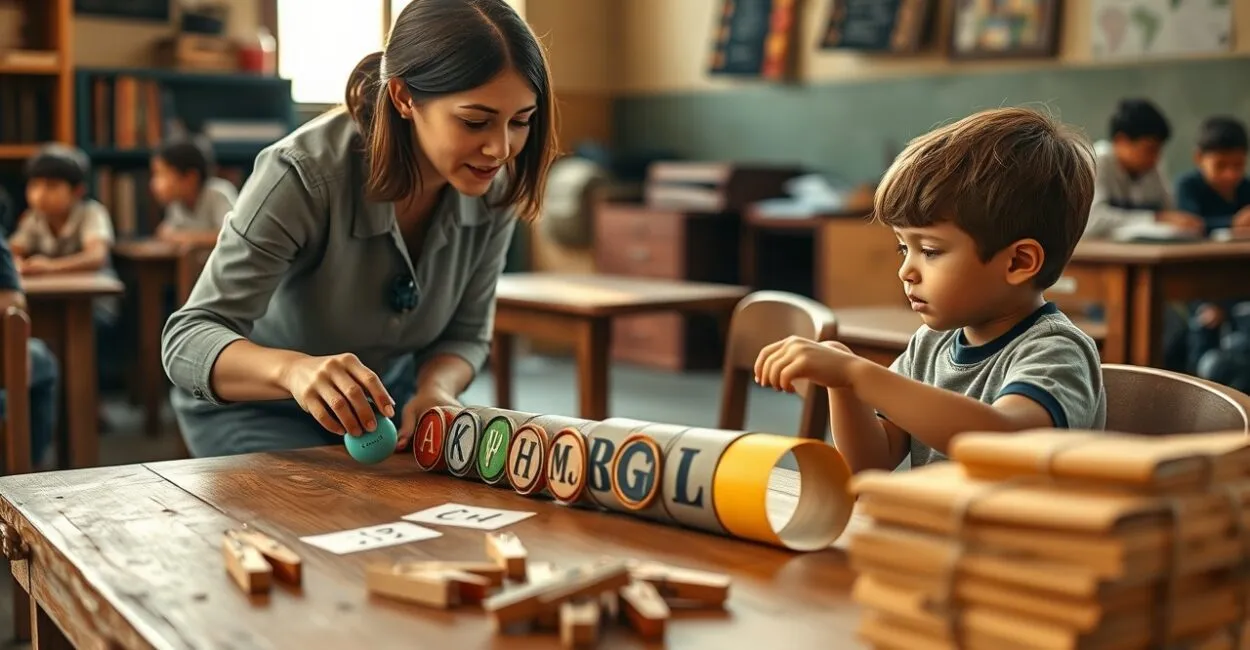
These are purposeful activities designed to promote learning through play, combining instructional goals (such as phonological awareness, letter recognition, and syllable recognition) with playful mechanics that encourage engagement and provide immediate feedback. They’re more than entertainment: when thoughtfully designed, they allow for ongoing assessment and differentiated tasks for children at different stages of cognitive and language development.
Phonological processing and emergent literacy are major challenges for children ages 4–6; limited resources and crowded classrooms call for low-cost, high-impact solutions. This article focuses on practical educational games made with recycled or inexpensive materials, 10–20-minute activities tested at school and at home, and guidance for adapting, assessing, and putting them into practice right away.

Key Takeaways
- Short educational games (10–20 minutes) can lead to measurable gains in phonological awareness when played three times a week for 8–12 weeks.
- Recycled materials (bottle caps, paper rolls, cards) make it possible to scale activities without compromising their educational value.
- Activities structured in three steps—modeling, guided practice, and independent practice—maximize transfer to reading.
- Simple measures (lists of correct and incorrect responses, quick recordings) are enough to monitor progress and adjust the level of difficulty.
Why Purposeful Educational Games Accelerate Early Literacy
Literacy gains don’t come from exposure to letters alone; they depend on the quality and direction of interactions. Educational games that focus on phonological awareness develop the processes underlying decoding: segmenting, blending, and manipulating phonemes, as well as matching graphemes to phonemes. Longitudinal studies show that phonological skills in preschool are strong predictors of accurate, fluent reading by second grade.
Structured play-based activities are therefore a preventive intervention, not just a recreational supplement.
How Game Mechanics Shape Learning
Games with immediate feedback and spaced repetition strengthen neural connections involved in reading. Mechanics such as quick matching, gentle time pressure, and cooperative competition increase attention and retention. Varying the stimuli—switching between initial syllables, rhymes, and plastic birds with letters—prevents rote responses and encourages generalization.
It’s essential to calibrate the challenge so children succeed often (within their zone of proximal development).
Practical Tips for Under-Resourced Classrooms
Even in high-demand settings, it’s possible to introduce 10–20-minute activity cycles in place of passive activities. Rotating small groups through the routine provides intensive practice without relying on expensive materials. Official documents, such as UNESCO guidelines for Early Childhood Education, support the use of games as an instructional practice—pair them with simple reports for administrators and families.
Simple Bottle Cap and Card Games to Build Letter and Syllable Skills
Materials: plastic bottle caps, permanent markers, and cardboard cards. Goal: match letters to sounds and segment syllables. Time: 10–15 minutes. Preparation: write letters on the caps and basic syllables on the cards (e.g., ba, be, bi, bo, bu).
Game 1 — “Bottle Cap Hunt”
How to play: spread out the caps face down; show a syllable card and ask the child to find the cap with the matching initial sound. Then move on to rhyming words (find a cap that rhymes with “cat”). Variations: time the activity to add gentle pressure, or use pairs for a memory game.
Why It Works
This activity links a written form (the letter) to the sound of a syllable and requires quick auditory discrimination, strengthening the recognition pathway children use before decoding. The sensory element of handling the caps helps young children remember, and the short duration keeps them focused.
Paper Rolls and Magnets: Games for Phoneme Segmentation and Blending

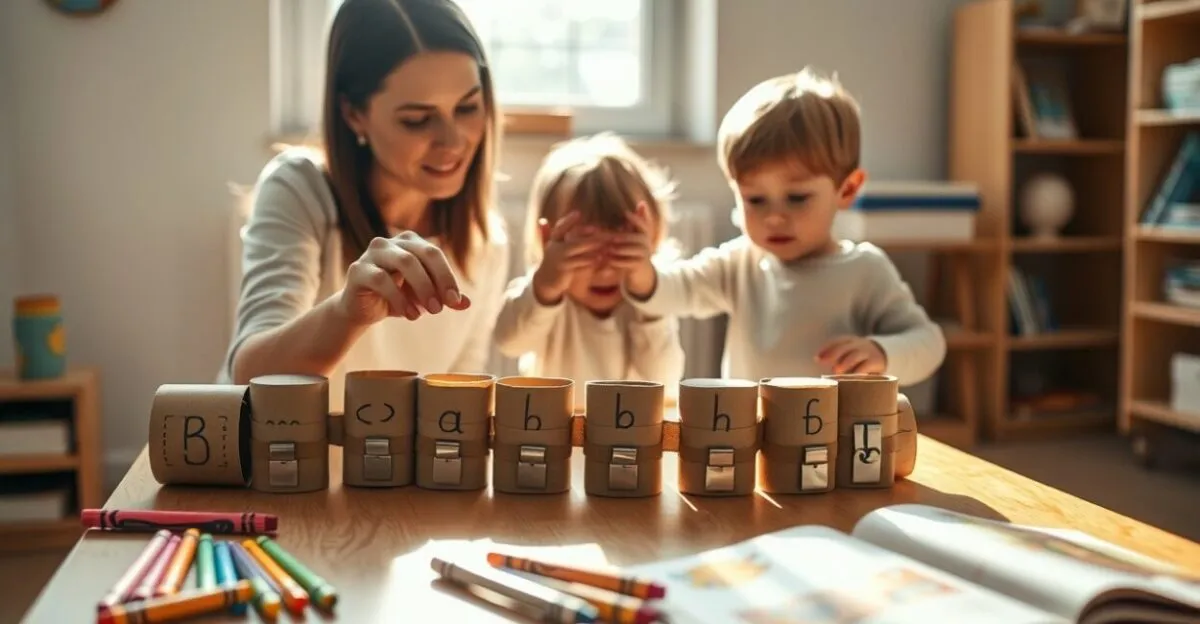
Materials: toilet paper rolls, tape, a marker, and small magnets (or paper clips). Goal: segment words into syllables or sounds and blend them to form words. Time: 12–18 minutes. This hands-on setup helps children represent sounds in sequence.
Game 2 — “The Syllable Train”
How to play: write one syllable on each roll. Say a word (e.g., “ba-na-na”) and ask the child to arrange the train in the right order; use magnets or paper clips to connect the rolls. To make it harder, ask children to change one syllable (replace “na” with “la”) to form a new word.
Read also: 7 Practical Literacy Games for First Grade
How to Adjust the Difficulty
Start with simple consonant-vowel syllables, then introduce consonant-ending syllables and diphthongs. For children with stronger skills, increase word length and the sound similarity between syllables (e.g., “pa/pa/po” vs. “pa/ba/pa”). Tracking correct answers per attempt helps you adjust the challenge.
Sound and Rhyming Games Using Materials You Have at Home
Materials: glass jars, cut-up paper, and pictures clipped from magazines. Goal: recognize rhymes and alliteration, and develop syllable awareness. Time: 10–15 minutes. Rhyming skills strongly predict reading success because they train children to recognize sound patterns.
Read also: Literacy in Brazil’s BNCC: What Teachers Need to Know
Game 3 — “Rhyming Jars”
How to play: place pictures of rhyming objects in each jar (e.g., cat and hat). Show a picture and ask the child to choose the matching jar. If you have few materials at home, draw simple pictures; for classrooms, make a chart with several categories.
Common Mistake and How to Correct It
Many educators confuse rhyming with vocabulary knowledge: a child may know a word but still not recognize its rhyme. Model how to break the words into syllables (“cat” / “hat”), use group repetition games, and reduce the range of sounds until the child responds consistently.
Quick Assessment and Progress Tracking with Simple Formats
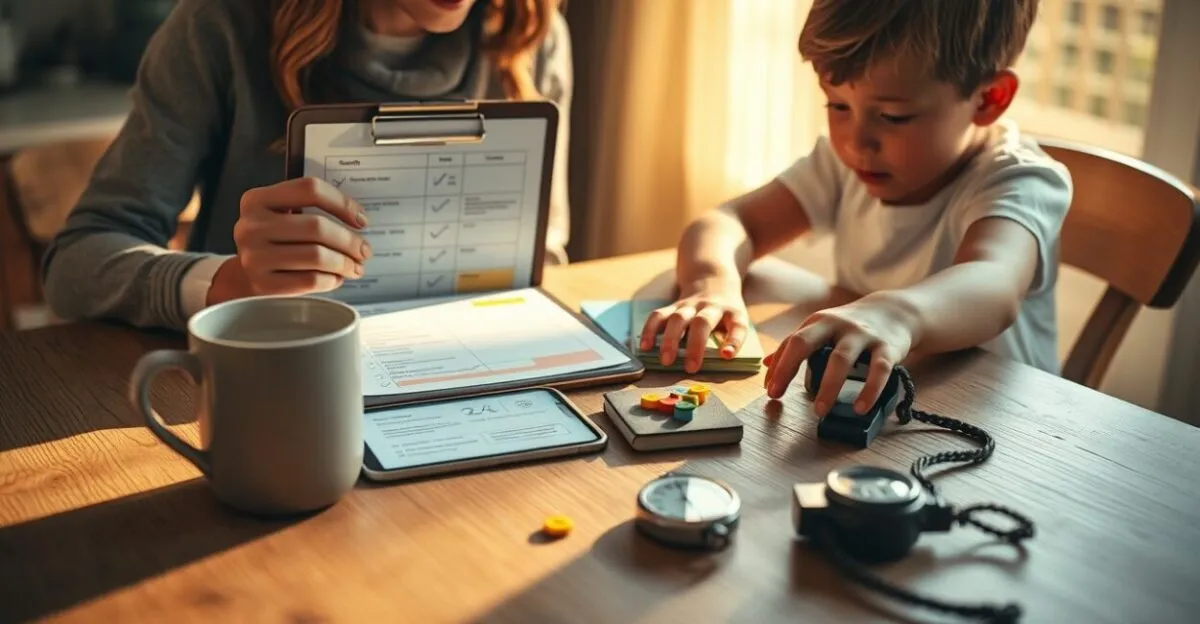
Assessment doesn’t have to be complicated: checklist spreadsheets, one-minute recordings, and structured observations provide useful data. For short educational games, track three indicators: accuracy (percentage correct), speed (average time per item), and transfer (ability to apply the rule to new stimuli).
A Practical Tracking Format
| Indicator | Measure | Frequency |
|---|---|---|
| Accuracy | % correct out of 20 items | Weekly |
| Speed | Average time per item (sec.) | Every two weeks |
| Transfer | Correct answers with new stimuli (10 items) | Monthly |
These records support simple decisions: maintain, adapt, or intensify the intervention. Use a shared spreadsheet with families to support continuity between school and home. For technical guidance, consult documents from Brazil’s Ministry of Education (the federal education agency) and studies published on Google Scholar or reports from UNESCO.
Adaptation and Inclusion: Supporting Linguistic Diversity and Specific Needs
Educational games should be culturally relevant and linguistically responsive. For bilingual children or children with language disorders, adapt the stimuli (use words that are common in the child’s home language), slow down, and increase repetition. Working in small groups with similar skill levels maximizes effectiveness without stigmatizing children.
Specific Needs — Dyslexia and DLD
For children at risk for dyslexia or Developmental Language Disorder (DLD), prioritize intensive phonological awareness activities (3–5 times a week) with multimodal feedback (auditory, visual, and kinesthetic). A referral for formal assessment is recommended if progress remains limited after 8–12 weeks of consistent intervention.
Connecting Families and Schools
Explain the goals to caregivers in practical language: demonstrate a game in five minutes, and provide written instructions and short videos. Continuing at home, even for just 10 minutes a day, has a significant cumulative effect. Provide lists of target words and variations for independent practice.
Next Steps for Implementation
Run an 8–12-week pilot, with 10–20-minute sessions three times a week; track accuracy and speed, and adjust the level of difficulty. Train teachers and aides in three essential techniques: explicit modeling, immediate corrective feedback, and a systematic progression in difficulty. Share results with families and administrators to build ongoing support.
To scale up, start with small groups and recycled materials; document costs and impact; and, if the data show improvement, make the activities part of the school routine. For implementation guidance and evidence, see reports from Brazil’s Ministry of Education and systematic reviews on PubMed.
Frequently Asked Questions
How Often Do Children Need to Play Educational Games to Improve Phonological Awareness?
Short, regular interventions are more effective than occasional long sessions. Evidence for preschoolers indicates that 10–20 minutes per session, three times a week for 8–12 weeks, can lead to statistically measurable gains in phonological awareness and decoding skills. Of course, the intensity and quality of instruction matter: poorly structured sessions aren’t effective. Monitor progress and adjust the frequency for children who respond more slowly, increasing it to as many as five sessions a week if needed.
How Can You Adapt Games for Bilingual Children Without Losing Focus on Portuguese Phonological Skills?
For bilingual children, keep instruction in Portuguese when working on phonological awareness for reading in Portuguese, but also use activities in the other language to support the transfer of metalinguistic skills. If phonemes differ between the languages, explicitly highlight similarities and differences. Use high-frequency words in both languages and limit new vocabulary during the initial phase. Track progress separately for each language to assess transfer and identify specific needs.
What Common Mistakes Do Educators Make When Using Educational Games, and How Can They Correct Them?
Mistake 1: no clear objective—correct this by setting a specific goal (e.g., segmenting consonant-vowel syllables). Mistake 2: no progression—structure the activities into difficulty levels. Mistake 3: too many similar stimuli that confuse the child—vary the stimuli while controlling how similar they are. Mistake 4: not tracking performance—use a simple checklist. These issues can be addressed with brief facilitator training, scripts, and standardized records to ensure the activities are implemented consistently and the results can be interpreted.
Can You Measure Progress Without Technology? What Quick Methods Work?
Simple measures are effective: 20-item lists (identify rhymes, segment syllables) timed to calculate average time per item; one-minute recordings scored with rubrics; and structured observations using correct/incorrect codes. Keep weekly records and calculate the relative percentage gain. These methods are enough to guide instructional decisions and show administrators and families the impact without relying on technology.
How Can You Involve Low-Income Families in Playing Educational Games at Home?
Provide practical instructions and recycled materials (bottle caps, paper rolls, cards), demonstrate games in five minutes, and hand out flyers with target words and easy-to-recreate variations. Suggest short routines (10 minutes a day) that fit into existing moments, such as after a snack. Use audio or short video messages when literacy is limited. Set simple, shareable goals, such as “Today we practiced rhyming for 10 minutes.” This encourages participation and helps children use their skills in the home environment.
Artigos Relacionados
 Early Literacy Milestones and Games for Preschoolers
 Practical Early Literacy Strategies for Preschool Success
 Literacy Difficulties and Early Intervention: How to Identify Them
 How to Introduce Literacy in Early Childhood Education
 Early Childhood Literacy: Effective Methods for the Early Years
 Educational Games: How Games Are Transforming Modern Education
