

A spotted leaf could point to a disease, insect damage, or even an irrigation problem. Treating it without identifying the cause often wastes time and resources. Integrated pest management combines prevention, monitoring, and control measures to reduce damage from pests, diseases, and weeds.

This approach works for both a home garden and a commercial farm. Whether to take action depends on the crop, the organism identified, the level of damage, and local conditions.
Control products can be part of the plan when needed, provided they’re used with proper guidance and in accordance with applicable rules.
Before you start
- Identify the affected crop and its current growth stage.
- Inspect the area before choosing a control measure.
- Record what you find: location, quantity, symptoms, and growing conditions.
- Check for reliable technical guidance specific to the crop and problem.
1. Integrated pest, disease, and weed management: What it is
Integrated pest management is a decision-making strategy that combines prevention, monitoring, and control methods to keep harmful organisms below levels that cause significant losses. It takes into account the crop, the environment, costs, safety, and effects on beneficial organisms. In simple terms, it means observing before acting and choosing measures suited to the problem you’ve identified. Integrated pest management is often associated with insects and mites, but the same principles also guide the management of plant diseases and weeds. In every case, accurate identification comes first: a leaf spot, for example, may be caused by fungi, bacteria, viruses, or environmental conditions, and each cause calls for a different response.
For more information about the concept, Embrapa, Brazil’s agricultural research corporation, provides technical resources on agricultural production and crop management. The method doesn’t guarantee that every harmful organism will be eliminated; its aim is to limit losses and reduce unnecessary interventions.
2. Monitor the area and decide when to act
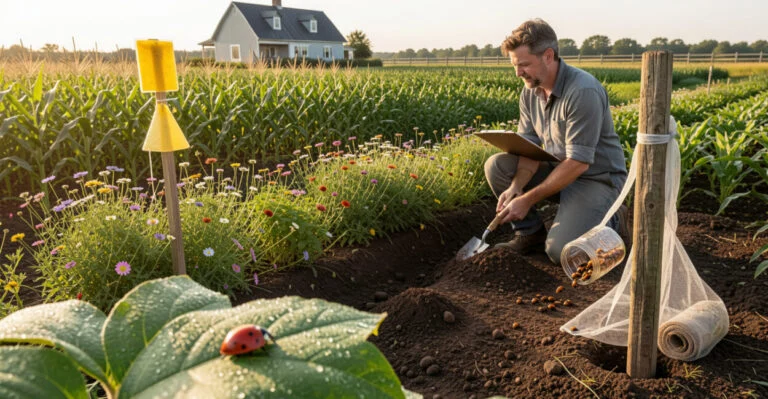
Inspect the garden or field regularly and at different locations. Check new and older leaves, the undersides of leaves, shoots, flowers, and fruit.
Also look for indirect signs, such as droppings, webs, tunnels, wilted plants, and poor seedling emergence.
Sampling should represent the area. In a small garden, this might mean checking plants in different beds; on a farm, the sampling plan needs to follow the crop and technical recommendations. Traps can help detect the presence and changing numbers of insects, but a catch alone doesn’t prove the population will cause damage. The action threshold depends on the crop, growth stage, organism, and value of the product. If technical guidance provides a control threshold for a specific situation, use it as a reference. Without such a benchmark, record how symptoms change over time and seek a diagnosis before applying a product.
One point can help prevent hasty decisions: newly emerged, small weeds may be easier to manage than established plants, but the right timing also depends on the crop and available methods. Recording where infestations occur can help distinguish an isolated problem from one that’s spreading.
3. Prevent problems with cultural practices and barriers

Prevention reduces conditions that encourage pests, diseases, and weeds. Adjust irrigation and spacing to suit the crop, keep tools clean, and remove diseased plant debris when recommended for the specific situation. In some cases, ground cover can also limit weed emergence.
Read also: Organic Farmers Markets: Who Profits While Growers Lose
Netting, covers, and physical barriers can make it harder for certain insects to reach plants, especially in gardens. They need to suit the crop and allow adequate airflow: an improperly installed cover can trap moisture or interfere with pollination. Sticky traps, in turn, are monitoring tools that may help control some targets, but they don’t replace plant inspections.
For diseases, good sanitation and healthy planting material can help reduce the spread of pathogens. The Secretariat of Agricultural Defense at Brazil’s Ministry of Agriculture provides information and guidance on plant health and agricultural production.
Read also: Plant Diseases: How to Identify Them and Prevent Losses
4. Diversify crops and disrupt life cycles
Crop rotation alternates species from different plant families in the same area. When a harmful organism depends on a specific host plant, changing crops can reduce the available food and shelter and disrupt its life cycle. Results vary: pests with many host plants and soilborne pathogens may persist despite crop rotation.
In a garden, rotating crops between beds and avoiding repeated planting of the same species in the same spot are practical steps. In commercial systems, crop sequences need to account for climate, markets, machinery, soil, and host plants. Intercropping and vegetated strips can also support natural enemies, as long as they don’t create excessive competition or provide alternate hosts for the problem at hand.
A common mistake is choosing a rotation based only on crop names. Check each plant’s botanical family and its relationship to the target organism; two different plants may host the same pathogen or pest.
5. Protect natural enemies and choose biological control agents
Ladybugs, lacewings, parasitoids, and predatory mites can help regulate populations of harmful organisms. To support these natural enemies, avoid interventions without a diagnosis and preserve shelter areas when compatible with production. The presence of predators doesn’t guarantee sufficient control, but it’s useful information when deciding whether immediate action is needed.
If you’re considering releasing a biological control agent, your choice depends on identifying the target, the crop, climate, location, and compatibility with other measures. A predator that effectively controls one pest may not act against another, and unsuitable conditions can prevent it from becoming established. Consult an agronomic specialist and check that the agent is approved for its intended use.
Biological products and plant extracts also require careful consideration. Check the target organism, approved crops, directions for use, storage requirements, and label precautions. “Natural” doesn’t automatically mean safe for people, pollinators, or aquatic organisms.
6. Combine control methods and use products carefully
If monitoring indicates a risk of losses, combine measures that work in different ways. Removing diseased plants in affected areas, mechanically controlling weeds, and protecting natural enemies can all be part of the same plan. In some cases, a registered product may be necessary; its use must follow technical recommendations, the label, and current laws.
When choosing a product, confirm that it’s approved for the crop and target organism. Also consider its effects on pollinators and natural enemies, the preharvest interval, and whether modes of action can be rotated, following technical guidance. Consulting Anvisa, Brazil’s health regulatory agency, can help clarify the agency’s role in regulating products under its authority; check applicable official channels for registration and use information.
Integrated pest management doesn’t necessarily eliminate the use of pesticides. It reduces unjustified applications and places each intervention within a broader strategy that protects the safety of applicators, consumers, and the environment.
7. Evaluate the plan and correct common mistakes
After applying a measure, revisit the monitored areas and compare your records. Check whether the organism’s population or the spread of symptoms has decreased, whether damage has stopped increasing, and whether any unwanted effects have appeared. The time between inspections depends on the crop’s life cycle, the weather, and how quickly the problem may develop.
Results can take different amounts of time to appear. A barrier may prevent new pests from entering, while reducing a population or helping a plant recover can take longer. A measure can also fail because the diagnosis was wrong, the target wasn’t susceptible to the method, or environmental conditions prevented effective control.
Common mistakes include applying products on a schedule without checking whether they’re needed, using traps as the only indicator, repeating the same method without evaluating its effect, and removing beneficial vegetation without identifying its function. If you’re unsure about a disease, pest, or product use, seek qualified technical assistance.
This monitoring approach works in home gardens and commercial agriculture, although the scale and sampling methods differ. To learn more, look for technical resources from Embrapa, universities, and government agencies. If you’re searching for an integrated pest management PDF or book, check the author, the responsible institution, and whether it applies to your crop and region.
Frequently asked questions
Is integrated pest management suitable for small home gardens?
Yes. It can be simple: inspect plants, record problem areas, remove affected parts when recommended, and avoid preventive applications without a diagnosis. Even a few minutes of observation per bed can help you notice changes.
How long does it take to see results?
There’s no set timeline. Results depend on the organism, crop, weather, and measure used, so compare your records across inspections rather than expecting a response by a fixed date.
Can integrated pest management be used in commercial agriculture?
Yes. The method can be adapted to commercial operations with defined sampling, field-by-field records, and technical criteria for intervention. The plan also needs to fit the operation’s logistics and the requirements of the crop and farm.
How do I choose predators and biological control agents?
Start by identifying the target organism and confirm that the agent is recommended for that crop and environmental conditions. Selection and release should follow technical guidance and applicable approval requirements.
Does integrated pest management completely eliminate pesticide use?
Not necessarily. In some situations, a product may be part of the plan, provided its use is justified, approved for the crop and target organism, and consistent with technical recommendations and official instructions.
%%AGPTRH1%%
Artigos Relacionados
 Integrated Pest Management: Sustainable Practices for Pest Control
 Integrated Livestock Farming: Efficient Management on Small Acreages
 Active Learning: Practical Classroom Techniques
 Literacy: Practical Techniques to Help Children Learn
 Active Learning: Practical Techniques to Engage Students
 Growth Mindset: Practical Techniques and Examples
