
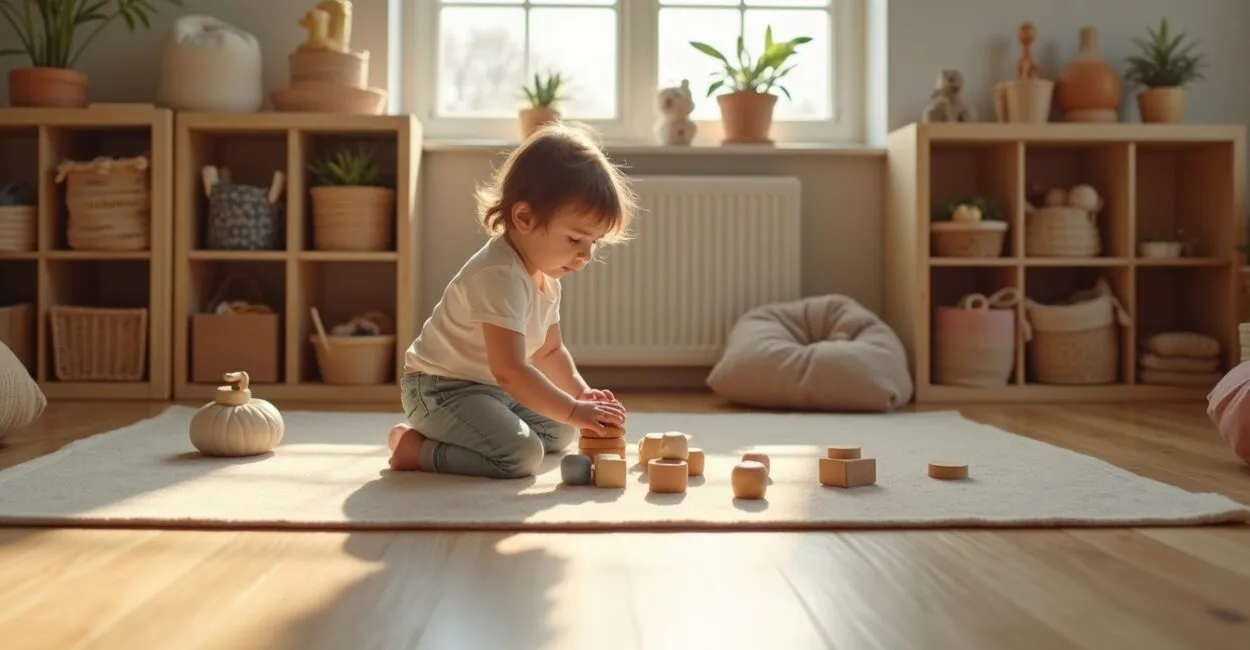
A well-designed space changes the way a child plays. When a play environment is thoughtfully planned, it becomes more than a room with toys: it becomes a daily invitation to explore, imagine, repeat, and move safely.

This matters because free play has become less common. Between school routines, smaller apartments, and more screen time, there’s less room for spontaneous play—the kind that builds independence, language, coordination, and social skills.
Here, we’ll look at what makes a good play environment, how to create one at home or at school, and which choices make a real difference in everyday use.
What You Need to Know
- A good play space isn’t about how many toys it has. What matters is how well it’s organized, how accessible materials are, and what kinds of challenges it offers.
- Spaces with open-ended materials—blocks, fabric, boxes, loose parts, and sensory items—tend to encourage more creativity than toys designed for just one purpose.
- Safety doesn’t mean controlling everything. The goal is to reduce serious risks without eliminating opportunities to test balance, reach, stack, and solve small problems.
- Free play thrives when the space allows meaningful choices, easy movement, and predictable routines, without requiring constant adult intervention.
- A well-designed environment works best when it combines sensory experiences, room to move, quiet corners, and materials suited to the child’s age and interests.
Play Environment: How Space, Materials, and Routines Work Together
Technically, a play environment is an intentional combination of physical space, materials, rules for use, and routines designed to support free play, sensory exploration, social interaction, and independence. Put simply, it’s not a “playroom”—it’s a setup that lets children do things on their own, safely and in different ways.
The difference may seem subtle, but it changes everything. A room full of random items creates clutter.
A space organized by activity—building, reading, moving, relaxing, and imaginative play—helps children understand what they can do there and stay engaged for longer.
What makes a space with toys a true play environment isn’t the number of objects, but the quality of the possibilities it offers.
The Role of Independence in Play
Young children learn a lot when they can choose, pick up, put away, and combine materials without relying on an adult at every step. That’s why low shelves, open bins, and visible objects work so well.
The fewer unnecessary barriers there are, the more likely children are to start playing on their own.
Why Challenges Should Be Gradual
A good space doesn’t do everything for a child, but it also doesn’t demand skills beyond their current ability. It offers manageable steps: first fitting pieces together, then stacking; first climbing onto a low support, then testing a less stable surface. This progression prevents frustration and sustains interest. Anyone who works in early childhood education knows that a space that’s too “easy” becomes decoration, while one that’s too difficult leads children to give up. The sweet spot is in the middle: controlled risk, achievable challenges, and the freedom to try again.
How to Organize a Play Space at Home or School
The best place to start is by observing how the space is actually used. Children rarely play the way adults expect them to. In practice, they move objects around, combine activities, and turn any open corner into a setting for play. So the organization should follow their behavior, not try to tame it.
Divide the Space Into Activity Zones
- Movement zone: Mats, tunnels, firm cushions, low steps, and room to roll, run, and balance.
- Creative zone: Blocks, paper, pencils, play dough, building toys, and construction materials.
- Pretend-play zone: Fabric, dolls, toy dishes, boxes, props for imaginative play, and simple play settings.
- Quiet zone: Books, noise-reducing headphones if needed, a cushion, softer lighting, and minimal visual distractions.
The zones don’t have to be fixed. In a small space, the same table can be used for drawing in the morning and play dough in the afternoon.
The important thing is to make it clear through the setup what activities are available at that moment.
Choose Materials That Help Children Create
Closed-ended toys have one purpose. Open-ended materials can be used in many ways. Blocks, rings, fabric, tubes, boxes, baskets, tongs, miniatures, natural objects, and loose parts encourage more combinations because they don’t tell children exactly what to do. They invite interpretation.
This idea is central to approaches promoted by organizations such as Zero to Three, an international resource on child development. The idea is simple: the more a material can be transformed, stacked, hidden, carried, or sorted, the more it tends to expand a child’s play repertoire.
Safety Without Restricting Exploration

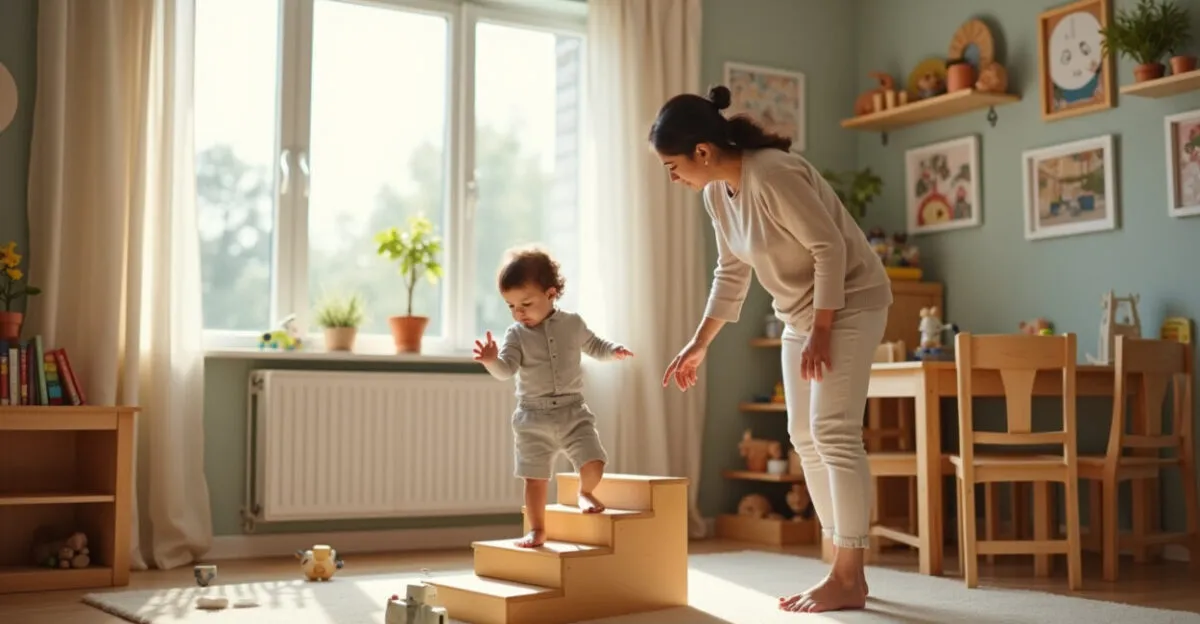
Safety doesn’t mean eliminating every chance of falling, slipping, or making a mistake. It means distinguishing acceptable risk from real danger. A low set of steps, for example, can be great for practicing motor skills. Exposed sharp corners, small parts unsuitable for a child’s age, and access to electrical outlets, on the other hand, need immediate attention.
A safe environment isn’t one without challenges; it’s one where children can explore without being exposed to serious, preventable harm.
What to Check Before Opening the Space for Use
- Secure tall furniture to the wall.
- Protect outlets, wires, and extension cords.
- Check floors, rugs, and slippery surfaces.
- Make sure pieces are the right size for the child’s age.
- Check ventilation, lighting, and easy access to water.
There’s an important caveat: safety rules don’t apply in exactly the same way at home, at school, and in a play center. A small home space may call for more flexible solutions, while an institution needs to follow stricter, documented protocols. A common mistake is copying standards without considering the context.
Read also: School Playroom: How to Create an Inspiring Space
Helpful Resources for Thinking About Safety and Childhood
Health and child development guidelines can help you make better decisions. The World Health Organization website offers resources on early childhood development, and UNICEF Brazil publishes information on play, protection, and care. For data on family life and screen time in Brazil, the Brazilian Institute of Geography and Statistics (IBGE) is an important resource.
Open-Ended Materials, Loose Parts, and the Power of the Unexpected
If one choice can transform play, it’s this: include materials that don’t have one right answer. Research on play often highlights the value of “loose parts”—items children can move, combine, and reinterpret over and over. They expand creativity because their use isn’t predetermined.
| Type of material | What it encourages | Example |
|---|---|---|
| Open-ended materials | Imagination, creativity, and combining ideas | Boxes, fabric, blocks, hula hoops |
| Closed-ended materials | Recognizing a purpose and repeating actions | Electronic toys, themed toy cars, dolls with a single action |
| Loose parts | Problem-solving and building | Large stones, tubes, lids, rings, cones |
In practice, a mix usually works better than having too much of just one type. A toy car can fit right in, as long as it doesn’t dominate the space. A play environment is more engaging when it supports storytelling, building, and movement at the same time.
A Real-Life Example
In a small early childhood classroom, the staff removed half the fixed toys and kept only blocks, fabric, books, and baskets of loose parts. During the first week, the room was quieter than expected. By the second week, a child who had previously run around without focus began building “houses,” “bridges,” and “stores.” The space wasn’t more crowded; it was more functional.
How to Adapt the Environment for Different Ages
Age matters, but it shouldn’t be treated as a rigid rule. What really changes is the kind of activity a child can sustain: mouthing objects, stacking, naming, acting out stories, creating simple rules, or cooperating with other children. That’s why the same space can work for different groups if the materials are chosen thoughtfully.
Early Childhood: Fewer Items, More Repetition
For babies and very young children, prioritize touch, contrast, sound, large pieces that fit together, and safe objects they can explore with their whole bodies. Too much can get in the way. When there are too many things competing for attention, children get distracted and miss the chance to explore play more deeply.
Preschool: Storytelling, Movement, and Cooperation
Between ages 3 and 5, pretend play, social roles, and more elaborate movement courses become important. This is the stage when boxes become rockets, blankets become capes, and blocks become cities. The space needs to support this without requiring children to use things “the right way.”
School Age: Projects and Greater Complexity
At this stage, the environment can include games with rules, more sophisticated building projects, materials for drawing maps, independent reading, and strategic challenges. Children can handle more frustration and stay with an activity longer when there’s a clear goal.
Mistakes That Undermine Play Without Anyone Noticing
Some mistakes go unnoticed because the space “looks nice.” But appearance doesn’t guarantee that a space works. The real test is simple: Does the child enter, understand what they can do, and stay there without needing an adult to organize every step?
Too Much Visual Stimulation
Walls covered with decorations, competing colors, too many objects on display, and harsh lighting can quickly become tiring. That doesn’t mean the space has to be boring. It means every element should serve a purpose rather than compete for attention all the time.
Too Many Toys, Not Enough Materials
An overcrowded room tends to reduce how long children stay engaged. They switch from one object to another but don’t explore anything deeply. Fewer, carefully chosen items with real potential for combining usually lead to richer play.
Routines That Interrupt Play Too Often
If adults keep calling children over, correcting them, putting things away, or reorganizing unnecessarily, play loses momentum. Intervention helps only when it protects, guides, or extends the play. Otherwise, it becomes noise.
When adults control every move, the space becomes a backdrop; when they set things up and then step back, the space becomes an experience.
What to Do Now to Turn a Corner Into a Play Space
The best approach isn’t to renovate everything at once. Start small: choose a corner, clear out the excess, put open-ended materials within reach, and observe what actually happens. Then make adjustments based on how the space is used, not on what you expected.
If your goal is to create a play environment that works day to day, here’s a practical rule: less decoration, more possibilities; fewer instructions, more independence; less clutter, more intention. Try it for a week, notice where the child spends the most time, and reorganize based on what you see.
Frequently Asked Questions
What’s the difference between a playroom and a play environment?
A playroom is a place with toys and space for play. A play environment is a broader concept that includes how the space is organized, the materials, routines, safety, and independence. A playroom can be a play environment, but only if it’s designed with that purpose in mind.
Do you need a lot of toys for the space to work?
No. A space with a few thoughtfully chosen materials often gets more use than one packed with toys. What matters is the range of ways children can use them, not the number of objects.
How can you adapt a play environment for a small apartment?
Use flexible zones and versatile materials: boxes, baskets, fabric, books, blocks, and loose parts. Ideally, choose items that can be put away quickly and used in different ways. In a small space, organization matters more than square footage.
Is playing alone part of a good play environment?
Yes. When the space is well prepared, children can start and continue activities with less adult help. This builds independence, concentration, and decision-making skills.
How can you tell if the environment is too stimulating?
If the child switches activities constantly, gets irritable or distracted, or can’t engage deeply, there may be too much stimulation. In that case, try displaying fewer objects and simplifying the setup. Less visual clutter often leads to richer play.
Does a play environment work the same way at school and at home?
The principle is the same, but the way it’s applied varies. At home, the space is usually more flexible and improvised; at school, routines, safety, and group size require more planning. The context determines how much structure is needed.
%%AGPTRH8%%
Artigos Relacionados
 Creative Play: 8 Activities That Inspire Creativity
 Light Colors That Make Spaces Feel Larger
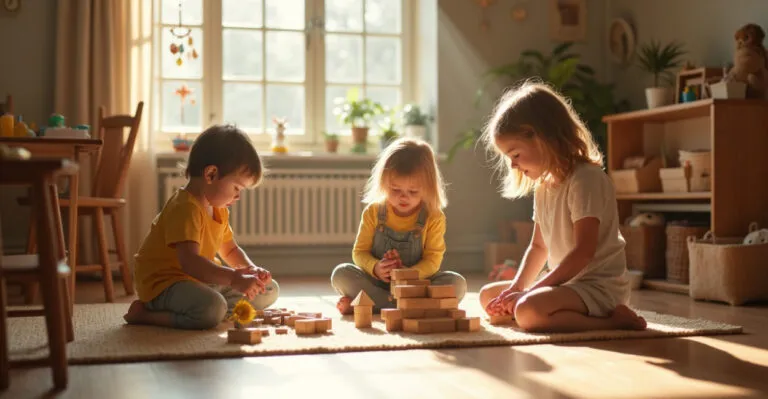 Child Attention: How Free Play Improves Focus
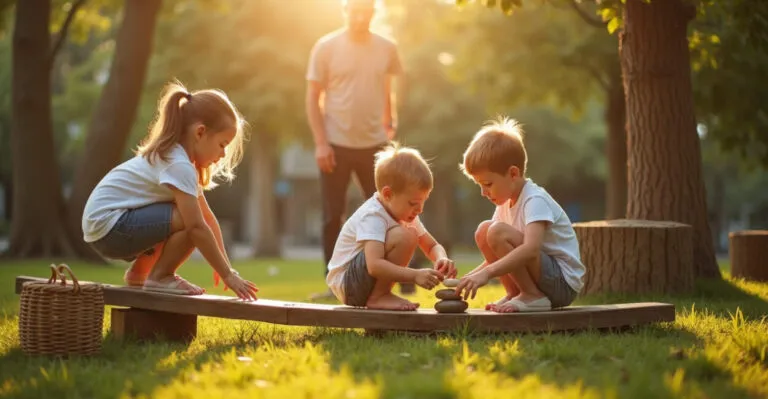 Free Play: How It Strengthens Cognitive Development
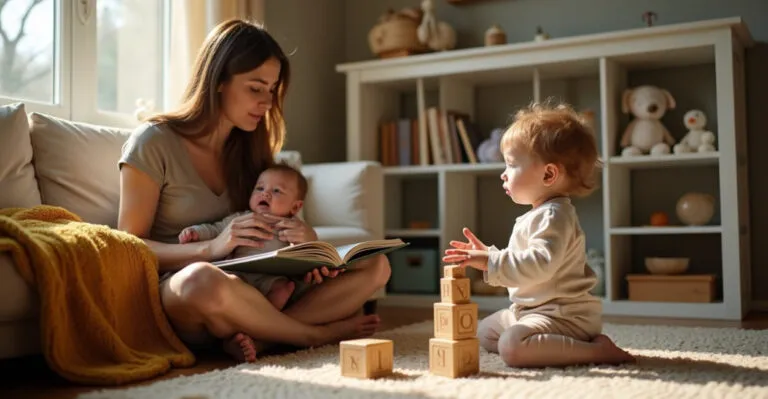 Child Language Development From Birth to Age 6: Stages and How to Encourage Speech
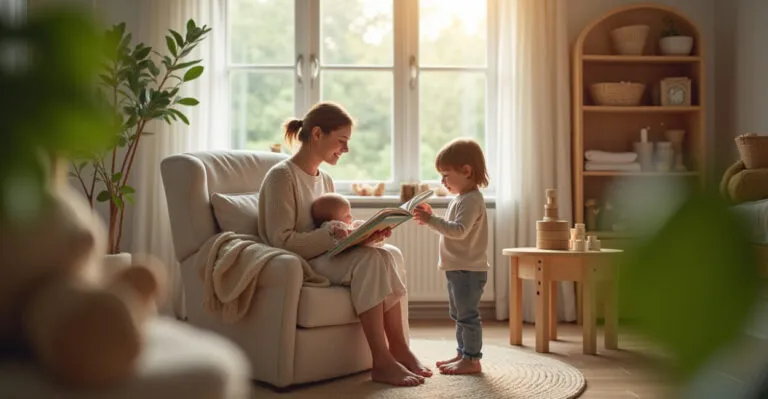 Cognitive Development From Birth to Age 6: Encourage Learning
