

Early literacy shapes how young children understand language, symbols, and stories—essential foundations for reading and communication. It includes vocabulary growth, phonological awareness, print recognition, and narrative skills. These abilities matter because strong language skills in preschool predict later school success and social confidence.
Many caregivers wonder where to begin. Simple daily interactions, targeted read-alouds, and playful games can build language and emergent reading skills. This article provides an overview of early literacy milestones, practical games, and read-aloud tips to support preschool language skills, along with evidence-based strategies and actionable steps.

Foundations of Early Literacy and Core Concepts
Key Components of Early Literacy Development
Early literacy involves several interconnected skills: oral language, phonological awareness, alphabet knowledge, and print concepts. Together, these skills give children a foundation for connecting sounds to letters and understanding stories. Focusing on each area supports balanced growth in comprehension, decoding, and vocabulary.
Oral language and vocabulary are central: children with broader vocabularies can decode and understand texts more easily. Phonological awareness—the ability to recognize syllables and sounds—predicts decoding success. Print concepts, such as knowing that English text is read from left to right, support the developing mechanics of reading.
Teachers and caregivers can observe these core skills during everyday routines, including mealtime conversations, shared book reading, and play. Tailoring activities to strengthen weaker areas can accelerate progress and prevent gaps before formal schooling begins.
Typical Milestones in Preschool Years
During preschool (ages 3–5), children typically expand their vocabularies, begin rhyming and segmenting syllables, recognize some letters, and understand simple story structure. These milestones are guidelines, not strict timelines, and reflect the wide variation in children’s development. At age 3, many children use 200–1,000 words and tell simple two-part stories. By ages 4–5, vocabulary grows rapidly and phoneme-level awareness begins to emerge. According to the American Speech-Language-Hearing Association, 85% of 4-year-olds can reliably follow multi-step directions Source.
Monitoring milestones helps caregivers and educators identify when additional support may be needed, such as small-group games, targeted vocabulary routines, or a referral to a specialist. Early intervention leads to better outcomes than waiting until kindergarten.
Practical Definitions and Related Terms
Understanding key terms helps guide practice: “phonological awareness” includes rhymes, syllables, and sounds; “print awareness” means recognizing that print carries meaning; and “emergent reading” describes the early stage before conventional decoding. These definitions help guide activity design and assessment. Related terms include “shared reading,” “dialogic reading,” and “oral language development”—all connected to strategies for building literacy. Using consistent language with caregivers and educators improves alignment across settings and reinforces skills.
Accurate terminology also helps when communicating with specialists and looking for resources. Clear definitions make it easier to target support for vocabulary gaps, speech sound errors, or delays in narrative skills.
- Oral language: vocabulary, grammar, and expressive skills
- Phonological awareness: rhymes, syllables, and phonemes
- Alphabet knowledge: letter names and sounds
- Print concepts: directionality, handling pages, and book orientation
- Emergent writing: from scribbles to letter-like forms
Practical Steps for Building Early Literacy
Daily Routines That Build Language
Incorporating literacy into routines—mealtimes, getting dressed, and running errands—turns everyday moments into language-rich interactions. Narrate what you’re doing, ask open-ended questions, and expand on children’s comments to model more complex sentences. This gives children more exposure to vocabulary and complex language structures.
Use repetition and predictable phrases to support memory and participation; predictable books and songs are especially effective. Short, focused interactions (2–5 minutes) repeated throughout the day can have a greater impact than one long session. According to the CDC, shared book reading several times a week improves language outcomes. Start with 10–15 minutes a day and build a consistent routine for measurable gains (CDC).
Structured Activities and Games to Practice Skills
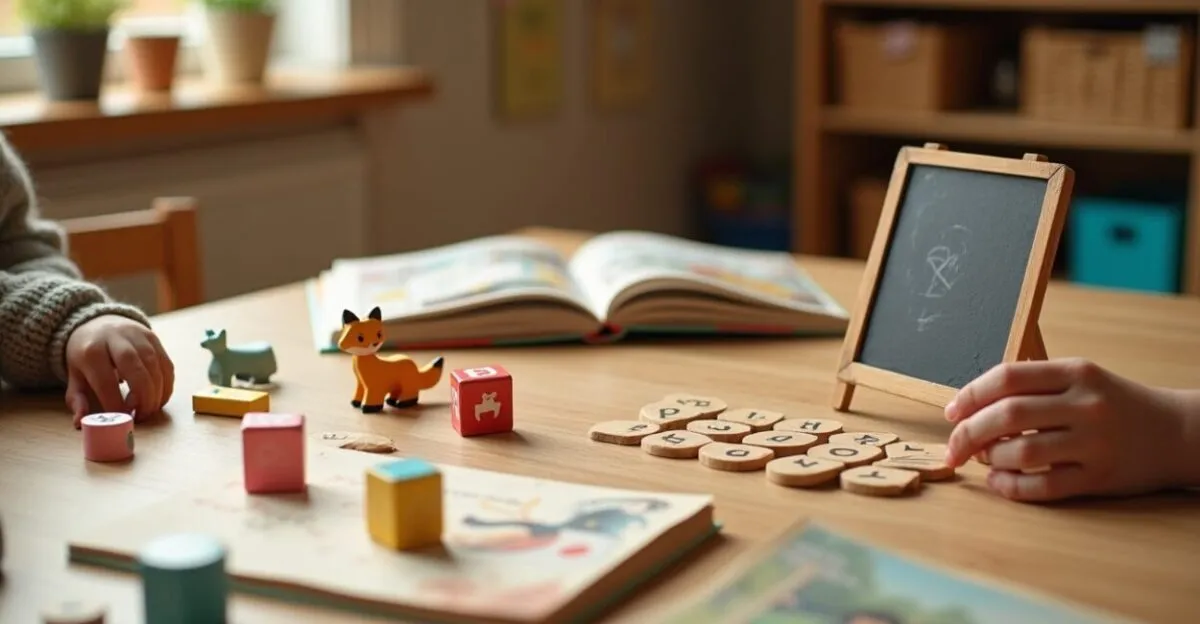
Play-based games can target specific skills: rhyming bingo for phonological awareness, letter scavenger hunts for alphabet knowledge, and storytelling dice for narrative skills. Games motivate preschoolers and provide repeated, scaffolded practice that helps them master new skills. Design games with clear, achievable goals and simple rules. Use visual aids and hands-on materials—letter tiles, picture cards, or puppets—to make abstract concepts concrete and multisensory.
Switch activities every 7–10 minutes to match children’s attention spans. Track progress in a small portfolio of observed behaviors rather than relying on test scores.
Step-by-step Routine to Implement a Literacy Session
Run a brief, effective session with a predictable sequence: warm-up conversation, targeted play or skills practice, and a read-aloud with follow-up. This structure supports attention and helps children connect spoken and written language. Keep sessions short (10–20 minutes) and focused on one goal, such as rhyming or vocabulary. End with a reflective question like “What happened first?” to encourage children to recall and understand the story.
Consistency matters: repeat the routine daily or every other day to build automaticity and help children integrate skills.
- Model focused attention by engaging the child with a warm-up comment.
- Introduce one measurable goal (e.g., recognizing rhymes).
- Play a focused game that practices the skill.
- Read a short book that reinforces the target language.
- Prompt the child to recall what happened, praise their effort, and briefly record progress.
Comparing Methods: Games, Read-Alouds, and Direct Instruction

Overview of Instructional Approaches
Different approaches—play-based games, dialogic read-alouds, and explicit phonics instruction—play complementary roles in early literacy. Play encourages engagement and experimentation, read-alouds build vocabulary and narrative skills, and direct instruction targets decoding and letter-sound connections. Effective programs combine these approaches: use games to introduce concepts, read-alouds to deepen understanding, and brief direct instruction to support decoding milestones. The right balance depends on each child’s needs and family priorities.
Educators should assess how children respond to each method and adjust the level of support over time—for example, providing more explicit instruction for children who struggle with phonological awareness and more dialogic reading for children with language delays.
Comparative Table of Common Options
| Approach | Primary Strength | Best for |
|---|---|---|
| Play-based games | Engagement and generalization | Building vocabulary and phonological awareness |
| Dialogic read-alouds | Comprehension and expressive language | Story structure and vocabulary |
| Explicit phonics | Decoding and letter-sound mapping | Children nearing kindergarten or with delays |
| Hybrid integration | Balanced skill development | Most preschool classrooms |
How to Choose Approaches by Child Profile
The right approach depends on assessment. Children with strong oral language but limited letter knowledge may benefit from alphabet-focused play and direct phonics instruction, while children with limited vocabularies need rich dialogic reading. Observe children’s spontaneous language and responses to activities to guide your choices. Consider cultural and home-language contexts: bilingual children may follow different developmental patterns and benefit from targeted vocabulary support in both languages. Work with families to align home routines and school strategies for maximum impact.
Regular progress checks every 4–8 weeks can help determine whether instructional intensity needs to change or a speech-language evaluation is needed.
Read-aloud Strategies and Interactive Storytelling
Techniques for Effective Read-alouds
Make read-alouds interactive: ask open-ended questions, invite predictions, and pause so children can fill in repeated phrases. Dialogic reading—where adults prompt and build on children’s responses—improves vocabulary and narrative skills. Choose books that match each child’s level: picture-rich books for young listeners, predictable, repetitive texts for phonological practice, and informational books to build background knowledge. Use expressive intonation and gestures to hold children’s attention.
Frequency matters: aim to read together every day. According to Reach Out and Read, daily reading routines are associated with measurable language improvements by the time children start kindergarten (Reach Out and Read).
Interactive Storytelling Games
Story-building games like “Story Stones” (pictures on stones) or “Pass the Plot” (each child adds a sentence) help children practice sequencing, vocabulary, and cohesion. These activities scaffold story structure and encourage expressive language.
Use props and role-play to bring stories to life—puppets, felt boards, and costumes deepen engagement and give children cues for producing language. Repeat favorite stories to create opportunities for deeper language play each time.
Vary your prompts: ask “Why did the character do that?” or “What might happen next?” to encourage inferencing and cause-and-effect language, both key parts of comprehension.
Read also: Early Childhood Education: for Parents
Choosing Books to Support Milestones
Choose books that match your goals: rhyming books for phonological awareness, predictable, repetitive texts that invite participation, and wordless picture books for practicing narrative inference. Balance fiction and nonfiction to build background knowledge and a broad vocabulary.
Pay attention to book difficulty: books that are too hard can reduce engagement, while books that are too easy may limit growth. Aim for the “Goldilocks zone,” where you can scaffold learning by explaining new vocabulary as you read and inviting children to retell the story with support.
Read also: Literacy Assessment Tools to Track Student Progress
Keep a rotating home or classroom library with 10–15 high-quality books to provide variety and repeated exposure over several weeks—a proven way to support retention and mastery.

Benefits of Games and Early Interventions
Academic and Social Advantages
Early literacy interventions improve reading readiness and social confidence. Strong preschool language skills are associated with higher reading achievement and greater classroom participation, supporting long-term educational success. Early gains can reduce the need for later remedial support and boost self-esteem.
Social benefits include stronger conversation skills, better peer interactions, and greater engagement in group learning. Language-rich play encourages children to take turns and consider others’ perspectives—skills that matter for school success.
According to the National Literacy Trust, children who read with an adult every day are more likely to enjoy reading and have higher vocabulary scores in the early grades (National Literacy Trust).
- Improves vocabulary and comprehension
- Predicts stronger decoding and reading fluency
- Supports social communication and classroom behavior
- Reduces the need for later remedial support
- Builds lifelong motivation to read and engagement with books
Long-term Educational Impact
Early literacy skills strongly predict later academic success. Children who start school with solid language and emergent reading skills often earn higher standardized reading scores. Investing in preschool literacy can lead to measurable gains in later achievement and graduation rates.
Economic analyses suggest that early interventions provide long-term benefits for educational attainment and workforce readiness. Programs that combine family engagement with classroom instruction tend to have the greatest impact.
Monitor outcomes by reevaluating interventions each year to ensure they continue to meet changing literacy needs and sustain gains through elementary school.
Evidence and Quantitative Outcomes
Research supports targeted early literacy instruction. According to UNESCO, greater access to preschool is associated with higher literacy levels worldwide. In some settings, preschool participation increases primary-grade reading proficiency by up to 20% (UNESCO).
The National Early Literacy Panel found that phonological awareness and alphabet knowledge are consistent predictors of reading success, although effect sizes vary across studies. Early, consistent exposure matters more than brief interventions.
Track effectiveness and adjust programming based on evidence using simple measures such as vocabulary growth, the percentage of rhymes identified correctly, and letter recognition rates.
Limitations, Challenges, and Realistic Expectations
Common Limitations in Preschool Settings
Constraints such as limited instructional time, high child-to-teacher ratios, and inconsistent caregiver involvement can reduce children’s exposure to literacy activities. These structural challenges may slow progress, even when strategies are high quality.
Cultural and linguistic diversity can be mistaken for developmental delays when assessments and materials are not culturally responsive. Bilingual children may follow different developmental paths and need tailored expectations and support.
Address these limitations by prioritizing high-impact practices—daily shared reading, small-group games, and family coaching—and advocating for resources and professional development.
- Limited instructional time and staffing
- Insufficient materials or training
- Cultural or language mismatch in assessments
When Progress Is Slower Than Expected
Slow progress may be related to speech or language disorders, hearing issues, or differences in a child’s home language. If progress stalls after 6–12 weeks of consistent, focused practice, consider screening the child’s speech and hearing and consulting a speech-language pathologist.
Increase the frequency of targeted activities, reduce group size, and provide more one-on-one support to adjust the level of instruction. Document interventions and the child’s responses to inform possible referrals.
Early referrals lead to better outcomes. The sooner a speech, language, or hearing concern is addressed, the more effective interventions are likely to be.
Practical Constraints for Families
Time pressures, stress, and limited resources can make it difficult for families to maintain consistent literacy routines. Simple, flexible strategies—two 10-minute read-alouds, one shared game, and conversations during daily routines—can reduce the burden while still making a difference.
Make use of community resources such as library storytimes, low-cost book exchanges, and guidance from a pediatrician. Encourage families to weave literacy into everyday life instead of treating it as another task.
Set realistic goals and celebrate small wins. Progress often comes from many small actions over time rather than a single intensive session.
Practical Tips, Games, and Best Practices for Caregivers
Everyday Tips for Parents and Caregivers
Prioritize consistent, short interactions: narrate routines, ask open-ended questions, and build on children’s comments. Repeat words and name objects to boost vocabulary. Aim for at least 10–15 minutes of focused literacy play daily, along with frequent back-and-forth conversation throughout the day.
Show your enthusiasm for books and language. Make reading social and predictable: choose favorite stories to read together again and again, then gradually invite children to retell them. Use gestures and props to support comprehension and engagement.
Track small wins—new words children use, rhymes they get right, and letters they recognize—to maintain motivation and guide next steps.
- Read aloud for 10–15 minutes every day.
- Describe what you’re doing and ask open-ended questions.
- Play short rhyming and letter games often.
- Repeat and build on children’s language naturally.
- Use props and visuals to support comprehension.
- Create a small, rotating home library of 10–15 books.
Quick Games to Try This Week
Try “Rhyme Relay”: say a word and have the child find an object that rhymes with it. Or play “Alphabet Scavenger Hunt” by looking for letters in your surroundings. Use “Story Dice” to prompt short stories and practice sequencing, encouraging children to tell three-sentence stories to build narrative cohesion.
Keep games short and frequent—3–7 minutes each—and adjust the difficulty by offering choices or hints. Games that combine movement and language engage active learners and support memory through multisensory experiences.
Bring back favorite games and introduce one new game each week to keep things fresh and build targeted skills over the course of a month.
Best Practices for Teachers and Program Leaders
Use a balanced literacy approach that includes daily read-alouds, targeted small-group games, and explicit letter-sound practice. Use ongoing formative assessments and document progress every 4–8 weeks. Train staff in dialogic reading techniques and the selection of culturally responsive materials.
Engage families through coaching: demonstrate short activities, share simple progress updates, and encourage home routines that align with classroom goals. Partnerships with community organizations, including libraries and health centers, can extend your reach and resources.
Measure impact with clear indicators, such as vocabulary growth, letter recognition rates, and phonological awareness tasks. Use the data to refine your approach and prioritize the most effective practices.
Conclusion
Early literacy is the foundation for later reading and academic success. With consistent read-alouds, targeted games, and language-rich daily routines, caregivers and teachers can strengthen preschoolers’ language skills. The milestones and strategies in this article offer a practical roadmap: assess each child, choose complementary approaches, and monitor progress. Make daily engagement a priority and tailor support to each child’s needs. Early, evidence-based attention to literacy can deliver measurable, lasting benefits. Start small, stay consistent, and celebrate progress.
Frequently Asked Questions
What Is Early Literacy?
Early literacy refers to the emerging skills and knowledge children develop before they learn to read formally. These include vocabulary, oral language, phonological awareness, alphabet knowledge, and print concepts. These abilities help children understand spoken language, recognize that print carries meaning, and begin connecting sounds to letters. Early literacy develops through daily interactions, play, and read-alouds, and strongly predicts later reading success. That’s why consistent early support is so important.
How Does Shared Reading Support Language Development?
Shared reading exposes children to richer vocabulary, more complex sentence structures, and story grammar than everyday conversation typically offers. Techniques such as dialogic reading—asking open-ended questions, prompting children to recall details, and building on their responses—encourage expressive language. Repeated read-alouds build familiarity, improve comprehension, and give children opportunities to practice phonological and narrative skills, especially when caregivers actively engage and provide support during reading.
What Is the Difference Between Phonological Awareness and Letter Knowledge?
Phonological awareness is the ability to hear and manipulate sounds in spoken language, including rhymes, syllables, and phonemes, without necessarily using print. Letter knowledge means recognizing letter shapes and connecting them to their names and sounds. The two skills are distinct but complement each other: phonological awareness predicts decoding ability, while letter knowledge helps children apply sound-letter connections when reading and writing.
When Should I Seek Extra Help for a Child’s Language Development?
Seek extra help if a child has a limited vocabulary, struggles to follow simple directions, is difficult to understand, or shows little interest in books by age 3–4. Also seek help if progress stalls despite consistent support for 6–8 weeks. Concerns about hearing, bilingual language development, or a family history of speech or language disorders warrant earlier screening. A timely referral to a speech-language pathologist or pediatrician can improve outcomes through assessment and targeted support.
How Much Does Early Literacy Support Typically Cost?
Costs vary. Many effective practices are free or low-cost, including daily read-alouds, simple games, library programs, and caregiver coaching. Structured programs, books, targeted curricula, and therapy services can range from modest fees to several hundred dollars per month, depending on the provider and level of support. Public resources such as libraries and community literacy programs often offer free services. Consider the cost alongside how often a service will be used and its potential long-term benefits.
Artigos Relacionados
 Literacy Difficulties and Early Intervention: How to Identify Them
 How to Introduce Literacy in Early Childhood Education
 Practical Early Literacy Strategies for Preschool Success
 Effective Literacy Instruction for Young Learners Today
 Literacy in Elementary School: Methods That Work
 Effective Brain Stimulation in Early Childhood Education
