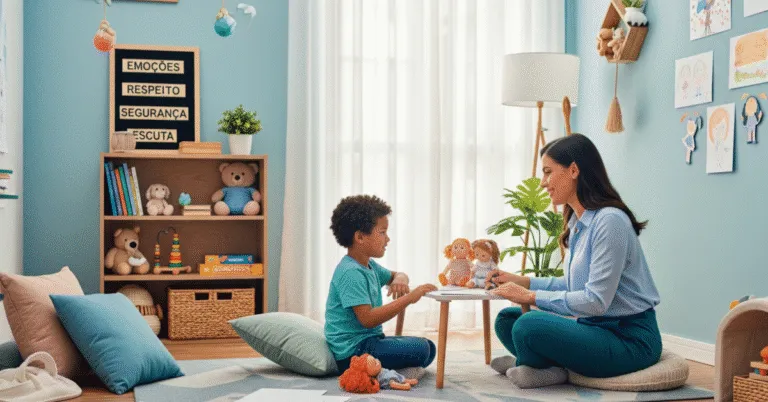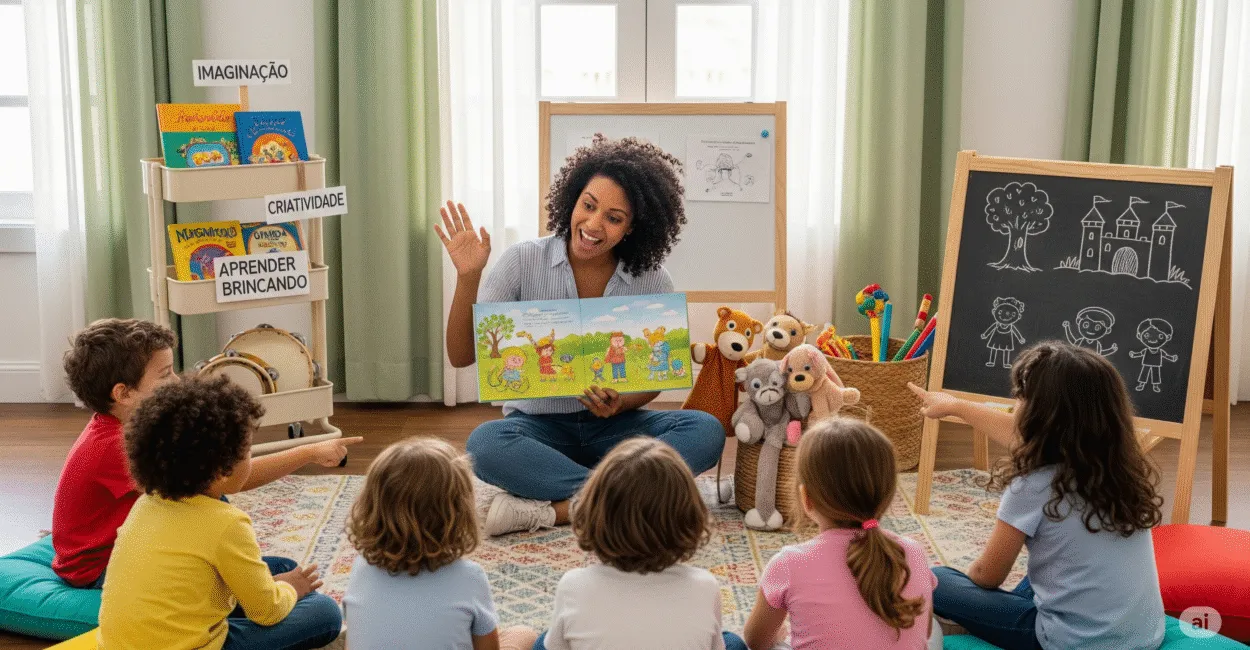
A good story holds a child’s attention for a simple reason: it brings emotion, language, and meaning together. In storytelling, that becomes real learning when adults use voice, pacing, mental imagery, and interaction without turning reading into a dull lesson.

The impact is greater than it may seem. Well-told stories build vocabulary, support listening skills, encourage narrative memory, and strengthen the bond between storyteller and listener.
Here, you’ll learn what makes a story engaging, which techniques work with young children, and how to adapt your storytelling to different ages and settings.
The Essentials
- How a story is told matters more than how many words it contains: pauses, intonation, and clarity all have a major effect on children’s attention.
- Stories with repetition, predictability, and active participation help children anticipate what happens next and build understanding.
- Visual aids are useful, but they don’t replace an adult’s presence; human guidance is what makes the experience meaningful.
- Not every story works for every age group: the same text may be a hit with 4-year-olds and leave a group of 8-year-olds restless.
- Good storytellers don’t overact: they guide the plot with confidence without taking away a child’s chance to imagine.
Storytelling for Children: Techniques That Turn a Story into an Experience
In technical terms, storytelling is the oral, physical, and emotional delivery of a narrative to foster attention, understanding, and engagement. Put simply, it’s more than reading aloud; it’s helping children enter the story with their bodies, ears, and imaginations.
In practice, anyone who works in early childhood education knows that the same story can go two very different ways. If an adult reads without changing their voice or looking at the group, attention quickly fades.
But if they build suspense, use well-timed pauses, and leave room for children to respond, even a short text can come alive.
What Makes a Story Truly Engaging
Three elements hold children’s attention: pacing, mental imagery, and participation. Pacing is the interplay of speech, silence, and vocal variation. Mental imagery is what a child “sees” in their mind. Participation happens when children respond, predict, complete sentences, or imitate sounds.
A story holds children’s attention when the adult controls the pacing, not when they simply speak louder.
This may seem like a small detail, but it makes all the difference. Too much drama gets tiring; reading without expression is sleep-inducing. The key is to let the story breathe without losing its energy.
Organizations and References That Help Explain the Topic
Brazil’s National Common Core Curriculum (Base Nacional Comum Curricular, or BNCC) emphasizes exposure to oral and written narratives in early childhood and elementary education. The official BNCC portal outlines learning areas related to listening, speaking, thinking, and imagination.
The United Nations Educational, Scientific and Cultural Organization (UNESCO) and organizations focused on children’s reading also identify guided reading as essential to literacy development. This helps explain why a well-told story isn’t just a “break-time activity”—it’s part of language development.
Other useful references in this field include Paulo Freire, Monteiro Lobato, picture books, shadow puppetry, puppets, story circles, and oral storytelling. Each can enrich the experience, but none can replace the attentive presence of the person leading it.
Voice, Pauses, and Intonation: The Trio That Captures Children’s Attention
The voice is the storyteller’s first tool. Children pick up on intent before they understand every word, so the rise and fall of speech matters as much as the text itself. If everything is delivered in the same tone, the story loses contrast. If the voice changes too dramatically all the time, it becomes a caricature.
How to Use Your Voice Without Overacting
- Use a moderate volume and save louder moments for key scenes.
- Give characters subtly different vocal qualities instead of exaggerated, artificial voices.
- Pause before revelations, questions, and important reactions.
- Use shorter sentences during action scenes and draw out moments of suspense.
The best storyteller doesn’t compete with the story. They reveal it at the right pace. That applies at home, at school, at the library, and even when presenting to a large group.
When a Pause Says More Than Words
A pause isn’t empty silence. It’s a storytelling tool. It gives children time to process, imagine, and predict what comes next. In stories with repetition, a pause also builds shared anticipation: the whole group senses they’re about to finish the sentence together.
A well-timed pause is more effective than overexplaining because children use their own imaginations to complete the meaning.
Anyone who tells stories to young children notices this quickly. Sometimes all it takes is an extra second before the ending to make the whole group lean forward.
Choosing a Story: Age, Topic, and Length Matter More Than You Might Think

Not every story is right for every child. The main criterion isn’t whether it’s “beautiful,” but whether it suits the child’s developmental stage, attention span, and background knowledge. A long text with lots of subplots may be perfect for 9-year-olds and exhausting for 3-year-olds.
Age Groups and Types of Stories
| Age Group | What Tends to Work | What Often Falls Flat |
|---|---|---|
| Ages 2–4 | Repetition, rhyme, sounds, vivid images, and a simple plot | Long stories, abstract metaphors, and too many characters |
| Ages 5–7 | A clear sequence, humor, light conflict, and opportunities to speak | An overly slow pace and too much explanation |
| Ages 8–10 | Suspense, adventure, moral dilemmas, and more complex narratives | Stories that feel too childish or predictable |
This chart is helpful, but it’s not a hard-and-fast rule. Children of the same age can have very different experiences, which affects how they respond. A group of 6-year-olds may handle a more complex story with ease, while another group needs more visual and verbal support.
A Brief Story from the Classroom
I once saw a teacher start reading a classic story to a group of 5-year-olds and realize within the first few minutes that the children were losing focus. She didn’t switch to a different text; she slowed down, pointed to the illustrations, asked two quick questions, and had the group repeat a key line. In less than a minute, the mood in the room had changed.
The moment illustrates an important point: often, the problem isn’t the story but the way it’s presented.
Visual and Interactive Tools That Help Without Stealing the Show
Pictures, objects, and movement can add a lot, but they need to serve the story. If a visual aid becomes a show of its own, the story loses its focus. Ideally, visual support deepens listening rather than distracting from it.
Tools That Tend to Work Well
- Picture books: Support comprehension and help younger children follow the plot.
- Puppets: Create dialogue and work especially well for characters with memorable lines.
- Shadow puppetry: Builds atmosphere and suspense and holds the group’s attention.
- Everyday objects: Provide sensory support for stories featuring familiar things.
The key is how you use them. A puppet that interrupts the story after every sentence gets in the way; one that appears at just the right moment builds connection. The same goes for story cards, oversized books, finger puppets, and short songs.
Where Technology Helps—and Where It Gets in the Way
Projections, audio, and animation can enrich an activity, but they shouldn’t replace adult guidance. In settings with lots of stimulation, a screen can sometimes compete with the story itself for attention. In smaller settings, digital tools can provide support as long as the adult continues to guide the experience.
If you’d like to deepen your teaching practice, look for guidance on reading and oral language from universities and public institutions, such as resources from UFMG, the Federal University of Minas Gerais, which often publishes research on literacy, language, and children’s literature.
Strategies for Engaging Children Without Forcing Them to Participate
Participation doesn’t mean making noise. Some children respond by speaking; others respond by looking, laughing, pointing, or sitting quietly and listening. Requiring everyone to participate in the same way makes the experience less rich.
Ways to Encourage Meaningful Participation
- Quick prompts: “What do you think will happen next?”
- Group repetition: a line, a sound, or a refrain.
- Simple choices: “Will this character take the bridge or go through the forest?”
- Imitating sounds and movements connected to the story.
These strategies work because they keep children within the narrative without interrupting its flow. If an activity turns into a long discussion, the story falls apart. If it feels like an interrogation, attention fades.
The best kind of participation deepens listening instead of turning the story into a quiz.
Educators disagree about how often a story should be interrupted for questions. My practical take is simple: with young children, fewer interruptions usually work better; with older children, the conversation can go further as long as it doesn’t derail the plot.
Common Mistakes That Undermine the Experience
Some mistakes are common, even among experienced storytellers. The first is underestimating the need to prepare. There’s a place for improvisation, but good improvisation comes from experience, not haste.
What Gets in the Way More Than It Helps
- Reading too quickly to “get through the material.”
- Explaining the story’s lesson before the ending.
- Choosing stories well above the group’s age level without providing enough support.
- Overusing visual aids and losing focus on the story.
- Treating every story as a lesson in behavior.
That last point deserves attention. Not every story needs to end with an explicit moral. Sometimes its value lies in the atmosphere, language, humor, or a little controlled fright. When adults force a lesson, they diminish the text’s literary power.
There are practical limits, too: long, complex stories may not work with very restless groups, even when they’re excellent. In those cases, consider breaking the story into parts or choosing shorter, more repetitive narratives.
How to Build a Storytelling Routine That Works at Home and at School
Routines help because they create anticipation. Children are more likely to settle into a story when they recognize the moment, the opening gesture, and the sequence of activities. A simple routine is better than a different performance every day.
A Practical Four-Step Structure
- Prepare the space: reduce noise and choose a place where everyone can focus.
- Introduce the story with a short, direct opening.
- Guide the narrative with a steady pace and occasional opportunities to participate.
- Wrap up with a simple follow-up: a drawing, question, retelling, or game related to the story.
At school, this might happen in a story circle, the library, or the classroom. At home, it can work before bed, after bath time, or during a screen-free break. The most important thing is for the moment to feel predictable, not like something that’s being improvised from scratch every time.
If you want to make storytelling a consistent habit, start small: choose a short text, set a regular time, and repeat the routine for a few weeks. Consistency matters more than performance.
Next Steps
Good storytelling for children doesn’t require rare talent; it takes technique, attentiveness, and intention. Learning to manage your voice, pauses, story choices, and interaction can already make the experience much better for a child. The rest comes with practice and observation.
To improve, try one short story for each age group, notice where attention wanes, and adjust one element at a time. Then compare the results with another story using the same structure. This kind of experimentation works better than trying to “be charismatic” without a plan.
Frequently Asked Questions
What’s the right age to start storytelling?
You can start very early, even with babies, as long as the format is appropriate. At this stage, the focus is on voice, pacing, repetition, and connection—not complex verbal comprehension. As children grow, you can introduce plots, characters, and spoken participation.
Do I need to memorize a story to tell it well?
You don’t have to memorize it word for word. What matters most is knowing the sequence, the moments of tension, and the repeated passages. Memorizing can help, but it doesn’t replace presence and a natural delivery.
Are picture books better than telling a story without a book?
It depends on your goal. Picture books support visual understanding and introduce children to print literature, while oral storytelling without a book can strengthen imagination and listening. Both formats have value.
How long should a story last?
There’s no set length because the ideal duration depends on the children’s age, the group, and the text. Short stories tend to work better for young children; older children can handle longer ones. The main goal is to hold their attention, not to fill a certain amount of time.
How can I tell if a story is working?
Look for clear signs: focused attention, anticipation, laughter at the right moments, spontaneous responses, and retelling the story afterward. If the group loses focus right away, the issue is usually the pacing, the story choice, or the way it’s being told.
Does storytelling help children learn to read and write?
Yes. It builds vocabulary, narrative structure, understanding of sequence, and familiarity with written language. It doesn’t replace formal reading and writing instruction, but it lays an important foundation for that learning.
%%AGPTRH10%%