
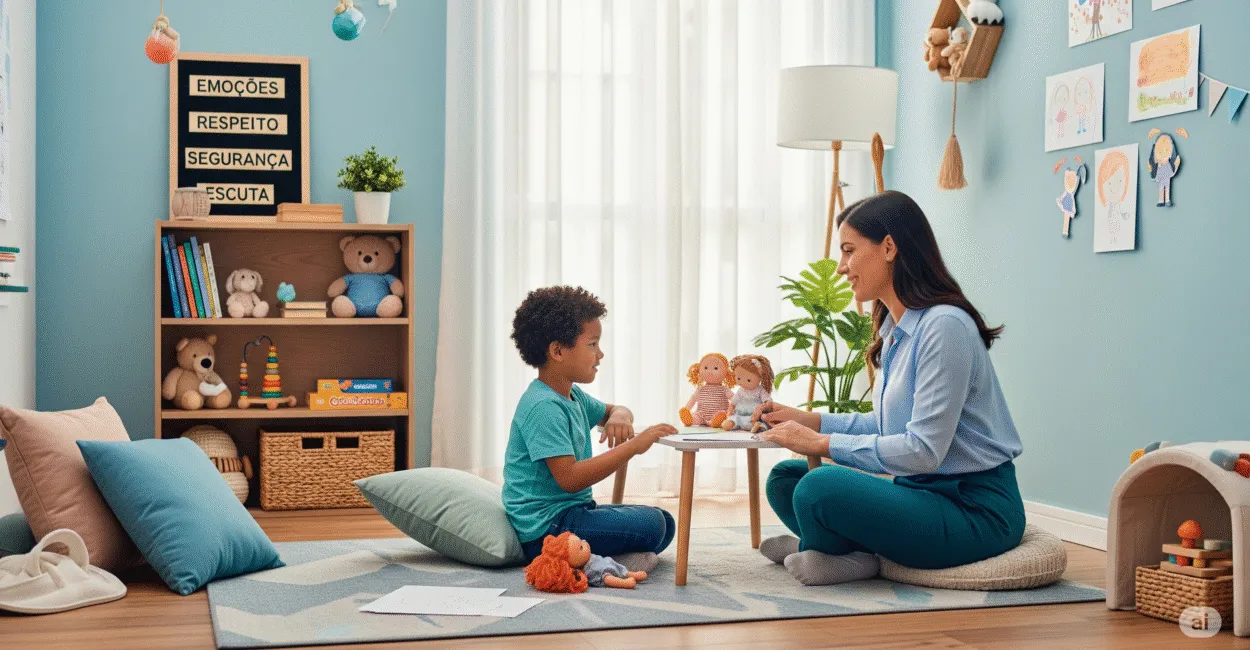
Child psychology helps us understand how children perceive the world before they can explain what they’re feeling. When a behavior seems “stubborn,” “whiny,” or “defiant,” it’s often communicating something else: fatigue, anxiety, emotional immaturity, or a need for security.

In practice, child psychology is the field that studies children’s cognitive, emotional, social, and behavioral development from the earliest years of life. This matters because identifying signs early can prevent minor challenges from turning into bigger problems at school, at home, and in relationships. Below, you’ll see how this knowledge applies to everyday life, when to pay closer attention, and what parents, caregivers, and professionals can do more effectively.
What You Need to Know
- Children’s behavior usually communicates a need before it communicates an intention.
- Emotional development isn’t linear: setbacks and ups and downs are common during periods of change.
- Boundaries and emotional support work better together than separately.
- Early intervention is often more effective when a difficulty shows up repeatedly at home and at school.
- The family environment matters as much as the child: routines, relationships, and predictability can change the picture.
Child psychology and children’s emotional development
Psychology sees a child as a person who is still developing, not as a small adult. That changes everything. Instead of interpreting every reaction through the lens of adult logic, the focus shifts to the child’s stage of development, ability to express emotions, and ways of regulating impulses, frustration, and relationships.
What emotional development can tell us
Between ages 2 and 6, for example, outbursts of anger, separation anxiety, and difficulty naming feelings are common. During the school years, children become more likely to compare themselves with classmates, more sensitive to criticism, and more focused on belonging. In adolescence, the search for independence can look like defiance, but it’s often an attempt to develop a sense of identity.
A straightforward technical definition
Technically, child psychology is the branch of developmental psychology devoted to studying the psychological, relational, and behavioral processes of childhood. In plain language, it helps us understand why children act the way they do and what their behavior reveals about their emotional state.
Children’s behavior is rarely the problem itself; it’s often the visible sign of an emotional, relational, or environmental need that hasn’t been met.
People who work in this field know that the right question is rarely “How do I make the child stop?” It’s “What’s driving this behavior?” That shift in perspective can prevent knee-jerk punishment and make room for more thoughtful responses.
How emotions show up in everyday behavior
Children can’t always say, “I’m frustrated,” “I’m scared,” or “I need to know what to expect.” So they show us. It can show up in their sleep, eating, play, tantrums, withdrawal, aggression, and even physical pain with no clear medical cause.
Signs that deserve attention
- Frequent outbursts that are out of proportion to minor situations.
- Intense crying or constant irritability that doesn’t improve with basic comfort and support.
- Regressions, such as starting to wet the bed again after a period of staying dry.
- Ongoing avoidance of school, peers, or activities the child used to enjoy.
- Repeated physical complaints, such as stomachaches or headaches, without a sufficient medical explanation.
These signs don’t establish a diagnosis on their own. They suggest that something deserves further attention. There’s an important distinction here: not every meltdown is a disorder, and not every quiet child is suffering. Patterns, intensity, and duration matter more than a single incident.
The CDC’s information on child development and resources from the American Academy of Pediatrics emphasize that emotional and social milestones should be understood in the context of overall development, not through simplistic comparisons between children of the same age.
When to seek professional help instead of waiting for things to get worse

A common mistake is waiting until things “get serious” before seeking an evaluation. In childhood, waiting can come at a high cost because children are still building emotional skills, language, relationships, and self-regulation. The sooner support begins, the less likely a difficulty is to become an entrenched pattern.
Signs that an evaluation may be helpful
- The behavior occurs in more than one setting, such as at home and at school.
- The child is distressed by their own behavior, even if they can’t explain why.
- The changes persist for weeks or months without consistent improvement.
- There’s a real impact on sleep, learning, socializing, or family routines.
In practice, many parents come in saying, “He’s always been this way.” But after looking at routines, sleep, separations, screen time, and recent changes, a clear trigger may emerge. I’ve seen cases where the concern seemed to be defiance, but was actually separation anxiety after a school change or an unspoken family conflict.
Read also: Biotechnology Admissions Cutoff: How to Find and Understand It
You don’t have to wait for a crisis to assess a child’s emotional health; recurring behavior, functional impairment, and distress are already good reasons to seek professional attention.
For an institutional resource, the website of the Brazilian Society of Pediatrics (Sociedade Brasileira de Pediatria, Brazil’s national pediatric association) offers helpful information on childhood development and warning signs, especially when behavior changes are accompanied by physical or school-related concerns.
The family’s role in emotional regulation
Family isn’t a neutral backdrop. It shapes a child’s daily rhythm. When life is predictable, routines are reasonably consistent, and adults can name emotions, children learn to regulate themselves with greater confidence. When everything is constantly changing, a child’s nervous system stays on alert.
What really helps
- Clear routines for sleep, meals, and transitions.
- Fewer rules, applied consistently.
- Naming emotions: “You’re frustrated,” “That scared you.”
- Correcting behavior without shaming the child.
- Quality time without digital distractions.
The goal isn’t to turn your home into a therapist’s office. It’s to create an emotionally understandable environment. Young children need to know what’s coming; older children need to understand why a boundary exists. When that’s missing, behavior tends to escalate.
A real-life example
A 7-year-old girl started “talking back” every day after school. Her family thought she was being rebellious. After observing her schedule for a few weeks, they realized the meltdown always happened at the same time: when her phone was taken away without warning and she was hungry. Adjusting her snack, transition, and 10-minute warning made a big difference. It wasn’t magic. It was planning.
School, relationships, and socializing: where signs become easier to see
School is often the first place where a difficulty becomes objectively visible. A teacher may notice distractibility, aggression, withdrawal, recurring crying, or refusal to participate. That’s no coincidence: the school environment calls for language skills, frustration tolerance, shared attention, and social interaction all at once.
What to discuss with the school
- Whether the problem occurs in every class or only in specific situations.
- Whether the child reacts more strongly to separations, tests, or conflicts with peers.
- Whether behavior changed after events such as bullying, bereavement, or the parents’ separation.
The school’s perspective is valuable because it offers insight into how the child compares with peers and responds to a structured routine. But it has limits: a child may do well in class and struggle at home, or the other way around. That’s why a good evaluation brings together the school, family, and, when needed, clinical observation.
Research and guidance from universities such as Harvard University have consistently shown a connection between secure relationships, self-control, and social-emotional outcomes throughout development.
What a child psychological evaluation looks like in practice
An evaluation doesn’t start with tests. It starts with careful listening. The professional explores the child’s developmental history, routines, language, motor milestones, family relationships, stressful events, and school environment. Then, when appropriate, they may use psychological tools, play-based interviews, and behavioral observation.
What an evaluation may include
- A detailed history from parents or caregivers.
- An interview with the child using age-appropriate language.
- Contact with the school, with the family’s permission.
- Validated tests and rating scales, if indicated.
- A feedback session with practical guidance for the family and caregivers.
Experts differ on how much weight to give each tool at different ages, but they agree on one point: a quality child assessment isn’t based on a quick impression or a single meeting. It requires context, time, and the integration of information.
A good child psychological evaluation doesn’t rush to label a child; it aims to understand the full pattern before any clinical or educational decisions are made.
Strategies that work better than automatic punishment
Not every difficulty requires a lengthy intervention. Many situations improve with adjustments to routines, parent guidance, and consistency. What tends to fail is an impulsive response: yelling, threats, punishment unrelated to the behavior, or a long argument in the middle of a meltdown.
What tends to help
- Give advance notice of transitions instead of waiting until the last minute.
- Reduce stimulation when the child is already dysregulated.
- Reinforce appropriate behavior more often than you punish inappropriate behavior.
- Hold the boundary even when the child protests, without letting your own emotions escalate.
- Review sleep, nutrition, and excessive screen time before deciding it’s “just behavior.”
This approach works well for mild and moderate concerns, but it may not be enough when there’s severe distress, a suspected neurodevelopmental disorder, trauma, or a highly chaotic family environment. In those cases, guidance alone won’t do the job; the child needs structured support.
Next steps: turning observation into action
Here’s the key: understanding your child doesn’t mean being permissive, and setting boundaries doesn’t automatically make you a better parent. Change comes from the middle ground—observing carefully, interpreting without jumping to conclusions, and responding consistently. This combination reduces conflict and increases predictability, which is what children need most.
If the behavior keeps recurring and has started to affect sleep, school, relationships, or home life, consider tracking patterns for a week or two and seeking a qualified evaluation. This can save months of trial and error. The sooner a difficulty is understood in context, the easier it is to build an effective response.
Frequently asked questions
Is child psychology only for children with a diagnosis?
No. It can also help make sense of emotional, behavioral, and adjustment difficulties before they lead to a formal diagnosis. Often, support helps prevent a difficulty from becoming entrenched in the first place.
Are tantrums always a sign of an emotional problem?
No. Tantrums are part of development at many ages, especially while children are still learning to tolerate frustration. What deserves attention is how often they happen, how intense they are, and how much they affect daily life.
When is a child’s behavior no longer “just a phase”?
When it becomes repetitive, intense, and disruptive in more than one setting. If school, home, and social interactions are all affected, it’s less likely to be just a phase. In that situation, an evaluation may help.
Can parents influence a child’s behavior?
Yes, but that doesn’t automatically mean the parents are to blame. Routines, relationships, predictability, how boundaries are handled, and the emotional atmosphere at home all have a strong influence on how children regulate emotions and respond to frustration.
Can a child psychological test replace clinical observation?
No. Tests are one part of an evaluation, not the whole thing. The best results come when tools, interviews, and observations are considered alongside the child’s real-life context.
Which professional should I contact first?
In general, start with a child psychologist or a neuropsychologist experienced in development. Contact a pediatrician if there are concerns about physical health, sleep, eating, or growth. If the cause of the behavior is unclear, a multidisciplinary evaluation is often the safest approach.
Artigos Relacionados
 Understanding Item Response Theory: A Complete, Detailed Guide
 Working From Home: The Complete Guide to an Ideal Workspace
 School Bullying: A Complete, Practical Guide
 Automated Learning Tools: A Complete Guide to Better Learning
 Physical Education Teacher: A Complete Guide to Training and Career Paths
 How to Write an Effective Argumentative Essay: A Complete Guide
