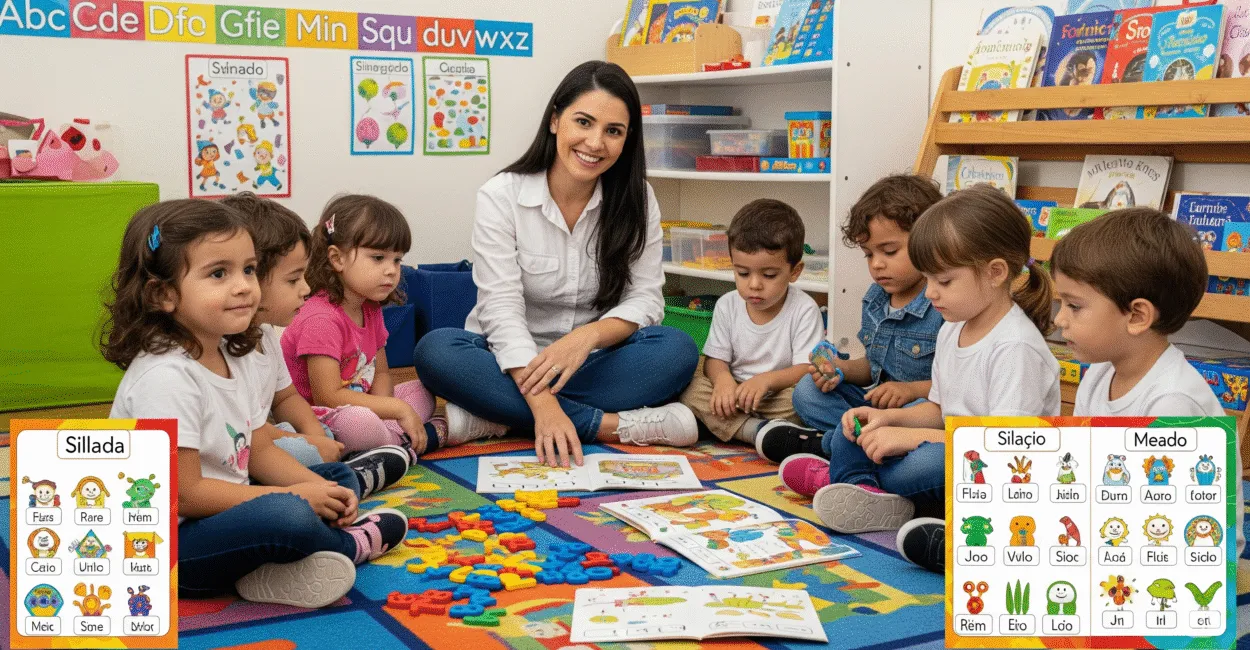
Literacy doesn’t begin when children repeat letters in order. It begins when they realize that writing serves a real purpose: to ask, remember, record, play, name things, and communicate.

In early childhood education, that changes everything. The focus shifts away from rote memorization and toward meaningful language.
In practice, what works is introducing children to authentic reading and writing situations: listening to stories, playing with sounds, noticing words around them, making purposeful marks, and trying to write in their own way. This approach respects child development and avoids a common mistake: expecting formal performance too soon.
The Essentials
- Literacy involves building a connection between speech, writing, and the social use of language.
- In early childhood education, the foundation comes from experiences with sounds, texts, images, early writing, and verbal interaction.
- Phonological awareness, fine motor skills, and exposure to books need to develop together.
- Forcing children to copy and practice mechanically may create the appearance of progress, but it doesn’t guarantee understanding.
- Adults play a crucial role by guiding, naming, listening, and broadening children’s knowledge without turning everything into a test.
How Literacy Really Begins in Early Childhood Education
Technically, literacy is the process of learning to use the alphabetic writing system. Put simply, children learn how speech sounds relate to letters and how writing represents language. This process doesn’t happen overnight, and it doesn’t depend on memorizing the alphabet alone. In early childhood education, children are still developing oral language, listening skills, motor coordination, and an understanding of what writing does in the world. That’s why the best starting point is meaningful experiences, not repeating syllables out of context. The Ministry of Education (Brazil’s national education ministry) recommends practices that support children’s overall development at this stage, helping prevent formal schooling from starting too early.
The key to literacy isn’t “knowing letters.” It’s understanding that writing represents speech and helps us make meaning.
Literacy and Reading and Writing Practices Aren’t the Same Thing
These two concepts go hand in hand, but they’re not identical. Learning to read and write means learning the alphabetic system; literacy practices mean taking part in social activities that involve reading and writing.
A child may recognize letters without yet understanding what writing is for. A child may also grow up surrounded by books, notes, and signs before mastering the relationship between letters and sounds.
That’s why daily routines need to offer both at once: access to real texts and opportunities to think about writing. Without this combination, children may “memorize” something without being able to apply what they’ve learned more broadly.
The Role of Oral Language and Phonological Awareness
Before children can write independently, they need to notice that words are made up of sounds. This is phonological awareness: the ability to recognize rhymes, syllables, alliteration, and beginning and ending sounds.
These skills don’t develop through worksheets alone. They emerge through nursery rhymes, songs, name games, and listening activities.
Activities That Make a Difference
- Play games to find words that rhyme.
- Clap once for each syllable in names and objects.
- Identify the beginning sounds in familiar words.
- Retell stories with the help of pictures.
- Compare long and short words in everyday situations.
Anyone who works with children knows they learn more when they participate actively. Instead of just listening to an explanation, they play with sounds, repeat patterns, and test their ideas.
These experiences lay the groundwork for conventional reading without rushing the process.
For a more technical reference on language development and early learning, see UNESCO materials on language and early childhood education. The message is consistent: strong oral language often provides better support as children begin learning to write.
A Literacy-Rich Environment: What It Should Include

A literacy-rich environment isn’t a classroom packed with colorful posters. It’s a space where writing is used for real purposes. That might include names on cubbies, attendance lists, calendars, books within reach, notes, captions, recipes, game rules, and children’s own work displayed with a clear purpose.
In my experience, some classrooms have made more progress with a simple, consistent routine than with an excess of materials. The reason is straightforward: when children see writing being used, they understand that it carries information. When it’s used only as decoration, it becomes visual noise.
Read also: The Role of Families in Children’s Literacy Development
An effective literacy-rich environment doesn’t just decorate the classroom—it makes writing part of a child’s everyday life.
What Should Be Included
| Resource | Educational purpose | Practical example |
|---|---|---|
| Children’s books | Build vocabulary and narrative comprehension | Daily read-aloud followed by a retelling |
| Name charts | Help children recognize meaningful words | Taking attendance and organizing belongings |
| Writing materials | Encourage early writing and exploration of how writing works | A shopping list for pretend play |
| Everyday texts | Show how writing is used in real life | Invitation, notice, recipe, or note |
Fine Motor Skills and Taking Time with Writing
Writing takes more than knowing letters. Children also need to control their strokes, hold a pencil, coordinate their eyes and hands, and stay focused for a few minutes. That’s why activities like cutting, fitting pieces together, playing with modeling dough, painting, gluing, and free drawing matter—they develop skills that writing will require later.
The Most Common Mistake
The most common mistake is asking children to write neatly before they have developed the necessary motor skills. This often leads to frustration, tension in the hand, and resistance to the task. Instead, it makes more sense to start with different kinds of marks, move on to more controlled strokes, and only then introduce conventional writing.
Experts disagree about how much formal motor practice early childhood education should include. But they agree on one point: insisting on mechanical repetition doesn’t speed up children’s understanding of the writing system. In some cases, it can even reduce their interest in reading.
The Adult’s Role in Everyday Guidance
Children don’t learn on their own just because they’re surrounded by letters. They learn when adults observe, name things, ask questions, respond to their ideas, and offer small challenges. Guidance bridges the gap between what a child already knows and the next step they can take.
What a Good Guide Does
- Reads aloud with expression and pauses.
- Points to words while reading without turning the activity into a test.
- Values children’s attempts at writing, even when they’re far from conventional spelling.
- Encourages children to compare words, sounds, and letters in real-life contexts.
- Listens to children’s ideas before correcting them.
In the classroom, this happens in small moments. A teacher asks who appeared first in the story, a child tries to find their name on the chart, or someone tries to write “ball” using the letters they know. These gestures may seem simple, but they help children reason about writing.
The IBGE (Brazil’s national statistics agency) and educational studies published by public institutions help explain the broader learning landscape in the country, especially when discussing unequal access to books, language-rich experiences, and early childhood education. The practical takeaway is clear: a child’s cultural experiences have a major impact on their pace of progress.
How to Tell Whether a Child Is Making Progress
Progress doesn’t always look like fluent reading. In early childhood education, it might mean recognizing their own name, noticing rhymes, telling drawings apart from words, trying to write with a purpose, or asking to hear a favorite story “one more time.” These signs show that a child is building a connection with written language.
Signs of Real Progress
- The child recognizes familiar words from everyday life.
- They try to connect speech and writing when they write on their own.
- They notice similarities in the sounds of words.
- They understand that texts serve a purpose: to give notice, tell a story, provide instructions, or record information.
- They start asking about letters, sounds, and words on their own.
Progress should be monitored through observation, not just worksheets. A child may complete printed exercises without understanding how writing works. Another may make scribbles full of meaning and be taking an important step in the right direction.
What to Avoid So the Process Doesn’t Stall
Some practices get in the way more than they help. The main one is turning early literacy into premature practice with copying, isolated syllable drills, and fill-in-the-blank exercises without context. This often leads children to depend on instructions and do little thinking about language.
Practices to Approach with Caution
- Expecting children to read conventionally when they’re still developing oral language.
- Prioritizing worksheets over interaction with real texts.
- Correcting every attempt with an exclusive focus on mistakes.
- Reducing the daily routine to letters, syllables, and repetition.
Not every approach works the same way for every child. Some children respond well to more structured challenges, while others need more time for oral and play-based experiences. The mistake is treating the whole class as if everyone learns in the same way and at the same pace.
Next Steps for Building a Strong Foundation
If the goal is to strengthen early learning, the safest approach is to build routines around language and real experiences rather than rushing through content. Children need to listen and talk often, play with sounds, explore books, and see writing being used around them. That matters more than any promise of quick results.
To put this into practice, take a look at your daily teaching routine and see whether it includes daily reading, language games, early writing, and materials with a social purpose. Then adjust anything that feels overly mechanical and expand the activities that encourage meaning, listening, and participation.
Frequently Asked Questions
What’s the difference between learning to read and write and literacy practices?
Learning to read and write means learning the alphabetic writing system—in other words, understanding how letters and sounds relate. Literacy practices involve taking part in social activities that use reading and writing, such as reading notes, lists, stories, and notices. In school, these two processes should go hand in hand.
When should literacy instruction begin?
It begins before children can read conventionally, when they start noticing and using writing in real-life contexts. In early childhood education, the focus is on building a foundation through oral language, sound-based games, books, and early writing. Expecting formal performance too soon tends to do more harm than good.
Are scribbles a sign of learning?
Yes, when the scribbles are meant to communicate something. They show that a child understands writing can represent ideas, names, or messages. With the right guidance, this stage develops into more organized ideas about writing.
Which activities are most helpful at the beginning?
The most effective activities include reading aloud, rhyming games, recognizing one’s own name, exploring nursery rhymes, writing lists, and playing with sounds. The best results tend to come when an activity is meaningful to the child and connected to the classroom routine.
Is it wrong to teach letters and syllables in early childhood education?
It’s not wrong to introduce letters, as long as it’s done in context and without pressure to meet formal performance expectations. The problem arises when teaching becomes mechanical repetition and ignores oral language, listening, and the social purpose of writing. Letters should have meaning, not appear in isolation as automatic exercises.
%%AGPTRH8%%