
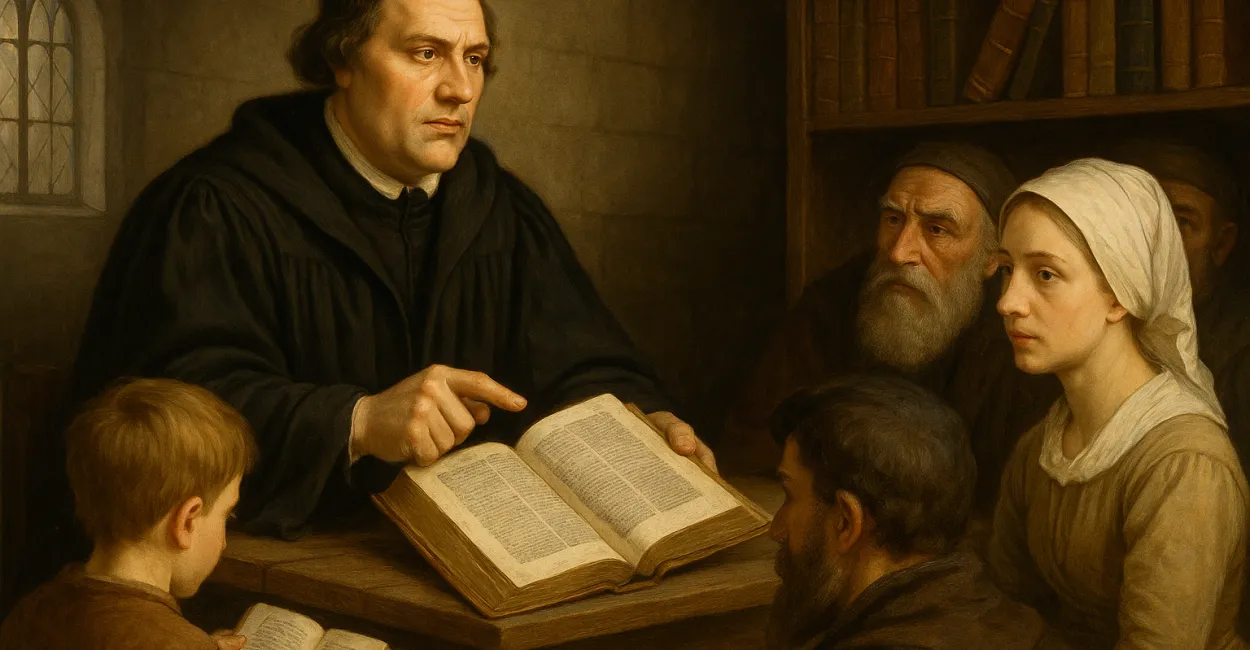
The relationship between education and the Protestant Reformation changed how Europe read, taught, and interpreted knowledge. Led by Martin Luther in the 16th century, the movement did more than reform religion: it reshaped schools, promoted literacy, and put individual reading at the heart of Christian and social life.

This matters because the impact did not end in the past. The Reformation influenced curricula, encouraged the creation of parish schools, strengthened vernacular-language instruction, and helped establish the idea that education was not a privilege for a few, but a public necessity.
Here’s what changed, why it changed, and which effects are still with us today.
The essentials
- The Protestant Reformation accelerated literacy by arguing that everyone should be able to read the Bible for themselves.
- Schools focused on basic education gained ground in Protestant regions, with greater emphasis on reading, writing, and religious instruction.
- Martin Luther and John Calvin helped establish education as a religious, social, and civic responsibility.
- Translating the Bible into local languages expanded the use of vernacular languages and strengthened reading practices beyond Latin.
- The Reformation’s educational legacy can still be seen in debates about compulsory schooling, literacy, and public responsibility for education.
Education and the Protestant Reformation: What Changed in Practice
The key point is both historical and practical: the Protestant Reformation championed direct access to Scripture, without the clergy serving as the sole intermediary. Put simply, this meant more people needed to learn to read. The consequence was immediate: if faith depended on personal reading, school was no longer a luxury but a strategic tool.
In practice, priorities shifted. In many regions influenced by the Reformation, civil and religious authorities began supporting elementary schools, teacher training, and instruction in religious doctrine in local languages. The effects were not uniform, but they were profound: where religious reading became a valued practice, literacy gained institutional importance.
From liturgical reading to individual reading
Before the Reformation, Latin dominated official religious life across much of Western Europe. After the split, reading the Bible in German, English, French, and other languages strengthened the use of vernacular languages and brought education closer to everyday life.
Why literacy gained ground
This was about more than learning to sound out words. Reading was a way to participate in faith, interpret texts, and sustain a new religious culture. This link between individual conscience and the written word created a powerful social incentive to learn.
The Protestant Reformation made literacy more socially useful by turning Bible reading into a valued religious practice, rather than simply a scholarly skill.
Martin Luther, Schools, and Public Responsibility
Martin Luther was a decisive figure in this shift. In works such as To the Christian Nobility of the German Nation and in his letters on education, he argued that cities and authorities should maintain schools for boys and girls. The idea was clear: a healthy Christian community needed educated people.
There’s an important detail here: Luther saw school as more than an instrument of faith; he saw it as a social institution. Anyone who studies the history of education can easily spot this point: when religious leaders begin talking about a public duty to teach, the debate moves beyond the private sphere and into the organization of society.
- Support for municipal and parish schools;
- Emphasis on the catechism as a teaching method;
- Use of the local language to make lessons more accessible to students;
- Separation of basic instruction from clerical training.
A useful source for exploring this context is Martin Luther’s biography in Encyclopaedia Britannica, which helps put the intellectual and religious dimensions of his work in perspective.
John Calvin and Intellectual Discipline in Geneva

If Luther opened the door, John Calvin helped put the house in order. In Geneva, the Reformed tradition linked education to moral discipline, systematic study, and the development of readers able to interpret religious texts rigorously. This influenced schools, academies, and education in territories shaped by Calvinism.
Calvin reinforced a more methodical culture of study. Reading instruction went hand in hand with memorization, interpretation, and the development of moral judgment. Rather than treating knowledge as an ornament, the Reformation placed it at the center of community life.
Geneva’s role
Geneva became an important educational laboratory in the 16th century. The city developed an educational system that reflected Reformed faith and the need to train religious leaders, teachers, and educated citizens.
Read also: Definitions and Concepts in Contemporary Education
The difference between medieval Catholic pedagogy and Reformed pedagogy lies not only in the subject matter, but also in the importance placed on the text, discipline, and individual reading.
For additional historical context, academic resources such as the Stanford Encyclopedia of Philosophy offer a precise account of Calvin’s intellectual contributions.
Read also: History of Education: Its Origins and Development Around the World
The Catechism, the Vernacular, and the Development of Readers
One of the Reformation’s most concrete legacies was the use of the catechism as a teaching tool. Rather than relying only on rituals and oral explanations, reformers created short texts organized as questions and answers to make learning easier. This made reading more accessible to children and adults.
The catechism served as a bridge between faith and schooling. It taught doctrine, but also strengthened memory, reading, and repetition. In many Protestant communities, it was the first systematic educational experience for much of the population.
| Element | Educational purpose | Social effect |
|---|---|---|
| Catechism | Organize learning through questions and answers | Make basic instruction easier |
| Bible in the vernacular | Enable direct reading | Expand literacy |
| Parish schools | Teach reading, writing, and doctrine | Reduce reliance on informal instruction |
This model did not solve everything. In poor rural areas, schools were unevenly available, and attendance was not always high. Even so, the method created a more stable foundation for elementary education than many places had before the Reformation.
How Printing Expanded the Reach of Reformation Ideas
The movable-type printing press associated with Gutenberg existed before the Reformation, but the religious movement made decisive use of the technology. Pamphlets, printed sermons, Bible translations, and catechisms circulated at an unprecedented speed for the time. This multiplied the educational impact of the Reformation’s message.
Once texts began circulating widely, teaching no longer depended solely on oral communication. Print culture made repeated reading, comparing versions, and public discussion possible. In educational terms, this shift was just as important as any curricular reform.
A concrete example
Imagine a small German town in the 16th century. The pastor reads a passage from the Bible in German during Sunday worship, the local school uses the same text during the week, and at home, parents review catechism answers with their children. Within a few months, reading goes from being rare to becoming a social practice.
This kind of cycle is one reason the relationship between the Reformation and education cannot be reduced to “more books.” What emerged was an ecosystem: texts, schools, pulpits, and families all working in the same direction.
For historical background on printing and the circulation of texts, the Library of Congress offers solid resources on the impact of printing on European print culture.
The Limits of the Protestant Educational Transformation
It’s tempting to say that the Reformation “invented modern education,” but that overstates its role. Schooling existed before the 16th century, and the medieval Church also maintained forms of education. What the Reformation did was accelerate certain trends, give literacy a new moral justification, and increase pressure for schools in some regions.
Experts disagree on the precise scale of its impact. In places where political authorities resisted the Reformation, the effects were smaller; where local elites embraced the change, schools advanced more quickly. This matters because it prevents easy generalizations.
The Protestant Reformation did not create education from scratch; it reshaped priorities, increased the value placed on reading, and strengthened the idea that teaching was also a public responsibility.
In historical scholarship, the debate often centers on scale, timing, and context. In other words, the legacy is real, but it was neither automatic nor uniform across Europe.
The Legacy That Lives On in Contemporary Education
The Reformation’s most lasting impact lies in the idea that access to texts and knowledge should not be restricted to an elite. This idea endured for centuries and helped support later efforts to establish public schools, compulsory education, and literacy as a social right.
Put simply, the Reformation helped normalize the expectation that a community should educate readers. This legacy can be seen in modern educational systems as well as debates about libraries, core curricula, and civic participation.
If you’d like to compare this legacy with other milestones in the history of European schooling, explore resources from the British education system and its historical records, as well as academic studies of historical literacy at European universities. The point is not to find a single origin, but to see how religion, the state, and schools converged.
Strategic takeaway: The Reformation’s greatest legacy was not only religious, but cultural. It helped turn reading into a public necessity, changing how entire societies understood education, authority, and participation.
Next step: Compare the development of Catholic, Lutheran, and Calvinist education in different parts of Europe. This contrast reveals where the Reformation was decisive and where other factors, such as local politics and urbanization, mattered more.
Frequently asked questions
Why did the Protestant Reformation place so much value on education?
Because reformers argued that everyone should be able to read and interpret the Bible for themselves. This required literacy and a broader school system. Education came to serve religious, social, and moral purposes at the same time.
Did the Protestant Reformation immediately increase literacy?
Not uniformly. Literacy advanced more quickly in regions where civil and religious authorities supported schools and the circulation of books. The impact was smaller in poor areas or places resistant to change.
Was Martin Luther the only person responsible for this educational change?
No. Luther was central, but he did not act alone. Other reformers, including John Calvin, as well as the printing press and local authorities, played decisive roles in expanding Protestant education.
Did the catechism really matter in schools?
Yes, a great deal. It was a simple, repetitive, and effective teaching resource for explaining doctrine and building reading skills. In many communities, it was the first organized teaching material for children and adults.
Can the Reformation be considered the origin of modern schools?
Not exactly. Modern schooling developed through multiple historical influences, including medieval traditions, humanism, nation-states, and the expansion of printing. The Reformation was an important catalyst, but not the only origin.
%%AGPTRH6%%
Artigos Relacionados
 Bilingual Education: Benefits, Challenges, and Impact on Learning
 Social Media in Education: Key Impacts, Benefits, and Challenges
 AI in Education: Exploring Philosophical Impacts and Challenges
 Socio-Environmental Change Through Education: Paths to a Sustainable Future
 Contemporary Education: Integrating Artificial Intelligence in Colleges and Its Impact on Careers
 Educational Technology and Blended Learning: The New Normal in Education
