
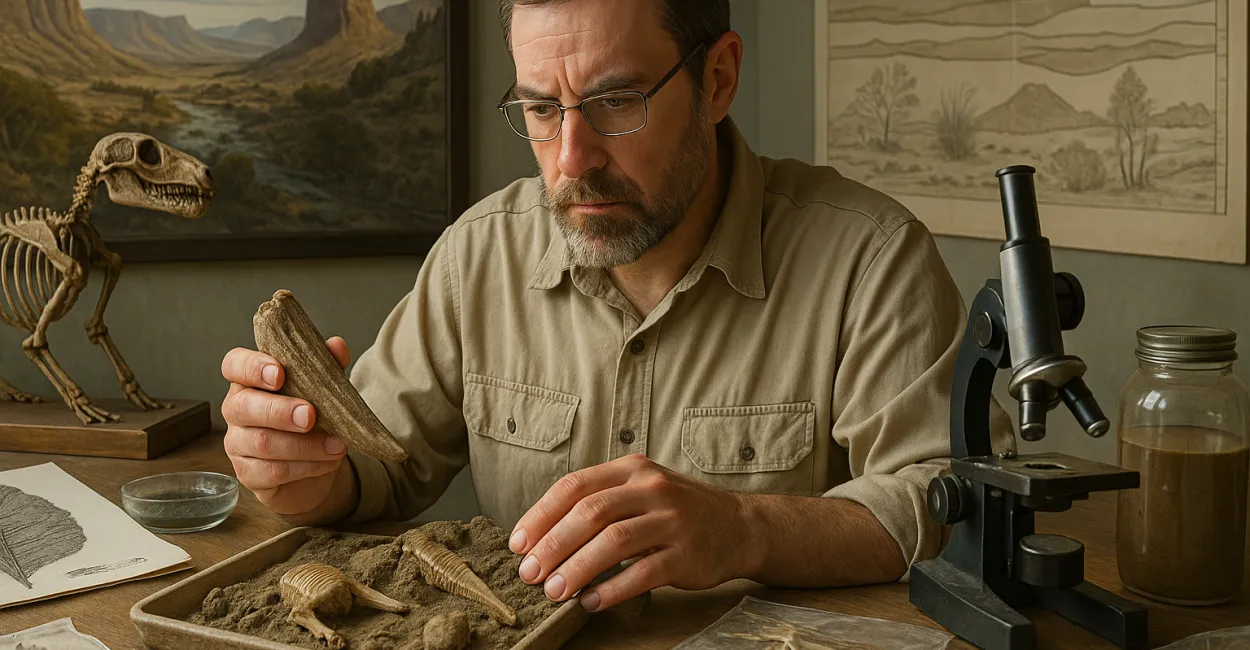
Fossils tell us more than just “what existed.” They record relationships, climate, vegetation, and even environmental crises that changed the history of life. Paleoecology brings these clues together to reconstruct ancient ecosystems using evidence such as sediments, organic remains, fossilized pollen, and microfossils.
This matters because the past holds patterns that remain useful today: responses to climate change, species expansion, ecological collapse, and environmental recovery. The focus here is straightforward: define the field precisely, show how it works in practice, explain which methods provide the most information, and show why reading the past helps us interpret the present.

What You Need to Know
- Paleoecology reconstructs ancient ecosystems from fossils, sediments, isotopes, and biological remains preserved in geological contexts.
- It does more than describe extinct species; it also estimates temperature, moisture, productivity, diet, and interactions between organisms and their environments.
- The field’s value lies in comparing past changes with current processes, especially those involving climate, biodiversity, and land use.
- Not every fossil record is complete: tropical environments and fragile organic materials tend to preserve poorly, so interpretations require caution.
- In many studies, the decisive evidence is not an isolated fossil but the whole picture: taphonomy, stratigraphy, dating, and sedimentary context.
Paleoecology and the Reconstruction of Past Ecosystems
In technical terms, paleoecology is the study of relationships between ancient organisms and their environments, based on records preserved over geologic time. Put simply, it seeks to understand how forests, lakes, deserts, shallow seas, and other past environments functioned—not just which organisms lived in them.
What It Investigates in Practice
The focus is not just on identifying fossil species. A good paleoecological study asks questions such as: Was the environment cold or warm? Were there seasonal droughts? Was the vegetation dense or open? Did animals live in groups? The evidence may include bones, teeth, pollen grains, microscopic charcoal, foraminifera, diatoms, and fossilized fish.
Anyone who works in this field knows that a single sample rarely tells the whole story. In practice, researchers combine multiple lines of evidence to arrive at a coherent interpretation.
If the sediment points to a lake environment but the fossils indicate strong marine influence, something about the depositional setting needs to be reconsidered.
Why This Interpretation Is Stronger Than a List of Fossils
A list of species tells you what was there. Paleoecology tries to explain how that system worked.
The difference may seem subtle, but it changes everything: the same organism can indicate different environments depending on the age of the rock, the sediment composition, and its place in the food chain.
What distinguishes a fossil inventory from a paleoecological interpretation is the ability to connect preserved remains to how the environment actually functioned.
For rigorous insight into this kind of reconstruction, resources such as Nature’s paleoecology topic page and academic geoscience centers often bring together studies using comparable methods and peer review.
Evidence Sources That Support Interpretation
The field’s strength comes from combining records. Each source provides a different kind of information, and each has limitations. That’s why serious studies rarely rely on a single line of evidence.
Macrofossils
Bones, teeth, shells, and fossilized trunks help identify organisms and estimate their ways of life. Teeth, for example, can suggest diet; shells can indicate salinity; and trunks can reveal vegetation type and even seasonal growth patterns. But preservation is uneven: what fossilizes well does not represent everything that once existed.
Microfossils and Pollen
Pollen, spores, foraminifera, and diatoms are valuable because they record environmental changes at high resolution. In lake and peat sediments, these remains often reveal shifts in vegetation and climate over thousands of years. Palynological research is, in practice, one of the cornerstones of this reconstruction.
Stable Isotopes and Geochemistry
Carbon and oxygen analyses in carbonates, teeth, or shells help researchers infer temperature, diet, and vegetation type. In some cases, the isotopic signal shows whether an animal fed in open or closed habitats, or whether available water had undergone substantial evaporation. This greatly expands what we can learn ecologically from the record.
Current climate data and historical time series, such as those compiled by NOAA, also help researchers compare past patterns with modern trends. The comparison is not perfect, but it is useful for testing hypotheses about biological responses to environmental variation.
Methods That Turn Traces into Robust Hypotheses

Paleoecological work begins long before the final interpretation. A well-described stratigraphic profile, consistent sampling, and reliable dating matter more than any compelling narrative. Without them, a study is vulnerable to errors of context.
Stratigraphy and Taphonomy
Stratigraphy organizes materials by their position in time and space. Taphonomy, in turn, examines what happened to an organism between death and preservation: transport, decomposition, fragmentation, and burial. This is crucial because a fossil may have been moved from the environment where the organism lived.
Read also: Biotechnology Cutoff Scores: How to Check and Understand Them
Dating and Temporal Correlation
Radiocarbon, luminescence, and other methods help place the record on a timeline. Without dating, comparisons between events lose precision. A fossil assemblage may appear to represent an entire community, but if the remains come from different time periods, the reconstruction can be misleading.
Modeling and Comparison with Modern Analogues
In many cases, an interpretation becomes stronger when researchers compare the past with similar modern environments. Floodplains, reefs, mangroves, and tropical lakes can serve as useful analogues. Still, this method has limits: the past is not a copy of the present, and forcing equivalences can distort results.
Comparisons with modern environments help us interpret the past, but they fail when researchers try to fit ancient ecosystems into current ecological categories without accounting for evolutionary and climatic differences.
Where Paleoecology Makes a Difference Beyond Academia
This field is not just about building ancient scenes for museums. It has implications for conservation, landscape management, and understanding long-term environmental change. When a current ecosystem is degraded, understanding its historical dynamics helps prevent decisions based on a “normal” state that never existed.
Conservation and Restoration
In ecological restoration projects, the paleobiological record can help answer questions such as what the original species composition was, which fire regimes were natural, and how the landscape varied before major human interventions. This is especially useful in regions where agriculture, mining, or urbanization has significantly altered vegetation.
Past Climate and Global Change
Long sedimentary records show how biodiversity and climate responded to warming, cooling, prolonged droughts, and sea-level changes. In debates about climate change, this kind of evidence helps avoid superficial interpretations. Earth has changed dramatically before, but the pace of change today is creating different pressures.
Natural Resource Management
In watersheds, coastal plains, and lake systems, paleoenvironmental reconstruction helps researchers understand sedimentation, erosion, salinization, and habitat shifts. This informs management and monitoring based on longer time series than instrumental measurements can provide.
For climate data and global context, the USGS and IBGE, Brazil’s national statistics and geography agency offer useful datasets when analysis requires linking environment, geography, and human impacts at a regional scale.
Limitations, Noise, and Common Interpretation Errors
This field is powerful, but it is no oracle. The biggest mistake is treating any fossil as direct and sufficient proof. Preservation selects what survives, creating bias: dry environments may preserve certain materials better, while humid forests encourage rapid decomposition.
The Record Is Never Complete
Gaps, contamination, sediment reworking, and weathering losses are all possible. In some cases, a fossil assemblage mixes organisms from different periods. In others, the absence of a taxon does not mean it did not exist; it may simply not have fossilized at that location.
Not All Evidence Points in the Same Direction
I’ve seen cases where sediment suggested a freshwater environment, but the microfossils indicated strong salinity. That doesn’t mean the study failed. Often, it points to a transitional system, such as a coastal lake subject to sea-level fluctuations. The inconvenient data are often the most useful.
Experts Do Disagree
There is genuine debate about which environmental proxies matter most in particular contexts. Some groups place more confidence in palynology; others prioritize isotopes or fauna. The choice depends on the research question, preservation, and timescale. No single method works everywhere.
A Concrete Example of Paleoecological Interpretation
In a sequence of lake sediments, a researcher finds an increase in microscopic charcoal, a decline in pollen from trees with dense canopies, and a rise in grains associated with grasses. At the same time, isotopes suggest greater seasonal variation in water availability. The most plausible interpretation is not simply “the vegetation changed”; rather, the landscape became more open, with recurring fires and a more pronounced dry season.
This kind of reconstruction changes the story of a place. A site that seems stable today may have gone through periods of intense disturbance, grassland expansion, and forest retreat. When the analysis is done well, the landscape stops being a backdrop and becomes a process.
In practice, a good paleoecological reconstruction does not look for a static past; it identifies transitions, disruptions, and patterns of change that help explain the present.
How to Read Studies in the Field Without Falling into Traps
When evaluating a paper, consider three points before accepting its conclusions. First: Is the geological context well described? Second: Does the dating support the proposed timescale? Third: Do the authors explain the limitations of their data, or claim certainty where there is only inference?
- Be wary of broad conclusions based on a few fossils or a single sample.
- Favor studies that combine taphonomy, stratigraphy, and environmental proxies.
- Check whether the study distinguishes direct observations from interpretive inferences.
- See whether the authors compare their findings with other similar sites or basins.
This simple filter helps avoid naive interpretations. In the science of the past, data rarely speak for themselves; they need context, method, and interpretive honesty.
Next Steps
If you want to understand the present more deeply, the best strategy is to look at long-term records, not just snapshots of today’s ecosystems. Paleoecology offers exactly that: a historical perspective that helps distinguish natural change, human impact, and long-term ecological responses.
The most useful next step is to seek out studies with strong datasets, explicit methods, and reliable sources, especially in academic journals and reputable institutions. To learn more, follow the work of museums, universities, and geoscience centers that study sedimentary records, palynology, and paleoclimatology.
Frequently Asked Questions
What’s the Difference Between Paleoecology and Paleontology?
Paleontology broadly studies fossils, including the classification, evolution, and anatomy of extinct organisms. Paleoecology focuses on the ecological and environmental relationships of those organisms. In other words, the first asks “who were they?” and the second asks “how did they live, and in what environment?”
What Materials Are Most Commonly Used in Paleoecological Studies?
The most common materials are macrofossils, pollen, spores, marine microfossils, shells, bones, teeth, and sediments. Stable isotopes and geochemical data are also frequently used. The importance of each material depends on the environment being studied and what has been preserved.
Why Is Taphonomy So Important?
Because it shows what happened to biological material before it became a fossil. Without this information, it is easy to interpret an organism outside its original context. A fossil transported by water, for example, may indicate an environment different from the one where the animal actually lived.
Can Paleoecology Help with Environmental Conservation?
Yes. It provides a historical baseline for understanding how an environment functioned before major changes. This informs ecological restoration, fire management, wetland protection, and the interpretation of climate impacts. It is a decision-making tool, not just a way to reconstruct the past.
Can This Type of Study Be Done Anywhere?
It works best where sediments are preserved and the geological context is clear. Highly erosive, hot, and humid environments can erase important evidence. Interpretation is still possible in these cases, but it requires greater caution and multiple lines of evidence.
Artigos Relacionados
 The Sleep Cycle: How to Understand and Maximize Its Benefits for School and Work
 Structural Racism: Understand It and Take Effective Action
 AI in Education: Exploring Philosophical Impacts and Challenges
 The Essential Role of Bees in Sustaining Ecosystems
 Quantum Computing: Understanding the Present and Future of Technology
 Social-Emotional Learning in Schools: Transforming Learning and Whole-Child Development
