
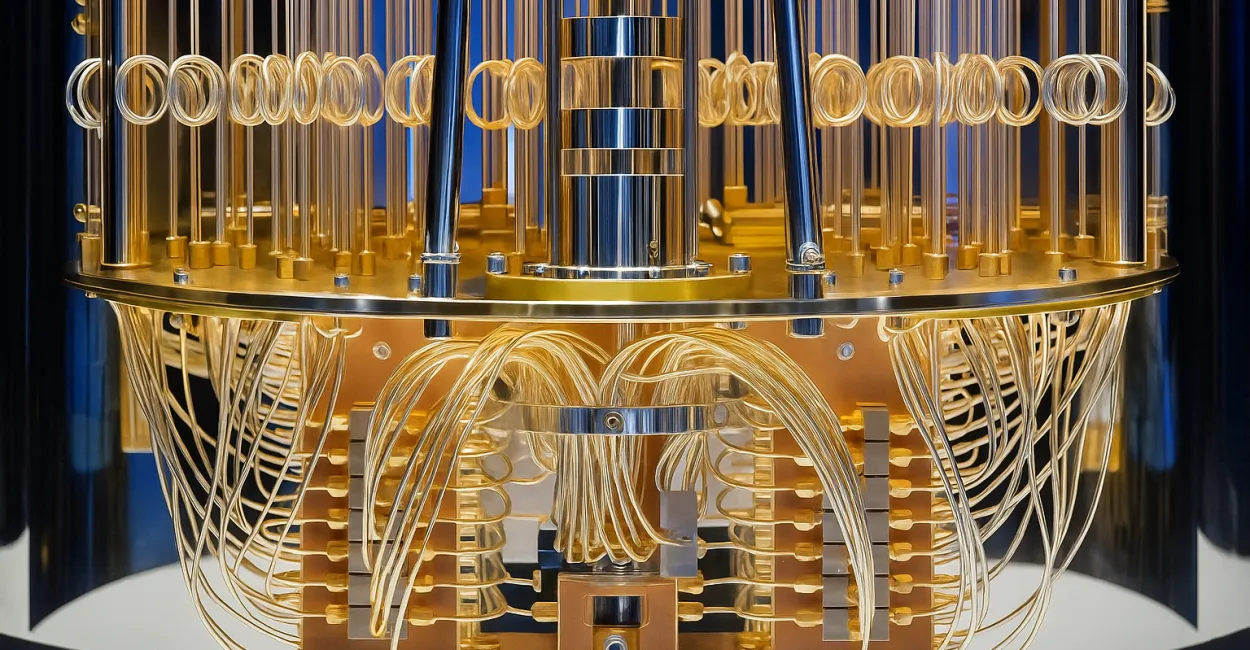
Quantum computing promises to solve certain problems differently from the computers we use today—not through “magic” or infinite speed, but by operating according to the rules of quantum physics. This changes how information is represented, possibilities are explored, and answers are found in fields such as chemistry, optimization, and cryptography.

The key point is simple: a quantum computer does not replace PCs, laptops, or classical servers. It comes into play when combining qubits, superposition, and quantum entanglement can dramatically reduce the computational effort required for specific tasks.
Here, you’ll learn what this means in practice, where the technology is already making a difference, and why it is still maturing.
The Essentials
- Quantum computers aren’t “turbocharged” versions of ordinary computers; they use qubits, which follow the laws of quantum mechanics.
- Real gains are possible for very specific problems, such as molecular simulation, cryptography, and certain types of optimization.
- Today, the technology still faces noise, costly error correction, and limited scalability.
- In practice, quantum computing is already useful for research and prototyping, but it is not yet a universal solution for everyday use.
- The future depends less on promises and more on engineering: stability, quantum gate fidelity, and error correction.
What Is Quantum Computing, and What Is a Quantum Computer?
Quantum computing is an information-processing model that uses quantum states to represent and manipulate data. Instead of bits, which can only be 0 or 1, it uses qubits, which can exist in combinations of those states until they are measured. Put simply, it harnesses the properties of matter at the atomic scale to compute in a different way. A quantum computer is a machine that implements this model. Depending on its architecture, it may use trapped ions, superconducting circuits, photons, or neutral atoms. IBM, for example, is one of the most visible companies in this field, while institutions such as the NIST work on standards, security, and the fundamental principles behind quantum technology.
Why It Matters
The goal isn’t to make everything faster. The value lies in certain problems where the number of possibilities grows explosively and a classical computer would have to test too many combinations. That’s where quantum approaches may offer an advantage.
Quantum computing’s advantage isn’t speeding up every task; it’s changing which kinds of problems can be handled efficiently.
How a Quantum Computer Works in Practice
In practice, a quantum computer prepares qubits, applies operations called quantum gates, and measures the result at the end. The process may seem abstract, but the logic is similar to an experiment: you configure the system, let the states interfere with one another, and read the probabilities of the possible outcomes. This is a matter of physical control, not just software.
From Physical State to Result
- Initialization: The qubits are brought to a known state.
- Manipulation: Quantum gates change amplitudes and phases.
- Interference: “Good” paths are amplified, while “bad” paths are partly canceled out.
- Measurement: The quantum state collapses into a classical result.
People who work in this field know that the real challenge isn’t the algorithm on the whiteboard; it’s keeping the system stable until measurement. A little thermal noise, a vibration, or a hardware imperfection can change the result. That’s why labs invest heavily in cryogenics, isolation, and calibration.
Google Quantum AI and IBM publish useful materials for understanding these architectures, and universities such as MIT and Oxford also have strong research groups in the field. This diversity exists because there is no single “ideal quantum computer”; there are competing technological approaches.
Qubits, Superposition, Entanglement, and Interference, Explained Simply

These four concepts are at the heart of the field. Once they make sense, the rest is much easier to follow.
Qubit
A qubit is the basic unit of quantum information. Before measurement, it isn’t limited to 0 or 1; it can be in a combination of both states, with different weights. This combination is described by amplitudes, which determine the probability of each outcome.
Superposition
Superposition is the property that allows a qubit to exist in multiple states at once until it is measured. This doesn’t mean “performing infinitely many calculations at the same time,” as exaggerated popular accounts often claim. It means the system keeps multiple possibilities available and manipulable before the final readout.
Quantum Entanglement
Quantum entanglement links the state of two or more qubits so that the state of one depends on the state of the other, even without a straightforward classical connection. It is one of the field’s most powerful resources because it creates correlations that do not exist between ordinary bits. Without entanglement, many quantum algorithms lose their power.
Quantum Interference
Quantum interference occurs when amplitudes add together or cancel out. In well-designed algorithms, incorrect answers tend to cancel out, while correct answers become more prominent. This is the elegant part of quantum computing: it doesn’t “try everything”; it organizes probabilities to favor the useful path.
Superposition creates room for possibilities; interference determines which possibilities survive; entanglement connects qubits in a way classical computers cannot reproduce as efficiently.
What Quantum Computing Is Used for Today
Today, quantum computing is used mainly for research, algorithm testing, and experimental solutions to specific problems. It is already being used to study molecules, evaluate combinatorial optimization, simulate materials, and investigate post-quantum cryptography. However, it has not yet replaced classical computing at scale in production.
Read also: Microcomputers: What They Are, How They Began, and Why They Changed Computing
Where It Makes the Most Sense
- Chemical simulation: Useful for understanding complex molecules and reactions that are difficult to model on conventional machines.
- Optimization: It may help with logistics, route planning, and resource allocation, although the gains depend greatly on the specific case.
- Cryptography: It threatens certain current methods and speeds up the search for protocols resistant to quantum attacks.
- Materials research: Important for batteries, semiconductors, and new compounds.
NASA and university research centers use quantum approaches in applied physics and modeling studies. The NIST, meanwhile, plays a major role in discussions about security and standardization, especially because the impact on cryptography is one of the field’s most serious concerns.
One important detail: not every “difficult” problem is a good candidate for a quantum computer. If a classical algorithm already solves the problem at an acceptable cost, a quantum system may offer no advantage at all. That’s one reason experts avoid making broad promises.
Real-World Quantum Computing Applications Across Industries
Quantum computing applications have moved beyond purely theoretical work, but they are still found more often in pilot projects than in widespread use. Real value emerges when a problem’s uncertainty, the number of possible combinations, or the need to simulate molecular behavior justifies the cost and complexity of the hardware.
Healthcare and Pharmaceuticals
Companies and labs are studying molecules to speed up drug discovery and understand chemical interactions. In these cases, accurately simulating a molecule’s quantum behavior may be more useful than adding brute-force computing power to traditional servers.
Finance
Banks and funds are exploring portfolio optimization, pricing, and risk analysis. That doesn’t mean a quantum computer can already find “the best portfolio” in real time; it means some models may benefit from new computational approaches in specific scenarios.
Logistics and Supply Chains
Routing, dispatch, and distribution problems are natural candidates. Anyone who has dealt with large-scale transportation knows that even small percentage improvements in routes and inventory can be worth a lot of money.
Energy and Materials
Modeling catalysts, fuel cells, and batteries is a promising area. The energy sector benefits when simulations of complex compounds become more accurate.
| Industry | Most Promising Use | Current Status |
|---|---|---|
| Healthcare | Molecular simulation | Research and pilots |
| Finance | Optimization and risk | Controlled testing |
| Logistics | Routing and allocation | Practical experimentation |
| Energy | Materials and catalysts | Highly experimental |
Here’s a concrete example: a research team wants to find a more efficient catalyst to lower the cost of hydrogen production. A classical model simulates part of the problem but hits a wall when faced with highly complex combinations. By testing a quantum approach, the team can explore a subset of the chemical space with greater accuracy. The result isn’t a miracle; it’s a strategic shortcut at a specific stage of the process.
Limitations, Challenges, and Why the Technology Is Still in Development
The main limitation of quantum computing today is noise. Qubits lose coherence easily, which affects the reliability of calculations. Also, the more qubits you add, the harder it becomes to keep the system stable, calibrated, and useful.
The Biggest Bottlenecks
- Decoherence: The quantum state degrades quickly.
- Error correction: Many physical qubits are needed to create one reliable logical qubit.
- Scalability: Increasing the number of qubits without losing quality is difficult.
- Cost and engineering: Cryogenics, control, and manufacturing are still expensive and delicate.
The American Physical Society and academic groups regularly publish discussions of these obstacles. The issue isn’t just “having more qubits”; it’s having better qubits, with enough fidelity to run long circuits without errors ruining the result.
Experts disagree about how quickly the field will advance. Some expect rapid progress in specific niches; others think broad usefulness will take longer than the market expects. That caution makes sense, because several impressive lab demonstrations have yet to translate into robust benefits beyond the lab.
The Future of Quantum Computing
The most plausible future isn’t a world dominated by quantum computers, but a hybrid ecosystem. Classical computing will continue to do most of the work, while quantum systems serve as specialized accelerators for high-value problems. This model is more realistic than any promise of total replacement.
What’s Likely to Happen First
- Better error correction and improved qubit fidelity.
- More use cases in chemistry, materials, and optimization.
- Integration with the cloud, enabling remote access to quantum processors.
- Growing pressure to migrate to post-quantum cryptography.
Progress also depends on hardware. Architectures such as superconducting qubits, trapped ions, and photons remain in competition because each solves part of the problem while creating other obstacles. In practice, the industry is still determining which approaches scale best.
Next Steps
If you want to understand the field from a market perspective, it’s worth following three areas at once: hardware research, applied quantum algorithms, and post-quantum security initiatives. Anyone evaluating the topic seriously should look for reproducible results, not just announcements of “historic milestones.”
The best use of your time right now is to study practical applications, compare what already works with what is still a promise, and follow reliable technical sources. The real value lies in distinguishing hype from useful capabilities—and that matters more than any spectacular prediction.
Frequently Asked Questions
What is quantum computing, in a nutshell?
It’s a computing model that uses qubits instead of bits. Qubits harness superposition, entanglement, and interference to handle certain problems differently from classical computing.
How does a quantum computer work?
It prepares qubits, applies quantum gates, and measures the result at the end. During the process, quantum states interfere with one another, increasing the chance of getting useful answers to specific problems.
Is quantum computing already being used in the real world?
Yes, but in a limited, experimental capacity. It is already being used in research, prototyping, and studies of chemistry, materials, optimization, and cryptography, without replacing conventional systems.
What problems does quantum computing solve best?
It tends to show the most promise in molecular simulation, factoring in certain contexts, combinatorial optimization, and the analysis of quantum systems. Performance depends on the algorithm and the type of hardware.
Why hasn’t quantum computing replaced ordinary computers?
Because qubits are fragile, noise is high, and error correction is still very costly. Most everyday tasks are also more efficiently handled by classical computers.
Is quantum computing a threat to current cryptography?
It could threaten some cryptographic systems in use today, especially those based on factoring and discrete logarithms. That’s why organizations such as the NIST are working on post-quantum cryptography standards.
%%AGPTRH8%%
Artigos Relacionados
 Microprocessors: History, Manufacturing, and the Future of Microchips
 Computer Scientist: A Complete Guide to Your Career and Future
 Microcomputers: What They Are, How They Began, and How They Changed Computing
 Paid Traffic Manager: A Complete Guide to This Essential Digital Marketing Career
 Data Scientist: A Complete Guide to Building a Successful Career
 Systems Analyst: A Complete Guide to the Modern Profession
