
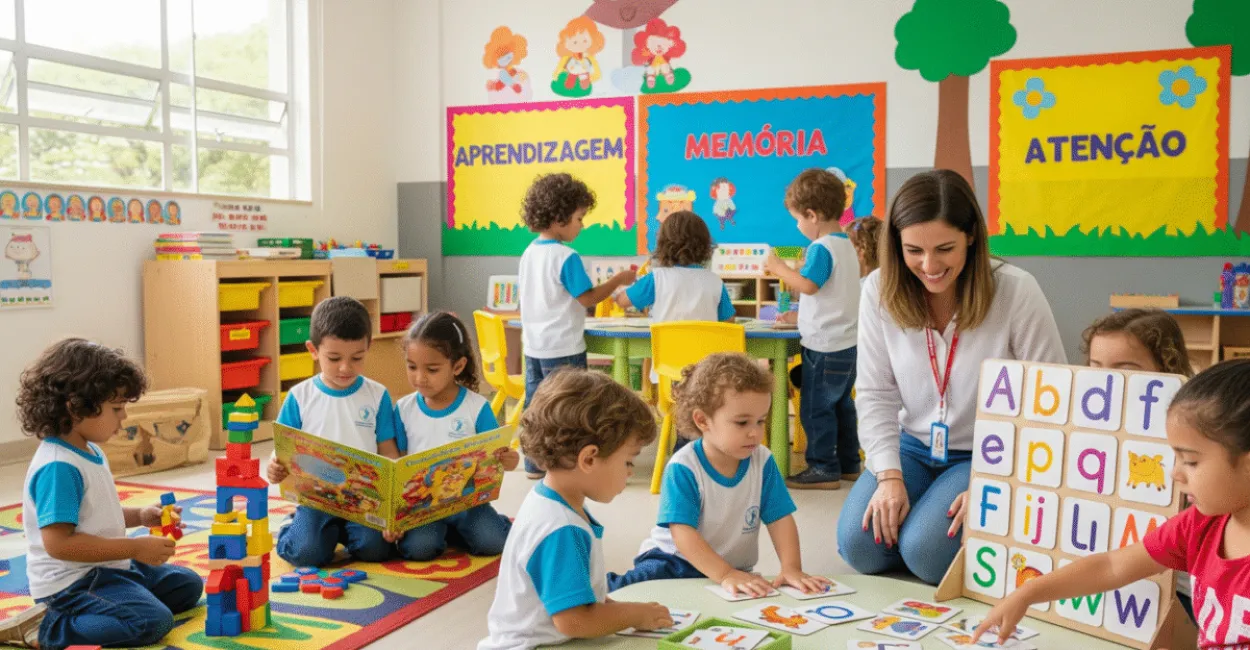
Early childhood learning is the process through which children develop essential cognitive, social, and emotional skills. Understanding how this learning works and why it matters helps educators and families create environments that effectively support early brain development.
Challenges such as inadequate stimulation, disorganized routines, or a lack of sensory experiences can limit children’s potential in their early years. By contrast, activities informed by neuroscience research increase neural plasticity, supporting memory, attention, and language. This article covers practices and routines that support early childhood learning, with practical strategies, comparison tables, and reliable references to guide education professionals and caregivers.

Environments that support early childhood learning
Organizing spaces for exploration
Creating rich, safe environments lets children explore freely and strengthens neural connections essential for attention and problem-solving. Spaces with a variety of materials—sensory toys, books, and hands-on resources—encourage curiosity and support cognitive development. A routine that combines free exploration with guided activities balances independence and instruction, supporting emerging executive functions. Incorporate visual, auditory, and tactile elements to promote working memory and sensory discrimination.
Teachers and caregivers should rotate materials periodically to keep things fresh and encourage ongoing learning, using observation to tailor challenges to each child’s ability level.
Lighting, sound, and emotional comfort
Environments with natural light, controlled noise, and welcoming spaces reduce stress and make children more mentally ready to learn. Emotional well-being regulates neurotransmitters that support sustained attention and memory consolidation. Small adjustments—such as cozy reading nooks and soft music during transitions—promote self-regulation and readiness for structured activities. Temperature and ergonomics also affect focus.
Building secure relationships with educators fosters confidence, creating a social-emotional foundation that enhances learning and supports the development of language and social skills.
Varied sensory materials
Multisensory resources (textures, colors, sounds, and scents) enrich early childhood learning experiences by stimulating different neural pathways and reinforcing memories through multiple associations. These stimuli are essential for selective attention and vocabulary development. Interlocking toys, blocks, musical instruments, and art activities engage motor coordination and spatial skills, while also promoting critical thinking through imaginative play.
Using open-ended materials allows for multiple answers and solutions, encouraging creativity and cognitive flexibility—executive function skills that support future academic success.
- Observe the child: Identify interests and skill levels through regular observation.
- Plan experiences: Set small, concrete goals before each activity.
- Introduce sensory activities: Use a variety of materials to stimulate multiple neural pathways.
- Repeat with variation: Reinforce learning with similar activities, gradually increasing complexity.
- Record and adjust: Track progress and adapt strategies based on each child’s responses.
Daily practices to strengthen early childhood learning
Predictable, secure routines
Clear, predictable routines help children anticipate what’s coming, reducing anxiety and freeing up cognitive resources for learning. Consistent daily structure builds habits of attention, working memory, and basic planning. Signaling transitions with songs, visual cues, or simple rituals makes it easier to switch activities and maintain the group’s focus. Adult support in explaining expectations improves self-regulation and cooperation.
Allowing some flexibility in routines helps meet individual needs, balancing security with opportunities for cognitive challenge.
Rich verbal interactions
Frequent conversations—with varied vocabulary, open-ended questions, and responsive feedback—support language development and semantic memory. Adult-child dialogue expands narrative skills and the ability to categorize. Shared reading and talking about everyday experiences build an understanding of cause and effect while enriching children’s vocabulary. Repetition in context helps consolidate learning.
Encouraging children to express their own thoughts develops executive functions, such as planning sentences and monitoring their speech.
Integrated movement activities
Movement and fine- and gross-motor play contribute to neural development and strengthen newly formed connections among the motor cortex, prefrontal cortex, and sensory areas. Coordination and rhythm support sustained attention and procedural memory.
Games that combine counting, rhythm, and spatial movement strengthen early math skills and spatial awareness. Incorporate music and dance to support timing and auditory memory.
Activities that involve handling objects improve inhibitory control and manual dexterity—skills essential for writing and future schoolwork.
Play-based activities that support early childhood learning

Symbolic and pretend play
Symbolic play supports executive function, language, and theory of mind by letting children represent and plan imaginary actions. Pretend play develops sequencing, problem-solving, and empathy.
Simple materials such as boxes, clothes, and everyday objects are enough to create rich scenarios. Adult guidance through questions and suggestions expands narrative complexity and vocabulary.
These games also build social skills as children practice roles and negotiate rules, strengthening communication and emotional self-regulation.
Building and hands-on play
Activities with blocks, puzzles, and construction sets promote spatial reasoning, persistence, and logical thinking. Building requires advance planning, weighing possibilities, and correcting mistakes, exercising working memory.
Gradually increasing difficulty and offering collaborative challenges encourage cooperation and discussion of strategies, building metacognitive skills. These practices also improve hand-eye coordination and understanding of cause and effect, key components of early math learning.
Attention and memory games
Activities that exercise short-term memory and selective attention—such as matching games, sound sequences, and working-memory games—strengthen neural circuits involved in academic learning. Keep these games brief and adjust their difficulty as needed.
Incorporate playful elements and positive feedback to maintain motivation; spaced repetition helps with long-term retention. Combine visual and auditory stimuli to support multimodal encoding.
Read also: Brain Plasticity in Learning: How to Accelerate It
Tracking progress makes it possible to adjust challenges and prevent frustration, promoting confidence and persistence.
Evidence-based educational interventions for early childhood learning
Early stimulation and structured programs
Early stimulation programs that combine responsive care, cognitive activities, and family support have been shown to affect language development and academic performance. High-quality, intensive interventions increase functionally relevant synaptogenesis.
Read also: Neuroscience and Learning: Insights to Enhance Your Learning
Integration with public policies and teacher training helps ensure sustainability. Standardized assessments and ongoing monitoring make it possible to measure effectiveness and adjust program components.
Prioritizing equitable access is essential, since the cumulative benefits are greatest when programs are offered in underserved communities.
Therapies and individualized support
Children with delays or neuropsychological risk can benefit from tailored interventions—speech-language therapy, occupational therapy, and cognitive training programs—to maximize brain plasticity in response to their environment.
Collaboration among schools, families, and specialized services makes it possible to develop an integrated plan with clear, measurable goals, helping children apply skills in everyday settings.
Ongoing assessments guide the intensity and focus of interventions, supporting better outcomes in language development and executive function.
Assessing and monitoring progress
Validated screening tools and ongoing assessments help identify needs and measure the effects of activities on early childhood learning. Systematic monitoring supports data-informed decisions and precise instructional adjustments.
Qualitative records (observations) and quantitative data (standardized tests) should complement each other to capture functional learning and the contexts in which skills are used.
Regular reports involve families and teaching staff, helping align strategies and carry skills over into children’s everyday lives.
Training educators to optimize early childhood learning
Training in child development
Teachers trained in brain development and early childhood learning principles are better equipped to plan activities that support plasticity and engagement. Ongoing training in applied neuroscience provides a foundation for effective instructional decisions.
Hands-on workshops and classroom supervision help educators apply theory in real-world settings and support continuous improvement. Peer collaboration encourages innovation and the refinement of practices.
Focusing on inclusive strategies ensures that children with diverse learning paces and styles are supported, broadening the impact of education.
Observation and reflective feedback
Systems for structured observation and instructional feedback help educators identify areas for improvement and adjust practices in real time. Group reflection on specific cases supports evidence-based professional learning.
Mentoring from experienced professionals helps educators adopt methods that support children’s attention, language, and self-regulation more quickly.
Documenting successful practices creates a collection of activities that can be replicated, improving the quality of instruction at scale.
Family-school partnership
Training families and educators in routines that support early childhood learning creates continuity between home and school. Simple strategies, such as bedtime reading routines or conversation games, extend the time children spend engaged in stimulating activities.
Regular meetings and helpful resources make it easier for caregivers to implement activities aligned with educational goals, strengthening relationships and creating a consistent learning environment.
This partnership also helps identify special needs early and make referrals, ensuring timely interventions.
Practical ways to assess the impact on early childhood learning
Observation metrics and records
Daily records of behavior, attention, and participation provide valuable information about the effects of interventions on early childhood learning. Standardized checklists and portfolios document progress in language, motor skills, and social skills.
Observations conducted over set periods make it possible to compare progress and adjust the intensity of activities. Involving families in documentation adds context and strengthens the validity of the measures.
Qualitative analysis complements numerical data, capturing nuances such as creativity and initiative that standardized tools may not measure well.
Standardized tests and screenings
Standardized assessments provide benchmarks for cognitive and language skills, helping identify gaps and monitor program effectiveness. Regular screenings detect risks early and guide targeted interventions.
Use tools appropriate for the child’s age and validated for their cultural context. Qualified professionals should interpret results, taking into account the child’s socioeconomic context and dominant language.
Combining tests with observation leads to better-informed, more individualized educational decisions.
Data analysis for continuous improvement
Collecting and analyzing data on the frequency, duration, and outcomes of activities makes it possible to adjust practices and maximize their impact on early childhood learning. Simple dashboard tools help schools and school districts track progress.
Case studies and comparisons across classrooms help identify the most effective components of interventions, making it easier to scale successful practices.
Transparent data and information-sharing among professionals foster a culture of continuous improvement and educational accountability.
Conclusion
Evidence-based activities and routines strengthen early childhood learning by supporting executive function, language, and emotional well-being. Rich environments, responsive interactions, and ongoing assessment are essential to supporting early brain development.
Professionals and families can use simple, scalable practices to improve outcomes and promote educational equity. Try the suggested strategies and track children’s progress with regular records.
Frequently asked questions about early childhood learning
What is early childhood learning, and why is it important?
Early childhood learning refers to the processes through which children develop cognitive, social, and emotional abilities in their early years. It matters because experiences during this period shape neural circuits that support attention, language, and self-regulation. Early interventions and rich environments increase plasticity, improving future outcomes at school and in social life while reducing the risk of developmental delays.
Which daily activities have the greatest impact on cognitive development?
Activities that combine verbal interaction, symbolic play, handling objects, and movement have the greatest impact on cognitive development. Shared reading, memory games, pretend play, and fine-motor tasks stimulate language, working memory, and executive function. Repetition with variation and adult involvement make these practices more effective.
How can you measure progress in early childhood learning without invasive tests?
Observations, portfolios, skill checklists, and behavior records provide noninvasive indicators of progress. Regular screenings and age-appropriate assessments help identify needs. Combining qualitative and quantitative data and consulting specialists when needed supports more precise intervention planning that respects each child’s development.
What role does family play in early childhood learning?
Families are essential: safe environments, rich conversations, and daily activities such as reading and play strengthen early childhood learning. Consistency between home and school creates more opportunities to practice and reinforce skills. Equipping caregivers with simple strategies and providing community support maximizes benefits and helps educational practices continue over time.
When should you seek specialized interventions?
Seek a specialized evaluation if delays in speech, social interaction, attention, or motor skills persist, or if caregivers continue to have concerns. Early interventions (speech-language therapy and occupational therapy) are more effective when started promptly, so timely screenings and referrals improve the chances of recovery and functional learning.
References and further reading: World Health Organization, UNICEF, and studies published in journals such as PubMed/NCBI.
Artigos Relacionados
 Collaborative Learning in Early Childhood Education
 Early Childhood Education: The Importance of Play in Child Development
 How to Introduce Literacy in Early Childhood Education
 Active Learning Methodologies in Teacher Education: How to Apply Them
 Entrepreneurship for Young Children: Early Childhood Activities
