
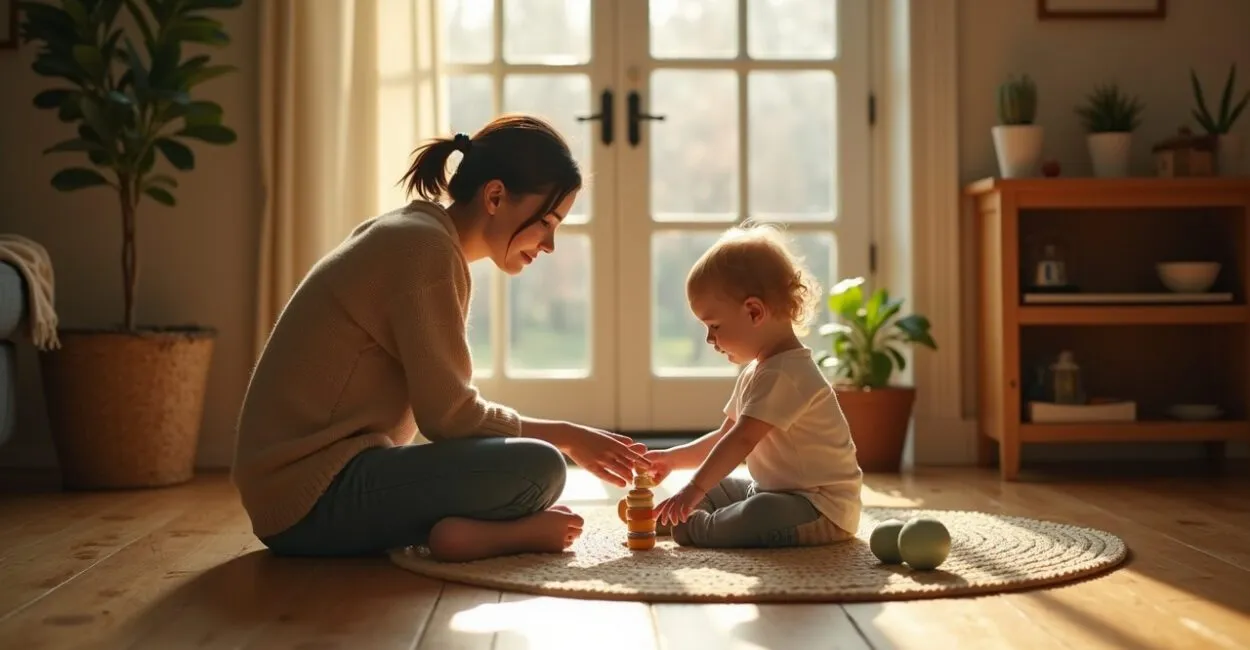
These are intentional play-based activities that prioritize verbal interaction between adults and children to encourage speech production and comprehension. They combine conversational turn-taking, repetition, word models, and visual or tactile support to create natural language opportunities throughout the day. In short, any brief, repeatable game whose main goal is to build vocabulary, sentence structure, joint attention, and communicative intent counts.
Key Takeaways
- Language-building games work best when they’re brief, repetitive, and part of the daily routine. This increases children’s exposure to speech and makes it more likely they’ll use what they learn in other settings.
- Simple activities with household objects provide context without overwhelming children. The quality of verbal interaction—responding, expanding, and modeling—is more effective than expensive materials.
- Adapting activities to a child’s age (0–6, 6–12, or 12–24 months) changes the goals and strategies. Setting clear age-specific goals makes progress easier to track.
- Responsive adult interaction—following a child’s interests, pausing, and asking open-ended questions—makes it three times more likely that children will use new words than direct commands do.
Why Language-Building Play Helps Babies Talk Sooner
Language-building games create small learning environments where language input is relevant and responsive. Unlike passive exposure, games invite children to respond through eye contact, turn-taking, and immediate reinforcement.

These features activate social and statistical learning mechanisms that accelerate the acquisition of sounds, syllables, and words.
The Neuroscience Behind It
Brain imaging shows that social responsiveness activates language and reward areas in children’s brains. Quick caregiver responses increase dopamine release, helping children form sound and meaning associations.
In practical terms, the same word has a greater impact when used in an interactive context than when said in a monotone voice.
Practical Tips
So, prioritize games with short turns, rhymes, and repetition. Even five minutes, three times a day, provides more high-quality language exposure than long, noninteractive reading sessions.
Work rhymes into diaper changes, sing songs during bath time, and name objects during everyday activities.
10 Easy Games Using Household Items
Here are 10 tried-and-tested activities to encourage speech in babies and young children. Each game uses simple items: cloths, plastic cups, small boxes, dolls, and songs.
Each activity includes goals and adaptations for different age groups.
- Sound Bath — Make sounds with cups and spoons, and name them.
- Surprise Box — Take objects out of a small box and name them.
- Word Wheel — Spin a cloth with pictures on it and say the name of each picture.
- Word Chase — Hide a toy and encourage the child to ask for it.
- Rhyme Echo — Rhyme syllables and encourage the child to echo them.
- Storytelling Doll — Use a doll to model simple sentences.
- Texture Book — Feel different textures and say the word for each one.
- Sound Kitchen — Pretend to cook, make sounds, and name the actions.
- Car Lineup — Line up toy cars and name their colors or actions.
- Cup Phone — Have a “phone” conversation, pausing and asking questions.
Adapt each activity to the child’s abilities: use fewer words for ages 0–6 months and introduce longer target phrases for ages 12–24 months. See the comparison table below.
| Activity | Goal | Suggested age range |
|---|---|---|
| Sound Bath | Sound imitation; joint attention | 6–12 months |
| Surprise Box | Naming objects; comprehension | 9–18 months |
| Storytelling Doll | Modeling sentences; turn-taking | 12–24 months |
How to Adapt Activities for Different Age Groups

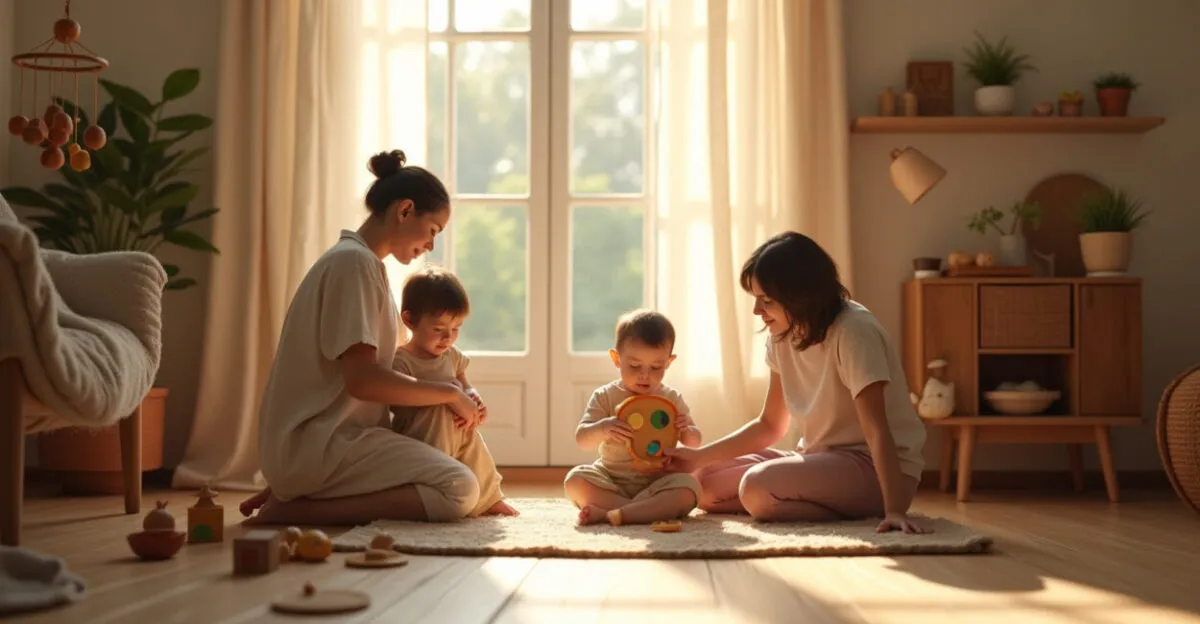
Adapting the same game means adjusting its complexity, duration, and verbal demands. The key is to fine-tune three factors: the target language level (sounds, words, or sentences), visual or tactile support, and how long to wait for a response. With the right modifications, the same activity can work for children from 6 months to 2 years old.
0–6 Months
Focus on eye contact, sound imitation, and simple syllable patterns. Use plenty of repetition and predictable routines. Goal: build social attention and awareness of speech patterns.
6–12 Months
Introduce named objects and peekaboo-style games. Wait for vocalizations and offer short language models. Goal: build comprehension and encourage the first intentional words.
Read also: Child Language Development: Stages and Ways to Encourage It at Home
12–24 Months
Encourage two-word combinations, back-and-forth exchanges, and simple questions. Build themed vocabulary (food, family, actions). Goal: increase spoken language and help children combine words.
Adult Strategies to Maximize Learning During Play
Effectiveness depends heavily on how adults respond. Strategies such as expanding on a child’s words, repetition, modeling, and intentional pauses create learning opportunities. The quality of verbal input—intonation, focus on the object, and timing—matters as much as the amount.
Read also: Language Development in Children Ages 0–6: Stages and Ways to Encourage Speech
Expansion and Modeling
When a child says “ball,” an adult might respond, “Yes, a big ball!” That’s expansion. Modeling provides a target phrase that’s slightly more complex. Both approaches increase the chances that children will use language patterns in other situations.
Pauses and Open-Ended Questions
Intentional pauses give children a chance to respond. Open-ended questions (where/who/what) are more effective than commands because they encourage spontaneous speech. Always use gestures to help prevent frustration.
Common Mistakes and What to Avoid
Some common mistakes can limit language development: talking too much without giving children a chance to respond, correcting words immediately, and using language that’s too complex or overly childish. Recognizing and correcting these mistakes makes language-building play more effective.
- Don’t correct; rephrase instead (“cat” → “Yes, the cat is meowing”).
- Avoid asking one question after another without pausing—give children time to process.
- Avoid multitasking; divided attention gets in the way of learning.
These adjustments are simple, but they can make a difference quickly when applied consistently.
Tracking Progress and Knowing When to Seek Professional Help
To track progress, set measurable goals: the number of spontaneous words used each week, increases in word combinations, and understanding of simple directions. Record short videos each week to compare. Seek an evaluation from a speech-language pathologist if there’s no progress after 6–8 weeks of consistent practice.
Warning Signs
No babbling by 10 months, fewer than 10 words at 18 months, or loss of skills are signs that a child may need support. Public services and university clinics offer screenings. For guidance on accessing services, consult resources such as Brazil’s Ministry of Health (the national health agency) or ABORIGINAL (a Brazilian resource), for example, the Ministry of Health.
References and Further Reading
Recent research on responsive interaction and child language includes work by Roy et al. (2015) on social contingency and data from IBGE (the Brazilian Institute of Geography and Statistics) on family exposure. For clinical protocols, consult speech-language pathology guidelines from university institutions (SciELO).
Next Steps for Putting These Ideas into Practice
Start by choosing three games from this list and playing for five minutes, three times a day, for eight weeks. Focus on responsive interaction: wait, expand, and repeat. Record short videos every two weeks and compare one simple measure: the number of spontaneous words used during two minutes of play.
If progress is limited, write down examples and seek an evaluation from a speech-language pathologist. Small changes in adult behavior can lead to big gains in a short time. Make play predictable, enjoyable, and part of the family’s routine.
How Do I Choose the First Three Games to Try Today?
Choose activities that use objects your child already knows and fit into your daily routine. Prioritize one routine-based game (such as a song at bath time), one object-naming game (like a surprise box), and one that encourages turn-taking (like a cup phone). Keep sessions short, play three times a day, and record 1–2 videos each week to track your child’s responses. Avoid introducing more than three new routines at once so you can stay consistent and give your child time to learn.
How Often Should Parents Play These Games to See Results?
To see measurable changes, aim for three daily sessions of 5–10 minutes each for at least eight weeks. Frequent practice encourages repetition and learning without overwhelming your child. Short, consistent sessions work better than long, occasional ones. Track progress every two weeks and adjust your goals: focus on comprehension first, then spoken language. If there’s no progress after eight weeks, document examples and seek help from a speech-language pathologist.
How Can I Tell if a Game Is at the Right Challenge Level?
A good challenge level leads to frequent responses, mild frustration paired with attempts at communication, and renewed interest after a pause. If your child never responds, make the activity easier: use fewer target words and add more gestures. If they respond easily, make it more challenging with longer phrases or open-ended questions. Tracking interactions—such as the number of turns per session and variety of words—provides objective information to help you adjust the level.
How Can I Involve Other Caregivers (a Parent, Grandparents, or Daycare Staff) in Language-Building Play?
Show caregivers three key strategies: follow the child’s interests, pause to allow a response, and expand on the child’s speech instead of correcting it. Demonstrate a short play session and share simple goals (for example, “today, let’s encourage two new words”). Use short videos as examples and set regular times to help everyone stay consistent. When all caregivers use the same strategies, children get more language exposure—and better-quality interactions.
When and How Should I Seek a Speech-Language Evaluation?
Seek an evaluation if your child isn’t babbling after 10 months, has fewer than 10 words at 18 months, loses skills, or has significant difficulty understanding language. Bring objective records: videos of play, lists of words your child uses, and how often you practice. A speech-language pathologist will administer standardized tests, observe interactions, and recommend specific goals or direct intervention. Referrals through public health centers or university clinics may help reduce costs.
Artigos Relacionados
 Creative Play: 8 Activities That Inspire Creativity
 Play-Based Activities for Elementary Education
 Financial Literacy Activities for Kids at School
 Supporting Oral Language Development: Ages 0–5
 Play at School: Bringing Free Play Into the Early Childhood Curriculum
 Parents and Play: A Guide to Encouraging Playful Freedom
