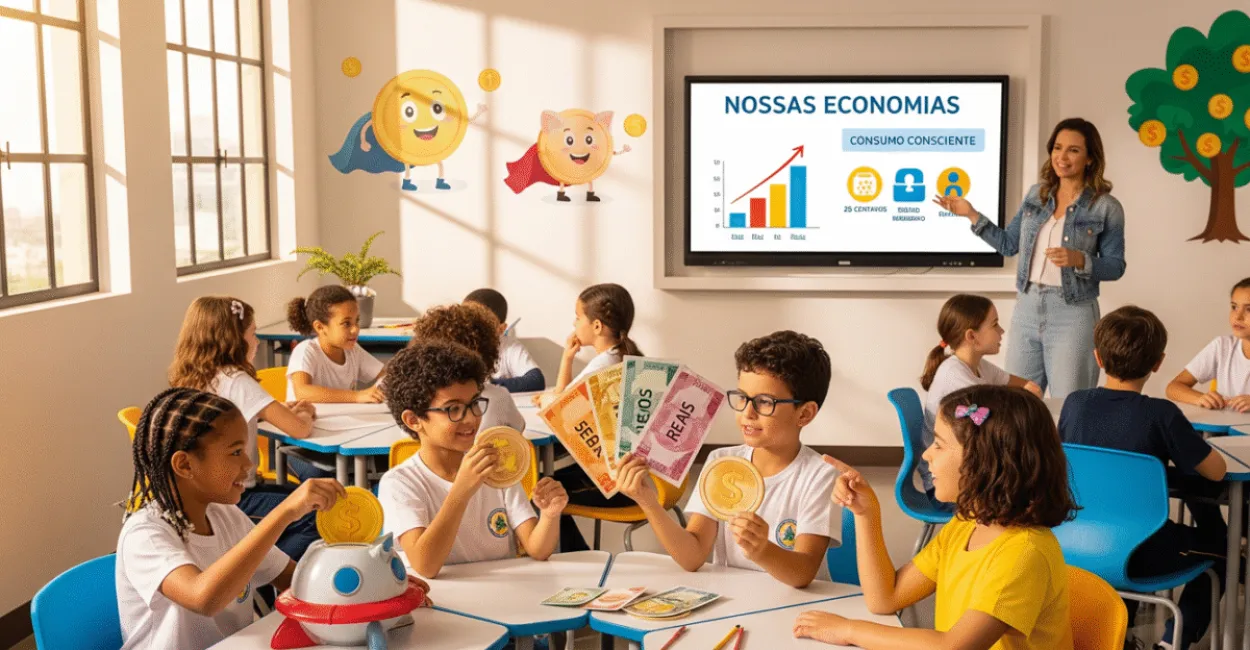
A child who learns to tell wants from needs isn’t “dealing with money” too early; they’re developing self-control, reasoning skills, and a sense of priorities. That’s how financial literacy for kids works: it turns everyday situations—buying, saving, waiting, comparing, and choosing—into practical lessons about value and consequences.
At school, this topic gains traction because it moves beyond abstract talk and becomes hands-on experience. When students run a mock store, set savings goals, or examine spending choices, money stops feeling like a distant subject and becomes a learning tool.

Below, you’ll find activities you can use right away, the principles behind them, and tips for avoiding a narrow focus on “piggy banks and allowances.”
What You Need to Know
- Financial literacy in childhood isn’t about talking investments; it’s about teaching decision-making, limits, planning, and responsibility with finite resources.
- Activities work best when they involve comparing, choosing, and dealing with consequences—not just counting coins or decorating piggy banks.
- Content needs to change with age: young children learn through concrete experiences, while older kids can start working with budgets, goals, and trade-offs.
- School projects have more impact when they connect money to math, mindful consumption, citizenship, and family routines.
- This kind of teaching falls short when it becomes moralistic (“spending is wrong”) or ignores families’ economic realities.
How to Bring Financial Literacy for Kids Into the School Day Without Turning It Into a Lecture
Technically speaking, financial literacy is the process of developing skills to make informed decisions about using, spending, saving, and planning resources, as well as managing risk. In childhood, that means translating these concepts into situations children can see, experience, and revisit.
Kids don’t need to master compound interest yet. They need to understand that resources are limited and every choice means giving something else up.
In practice, schools have a major advantage: they can set up experiences that families may not always be able to create at home. Teachers provide the context, observe how students respond, and adjust the challenge. That’s where games, stories, and simulations come in. Anyone who works with kids knows that learning happens when a child has to make a decision, not just listen to an explanation.
What makes a financial activity useful rather than generic isn’t the money itself—it’s the quality of the decision the child has to make.
What to Teach First
Before talking about saving, introduce three basic ideas: money doesn’t come from nowhere, choices have a cost, and goals take time. These three ideas lay the groundwork for everything else.
Without them, a child can play store without understanding what the game is meant to teach.
What Often Falls Short
A lesson that only asks kids to color coins or fill out worksheets doesn’t build understanding. It’s also unhelpful when a school sends the message that “saving” is the only right thing to do. In many households, real life calls for prioritizing, negotiating, and waiting—not just saving. Teaching needs to acknowledge that.
For background as you plan, consult resources from the Banco Central do Brasil (Brazil’s central bank) on financial citizenship and the website of the Secretaria Nacional do Consumidor (Brazil’s National Consumer Secretariat), which offers useful information on consumer issues and protection. For a broader perspective, the OECD publishes research on financial literacy and related skills.
Activities for Ages 3 to 6: Hands-On Learning, Repetition, and Simple Language
At this age, the goal isn’t to “teach budgeting.” It’s to help children recognize value, choice, and counting in familiar situations. Activities should be visual, tactile, and brief. The more abstract the idea, the less likely they are to remember it.
Play Store With Guided Choices
Set up a stand with plastic fruit, empty packages, and simple price tags. Give children pretend money and ask them to buy just a few items.
The point isn’t to get the change right; it’s to see that you can’t take everything.
A Piggy Bank With a Picture Goal
Instead of using a piggy bank without a purpose, draw a specific goal: a toy, a book, or an outing. Children can add a sticker each time they “save” a token.
Read also: Financial Literacy for Young People: A Complete Guide to Building a Secure Future
Visual cues are much more effective than long explanations.
Stories About Choices and Consequences
Tell short stories about a character who has to choose between spending now or waiting to get something bigger. Ask children what they would do. At this stage, the value is in the conversation, not in finding the “right” answer. An early childhood teacher often sees this in the first week: when a child realizes they have only three tokens to buy five items, frustration becomes a learning opportunity. After a couple of rounds, they start asking, “If I buy this, will I still have enough for that?” That’s when the concept starts to take shape.
Activities for Ages 7 to 9: Comparing, Setting Goals, and Starting to Plan

At this age, children can follow clearer rules, keep track of their choices, and think in steps. It’s a great time to introduce lists, small goals, and prioritizing. A common mistake is underestimating this age group: kids can handle more than many people think.
Read also: Saving for Kids: 5 Easy Goals That Work in 2025
Wish List With Priorities
Ask each student to write or draw three things they want: one they really want, one that can wait, and one they may not need that much. Then discuss why they put them in that order. This exercise builds decision-making skills, not just consumer habits.
Swap Meet
Set up an activity where students can trade stickers, school supplies, or duplicate cards according to a set of rules. They’ll see that value isn’t fixed; it depends on interest, supply, and context. It’s a safe introduction to trading and negotiation.
Weekly Goal Tracker
Create a progress chart for simple goals: saving tokens, avoiding impulse buys during the activity, or completing tasks to earn points. The key is to make progress visible over time. Kids this age respond well to clear milestones.
Activity
Main skill
What to look for
Wish list
Prioritizing
Whether the child can distinguish an immediate want from a bigger goal
Swap meet
Negotiation
Whether they can explain a trade with a reason
Weekly goal
Planning
Whether they track progress without giving up halfway
Financial planning for kids doesn’t start with big numbers; it starts when a child learns to wait for something they want.
Activities for Ages 10 to 12: Budgets, Opportunity Cost, and Independence
At this stage, students can work with more realistic choices. You can introduce budgets, unit prices, recurring expenses, and opportunity cost—that is, what you give up when you choose one option over another. Lessons get much more engaging when students have to explain their decisions, not just carry them out.
Field Trip Budget
Plan a mock field trip, picnic, or science fair. Give students a total budget and prices for a few items: snacks, transportation, souvenirs, water, and shared supplies. The group has to put together a plan without going over the limit.
“Mini-Business” Project
A class can sell bookmarks, decorated planters, or simple snacks as part of a supervised activity. The goal isn’t profit for its own sake; it’s to understand costs, revenue, and what’s left over. Teachers need to provide clear guidance so the project doesn’t turn into cutthroat competition.
Practice Expense Spreadsheet
Create a mock month with weekly income, fixed expenses, and unexpected costs. Students see that money doesn’t “disappear” by magic; small expenses add up. This kind of exercise often sparks a meaningful conversation about everyday decisions.
There’s an important nuance here: this approach works well when students can handle abstract thinking, but it falls flat if introduced too early. Pushing a complex budget on children who haven’t mastered comparison and sequencing only creates confusion. Age-appropriate progression isn’t a minor teaching detail; it determines whether an activity teaches something or just fills time.
How to Build a Lesson That Teaches, Not Just Entertains
An effective lesson has three parts: context, decision-making, and reflection. Without context, the activity is just play. Without a decision, it’s just make-believe. Without reflection, the learning doesn’t stick.
A Practical 40- to 50-Minute Lesson Plan
- Brief introduction: Present a concrete situation, such as making a purchase with limited money.
- Guided activity: Let students choose, trade, compare, or plan.
- Wrap-up discussion: Ask them to explain why they made those choices and what they might do differently.
Meaningful Assessment Criteria
- Can identify a need and a want in a realistic situation.
- Can explain why one choice is better than another within a set limit.
- Uses language about goals, priorities, and consequences more independently.
For a more objective measure, pay attention to the words students use by the end of the unit. When a child starts saying “save it for later,” “I can’t take everything,” or “I chose this because I’ll have more left over,” the lesson has moved beyond the abstract. That matters more than any worksheet filled out just to check a box.
Getting Families and Teachers on the Same Page
Schools teach more effectively when families reinforce the message, and families can help more when schools avoid creating guilt. That alignment matters. If students learn that every purchase is impulsive, but no one at home talks about priorities, the lesson’s impact quickly fades.
What Families Can Reinforce
- Put everyday choices into words: buying, waiting, trading, and saving.
- Show how to compare prices, sizes, and usefulness in simple situations.
- Avoid using money as a threat or constant reward.
What Schools Should Avoid
Don’t assume every child has the same financial circumstances. Some families can use allowances and savings goals; others have tight budgets and unpredictable incomes. The same activity can work well for one group and be a poor fit for another if it isn’t handled with social awareness.
It also helps to take a broader look at consumer education and financial citizenship resources. Brazil’s INEP (National Institute for Educational Studies and Research) and educational research institutions have found in various studies that applied skills tend to stick better than material taught only through lectures. This is especially clear with money: knowing a formula isn’t enough if a child can’t recognize when to use it.
Next Steps for Bringing the Topic Into the Classroom
If schools want meaningful results, they need to stop treating this as a one-off activity and start teaching it as a sequence. A good learning path includes repetition, gradually increasing complexity, and real-life connections. That’s what turns a fun activity into lasting learning.
The smartest next step is to choose an age group, identify one core skill—prioritizing, waiting, budgeting, or negotiating—and run one activity a week for a month. Then compare students’ behavior at the beginning and end. That observation is worth more than a polished lesson with no connection to real life.
Frequently Asked Questions
What’s the Best Age to Start?
You can start in early childhood education as long as the focus is on concrete experiences: simple choices, counting, and the relationship between wants and limits. There’s no point in introducing complex concepts too early. Progress should match the child’s cognitive development.
Does an Allowance Help Kids Learn?
It can, when paired with guidance and clear goals. Without discussion, an allowance is just money handed over. Learning happens when a child has to decide what to do with it.
Should You Talk to Kids About Investing?
Not at first. Children need to understand budgeting, spending, saving, and opportunity cost first. Investing can come later, once they understand how goals and timelines work.
How Can You Keep an Activity From Becoming Just Play?
Build in a real decision, even if it’s symbolic, and end with reflection. Children need to choose, explain their reasoning, and reconsider their choice. Without that cycle, the activity lacks depth.
Does This Kind of Teaching Work in Every Family Setting?
It works best when it reflects the realities of the students. Families with unstable incomes, for example, need approaches that are less judgmental and more focused on priorities and mindful spending. Adapting the lesson is part of the method, not an afterthought.