

This refers to a set of practices—reading aloud, handling books, singing, and playing with words—for children ages 0 to 5, with the goal of stimulating language, attention, and emotional bonding. In essence, it’s not just “reading to a child”; it’s creating repeated opportunities for verbal and sensory interaction that turn words into meaning, memory, and active speech.
The practical benefits are twofold. First, neuroscience evidence and longitudinal studies show that rich language exposure in the early years predicts vocabulary development and later reading skills. Second, simple interventions at home and in child care can lead to measurable gains in spoken language and school readiness. This article covers the basics, techniques, and age-specific applications, with practical guidance and references from recognized organizations.

Key Takeaways
- Regular reading to babies builds receptive and expressive vocabulary and supports early literacy; longitudinal studies have found effects as early as 24 months.
- Interactive reading—asking questions, pausing, and inviting children to repeat—turns passive exposure into active spoken language.
- Techniques and materials should match each stage of sensory development: high-contrast, tactile, rhyming, and short-story books serve different purposes for ages 0–6 months, 6–12 months, 1–3 years, and 3–5 years.
- Bonding and routine are essential: reading at a predictable time boosts attention and helps children learn key words.
- Professionals and families can set simple, measurable goals: minutes of reading per day, new words introduced, and frequency of interactive reading.
Why Reading to Babies Builds a Foundation for Vocabulary and Speech
Reading to babies creates a structured language environment, exposing children to a wider range of words and sentence patterns than everyday conversation. Books introduce less common words, prosodic patterns, and narrative structure—elements a developing brain uses to map sounds to meaning.
Studies show that children who hear more words and are read to aloud have larger receptive and expressive vocabularies at 24 and 36 months, which is associated with later reading skills.
How Reading Expands Vocabulary
Books contain words that are less common in everyday speech, including descriptive terms, names, and a variety of verbs. By hearing them repeatedly, babies connect sounds with visual and emotional contexts. Spaced repetition during regular reading improves retention. In addition, a reader’s prosody signals sentence boundaries and stress, helping children break continuous speech into words.
From Exposure to Expression: How Reading Encourages Speech
Interactive reading encourages children to imitate and speak: strategic pauses and simple questions invite responses, while children who finish refrains or repeat words strengthen their spoken language. This cycle—exposure, imitation, reinforcement—is what turns receptive vocabulary into words children use themselves.
How Reading Strengthens Bonding and Emotional Self-Regulation
Reading together combines physical closeness, eye contact, and a gentle voice—all central to emotional regulation. Short, predictable sessions lower cortisol in distressed babies and increase behaviors that seek closeness.
Bonding and emotional security make verbal exploration easier: children who feel safe tend to vocalize more and try new words.
Routine and Predictability: Creating a Safe Setting
Reading at regular times—before a nap or after bath time, for example—creates a contextual cue that helps children get ready to pay attention. Knowing what to expect reduces resistance and encourages cooperation.
Book rituals also make transitions easier—for example, closing the book as a signal that storytime is over—which helps children develop behavioral self-regulation.
Leia também: Children’s Memory: Activities to Train and Develop It
When Reading Helps Reduce Stress
Reading in a calm, slow voice can help settle very active children. Content matters, too: short stories with happy endings and relatable characters can ease anxiety and open up conversations about emotions, building emotional vocabulary.
Interactive Reading Practices That Encourage Children to Speak

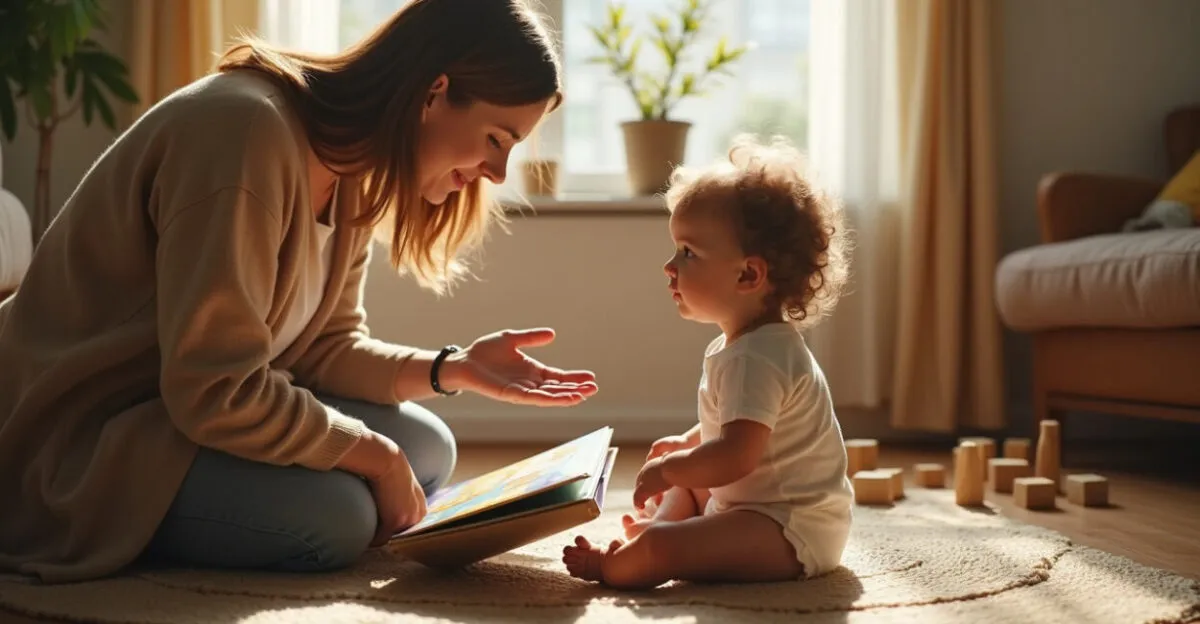
Interactive reading turns adults into conversation partners, not just storytellers. Techniques such as “intentional pauses,” “recasting” (rephrasing a baby’s error correctly), “echoing” (repeating and expanding on a vocalization), and open-ended questions prompt longer responses and a wider vocabulary. These practices have shown benefits in early interventions designed to improve speech among at-risk populations.
Pauses and Prompts: Encouraging Children to Speak
Pausing on purpose after a key phrase invites children to finish the sentence. For example, pausing after “The dog barks because…” gives a child a chance to respond. Short pauses (1–2 seconds for babies, 3–5 seconds for older children) are enough. Reinforce responses with praise and an expanded reply that models correct sentence structure.
Read also: 10 Philosophy Books
Recasting and Expanding: Correcting Without Interrupting Learning
When a child says “big dog,” an adult can respond, “Yes, the dog is really big and fluffy.” This technique corrects the form without dismissing what the child said. Language therapy studies show that frequent recasts improve grammatical accuracy and sentence length in the following months.
Choosing Books by Age: What to Pick and Why
Books should match children’s sensory and cognitive abilities at each stage. The wrong choice can reduce engagement; the right one maximizes attention and repetition. The table below summarizes book types, primary goals, and practical examples for each age group.
| Age | Type of book | Primary goal | Practical example |
|---|---|---|---|
| 0–6 months | High-contrast images, textures | Stimulate visual attention and touch | High-contrast cards, cloth books with tags |
| 6–12 months | Rhymes, repetition, and flaps | Rhythm, predictability, and cause and effect | Lift-the-flap books, rhyming songs |
| 1–3 years | Books with single images and daily routines | Naming, first sentences, and conversation | Books about daily routines, animals, and vehicles |
| 3–5 years | Short stories and characters | Narrative skills, inference, and abstract vocabulary | Short plots with a simple conflict and resolution |
Practical Tips for Choosing Books
Look for books with clear images, repetitive language, and familiar themes. Avoid long text and confusing illustrations for very young children. Rotate books periodically to keep things fresh, and reread favorite titles—repetition is key to memorization.
Step-by-Step Reading Tips for Parents, Caregivers, and Professionals
Effective reading takes routine, supplies, and simple goals. Start with a goal of 15 minutes a day, divided into sessions (in the morning and before bed). Use three techniques per session: expressive reading, pausing for a response, and expanding on a sentence. Track progress with weekly notes on new words and spontaneous attempts to speak.
Routine and Measurable Goals
Set clear goals, such as “introduce three new words a week” or “do three interactive reading sessions a day.” Record spontaneous words and sounds after reading. These measures help you adjust the content and techniques if progress stalls.
Adapting for Child Care Centers and Community Programs
In settings with multiple children, organize small-group storytime and include group repetition activities. Pair each adult with a child to maximize recasting opportunities. Programs with brief supervision and accessible materials tend to see better participation and community impact.
Common Mistakes and How to Avoid Them
Some mistakes reduce the benefits of reading: treating a book as a passive toy, reading mechanically without interaction, choosing texts above a child’s level, or relying exclusively on screens. Don’t rush; forcing a child to sit still for long periods reduces engagement. Correcting these mistakes requires changes to routines and basic caregiver training.
Avoid Passive Reading
Screen-based or monotonous reading alone doesn’t encourage children to speak. Replace monologues with conversation, ask questions, and let children handle the book. Even with babies ages 0–6 months, simple interactions like pointing to and naming objects are valuable.
Too Many New Words and Inappropriate Content
Introducing too many new words at once can be overwhelming. Introduce 2–4 new words per reading session and repeat them in different contexts. Content that is too complex for a child’s age can reduce comprehension and interest.
Sources, Evidence, and Practical Resources
I recommend basing your practices on guidance from recognized organizations. The American Academy of Pediatrics publishes guidance on reading aloud and its role in supporting language development. Longitudinal studies, including those conducted by Hart and Risley (1995) and subsequent research, document the relationship between the number of words children hear and their language skills. In Brazil, data from the IBGE (Brazilian Institute of Geography and Statistics) and public early literacy policies provide demographic context for implementation.
Practical Resources
Organizations such as UNICEF and the AAP offer guides for families. Consider brief training for caregivers (2–4-hour workshops) focused on interactive reading; these courses increase the use of effective practices in child care centers.
Next Steps for Putting These Ideas into Practice
Set simple goals: 15 minutes a day, three interactive techniques per session, and a weekly progress log. Start with age-appropriate materials and teach caregivers to use recasts and pauses. In child care centers, hold small-group reading sessions and measure results using basic indicators (new words per week, number of attempts to speak). With practical, measurable steps, reading to babies can become more than a good intention—it can lead to real, lasting progress.
Frequently Asked Questions About Reading to Babies
How Much Should I Read to My Baby Each Day to Build Vocabulary?
Start with 15 minutes a day, divided into two or three short sessions. Studies show benefits when exposure is regular and interactive. What matters isn’t just the amount of time but the quality: reading with pauses, questions, and repetition is more effective than longer stretches of passive reading. Families can gradually increase to 30 minutes as the child grows, while keeping sessions interactive to encourage spoken language.
Which Techniques Have Been Shown to Encourage Children to Speak?
Evidence-based techniques include intentional pauses that invite a response, recasting (rephrasing a child’s words correctly), and expansion (adding words to a baby’s speech). Open-ended questions and leaving a refrain unfinished also encourage children to try imitating speech. Interventions using these techniques in speech therapy and early childhood education have been shown to increase sentence complexity and the number of words children produce in the following months.
What Types of Books Work Best at Each Age Up to 5?
For ages 0–6 months, choose high-contrast and textured books; for 6–12 months, books with rhymes, repetition, and flaps; for ages 1–3, books with single images and everyday routines to encourage naming and short sentences; and for ages 3–5, short stories with characters to develop inference and narrative skills. Rotating titles and rereading books is more effective than offering a large variety without repetition, because memorization depends on repeated exposure in context.
How Can I Track Progress at Home or in Child Care Without Formal Tests?
Use simple indicators: the number of new words introduced each week, spontaneous attempts to speak after reading, and average response length (words per response). Keep brief weekly notes (for example, “Week 1: 2 new words; 5 attempts to speak”). These records can guide adjustments to techniques and materials and help you decide when to seek a speech-language evaluation if progress is slow.
When Should I Seek a Speech-Language Evaluation Related to Reading and Speech?
Seek an evaluation if, after consistent intervention (interactive daily reading for 3 months), your child has not increased vocalizations, does not respond to attempts at communication, or loses previously acquired skills. Other signs include no communicative gestures by 12 months, little variety in sounds at 12–18 months, or no functional words by 18 months. Early intervention improves outcomes and should begin without undue delay.
Artigos Relacionados
 Child Language Development From Birth to Age 6: Stages and How to Encourage Speech
 Entrepreneurial Skills Build Leadership and Drive Action
 School Entrepreneurship Builds Independence and Creativity
 Boosting Reading Comprehension with Simple Classroom Tasks
 Phonics Teaching Methods That Build Fluent Decoding Skills
 Saving Strategies to Reach Your Goals and Build an Emergency Fund
