
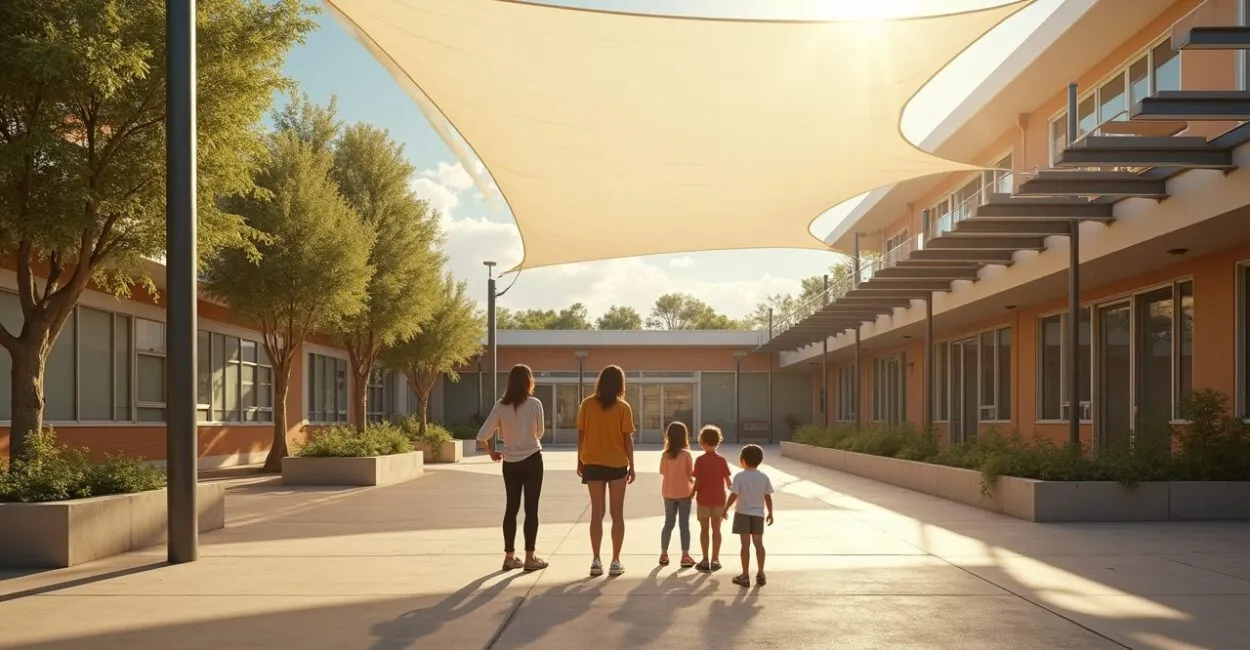
When the sun beats down during recess, the schoolyard stops being a place to gather and becomes somewhere to escape from. Outdoor schoolyard shade addresses that problem directly: it reduces heat, improves comfort for children and educators, and makes the space more usable throughout the day.
In practice, there’s no one-size-fits-all solution. Permanent roofs, tensioned awnings, pergolas, trees, and metal structures meet different needs when it comes to cost, maintenance, durability, and appearance.

This article compares the options in straightforward terms to help you choose what truly makes sense for a public or private school, a school district, or a renovation completed in phases.
What You Need to Know
- The best shade system combines meaningful reduction in solar radiation, natural ventilation, and low maintenance throughout the year.
- Permanent structures usually last longer, but they require a design, foundation, and careful attention to wind, drainage, and anchoring.
- Awnings and tensioned membranes offer a quick solution, but their fasteners, fabric, and overall tension need periodic checks.
- Trees improve thermal comfort, but take longer to provide shade and depend on soil, irrigation, and care.
- The costliest mistake is choosing based on appearance while ignoring daily use, sun exposure, student traffic, and available maintenance.
Outdoor Schoolyard Shade: What Really Helps Beat the Heat
Technically, shade means reducing direct solar radiation and heat gain on a surface. Put simply, it keeps the schoolyard from turning into a hot plate at midday. In school settings, that matters because thermal discomfort affects how long people stay, how they move around, how they play, and even their safety during extreme heat. The goal isn’t just to “create shade.” It’s to combine solar protection, ventilation, and safe use of the space. A roof that’s too enclosed can trap heat; one that’s too flimsy may not withstand wind or wear; and one that’s poorly positioned may cast shade at the wrong time, leaving the play area hottest of all.
What separates a good shade solution from one that merely looks good is how it performs at midday during regular use, with children moving around and limited maintenance available.
Reference data on urban heat and sun exposure help explain why this has become an infrastructure issue, not just an aesthetic one. INMET, Brazil’s National Institute of Meteorology, publishes alerts and weather information that can help identify critical periods. The Brazilian Ministry of Health website provides guidance on preventing heat-related effects. For schools, this means planning for continuous use rather than improvising.
Why It Matters in the School Day
Anyone who works in a school knows the schoolyard is more than a walkway. It’s used for recess, physical education, lining up, events, welcoming students, and often assemblies. Without shade, these activities become less enjoyable or move indoors, where there may not be enough room. The result is predictable: more heat, more distraction, and less use of outdoor space.
A well-chosen solution also helps preserve the flooring, playground equipment, and furniture. Surfaces exposed to the sun expand, fade, and wear out faster. In some cases, people feel more comfortable even without a major change in temperature, simply because direct sunlight no longer hits their skin or the benches.
Comparing Roofs, Awnings, Trees, and Pergolas: A Reality Check
To make an informed choice, it helps to compare what each option offers in the real world. A permanent roof is different from a retractable awning; a tree is different from a metal frame with fabric; and a pergola can be an architectural solution or merely a decorative feature, depending on its materials and orientation to the sun.
Option
Upfront cost
Maintenance
Durability
Practical note
Metal roof with insulated panels
High
Low to moderate
High
Good for heavy use and large areas
Tensioned awning or architectural fabric
Moderate
Moderate
Moderate
Provides quick relief but requires regular inspections
Properly sized trees
Low to moderate
Moderate to high at first
Very high
Best for long-term comfort, but the effect isn’t immediate
Pergola with shade cloth or lattice
Moderate
Low to moderate
Moderate
Works best when sun exposure is taken into account
If the school needs to address the problem right away, awnings and lightweight roofs are often the best bet. For a long-term project, a permanent roof is generally more durable. If there’s open space and a landscape plan, well-chosen trees add comfort, but the benefits grow over time. A common mistake is assuming these options are mutually exclusive; in fact, many work better together.
In a schoolyard, the best shade is rarely the most expensive. It’s the option that stands up to daily use, handles the local climate, and fits the maintenance budget.
When Each Option Makes the Most Sense
- Permanent roof: Ideal for schoolyards with heavy use, frequent events, and a need for consistent protection.
- Awning or tensioned membrane: A good choice for tight timelines, phased renovations, and areas where work needs to be completed quickly.
- Trees: Recommended when the school can wait for them to grow and wants to combine shade with landscaping and environmental comfort.
- Pergola: Works well in gathering areas, as long as the sun’s path and the materials don’t result in too little shade.
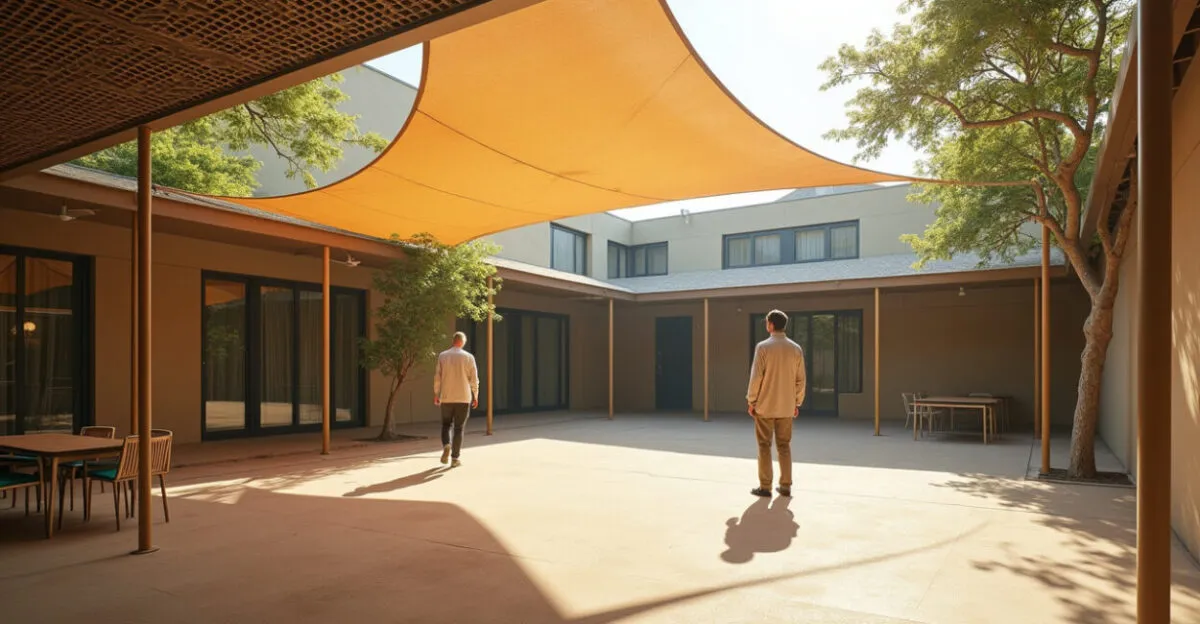
Sizing, Sun Orientation, and Ventilation: Factors You Can’t Ignore

Comfort depends on more than the area covered. It also depends on the sun’s orientation, the structure’s height, the spacing between supports, and airflow. A shaded schoolyard with no air circulation can feel stifling. A partially covered but well-ventilated yard is often more comfortable for young children and teachers moving through the space.
In practice, sizing starts with observing when the sun is strongest and how the space is used. Morning and afternoon sun come in at different angles, so the shade needs to cover the hours when the space is used most. That’s why site planning can’t be generic: the same design that works at one school may fail at another, where trees, buildings, and walls are positioned differently.
A simple tool can help: map where recess takes place and when the ground gets hottest. This prevents costly work in the wrong spot. In areas with intense sun exposure, local climate data from the INMET network can help compare temperatures, solar radiation, and seasonal patterns before the design is finalized.
Read also: Attention Teachers: Changes to the School Routine for Students with ADHD
What Good Ventilation Changes
Cross-ventilation improves how warm a space feels without increasing operating costs. Structures that are too enclosed trap heat under the roof, and that becomes obvious in everyday use. Anyone planning a school knows that shade without airflow only solves half the problem; the other half is making sure the space stays breathable on hot days and when it’s crowded.
This detail is often underestimated by people who look only at the floor plan or rendering. The shade works, but the real experience depends on how air moves in and out of the space. That’s why clear height, distance from walls, and the placement of openings matter so much.
Read also: Inclusive Playground Equipment for Schoolyards: How to Choose
Materials, Structures, and Maintenance Over Time
At schools, durability matters as much as upfront cost. The ideal structure needs to withstand sun, rain, dust, frequent cleaning, and the minor impacts of daily use. That makes a big difference when choosing between galvanized steel, aluminum, treated wood, polycarbonate, tensioned fabric, and insulated roofing panels.
Galvanized steel is a common choice for sturdy construction because it can span wider areas and accommodate different types of roofing. Polycarbonate lets in light, but can make the space hotter if ventilation is poor. Architectural fabrics and tensioned membranes work well in open areas, though seams, fasteners, and anchor points need inspection.
Factors That Affect Total Cost
- Installation: A simple installation doesn’t always mean a low-cost solution if frequent maintenance is needed.
- Service life: More durable materials are worth the investment when the school wants to avoid replacing the roof within a few years.
- Replacement parts: Parts and components should be easy to find locally.
- Cleaning: Dust, leaves, and mold add hidden costs to any system.
There’s an important limit to keep in mind: not every project needs the heaviest structure. If the schoolyard sees moderate use and the budget is tight, a well-built lightweight solution may be more practical than a major project rushed through. Experts often disagree on this point—some prioritize maximum durability, while others focus on speed of installation. The right answer depends on how the space is used and how maintenance is managed.
Trees, Landscaping, and Natural Solutions That Really Work
Trees aren’t a “Plan B” when it comes to shade. In many cases, they’re the smartest choice for outdoor areas because they reduce heat, create a more pleasant visual environment, and improve the overall setting. The right species can make the space feel cooler and help create a more welcoming school, as long as the planting plan suits the available space.
The mistake is treating trees as an instant solution. They take time to grow and need reasonably healthy soil, initial watering, and expert pruning. Some species can also pose risks because of aggressive roots, brittle branches, or fruit that makes walkways messy. These factors matter a lot at a school.
Good planning often combines trees with garden beds, benches, permeable paving, and walkways. Together, these features change how the schoolyard is used. Embrapa, Brazil’s agricultural research agency, offers technical resources on species, care, and adaptation to Brazil’s climate. These can help schools avoid decorative choices that cause problems later.
A Real-World Example
A neighborhood school was renovating and wanted to cover the entire schoolyard at once. The budget, however, only stretched to half the area. The team installed a permanent roof over the line-up area and the part of the yard used most for recess, then planted trees along one side for the long term. The first summer, the roof made an immediate difference where use was heaviest; by the second, the growing trees were starting to add more shade. The result wasn’t “perfect,” but it worked from the very first month.
Standards, Safety, and Approvals That Prevent Headaches
A school project involves more than choosing materials. It also requires structural safety, clear pathways, accessibility, and compliance with local regulations. This means accounting for wind loads, anchoring, clear height, emergency exits, and distance from hazardous areas. With metal structures and tensioned roofs, problems often don’t show up on installation day; they appear during the first bout of severe weather.
That’s why it’s worth working from technical plans and clear specifications that fit the school’s daily routine. The schoolyard needs to remain safe to use, including during the busiest times. For public schools, reviewing the requirements of FNDE, Brazil’s National Fund for Education Development, can help prevent conflicts in funded or standardized projects, especially those involving accessibility and construction requirements.
To reduce health and heat risks in spaces where people spend time, Fiocruz, Brazil’s public health research foundation, offers studies and publications on health, the environment, and heat exposure. These resources underscore the importance of protected spaces for children. The goal isn’t to make the decision more bureaucratic; it’s to prevent a poorly designed roof from becoming an expensive fix later.
Where Projects Commonly Go Wrong
- Choosing a structure without considering local wind conditions and anchoring methods.
- Positioning shade without checking when the schoolyard is actually used.
- Choosing materials that look good but are difficult to clean or replace.
- Failing to plan for maintenance after installation.
How to Choose the Right Solution Without Wasting Money
The safest decision starts with three questions: Which areas need protection? When are they used? Who will handle maintenance afterward? If the school needs a quick fix, priorities shift. If the focus is a long-term investment, the emphasis should be on structure, durability, and thermal comfort over the years.
To make the right choice, use a simple rule: pick the solution that provides shade during the hottest hours without compromising ventilation, safety, or cleanliness. Everything else is just window dressing. And at school, appearance matters, but function comes first.
Next steps: map sun exposure in the schoolyard, list the hours it’s used, check installation costs and annual maintenance expenses, then compare at least two real options before approving the project. This screening process helps avoid a solution that looks good on paper but can’t stand up to the demands of a real school routine.
Frequently Asked Questions About Schoolyard Shade
Which Shade Solution Lasts the Longest in a Schoolyard?
In general, permanent roofs with well-designed metal frames and appropriate roofing offer the greatest durability. They stand up better to heavy use and the weather, provided they receive basic maintenance and are properly anchored. Trees can also last for decades, but their full benefit takes longer to realize. Awnings and tensioned membranes work very well, too, but need regular inspections and occasional component replacement.
Are Tensioned Awnings Safe for Schools?
Yes, as long as the system is sized by a qualified professional and installed with proper anchoring, adequate tension, and materials designed for outdoor use. Problems arise when fabric is chosen based only on price or when the anchoring fails to account for wind, tension, and normal wear. At a school, structural safety must come before appearance. Maintenance also needs to be planned, since small gaps and tears can worsen quickly with continuous use.
Can Trees Replace Artificial Shade in a Schoolyard?
To some extent, but not in every situation. Trees provide more pleasant shade and improve the environment, but they take time to grow and depend on the right species, suitable soil, and ongoing care. In heavily used schoolyards, it’s usually best to combine trees with partial coverage. That way, the school gets immediate relief where it’s needed and long-term environmental benefits without relying on a single solution.
Which Affects Total Cost More: Installation or Maintenance?
It depends on the material, but maintenance is often underestimated. A cheap structure that needs frequent repairs can cost more within just a few years. A sturdier system with a higher upfront cost may be worthwhile when the school wants predictable expenses and fewer repairs. A thorough estimate includes installation, cleaning, replacement parts, and actual service life—not just the initial construction price.
How Can You Tell if a Schoolyard Has Enough Shade?
The best test is to observe how the space is used during the hottest part of the day. If the ground, benches, and walkways are still exposed to direct sunlight, the shade is incomplete. It’s also worth checking ventilation, clear height, and how much of the area is protected. A well-designed schoolyard allows students to play, line up, and spend time outdoors without constantly searching for the coolest spot.
Artigos Relacionados
 Play-Based Activities and Child Neuroscience: 5 Effective Ideas
 Neuropedagogy Strategies for Effective Literacy Instruction
 A Complete Guide to Entrepreneurial Education: Build Leadership Skills, Create an Effective Business Plan, and Start a Successful Career
 Building Healthy Relationships: Effective Strategies to Foster Positive Social-Emotional Development at School and Home
 Family Engagement in Schools: Effective Strategies
 Effective Literacy Instruction for Young Learners Today
