
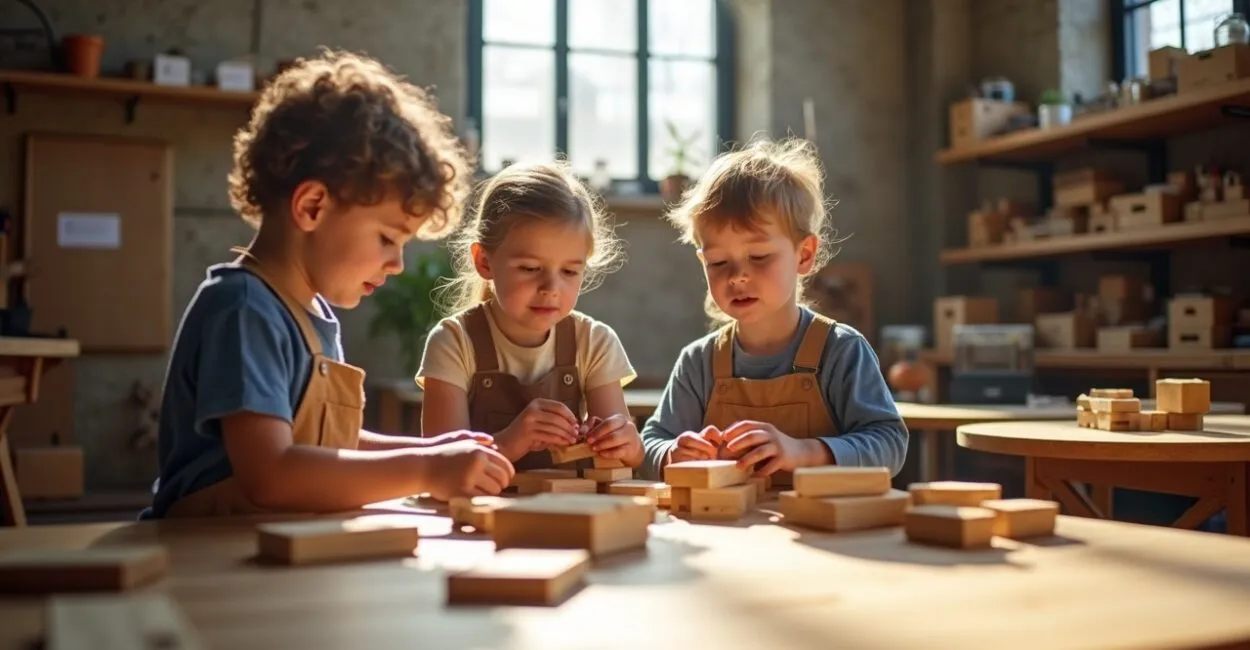
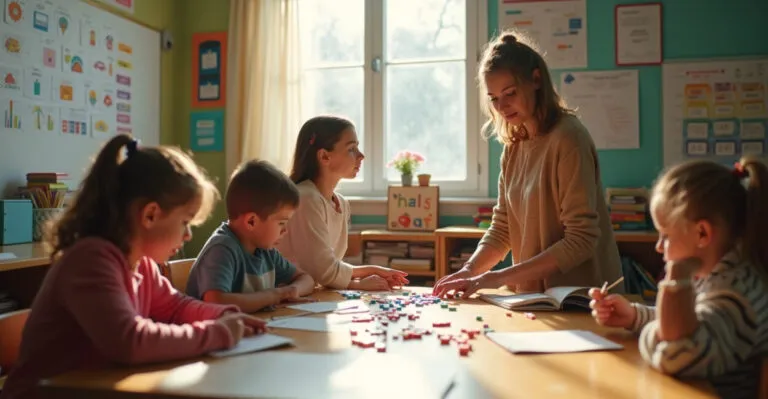
A class compares different strategies to figure out why two fractions can represent the same amount. The teacher presents the problem, listens to students’ reasoning, and steps in when an explanation needs support.

That’s educational constructivism in practice: students build knowledge by investigating and discussing ideas, with clear learning goals and guidance from the teacher.
This approach takes planning. Activities should draw on prior knowledge, offer an achievable challenge, and give the teacher a way to track what each student understands.
Projects, experiments, and discussions can all be part of a lesson, as long as they connect to the content being taught.
Before planning the activity
- Set a learning goal and identify the content students need to work on.
- Find out what students already know and what misconceptions might come up.
- Choose a problem or question that lets students investigate the content.
- Decide what evidence will show what each student has learned.
Educational constructivism: how it works in practice
A constructivist lesson starts with a curriculum goal and creates opportunities for students to connect prior knowledge with new information. The teacher poses a question, structures the investigation, explains concepts when needed, and assesses the ideas students develop. A lesson sequence might include exploration, discussion, explicit instruction, and an individual task to check for learning.
The lesson might begin with a genuine question, an object to examine, or a problem with more than one way to solve it. But the content doesn’t need to be left implicit: when students hit a roadblock, the teacher can explain, model a strategy, and give them another chance to try.
A constructivist approach also plans what happens after the whole-class discussion. If some students still don’t understand a concept, the teacher can revisit it with different examples, form a small support group, or assign practice that builds in difficulty. Participation is a way to learn, not enough evidence that everyone has learned.
What supports knowledge building
In constructivist theory, learning involves reorganizing knowledge through the interaction between what a person already understands and new experiences. This doesn’t mean every student has to discover on their own concepts that can already be taught. It means considering how students interpret information and planning instruction that helps them move forward.
Jean Piaget studied changes in thinking over the course of development and described processes such as assimilation and accommodation. Put simply, a person may interpret something new using existing mental frameworks or change those frameworks when they no longer explain what they observe.
Lev Vygotsky emphasized the role of social interaction and culture in learning. The zone of proximal development describes the gap between what a student can do independently and what they can do with guidance. That’s why a well-timed question, a demonstration, or help from a classmate can get a student unstuck.
Piaget and Vygotsky didn’t propose a single lesson plan to follow. Their theories help us think about development, interaction, and learning, but they don’t justify abandoning direct instruction or assuming that all students progress at the same pace. Brazil’s Base Nacional Comum Curricular (BNCC), the national curriculum framework, outlines essential learning goals; lesson plans need to connect those goals to what students already know.
How to plan a constructivist lesson

Start with what students should know or be able to do by the end of the lesson. Then choose a situation that lets them investigate that goal and anticipate what kind of guidance they’ll need. An open-ended question can launch an activity, but it should lead to a specific learning outcome.
- Define the goal: Write down what you’ll look for in students’ work or explanations.
- Check prior knowledge: Use a question, a short exercise, or an example to analyze.
- Set an achievable challenge: The task should require thinking without relying on knowledge students haven’t learned yet.
- Plan your interventions: Prepare hints, examples, explanations, and questions for different challenges.
- Gather evidence: Set aside time for each student to show what they understand, including through individual work.
Projects can be part of this plan, as long as they don’t replace teaching the content. In project-based learning, students investigate a question and create something, but the teacher still needs to set content goals, work steps, and assessment criteria. Otherwise, the class might produce an impressive final project without understanding the concepts behind it.
The roles of the teacher, students, and resources
The teacher structures learning experiences and tracks students’ thinking. They listen to explanations, notice recurring errors, and decide how to respond: ask for a justification, offer a hint, present a counterexample, or teach a strategy directly.
Students form hypotheses, compare approaches, consult sources, and revise their answers. Collaboration helps when each student has to explain their choices; dividing up the work without discussion can hide who hasn’t followed the content.
Hands-on materials, texts, digital tools, and experiments should serve the lesson’s goal. Using a new resource doesn’t make an activity constructivist on its own. In math, for example, fraction tiles can help students visualize equivalent fractions, but they also need to connect the physical model to numerical notation.
One classroom detail that often gets overlooked in planning: during group work, more confident students may answer first and leave little room for others. Giving everyone a few minutes to work independently before the discussion helps the teacher hear from more students and catch questions the group might otherwise conceal.
Examples of constructivism in the classroom
Elementary school math
Goal: Understand equivalent fractions. The teacher shows drawings of rectangles divided into different numbers of parts and asks which ones represent the same amount. Students compare them, write down their reasoning, and discuss different approaches. If they don’t identify the equivalence, the teacher uses a visual model and connects it to fractions such as 1/2 and 2/4. An individual written explanation shows whether each student understands the relationship.
High school history
Goal: Analyze how different sources portray an event. Groups examine documents, identify their authorship, context, and perspective, and support an interpretation with evidence. The teacher explains how to distinguish opinion from evidence and asks what each source leaves out. Learning becomes clear when each student writes an analysis citing the documents, not just when the group reaches a conclusion.
High school science
Goal: Understand variables in an investigation. Given a question about how quickly a material dissolves, students plan a comparison, record conditions, and interpret their observations. The teacher guides them in controlling variables and distinguishing observation from explanation. A final write-up should state what was tested, what the data support, and what questions remain.
How to assess learning and address challenges
Constructivist assessment tracks the learning process and checks students’ understanding of the content. Observations of discussions, notebooks, concept maps, and projects can reveal different aspects of learning, but an individual task may also be needed to see what each student can do without support.
Clear criteria help distinguish participation from understanding. For a source analysis, for example, the teacher can check whether the student identifies where a document came from, uses evidence, and justifies an interpretation. This formative assessment makes it possible to adjust instruction before moving on to a topic that depends on that knowledge.
Traditional tests can also be part of assessment. A well-aligned individual question can show whether students can apply what they’ve learned to a new situation. Assessment falls short when it measures only the quality of a group project or the fluency of the students who speak up most often.
There are practical limitations. An open-ended investigation can take a lot of time and widen learning gaps if it assumes vocabulary or knowledge that hasn’t been taught. Students with learning difficulties may need instructions broken into steps, visual supports, extra time, or guided practice. These accommodations keep the learning goal intact while changing the path and the support.
Pressure to cover the curriculum also calls for careful choices. Not every topic needs to become a project or investigation; direct instruction, practice exercises, and review are all legitimate tools. The Education Endowment Foundation offers guidance on teaching and assessment practices; recommendations should be considered in light of students’ ages, the content, and classroom conditions.
Constructivism, active learning, and frequently asked questions
Active learning is a broad category of practices in which students engage in intellectual work, for example, by solving problems, discussing ideas, or applying concepts. Constructivism is a perspective on how knowledge develops and informs teaching decisions. An active learning activity can be constructivist in its approach, but the terms aren’t interchangeable.
Constructivism can work for students of different ages, with activities tailored to their development, background knowledge, and needs. Young children can explore hands-on materials and explain comparisons; teenagers can analyze sources, support arguments, and test hypotheses. At every stage, guidance and explicit instruction may be needed.
Can this approach leave gaps in students’ knowledge?
It can if investigation replaces explanation and necessary practice. To reduce that risk, teachers check prerequisites, teach missing concepts, and revisit areas where the evidence shows students are struggling.
Can you assess learning without traditional tests?
Yes. Individual work, oral explanations, application tasks, and investigation notes can all show learning. The right choice depends on the goal; in some cases, an individual test provides useful additional evidence.
How can you support students with learning difficulties?
Break complex tasks into steps, model procedures, and provide appropriate accommodations, such as visual supports or extra time. Guidance should respond to the student’s needs and let them demonstrate what they’ve learned without unnecessary barriers.
What’s the first step in trying this approach in class?
Choose a goal students need to reach and turn it into a question they can investigate. At the end, ask for an individual response and compare it with where students started; that contrast helps you decide what to review in the next lesson.
To get started, plan a short activity around a specific goal and decide in advance what kind of response will count as evidence of learning. Then adjust your instruction based on what students show, without forcing every topic into the same format.
Artigos Relacionados
 Educational Projects That Transform Classrooms in 30 Days
 Educational Technology: Tools That Transform Classrooms
 Educational best practices: A complete guide to transforming teaching
 The Montessori Method: What Does It Look Like in Practice?
 Reading and Writing Words: 8 Classroom Exercises
 Diagnostic Assessment in Physical Education: How to Apply It
