
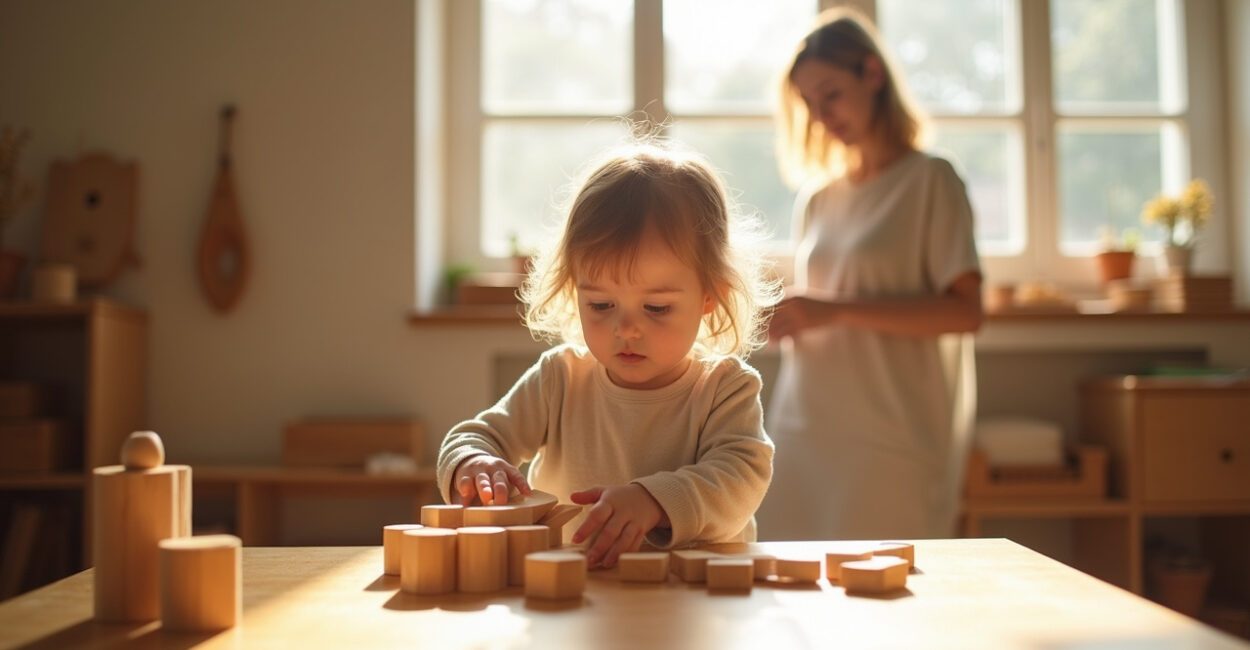
In a Montessori classroom, one child might choose to arrange flowers in small vases while another practices fastening buttons on a dressing frame. The Montessori method’s differences in early childhood education show up in this guided freedom, an environment designed to foster independence, and the educator’s role as an observer and guide.
In traditional education, the class is more likely to follow activities set by the teacher at scheduled times, although every school has its own approach.

That doesn’t make one model better for every child. The choice depends on what the school actually offers, the child’s needs, and the family’s circumstances, including cost, commute, and continuity in the educational approach.
Observing a class often tells you more than the name of the method on the sign outside.
In a Nutshell
- In Montessori, children choose from activities planned for their stage of development, within clear boundaries.
- Specialized materials let children explore concepts hands-on and, in many cases, notice and correct mistakes without waiting for an adult to give them the answer.
- The educator follows each child’s progress and introduces activities; freedom of choice doesn’t mean a lack of teaching or supervision.
- Traditional schools vary: some rely more on teacher-led routines, while others incorporate projects, choices, and hands-on activities.
The Montessori Method in Early Childhood Education: What It Looks Like Day to Day
In early childhood education, Montessori often differs from traditional approaches in how the space is organized, how activities are chosen, the pace of work, and how learning is supported. Rather than having the whole class do the same task at the same time, each child can work with materials suited to their current stage while the educator observes, guides, and sets boundaries. Traditional schools, however, can also vary considerably.
Aspect
Montessori Approach
More Teacher-Directed Traditional Approach
Activities
Choice among available activities introduced by the educator.
Activities are more often assigned to the class by the teacher.
Environment
Materials are accessible, organized, and sized for children.
The setup may prioritize whole-class instruction or the use of shared desks and resources.
Pace
Time for individual exploration, with progress monitored.
More opportunities to move forward as a group, depending on the school.
Educator’s Role
Introduces materials, observes, and steps in when needed.
More often leads explanations and whole-class activities.
This comparison describes general patterns, not a universal rule. A traditional school may offer plenty of independence, while a school that calls itself Montessori may apply the principles superficially. The educational approach and what happens on an ordinary Tuesday matter more than the label.
What Defines the Approach Created by Maria Montessori
The Montessori method is an educational approach that organizes the environment and the educator’s role to encourage children’s independent activity through structured materials and observation of their development. Put simply, adults create learning opportunities and teach children how to use them rather than directing every step for the entire class.
Maria Montessori, an Italian physician and educator, developed the approach by observing children and creating environments designed around their needs. Concepts such as the prepared environment, the sensitive period (a phase when a child develops an intense interest in a particular skill), and self-education inform the practice, but they don’t eliminate the need for planning or pedagogical knowledge.
The American Montessori Society describes elements associated with the approach, including mixed-age classrooms, work periods, and specialized materials. The presence of these elements alone doesn’t prove the quality of instruction; it’s important to see how staff bring them together and support each student.
Independence with Boundaries and Educator Support

Children choose from activities they already know or that the educator has introduced, while following shared expectations for using materials, caring for the space, and interacting with others. If a child takes out a material and leaves it scattered around, an adult can help them finish the sequence: put the pieces away, return the tray to its place, and then choose another activity.
The educator observes each child’s interests, coordination, concentration, and challenges. They demonstrate how to use a material with precise movements, avoid unnecessary interruptions, and step in when a child needs guidance, safety, or help interacting with classmates. Freedom, then, exists within an intentional structure.
In the Montessori approach, children learn independence through real choices, accessible materials, and consistent boundaries.
Montessori Materials and the Prepared Environment in Practice
A prepared environment includes furniture sized for children, items organized by area, and enough materials for everyone to use them carefully. Children can take a tray, work at a table or on a mat, and return the material to its designated place. This order reduces the need for instructions at every step.
Read also: The Education Market: Trends and Opportunities for Teachers
Montessori materials are often designed to focus on one challenge at a time. Knobbed cylinders help children explore dimensions and coordination; sandpaper letters introduce the sounds and shapes of written language; practical life activities, such as pouring water between containers, develop control of movement and sequencing. Many materials include a control of error—a feature that helps children notice when something doesn’t fit or is incomplete.
A familiar scene helps illustrate the approach:
- A child chooses an activity that involves transferring grains with a spoon.
- After spilling some on the mat, the child pauses the activity and gets a small broom.
- The educator stays nearby but lets the child try to clean up and put the material away.
The goal isn’t to turn every task into a school exercise. Practical life activities also help children take part in caring for themselves and their surroundings. At home, similar principles can be used with a low shelf holding a few toys, a sturdy cup within reach, and simple chores, always with supervision appropriate to the child’s age.
Pace, Assessment, and Socialization Among Children
In many Montessori schools, children have individual or small-group work periods, and educators keep notes on the activities they introduce and each child’s development. Assessment may include portfolios, observations, and conversations with families rather than relying only on tests or standardized worksheets. The exact format varies by school and curriculum requirements.
An individual pace can allow children to repeat an activity, but it doesn’t guarantee that challenges will be identified without careful follow-up. Staff need to notice when a child avoids an area, makes little progress, or needs a different presentation. The National Association for the Education of Young Children emphasizes, in its work on developmentally appropriate practice, the importance of considering a child’s age, individual characteristics, and context. This principle can also help families evaluate any educational approach.
Having children of different ages together, as in many Montessori classrooms, can create opportunities to observe peers and collaborate. Still, socialization doesn’t happen automatically: adults need to support turn-taking, conflict resolution, respectful language, and participation by quieter children. A school with mixed-age groups should explain how it handles supervision and expectations for each age range.
How to Decide Whether a School Is Right for Your Family
Montessori may be a good fit for families who value independence, hands-on materials, and support for each child’s pace. The fit also depends on the child, the quality of the staff, and how well the school aligns with the family’s routine. Children with specific needs may benefit from structured environments, but the school should explain how it adapts materials and provides support rather than assuming the method alone will meet everyone’s needs.
During a visit, observe a class in session and ask how the principles show up day to day. Check whether materials are complete and accessible, whether adults know each child’s progress, and how they handle conflicts, boundaries, and support needs. Also ask about staff training, communication with families, and curriculum guidelines. In Brazil, the school’s approach must align with the Base Nacional Comum Curricular (BNCC), Brazil’s national curriculum framework.
Some schools may charge more because of factors such as materials, facilities, staff training, and location, but there’s no single price associated with the method. Compare tuition, meals, transportation, fees, and hours with your family’s budget. It’s “worth it” when the approach is demonstrably high quality and sustainable for your family—not simply because the Montessori name appears in the school’s marketing.
Switching to a Different Approach and Montessori-Inspired Practices at Home
A child who leaves a Montessori school isn’t automatically behind. At first, they may find simultaneous activities, whole-class instructions, or a different way of documenting learning unfamiliar. The impact depends on what they’ve learned, their new school, and the support they receive during the transition. If possible, arrange a conversation between the school teams and share learning records and information about strategies that work for your child.
When moving to a Montessori school, staff can help a child learn to choose, use, and put away materials. The transition can take time for families, too; they may need to adjust to receiving observation notes instead of identical assignments for every student.
At home, you don’t need to buy a complete set of materials to use some Montessori principles. Keep a few items within reach, show your child how to use them, and put them away together after the activity. For tasks involving water, small pieces, or utensils, choose age-appropriate, safe items and supervise your child; independence doesn’t replace adult supervision.
Next Steps for Making an Informed Choice
Before deciding, visit more than one school and observe how adults talk to children when they make a mistake, get frustrated, or finish an activity. Those moments often reveal the quality of the approach more clearly than a spotless classroom during a tour.
Make a list of your family’s nonnegotiable criteria, compare total costs, and ask how the school tracks development and supports transitions between stages. The best choice is one that combines a consistent educational approach with your child’s needs and your family’s real-life circumstances.
Is Montessori Better Than Traditional Education?
There’s no universal answer: quality depends on the school’s practices, the child, and the family’s circumstances. Compare the support, environment, and teaching approach rather than choosing based on the name alone.
How Can I Tell if My Child Will Adapt?
Notice how your child responds to choices, routines, and hands-on activities, but don’t treat a brief visit as a diagnosis. Talk with the staff about the transition, your child’s individual needs, and what the school does when a child still needs help choosing or finishing activities.
Does a Montessori School Always Cost More?
Not necessarily, and the method doesn’t come with a single price range. Ask for the total cost, including enrollment, materials, meals, and transportation, and compare it with schools using different approaches in the same area.
Can I Use Montessori at Home Without Enrolling My Child in a Montessori School?
Yes. Keeping a few items within reach, inviting your child to help with simple tasks, and teaching them to put away what they’ve used are all practices inspired by the approach. That’s not the same as recreating a complete Montessori classroom, and it doesn’t replace formal schooling.
Will My Child Fall Behind if They Leave a Montessori School?
Changing approaches doesn’t, by itself, mean a child will fall behind. Ask the new school what your child already knows and agree on a transition period, especially if the new routine involves more group activities or different ways of documenting learning.
Artigos Relacionados
 Positive Discipline: The Key to Early Childhood Education
 A Guide to Early Childhood Education: Best Practices, Play-Based Activities, and Innovative Approaches to Whole-Child Development
 Early Childhood Education: Essential Practices for Development
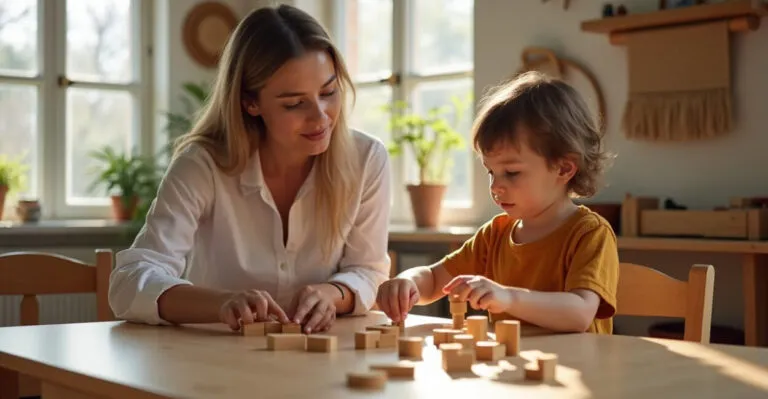 Early Childhood Education Across Cultures
 Biodiversity Project: Exploring Animals and Plants
 A School Garden in Early Childhood Education
