
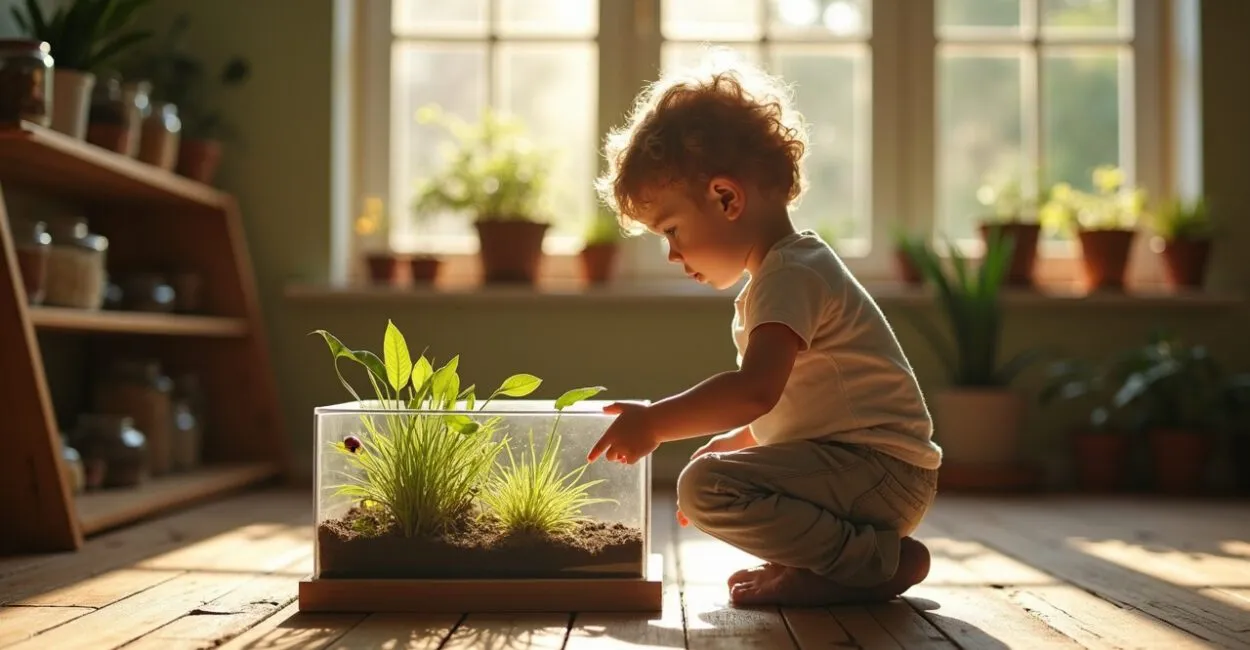
A puddle after the rain can reveal larvae, fallen leaves, and insects on the move. A biodiversity project for young children featuring animals and plants turns these discoveries into ongoing investigations suited to their age and available space.

Children observe, document, and learn to care for living things without having to capture them.
Biodiversity is the variety of life, the differences among living things, and the relationships they form with one another and with their environment. For young children, this idea becomes meaningful when they compare leaves, follow a plant’s growth, or notice that certain animals appear in specific places.
The project can begin in the schoolyard, on the sidewalk outside the school, or with pots near a window. The key is to set aside time to observe closely, talk about what the children saw, and return to the same place to notice changes.
At a glance
- Ongoing investigation teaches more about living things than a one-off activity focused on coloring or copying names.
- Observing animals without touching them protects children and reduces stress and risks for the animals themselves.
- Leaves, flowers, and seeds can be compared by visible features without asking young children to memorize scientific classifications.
- Drawings, children’s words dictated to the teacher, and photographs help document what the group notices over time.
A biodiversity project for young children featuring animals and plants
A biodiversity project for young children is a planned investigation into the variety of living things and their relationships with the environment, carried out through age-appropriate observations, conversations, and documentation. By focusing on animals and plants, children can compare features, track changes, and ask questions using the schoolyard, potted plants, or other accessible spaces.
Start with a question the children can actually explore, such as “What animals visit the garden beds?” or “What has changed about this plant since last week?” Choose a place to observe, agree with the children on what to document, and return on different days. Repeated visits help distinguish a one-time discovery from a pattern worth investigating.
The project connects with the learning fields in the Base Nacional Comum Curricular (BNCC), Brazil’s national curriculum framework, especially when it brings together exploration, communication, relationships, and change. There is no single ideal age: younger children can observe colors, shapes, and movement; older children can compare records and suggest explanations, always with adult guidance.
Observing insects and other small animals without disturbing them
To investigate small animals, choose a fixed spot, such as the edge of a garden bed or a section of wall, and agree to observe quietly for a short time. Children can look for signs of animal life, count how many they see, and describe what the animals are doing without touching them or moving leaves, rocks, or shelters.
A simple record can include the date, location, a drawing of the animal, and a note about what it was doing. If a child says, “The ant is carrying a piece,” the teacher can write down those exact words and revisit them later: What was the ant carrying? Were there other ants along the way? What would the group like to observe on the next visit?
After it rains, children often notice earthworms in damp areas and want to pick them up. This is a good opportunity to talk about where each living thing was found, but handling the animal isn’t necessary: the group can observe from a distance and let it go on its way.
If a child is afraid, don’t force them to get closer. Offer more distance, pictures, observation through a window, or the option of following a classmate’s notes. A child can take part by drawing or talking without having to approach the animal.
Plants, garden beds, and miniature habitats

Plants let children track visible changes at their own pace: new leaves, opening flowers, or germinating seeds. To compare species, use features children can observe, such as leaf shape, texture, whether flowers are present, and where the plant grows. Don’t ask them to taste or smell unfamiliar plant parts.
A garden bed or a few pots provide plenty to investigate. If the school has no outdoor area, children can observe plants in approved locations or follow a plant in a suitable container, checking its light, water, and signs of change. The adult should record growing conditions, since a wilted plant could point to too little water, too much sun, or other factors—not necessarily one single cause.
Read also: Environmental Education Trends for 2025: What’s New
Terrariums and aquatic habitats are optional and require planning. A closed container can build up too much heat or moisture; aquariums require maintenance and conditions suited to the species. For many groups, photographs, drawings, and observations of existing spaces offer plenty to investigate without creating the responsibility of maintaining a classroom habitat.
The Instituto Chico Mendes de Conservação da Biodiversidade (ICMBio), Brazil’s biodiversity conservation agency, provides information about conservation and Brazilian species that can help teachers prepare. With children, turn research into questions they can answer through observation rather than making the conversation a list of names to memorize.
Safety and caring for living things
Set clear rules before going outside to observe: look without capturing, don’t put your hands in holes or crevices, don’t taste plants, and tell an adult if you find an unfamiliar animal. Closed-toe shoes and close supervision are wise in areas with vegetation, rocks, or water. Rules should also take known allergies, the space, and school guidelines into account.
- Don’t collect wild animals or keep them in jars, boxes, or makeshift aquariums.
- Avoid touching caterpillars, spiders, frogs, and unfamiliar plants; if in doubt, observe from a distance.
- Don’t feed animals or disturb their shelters to make them easier to observe.
- If there is a bite, sting, or concerning contact, stop the activity and follow the school’s health protocol.
Appropriate precautions depend on the location and the species found. An urban garden, a rural area, and the grounds around a protected area all present different risks. If a species could be dangerous or local rules apply, observations should be guided by school administrators and, when necessary, the relevant authorities.
A good nature investigation leaves living things where they can keep living.
Connecting language, math, art, and movement
The same topic can span different learning experiences without losing its focus on nature. Language comes into play when children describe what they saw, dictate captions for drawings, or compare predictions with later observations. The teacher can preserve their words while introducing new vocabulary, such as “habitat” or “pollinator,” and explaining what each word means in context.
In math, children can count leaves, compare sizes, or sort images by visible features. In art, observational drawings help them notice details they might miss at first glance. Movement can be part of exploration walks, games that imitate how animals move, or activities connecting animals to the environments where they live.
These activities don’t all need to happen on the same day. One observation can spark a conversation and inspire a drawing or sorting activity later. The teacher keeps the investigation question as a guiding thread and avoids turning each subject area into an activity disconnected from the group’s discoveries.
Planning the project and tracking learning
The project’s length depends on the question, the daily routine, and the school’s resources. It may run for a few weeks or continue through a season; the important thing is to allow time to revisit observations and notice changes. For example, following the same plant for several days makes it possible to compare records that a single visit wouldn’t provide.
You don’t need a background in biology to lead this project. The teacher should choose safe, age-appropriate questions, observe alongside the children, and check reliable sources when a question comes up that they can’t answer. Saying, “We don’t know yet—let’s find out,” models honest inquiry. The Ministry of the Environment and Climate Change website can be a starting point for exploring environmental conservation topics.
To track learning, look for changes in the children’s explanations and actions: Are they noticing differences between leaves? Can they connect an animal to the place where it was found? Do they remember to observe without touching? Dated photographs, drawings, and notes about what children say help you compare these signs of learning without relying on a formal assessment.
Involving families and keeping curiosity alive
Invite families to share observations from the trip to school or from home without requiring outings, purchases, or collected materials. A question sent home, such as “What plant did you see blooming this week?” can lead to drawings, spoken stories, or a photo taken with permission. To include families without access to a camera or the internet, offer a paper-based option at school.
At the end of each stage, display the children’s records along with their questions, dates, and observation locations. The group can choose a new place to investigate or agree on a practical way to care for the school environment, such as avoiding an area where small plants are growing. This makes biodiversity part of the daily routine rather than a topic limited to a themed poster.
Choose a question your group can explore and return to the same place on different days. Record what the children notice before explaining what has changed: this habit gives the project a solid foundation and shows which ideas are worth investigating next.
Frequently asked questions
What’s the best age to start a biodiversity project?
You can start in early childhood education, adapting the activities to the group’s age and needs. Younger children can observe shapes, colors, and movement; older children can compare records and ask more detailed questions.
What should I do if a child is afraid of insects?
Respect the distance the child needs, and don’t force them to touch an insect or get closer. They can take part by drawing, looking at pictures, or listening to a classmate’s description until they feel comfortable.
How long should the project last?
There’s no set duration. Allow enough time to observe the same environment more than once, and adapt the project to the school calendar and available resources.
How can I involve families without creating extra costs?
Ask families to share spoken stories, drawings, or observations from the trip to school without requiring materials or outings. Offer a paper-based way to participate for families without easy access to the internet or devices.
%%AGPTRH3%%
Artigos Relacionados
 The Power of Free Play: Exploring Why Play Matters in Early Childhood Education and How to Foster Creativity and Imagination
 Exploring the World Through the Senses: 10 Creative, Safe Sensory Activities to Support Early Childhood Development
 A School Garden in Early Childhood Education
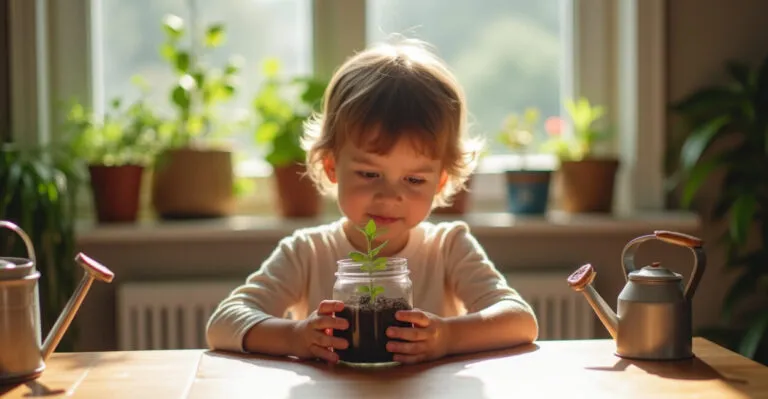 Environmental Activities for Early Childhood Education
 Letter Activities in Early Childhood Education
 Activities for Early Childhood Education: Practical Ideas
