
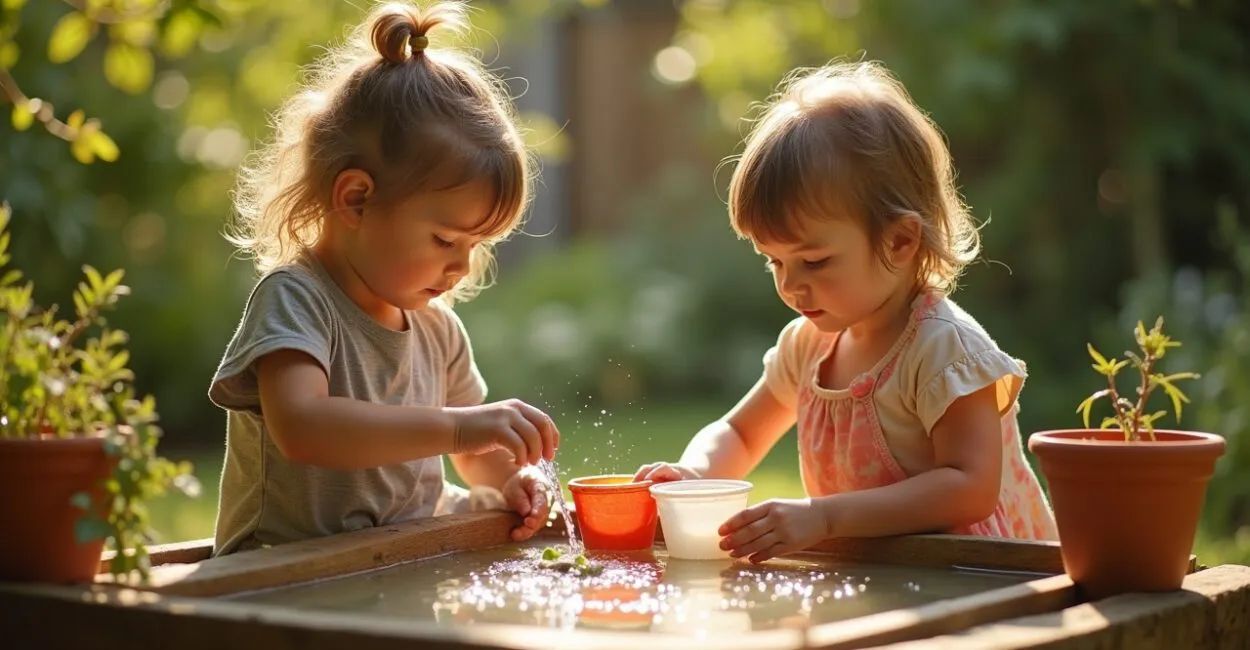
A shallow basin, a few objects, and some water are all you need for activities that introduce young children to the environment. With short activities and close supervision, children can explore floating, absorption, rain, and water conservation at home or school using everyday materials and conversations tied to their routines.

These experiences help children observe natural phenomena and practice age-appropriate ways to care for the environment. Environmental education is the process of building knowledge, values, and attitudes related to the environment. For young children, it can start with noticing, for example, that an open faucet lets water run without being used.
At a glance
- Water activities should be brief, supervised by an adult, and done in shallow containers.
- Everyday objects let children explore floating, absorption, and evaporation without special materials.
- A filtration demonstration shows physical processes, but it does not make water safe to drink.
- Water conservation feels more concrete when children take part in a daily task, such as turning off the faucet while brushing their teeth.
Water and Environmental Activities for Young Children: How to Choose
For young children, the best activities combine sensory exploration, an easy-to-investigate question, and a caring habit that fits into their routine. Choose one activity at a time, with just a few materials and a flexible duration. Children ages 2 to 3 can explore differences and actions, while older children can begin comparing results and explaining what they observed.
Age alone does not determine what a child can do. Consider their coordination, interest, and ability to follow directions.
An adult should stay within arm’s reach whenever water is in a container. Even a small amount of water can pose a drowning risk for young children.
Set up the space before inviting the child to join. Use a stable basin, limit the amount of water, and keep a towel nearby.
One detail can prevent confusion: in floating tests, hollow items such as sealed containers may float because of the air trapped inside. So it’s worth comparing objects made from different materials and observing what happens, rather than trying to guess the result based on weight alone.
Sensory Exploration: Temperature, Floating, and Absorption
A basin with a little water can become a place to observe and experiment. To explore floating, gather a spoon, a lid, a stone too large to swallow, and a sponge.
Invite the child to place one item in the water at a time and say or point to what happened.
Read also: First Aid: What to Do in Common Situations
To explore absorption, offer pieces of fabric, paper towels, and a sponge. The child can touch each material to the water and compare which gets wet, which holds the most liquid, and which dries first. This activity introduces the properties of materials and creates an opportunity to talk about everyday uses, such as choosing a cloth to wipe a surface.
If the child is interested, compare water in two safe containers: one with warm water and one at room temperature. The adult should prepare the water and check its temperature; the child can feel it with a hand, but never use hot water. Simply naming the sensations is enough. There’s no need to provide a full scientific explanation.
Water Experiments: The Water Cycle and a Filtration Demonstration

A Cloud in a Jar
To represent part of the water cycle, pour warm water into a clear jar and cover the opening with a plate or lid. An adult can place a few ice cubes on top of the cover. After a few minutes, look at the droplets that form on the inside.
Read also: Sensory Activities: Creative Learning in Early Childhood
Explain that heat helps water evaporate, and that the vapor cools and forms droplets through condensation. The jar shows stages of the water cycle, but it doesn’t recreate the entire journey water takes in nature. For more information, see the USGS page on the water cycle, from the U.S. Geological Survey.
Filtering Is Not Purifying
Make a demonstration filter using a bottle cut by an adult, with layers of cotton, sand, and small stones. Pour in muddy water and observe what gets trapped. The water that comes out may look cleaner, but it could still contain microorganisms or invisible substances. Do not let anyone drink this water. The activity demonstrates how particles are trapped; it does not produce drinking water.
Water Conservation and Reuse in Everyday Routines
To teach water conservation, turn everyday situations into visible choices. Use cards or drawings to show actions such as turning off the faucet while lathering hands, taking a shower, and washing a toy. With an adult’s help, the child can sort the cards into “water being used” and “water running for no reason.”
You can also reuse bathwater to water plants, as long as it hasn’t come into contact with cleaning products, disinfectants, or other substances that could harm the plant. If soap or shampoo was used, it’s best not to save that water for this purpose. Another option is to collect clean water used to rinse toys, as long as it doesn’t contain unsuitable residues.
The National Water and Basic Sanitation Agency (ANA), Brazil’s national agency for water resources and sanitation, provides information on water resources and sanitation. With children, though, the conversation can start with something closer to home: using only the water needed to wash their hands or water a potted plant.
Plants and Rain: Observing Water in the Environment
Choose two plants of the same species in similar pots, and observe how the soil changes after watering. If conditions allow, compare one plant watered with an appropriate amount of water and another given too much. Don’t deliberately let a plant dry out; the goal is to observe its watering needs, not cause damage.
To collect rainwater, place a clean, stable container in an open area during light rain. An adult should choose the spot and bring the container inside soon afterward. Use the water to water ornamental plants if appropriate, and make sure the child doesn’t drink or play with it. Don’t leave containers outside where water can collect; they can become mosquito breeding sites.
A short conversation can connect the observation to the environment: “What happened to the soil after the rain?” or “Does the plant need water every day?” How often a plant needs watering depends on its species, the climate, and where the pot is kept, so there’s no one rule for all plants.
Adapting Activities for Home and Early Childhood Education
At home, an activity can fit into a task that’s already part of the day, like watering a plant or washing toys. At school, organize small groups and set out the materials before you begin. This helps the adult keep a closer eye on each child and reduces waiting time.
Here’s a common scenario: during a floating test, a child wants to repeat the experiment with the same lid several times. The adult can allow more tries and then suggest comparing it with a stone. If the child loses interest, wrap up without insisting; the observation can continue another time, during bath time or in the garden.
For children who don’t yet use long sentences, accept pointing, choosing between two options, or copying an action. Drawings, photos, and notes made by the teacher can help revisit discoveries later. UNICEF’s work on water, sanitation, and hygiene presents these topics as part of health and well-being. In activities for young children, you can make the connection through safe hygiene habits.
Recording Discoveries and Next Steps
After the activity, ask the child to draw what floated, what absorbed water, or what happened to the soil in the pot. The drawing doesn’t have to show a scientific conclusion; it can capture a question, an attempt, or an observation. For young children, noticing a change is already meaningful progress.
Choose one habit to practice over the next few days, such as turning off the faucet while lathering hands. Do it together with the child and explain the action in concrete terms. One conversation or activity doesn’t guarantee lasting change; understanding depends on the child’s age, repetition, and the examples they see at home and school.
Start with a shallow basin and a simple question, such as “Which objects stay on the surface?” Follow the child’s interest, supervise throughout the activity, and choose one water-saving habit to repeat as part of the routine.
What’s the best age to start water and environmental activities?
There’s no single best age, since development and familiarity with water vary. From the early years, children can observe and explore with an adult beside them, using activities suited to their coordination and understanding.
Do I need to buy special materials?
No. Stable containers, sponges, fabric, and large everyday objects are usually enough. Avoid small pieces that could be swallowed, as well as sharp or breakable materials.
What if the child doesn’t want to participate or gets bored?
Wrap up or offer another way to observe, such as pointing to what floats. Short, pressure-free activities respect the child’s interest; you can revisit the same idea another day.
How do I explain water conservation to a young child?
Use visible actions and concrete phrases, such as turning off the faucet while lathering hands. Children can learn to take part in this habit before understanding abstract ideas about water availability.
Can these activities be used at school?
Yes. Educators can adapt the materials and organize turns or small groups, always with close supervision. The activity should follow the institution’s safety rules and routines.
Artigos Relacionados
 Colors and Shapes Activities: Learning Through Play
 Attention and Focus: Practical Activities for Young Children
 Entrepreneurship for Young Children: Early Childhood Activities
 A School Garden in Early Childhood Education
 Play-Based Activities and Child Neuroscience: 5 Effective Ideas
 Technology for Young Children: Finding the Right Balance
