
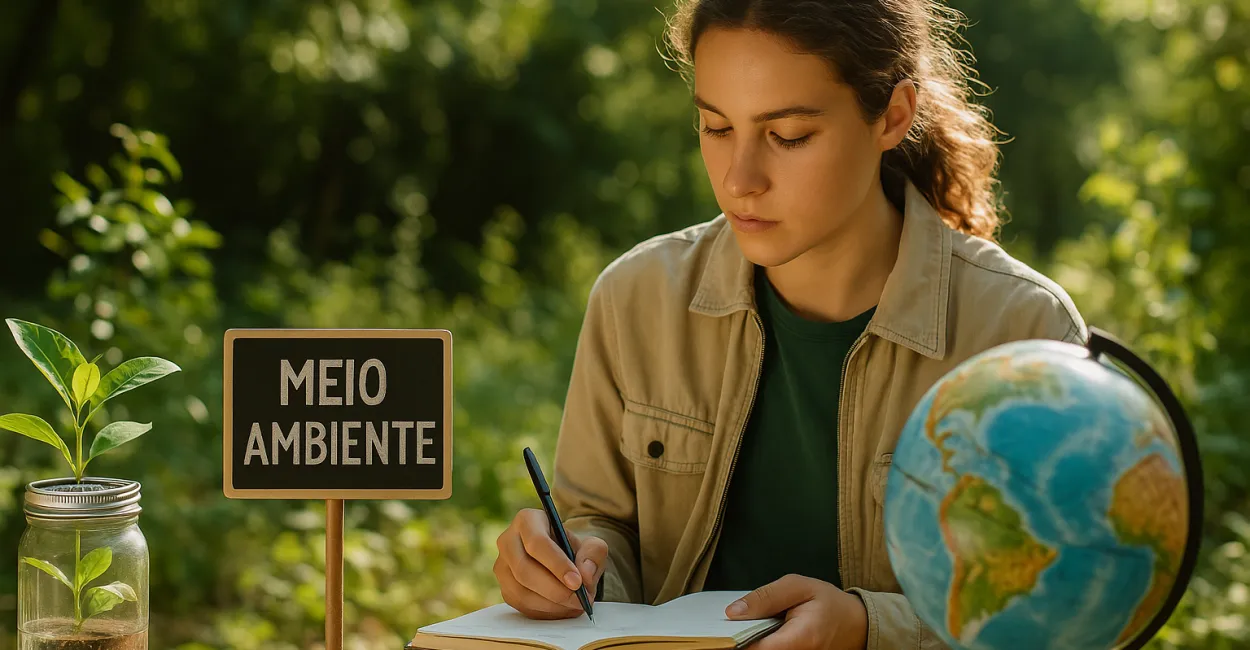
When a flood brings a city to a standstill, water bills rise, or the heat becomes hard to bear, we’re not talking about an abstract topic. We’re talking about the environment at work—or in crisis. It encompasses the natural, social, and cultural elements that sustain life, and understanding that changes how we consume, learn, and hold policymakers accountable.

The topic also comes up in schools, on occasions like World Environment Day, and in practical searches such as “environment activities,” “environment drawing,” and “environment essay.” The goal here is to bring together a clear definition, current context, examples from Brazil, and actions anyone can take—without empty rhetoric.
The essentials
- The environment is the set of natural, social, and cultural conditions surrounding life and affecting its quality.
- Sustainability is not the same as the environment: it means using resources without depleting them for future generations.
- Today’s most serious environmental problems include deforestation, pollution, the climate crisis, biodiversity loss, and unequal access to sanitation.
- World Environment Day takes place on June 5 and, in 2025, remains an important occasion for education, mobilization, and public debate.
- The most effective practical response starts with everyday habits, schools, neighborhoods, and pressure for efficient public management—in that order.
What is the environment, and why does it matter?
The environment is the system made up of everything that surrounds living things and makes life possible: air, water, soil, climate, wildlife, plants, cities, infrastructure, culture, and social relationships. Put simply, it’s the “living context” for people, animals, and plants.
It matters because any change to this system affects health, food, the economy, transportation, and even children’s learning.
In practice, nearly every everyday problem has an environmental dimension. Without adequate drainage, rain becomes a major disruption. When a watershed is degraded, water bills go up. When a lack of trees intensifies urban heat, school and work performance suffer. This is no exaggeration: the environment is essential infrastructure for survival.
A technical definition, in everyday language
Technically, the term encompasses biotic and abiotic components, as well as human interactions with the land. In plain English, it’s not just forests and rivers; it also includes sanitation, urban development, transportation, waste, and land use.
That’s why treating the environment as “untouched nature” limits the discussion.
The environment is more than a natural landscape. It includes the physical, biological, social, and cultural conditions that make life possible and shape its quality.
Why the topic moves beyond theory and into everyday life
Anyone who works in schools, health care, construction, or agriculture knows that the environment shows up in the details. A neighborhood without regular trash collection can become a breeding ground for disease-carrying pests. An area without vegetation suffers from heat islands. A contaminated river affects fishing, drinking water, and tourism. These connections explain why the topic has moved beyond a niche concern in ecology and become a public management issue.
For data and policy updates, consult sources such as IBGE, Brazil’s national statistics agency, Ipea, Brazil’s Institute for Applied Economic Research, and materials from the Ministry of the Environment and Climate Change.
What makes up the environment?
The elements of the environment are usually grouped into three dimensions: natural, social, and cultural. This framework helps us understand the whole picture without reducing the topic to vegetation. It also explains why a city can have trees and still face pollution, exclusion, and a lack of accessible green spaces.
The natural dimension
This includes the atmosphere, water, soil, landforms, climate, wildlife, and plants. It is the biophysical foundation that sustains ecosystems. When that foundation is degraded, the effects cascade: erosion, river siltation, habitat loss, and a decline in ecosystem services such as temperature regulation and pollination.
The social dimension
This involves how people occupy land, create wealth, live, travel, and consume. Basic sanitation, housing, public transportation, trash collection, and urban planning are all part of this dimension. In large cities, environmental inequality is easy to see: the heaviest impacts almost always fall on people with the fewest resources to protect themselves.
The cultural dimension
This includes values, habits, traditional knowledge, environmental education, and the symbolic relationship with nature. Riverine, Indigenous, and Quilombola communities, for example, preserve knowledge of land management that public policies often overlook. This is no folkloric footnote; it is practical knowledge about living alongside the environment.
| Dimension | What it includes | Practical example |
|---|---|---|
| Natural | Air, water, soil, climate, wildlife, and plants | Protecting springs and streamside forests |
| Social | Housing, sanitation, transportation, and consumption | Recycling programs and urban drainage |
| Cultural | Knowledge, habits, education, and identity | School and community conservation projects |
The most common mistake is treating the environment as “nature separate from society.” In practice, the environmental crisis stems from the interaction of land, consumption, inequality, and governance.
The environment and sustainability: what’s the relationship?

The environment is the system; sustainability is how we use it without undermining its ability to renew itself. In other words, one describes what exists, while the other guides how we act on it. The difference may seem subtle, but it matters when the discussion moves beyond rhetoric into planning, budgets, and public policy.
Where people often confuse the two concepts
Talking about sustainability doesn’t automatically solve an environmental problem. A “green” product may still be expensive, inaccessible, or inefficient; an “offset” project may still have a significant impact; a company may market itself as environmentally responsible without changing its practices. In other words, sustainability requires measurable results, not just a good story.
What actually changes in practice
A sustainable policy considers three criteria at once: environmental viability, social justice, and economic continuity. When one of these pillars is missing, the solution is likely to fail. Planting trees without ensuring their ongoing care, for example, makes for a nice photo but has little real effect. Restoring a degraded area with native species, monitoring, and local participation is more likely to produce lasting results.
This point features prominently in reports from organizations such as the United Nations Environment Programme (UNEP), which connects environmental degradation to patterns of production, consumption, and governance. The message is clear: sustainability isn’t a branding accessory; it’s essential to economic and social survival.
Major environmental problems in Brazil and around the world
Today’s biggest environmental problems don’t happen in isolation. They reinforce one another. Deforestation increases emissions, emissions worsen climate extremes, climate extremes affect agriculture and cities, and pressure on resources deepens inequality. In Brazil, these problems are especially evident in the Amazon, the Cerrado, urban areas, and regions with inadequate sanitation.
The five most urgent challenges
- Deforestation and wildfires: affect the climate, water, soil, and biodiversity.
- Air pollution: worsens respiratory diseases and reduces quality of life in cities.
- Water scarcity and contamination: affect drinking water, agriculture, and public health.
- Biodiversity loss: weakens ecosystems and services such as pollination and ecological balance.
- Climate change: intensifies droughts, floods, heat waves, and extreme weather events.
Brazil: it’s not just about forests
When people talk about the environment in Brazil, many think only of the Amazon. But urban crises weigh as heavily as forest loss across several indicators. Lack of sanitation, poor waste disposal, settlement on hillsides, and inadequate drainage cause real harm, especially in low-income neighborhoods. A closer look makes it clear that environmental policy is also health, housing, and transportation policy.
To follow environmental news in context, compare news coverage with technical sources and official data. News without data becomes noise; data without news doesn’t reach the public.
A short story that plays out in many cities
In a low-income neighborhood, a school started losing class time whenever heavy rain fell. The problem wasn’t just water in the schoolyard. Poor drainage, trash piled up nearby, and informal development in a runoff area were all factors. After a community cleanup and pressure for public works, classes resumed with fewer interruptions. Stories like this show how closely the environment and urban management are connected.
World Environment Day: meaning, date, and 2025 theme
World Environment Day is observed on June 5. It was established by the United Nations in 1972, during the Stockholm Conference. The day draws attention to environmental problems, encourages public policy, and promotes environmental education. In 2025, the official theme continues to be set by the UNEP/UN agenda and typically guides campaigns, schools, and community initiatives throughout the year.
Why this day still matters
Observances have their limits, but they can be a starting point for meaningful action. The problem is treating June 5 as a showcase and forgetting about the rest of the year. In schools and organizations, the day is more useful when it’s tied to an ongoing project: composting, gardens, waste monitoring, landscape observation, or water conservation campaigns.
How to use World Environment Day at school and in the community
Rather than giving a one-off presentation, connect the day to something people can observe. One class can map litter hotspots in the neighborhood. Another can compare shaded areas with paved ones to understand heat islands. Students could also interview residents about flooding or the lack of trees. When the topic moves off the poster and into the community, it becomes meaningful.
Environmental activities for schools and early childhood education
The best activities turn observation into learning. In early childhood education, the goal isn’t to “teach complex concepts,” but to build a connection with nature, a sense of care, and an awareness of everyday routines. Simple materials work well when the teacher has a clear purpose.
Practical ideas for young children
- Sort waste using color-coded bins and real objects.
- Plant beans, herbs, or seedlings in recycled cups.
- Hold a group discussion about water, trees, animals, and trash.
- Create collages with paper, dried leaves, and reused materials.
- Walk around the schoolyard to spot shade, plants, and areas that need care.
Activities for elementary school
With older children, you can introduce recordkeeping and analysis. They can track water use at home, compare packaging, make recycling posters, and observe the area around school. The activity is more effective when it includes a question, a record of findings, and a follow-up discussion—not just a hands-on project.
An environmental activity for young children that often works well is setting up “mini stations” for caring for the environment: one for water, another for plants, and another for waste. Children learn through hands-on experience and repetition. Not every activity works the same way in every setting—age, space, and classroom routines all affect how it should be designed.
Quick checklist for an educational activity
- State the goal in one sentence.
- Use accessible, safe materials.
- Connect the activity to a real issue in the community.
- Ask children to document something: a comment, drawing, photo, or list.
- End with a practical action to take at home or school.
Ideas for environmental drawings, essays, and projects
People searching for an “environment drawing” or “environment essay” often need quick inspiration that’s also useful. The key is to avoid overly generic images. A good drawing or essay about the environment shows relationships, care, and consequences—not just a few trees and a sun in the corner.
What to include in an environmental drawing
You can combine natural and social elements in the same scene: a clean river, trees, birds, recycling, a bicycle, a garden, children planting, and homes with sanitation. This makes it clear that the environment isn’t separate from human life. A strong drawing conveys balance, responsible use of space, and harm prevention.
How to write an essay about the environment
A good school essay starts with a central idea and ends with a practical action. Instead of listing disconnected statements, use a simple structure: definition, problem, example, and solution. If you’re writing an environmental essay for school, use clear language and end with a call for everyday responsibility.
Project ideas that go beyond the obvious
- A school garden with weekly growth tracking.
- Mapping street trees and comparing areas of shade.
- A campaign to reduce plastic in school lunches.
- A bulletin board featuring environmental news from the month.
- An art show of drawings featuring solutions for the neighborhood.
An environmental drawing or essay is more powerful when it shows cause and effect: what’s being protected, what’s under threat, and what action can change the situation.
How anyone can help in practice
Individual contributions matter, but they don’t replace public policy. That’s a limitation many campaigns overlook. Sorting trash, conserving water, and avoiding waste really do help; at the same time, the scale of the problems calls for action on sanitation, enforcement, clean transportation, and protecting biomes. Combining both levels is what works.
What actually makes a difference
- Reduce food and energy waste.
- Use public transportation, ride a bike, or walk when possible.
- Dispose of electronics and cooking oil at designated drop-off locations.
- Cut back on single-use plastics.
- Follow local elections, urban plans, and environmental decisions.
If you want to make lasting changes, start with one habit you can maintain for 30 days. People who try to change everything at once often give up. Establishing a routine—composting, carrying a reusable water bottle, sorting waste, or supporting local initiatives—creates real, lasting impact.
What to do now
Environmental issues stop being abstract when they become part of everyday life, school, and the push for basic services. The next step isn’t to gather more information; it’s to choose a concrete action: reduce waste at home, adapt a school activity, take a closer look at your neighborhood, or follow a public issue related to water, waste, or tree cover.
If you want to use this as a practical reference, turn one idea into action this week: try an activity with children, review a school drawing or essay, or follow an environmental news story alongside official data. That’s how a broad topic becomes visible change.
Frequently asked questions
What does the environment mean?
The environment is the set of natural, social, and cultural conditions surrounding living things and making life possible. It includes air, water, soil, climate, wildlife, plants, cities, sanitation, habits, and human relationships. It’s not just preserved nature, but the complete system in which life takes place.
What is the difference between the environment and sustainability?
The environment is the set of elements and relationships that make up our living space. Sustainability is how we use that system without compromising its ability to renew itself in the future. One is the reality; the other is the principle for managing it.
When is World Environment Day?
World Environment Day takes place on June 5. It was established by the United Nations in 1972 and is used to promote mobilization, environmental education, and public policy. Schools, companies, and communities often mark the day with campaigns and themed projects.
What environmental activities can young children do?
Simple activities work best at this age: planting, sorting waste, making collages with reused materials, group discussions, and exploring a schoolyard or garden. The focus should be on connection, care, and discovery—not heavy theory. The more hands-on the experience, the more children learn.
What should I include in an essay about the environment?
A good essay needs a definition, an example, and a proposed action. You could discuss the importance of water, trees, recycling, pollution, or wildlife conservation, always connecting the topic to everyday life. End with a practical action or a reflection on shared responsibility.
What should I include in an environmental drawing?
A drawing can show nature and urban life coexisting in balance: trees, a clean river, animals, recycling, people planting, and well-kept streets. What makes the drawing powerful is its visual message about care and consequences. Avoid empty, generic scenes if you want to communicate something more memorable.
%%AGPTRH10%%
Artigos Relacionados
 Essential 21st-Century Skills: Prepare for the Future
 Socio-Environmental Change Through Education: Paths to a Sustainable Future
 Artificial Intelligence: A Revolution in 21st-Century Education
 AI Advances: Transforming 21st-Century Education
 Youth and Adult Education in Brazil: Better Preparation for a Successful Future
 Education and New Technologies: Transforming the Future of Teaching
