
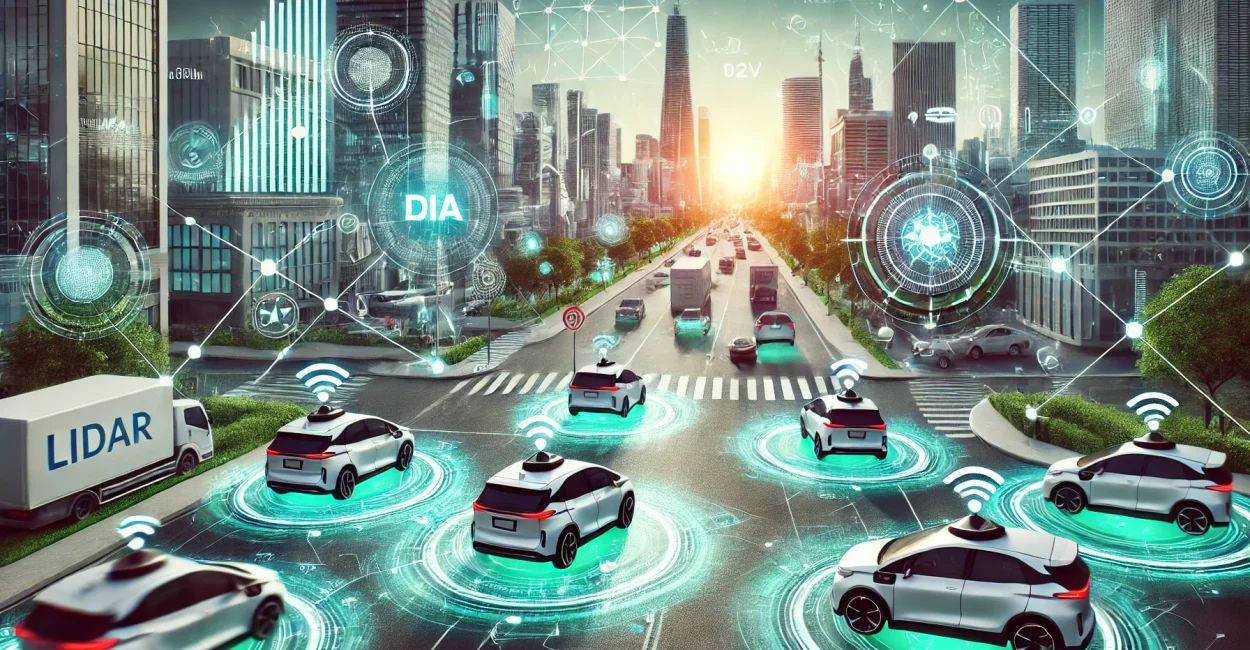
A vehicle that drives itself is no longer science fiction. It’s a combination of sensors, software, and onboard computing designed to take over some—or all—of the task of driving. For autonomous cars, the goal is to have the vehicle perceive its surroundings, make decisions, and maneuver based on real-time data, with or without a driver’s intervention. This matters because it changes how we think about mobility: fewer human errors, more efficient routes, new forms of urban transportation, and a direct impact on insurers, automakers, cities, and legislation. Here, we’ll look beyond the hype to show what already works, what still needs validation, and why this technology is advancing faster in some scenarios than others.

The Essentials
- An autonomous car can perceive its surroundings, plan a route, and control acceleration, braking, and steering at varying levels of automation.
- In practice, the most reliable systems today operate in restricted areas with detailed maps and clearly defined rules. Driving “anywhere” remains the biggest challenge.
- The biggest constraint on adoption isn’t just hardware, but the software’s ability to interpret rare situations, such as roadwork, heavy rain, unpredictable cyclists, and confusing signs.
- SAE automation levels help distinguish driver assistance from truly autonomous driving, preventing exaggerated marketing claims.
- Safety, civil liability, and regulation are just as important as the technology in determining how quickly it’s adopted commercially.
Autonomous Cars And The Evolution Of Automated Driving
Technically, an autonomous car is a cyber-physical mobility system that integrates perception, localization, planning, and control to perform driving tasks without continuous human supervision. Put simply, it “sees” its surroundings, understands what’s happening, and decides what to do.
It sounds simple on paper.
This evolution didn’t begin with fully driverless vehicles. It started with anti-lock brakes, stability control, adaptive cruise control, lane-keeping assistance, and automatic emergency braking. Each layer reduced the driver’s cognitive load and paved the way for more ambitious systems.
SAE Automation Levels
The SAE J3016 classification is the most widely used reference for distinguishing driver assistance from true autonomy. It ranges from Level 0, with no automation, to Level 5, where the vehicle could drive itself in any drivable condition.
- Level 1: The car assists with one function at a time, such as adaptive cruise control.
- Level 2: It combines steering with acceleration and braking, but the driver remains responsible at all times.
- Level 3: The system takes over in specific scenarios but may ask the driver to resume control.
- Level 4: It operates on its own within clearly defined limits, such as a mapped urban area.
- Level 5: In theory, it needs no steering wheel or pedals, but in practice, this is the least mature stage.
The key distinction between advanced driver assistance and true autonomy isn’t whether the vehicle has cameras or radar. It’s whether the vehicle can handle the unexpected on its own without relying on immediate human intervention.
How Sensors Turn The Environment Into Decisions
A car doesn’t “see” the way a person does. It combines different sensors to reduce errors and add redundancy. Cameras identify lane markings, signs, and objects; radar measures distance and speed; LiDAR creates a 3D point cloud; GPS and IMUs help pinpoint the vehicle’s location; and HD maps provide an additional layer of context.
This redundancy exists because no sensor is perfect on its own. Cameras struggle in poor lighting; radar is excellent at measuring distance but poor at capturing fine details; LiDAR tends to cost more and can be less effective in adverse weather. Anyone who works in this field knows that reliability comes from sensor fusion, not a single “miracle” component.
Perception, Localization, And Planning
After capturing its surroundings, the software has to answer three questions: Where am I? What’s around me? What’s a safe path right now? This is where computer vision algorithms, SLAM (simultaneous localization and mapping), and trajectory planning come in.
This stage is the heart of the system. If perception misses a pedestrian, the rest of the technology stack is of little use. If localization is off by a few yards, the car may misinterpret the road, especially on urban streets with faded lane markings or temporary construction zones.
Where The Technology Already Works And Where It Still Falls Short

In practice, the best results come in controlled environments: logistics corridors, corporate campuses, test tracks, urban shuttles on fixed routes, and operations in predictable weather. That’s why companies such as Waymo, Mobileye, and GM Cruise have focused their efforts on well-defined regions and scenarios.
The problem is that real-world traffic doesn’t follow a script. An autonomous car may perform well for weeks, then freeze when faced with an ambulance, poorly marked roadwork, or a motorcyclist making an unexpected move. That’s where the commercial promise meets the physical world.
| Scenario | Current performance | Main limitation |
|---|---|---|
| Well-marked highways | High | Rare cases and sudden lane changes |
| Mapped urban centers | Moderate to high | Pedestrians, roadwork, and unpredictable behavior |
| Rural or unmapped areas | Low | Limited data, inconsistent signage, and poor coverage |
| Severe weather | Variable | Heavy rain, fog, and debris on sensors |
A useful resource for understanding the regulatory landscape is the NHTSA’s page on automated vehicles, which shows how safety remains central to the discussion.
Full autonomy in open environments isn’t just an engineering problem; it’s also an edge-case problem, where rare situations matter more than routine trips.
Safety, Regulation, And Liability In Practice
One of the biggest misconceptions about this technology is that “self-driving” automatically means “safer.” It could be safer in some ways: human error contributes to a large share of crashes. But automotive safety isn’t just about reducing distraction and fatigue. It also depends on anticipating failures, proving reliability, and determining who’s responsible when something goes wrong.
Read also: Chipsets and AI: Revolutionary Innovations and Processing Challenges
In the U.S., regulators focus heavily on incident reporting, certification, and ongoing monitoring. In Brazil, the discussion is still evolving around traffic regulations, controlled testing, and civil liability. To follow the regulatory framework, consult the Brazilian Ministry of Transport’s website and discussions by Senatran, Brazil’s National Traffic Secretariat.
Who’s Responsible For A Crash?
There’s no single answer. Responsibility could fall on the manufacturer, fleet operator, software developer, owner, or even a third party who altered the environment, such as by setting up poorly marked temporary signs. The key point is that the more autonomy a system takes on, the less sense it makes to treat the car as an isolated mechanical object.
Experts disagree on exactly when responsibility shifts from the driver to the system. At Levels 2 and 3, that boundary is particularly delicate.
Read also: The Future of Image Search
The Impact On Urban Mobility, Insurance, And Ownership Costs
If this technology matures, its impact will be greater on mobility than on individual car ownership. Shared fleets, robotaxis, last-mile transportation, and urban logistics could become more efficient because vehicles can operate more hours per day and be used more predictably.
In practical market terms, what’s likely to change first isn’t the average family’s car, but the way businesses operate. That’s because centralized fleets, standardized routes, and planned maintenance make it easier to achieve a return on investment. Consumers, meanwhile, tend to expect affordability, privacy, trust, and convenience all at once—a much higher bar.
What Insurers And Manufacturers Are Watching
Insurers analyze telematics, incident rates, system behavior in risky scenarios, and repair costs. Manufacturers, in turn, are working to reduce the cost of sensor systems and the computing power needed to run AI models in real time.
This balance is critical. If hardware costs fall but validation remains too expensive, commercial expansion will slow. If insurers can’t price the risk, adoption will stall too.
Companies, Data, And The Global Race For Autonomy
The ecosystem includes automakers, software companies, map providers, sensor manufacturers, and cloud providers. Frequently cited names include Tesla, Waymo, Mobileye, Baidu Apollo, and traditional manufacturers such as Mercedes-Benz and General Motors, each with a different strategy.
This market isn’t advancing in a straight line. It goes through hype cycles, aggressive promises, regulatory setbacks, and, in some cases, a shift toward more specialized markets. In practice, many companies have found that selling reliable partial automation is easier than delivering full autonomy in every condition.
Why Data Is The New Fuel
Automated driving models depend on large volumes of labeled data, synthetic scenarios, and real-world validation. The competitive edge lies not just in the car, but in training quality, coverage of rare cases, and the ability to update software continuously.
That’s why road tests and large-scale simulations matter so much. Without them, a system learns the “normal” but fails when faced with the extraordinary.
What To Expect In The Coming Years
The most plausible trend isn’t a sudden leap to Level 5, but a gradual expansion of Level 4 applications in defined areas. First will come logistics corridors and robotaxis in mapped regions, followed by more cities, more weather conditions, and greater integration with smart infrastructure.
At the same time, the next phase will require less marketing and more reliability engineering. The market has already learned that a flawless demo at a closed event isn’t enough. What matters is completing thousands of trips without a hitch, with predictable maintenance, clear rules, and an incident rate suitable for commercial use.
Short story: In an urban transportation pilot, a vehicle completed its first 100 trips without intervention but failed on the 101st when roadwork signs had been moved overnight. This kind of case shows why autonomy must handle even small variations in the real world, not just attractive maps on a screen.
To follow global trends and technical reports, it’s also worth keeping an eye on publications from universities and research centers, along with public documents on automated vehicles. The serious discussion isn’t whether automation will grow, but where, when, and at what level of autonomy.
What To Do Now If You Want To Follow This Market
If you want to understand this field, keep an eye on three areas at once: technological progress, regulation, and real-world use cases. Anyone who follows only automaker announcements misses the bigger picture. Anyone who looks only at legislation without understanding sensors and software gets an incomplete view, too.
The best next step is to compare SAE levels, look at commercial applications already in operation, and follow safety reports from regulatory agencies. That’s how you separate promises from products. And that’s when autonomous cars stop seeming like an abstract concept and become an industry with measurable limits, risks, and opportunities.
Frequently Asked Questions
Is an autonomous car the same as a car with cruise control?
No. Cruise control is generally a form of driver assistance, not full autonomy. An autonomous car needs to perceive its surroundings, make decisions, and take action with far less reliance on the driver.
Are autonomous cars safe to use in any city yet?
No. They can be safe in specific areas with detailed maps and well-controlled rules, but they still struggle with chaotic traffic, bad weather, and unfamiliar situations. Driving “in any city” remains a difficult goal.
What’s the main technical obstacle today?
The biggest challenge is handling rare, unpredictable situations without losing performance. Makeshift roadwork, erratic human behavior, and sensor failures still require more robust solutions.
Why are sensors so important?
Because they feed the vehicle’s entire perception process. Without reliable, well-integrated sensors, the software can’t locate the car or correctly interpret what’s ahead.
Will this technology replace all drivers?
Not in the near term. The most realistic scenario is gradual replacement in specific tasks, such as transportation on fixed routes, logistics, and controlled urban services. Driving in any condition remains far from widespread commercial use.
How can you tell if a vehicle is truly autonomous?
Check the SAE level reported by the manufacturer and the conditions in which the vehicle operates. If the system requires constant supervision, it isn’t equivalent to full autonomous driving, no matter how sophisticated its marketing name sounds.
%%AGPTRH5%%
Artigos Relacionados
 Quantum Computing: Understanding the Present and Future of Technology
 Transportation Engineer: A Key Professional for the Future of Urban Mobility
 Technology in the Workplace: A Complete, Practical Guide
 Blockchain: Transforming the Future Beyond Cryptocurrency
 Microprocessors: History, Manufacturing, and the Future of Microchips
 Computer Scientist: A Complete Guide to Your Career and Future
