
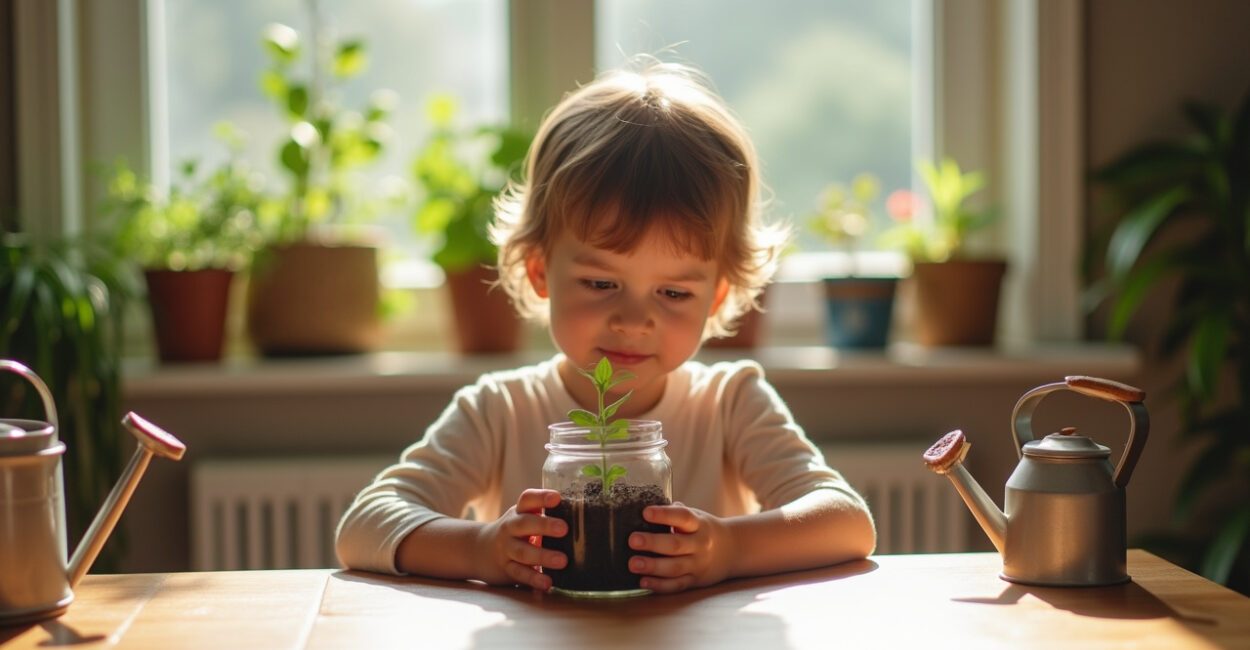
A child might walk past a puddle without noticing anything. Given time to look closely, they may spot floating leaves, tiny insects, or traces of the rain. Environmental activities for young children begin with experiences like these: simple ways to explore nature and everyday surroundings, at home or at school.
Environmental education at this age is a learning process that helps children connect with living things, natural resources, and the places they spend time in. It can start with a window, a potted plant, or the water used to wash their hands; a garden and printed worksheets are optional.

How to choose environmental activities for young children
Choose something the child can observe and explore safely, such as tracking a seed’s growth, comparing fallen leaves, or finding out where rainwater goes. Gather just a few materials, explain the ground rules, and leave room for questions and discoveries. Then talk about what changed and what the experience revealed about caring for the environment.
An activity works best when it has a clear purpose and fits the group’s attention span. For young children, observing a single change, such as a seed opening, is often more rewarding than piling on tasks and explanations about distant environmental problems.
Caring for the environment becomes meaningful when children see how their actions affect the places they share.
Explore your surroundings without a garden
Your surroundings might be the schoolyard, the sidewalk outside a window, or the walk to school. The goal is to investigate what’s within reach without picking plants, disturbing animals, or touching unfamiliar materials.
- Choose a focus: sounds, shadows, fallen leaves, wind, or signs of rain.
- Invite children to observe quietly for a few moments. Then ask what they noticed and what they’d like to investigate.
- Record discoveries with drawings, words dictated to an adult, or a conversation you revisit the next day.
One way to avoid frustration: shadows move, the wind may stop, and a bird might not show up. The investigation is still worthwhile; the subject can also be the absence of a sign at that moment and how it compares with another observation.
Germinate seeds and track their growth

Germination lets children observe one stage in a plant’s life cycle. For a short activity, use a clean container, cotton or a paper towel, water, and large seeds such as beans, always with adult supervision.
- Dampen the cotton without soaking it, then place a few seeds in the container.
- Set it in a bright spot out of direct, strong sunlight, and decide who will check for changes each day.
- Record what appears: the seed coat opening, the root, and then the sprout. If conditions allow, transfer the seedling to a suitable pot.
Cotton makes germination easier to see, but it doesn’t give a plant everything it needs to grow for long. Explain the difference to children and discard the materials if mold appears. If allergies, small seeds, or the risk of a child putting seeds in their mouth are concerns, adapt the activity and supervise closely.
Read also: Environmental Coloring Activities
Explore water, textures, and biodiversity safely
A shallow tray with a small amount of water can help children compare how large, clean objects behave: some float, while others sink. Offer items that can’t be swallowed, and keep an adult within arm’s reach of the group throughout the activity. Empty the tray when you’re done.
To explore textures, choose fallen leaves and other objects that are already loose, with no thorns or signs of decay. Children can compare roughness, shape, and color by looking and touching, as long as they don’t put the materials in their mouths. Ornamental plants and lichens can be toxic or irritating, and it’s not possible to identify every species safely by appearance alone.
Read also: Entrepreneurship Activities for Young Children
If the group can’t touch natural materials, photographs, drawings, or looking through a window can still spark conversations about living things and their habitats. Exploration should respect both the child’s pace and the actual conditions of the space.
Create collages with reused materials
Environmental collage activities can explore composition, textures, and consumer choices. Gather clean, previously used paper, such as uncoated cardboard packaging or scrap paper, and provide nontoxic school glue. Avoid packaging with food residue, an unclear source, or sharp edges.
- Suggest an observable theme, such as a place the class knows or the living things they imagine finding there.
- Provide large pieces of paper and let each child tear them or choose shapes prepared by an adult.
- As they create, talk about where the materials come from and where they go, without expecting everyone to make the same picture.
For children who still put objects in their mouths, don’t offer small scraps. An adult should cut the paper ahead of time, put scissors away, and supervise the glue. The activity can still be meaningful if a child would rather arrange the shapes than glue them down.
Alternatives to printable activities
A printed worksheet can help children record what they notice, but it can’t replace an experience that lets them observe, talk, and test an idea. If you don’t have a printer, use reused paper for drawing, a board to record the group’s notes, or photos taken by an adult, following the school’s rules for images.
Instead of using a recycling coloring sheet, for example, the class can look at clean packaging and talk about which materials they recognize. At home, a child can describe what they observed while an adult writes down their words. Printable activities are one option, not a requirement.
Adapt the activity to the children, space, and BNCC
These activities can be introduced during the early years of childhood education, with adjustments for children’s development and the supervision available. For toddlers, keep observations brief and use large materials; with older children, add comparisons, record-keeping, and questions about changes over several days.
| Situation | Adaptation |
|---|---|
| No garden | Observe the sky, shadows, sounds, or plants through a window. |
| Limited time | Make a brief observation and return to the topic another day. |
| Child who prefers not to touch | Offer visual observation, drawings, or objects presented by an adult. |
To connect an activity to the BNCC, Brazil’s national curriculum framework, identify the learning experience it involves. Investigating changes and recording discoveries can align with the field of experience “Spaces, times, quantities, relationships, and transformations”; creating a collage connects with “Lines, sounds, colors, and shapes.” The connection should be evident in what children do and investigate, not just in the activity’s name.
The Base Nacional Comum Curricular (Brazil’s Common Core Curriculum) outlines learning rights and fields of experience for early childhood education. Law No. 9,795/1999, which established Brazil’s National Environmental Education Policy, treats environmental education as part of national education. How it is applied depends on the children’s ages, the school’s program, and safety conditions; a one-off activity is no substitute for ongoing work.
Frequently asked questions about environmental activities for young children
At what age can I start these activities?
You can introduce these experiences in the early years, with constant supervision and age-appropriate materials. For babies and children who put objects in their mouths, stick to observing and exploring large, safe objects with an adult.
How can I explore this topic without a garden?
Use what’s available: a window, the schoolyard, the street viewed from a safe spot, or even water and shadows indoors. The focus is on investigating, not on the size of the space.
How can I make sure reused materials are safe?
Inspect every item and use only clean materials with no sharp edges, residue, or small parts that could be swallowed. An adult should prepare the objects and supervise the use of glue, scissors, and water.
Do I need to print a worksheet to record observations?
No. Children can draw, explain what they noticed, or take part in a conversation that an adult records. A worksheet is optional and shouldn’t take the place of exploration.
How can I tell if an activity is right for the group?
Notice whether children can take part without waiting too long or handling risks they don’t yet understand. If the task requires abstract explanations, too many steps, or materials that are hard to control, scale it back or choose another kind of exploration.
Artigos Relacionados
 Letter Activities in Early Childhood Education
 Activities for Early Childhood Education: Practical Ideas
 Activities About Jobs in Early Childhood Education
 Mother’s Day in Early Childhood Education: 7 Memorable Activities
 Exploring the World Through the Senses: 10 Creative, Safe Sensory Activities to Support Early Childhood Development
 A Guide to Early Childhood Education: Best Practices, Play-Based Activities, and Innovative Approaches to Whole-Child Development
