
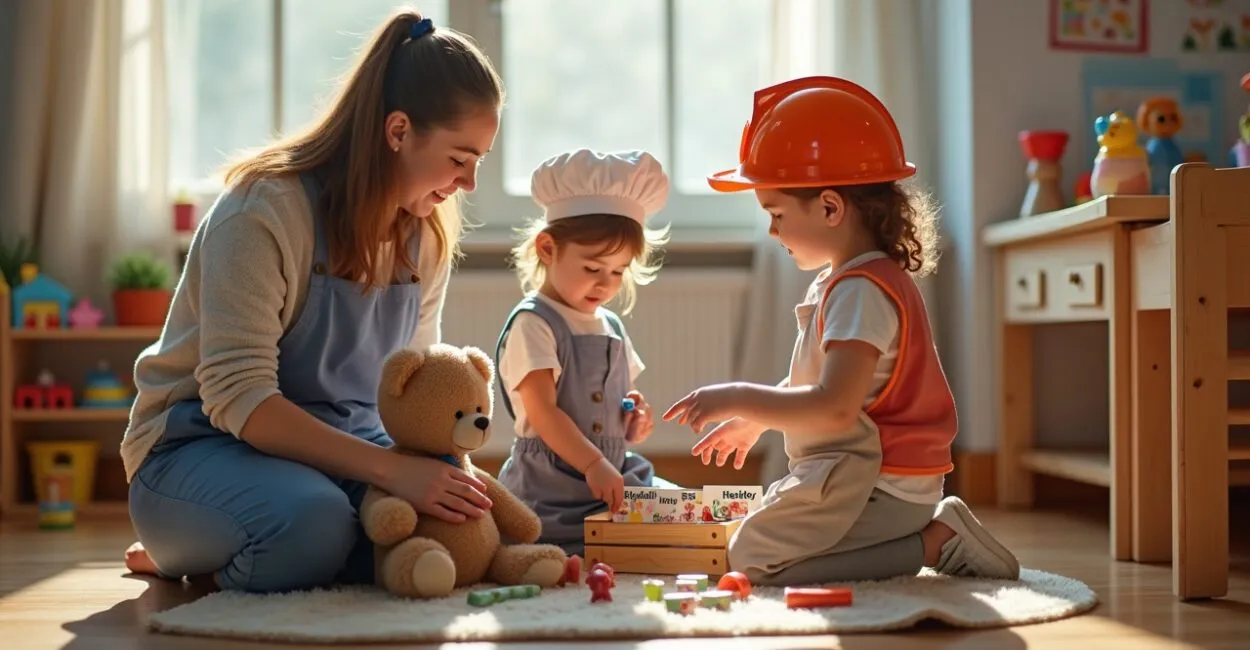
When a child plays doctor, cook, or firefighter, they’re doing more than imitating adults: they’re organizing the world into categories, expanding their vocabulary, and practicing social language. Job activities in early childhood education work especially well because they turn a concrete topic into play, conversation, and observation—three ways into learning that make sense for this age group.
In practice, what works best isn’t “teaching jobs” as an abstract concept. It’s creating situations where children name, compare, act out, and draw the work people around them do. This article explains how to do that with a clear educational purpose, which activities suit different ages, and where they make a real difference: oral language, motor skills, imagination, and group interaction.

The Essentials
- Jobs in early childhood education should be explored through language, pretend play, and social interaction—not by memorizing job titles.
- The best activities let children observe, role-play, sort, and talk about what different workers do.
- For younger children, focus on recognition and imitation. Older children can move on to comparing jobs, sequencing tasks, and creating their own records.
- Activities that are too long or abstract quickly lose their appeal. Short, repeatable activities using real objects or pictures tend to work best.
- The topic is more engaging when it connects to jobs in the local community, such as a school custodian, cafeteria worker, nurse, driver, teacher, farmer, or shopkeeper.
Job Activities in Early Childhood Education: What Children Really Learn
The key educational concept here is social role-play: a child acts out everyday roles to understand how human relationships work. That’s different from “memorizing jobs.”
When a child puts on a lab coat, sets up a market stall, or cares for a doll in a pretend doctor’s office, they’re practicing oral language, sequencing, empathy, and an understanding of social roles.
This kind of activity aligns with Educação Infantil na BNCC (Early Childhood Education in Brazil’s National Common Core Curriculum), which emphasizes areas of experience, interaction, and play. It also reflects what UNICEF Brazil highlights about play as a central language of early childhood.
In practice, that means the material shouldn’t become a lecture. Instead, plan a series of short, connected experiences.
What makes an activity educationally effective—not just fun—isn’t the materials. It’s the quality of the adult’s guidance during play.
Why This Topic Works So Well
Jobs are concrete. Children see doctors, cooks, drivers, sanitation workers, teachers, and store owners on the way to school, at a health clinic, at the bakery, and on TV. That makes the topic easier to understand because it starts with something children can observe. When adults name, ask questions, and make comparisons, children begin to notice that each job involves different tools, places, clothing, and responsibilities.
This kind of thinking can also help challenge stereotypes early. I’ve seen children say that “firefighters are for boys” or that “nurses are the same as doctors.”
A few discussions using real pictures, toys, and role-play were enough to help the children rethink those ideas without conflict.
How to Plan for Different Age Groups Without Pushing Too Hard
Good planning helps avoid two common pitfalls: making activities too simplistic for older children and expecting too much from younger ones. Age isn’t the only factor, but it can guide the level of abstraction, attention span, and kind of documentation that makes sense.
Here’s a practical age-group breakdown that tends to work well in early childhood education.
Age group
Main goal
Most effective format
Activity example
Ages 2–3
Recognize and imitate
Sensory play and gestures
“Who uses this?” with simple objects
Age 4
Name and make connections
Pictures, group discussion, and short role-play
Job-themed memory game with cards
Ages 5–6
Compare and explain
Projects, interviews, and oral presentations
Map of jobs in the community
Ages 2–3: Imitation, Sounds, and Objects
At this age, hands-on experiences make the biggest difference. Objects like a wooden spoon, toy stethoscope, helmet, brush, mop, or toy cash register are more engaging than long explanations. Children watch, touch, and imitate the actions. If an adult asks, “Who uses this?”, a child might answer with a word, a gesture, or a point—and all of these count as participation.
Age 4: Naming, Comparing, and Sorting
At this stage, children can start matching jobs with tools, workplaces, and actions. Memory games, picture hunts, and group discussions make a lot of sense. The important thing is not to turn the activity into an oral quiz. Children need room to make mistakes, try again, and listen to their classmates, because social learning matters just as much as the content at this age.
Ages 5–6: Explaining Roles and Making Community Connections
With older children, you can introduce simple interviews, work sequences, and short written records with teacher support. They can understand that jobs meet real needs: caring for people’s health, transporting people, preparing food, teaching, cleaning, selling, and building. This is a great time to connect the topic to the school community and families.
Read also: Entrepreneurship for Kids: Activities for Early Childhood Education
7 Practical Activities That Work in the Classroom

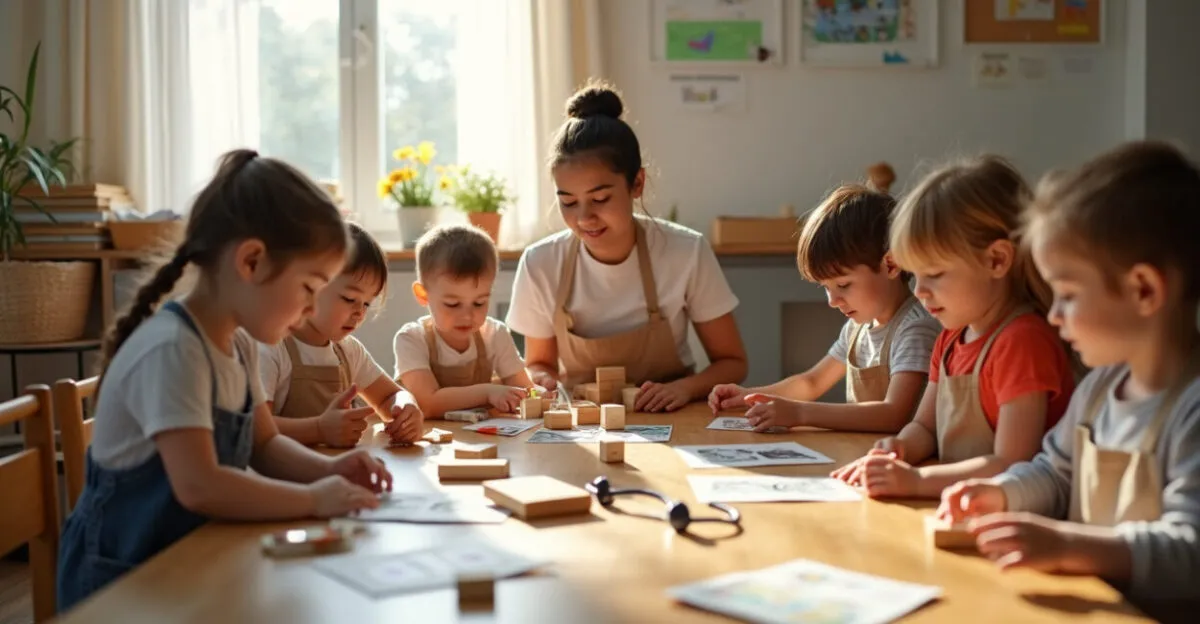
If your goal is to build vocabulary and interaction, the activity should be easy to explain and open to exploration. Here, less is more: a good activity leads to conversation, repetition, and variations. The best experiences often use real pictures, improvised costumes, everyday objects, and movement.
- Job Box: Put objects in a box and ask the children to guess which jobs they go with.
- Picture Circle: Show photos of workers and ask where they work, what they do, and what tools they use.
- Classroom Mail Carrier: One child “delivers letters” as a mail carrier while the others plan the route.
- Classroom Store: Use empty packages, shopping bags, and labels to play store.
- Pretend Doctor’s Office or Hospital: Dolls, clipboards, and lab coats help children act out caring for someone’s health.
- Building with Blocks: A great way to talk about engineers, construction workers, architects, and job-site safety in age-appropriate language.
- Family Jobs: Children draw or talk about what the adults in their household do at work.
When children play at having a job, they’re not “putting on a show” just for fun. They’re practicing language, logical sequencing, and how to understand the social world around them.
One important note: not every job needs to involve costumes. Sometimes pictures, short videos, and real objects work better than an elaborate performance. The topic should also reflect the local community. In rural areas, for example, jobs like farmer, tractor operator, market vendor, and community health worker may be more relevant than activities focused only on urban jobs.
How to Build Vocabulary and Speaking Skills Without Turning It into an Interrogation
A good strategy is to ask questions that help children think, not just answer. Instead of “What job is this?”, try asking “What does this person do?”, “Where do they work?”, and “What do they need to do their job?” These questions encourage fuller sentences and give children a chance to make meaningful connections.
Questions That Worked Well in the Classroom
- What does this person do during the day?
- What tools do they use at work?
- Where do they work?
- Who do they help?
- Does this job involve caring for people, fixing things, making things, or selling things?
The strength of these questions is that they take children beyond job titles. They help children understand roles, tools, and context. Instead of a disconnected list, children start building a network of meanings. It may seem like a small step on paper, but it makes a big difference in oral language development.
Simple Materials, Planning, and Inclusive Adaptations
The most useful materials are often the easiest to find: cards with real pictures, clean recyclables, aprons, boxes, letter-size paper, chalk, modeling clay, dolls, and classroom supplies. A good activity doesn’t require expensive purchases. What matters is how the space is arranged and how clearly the activity is explained.
Preparation Checklist
- Choose just a few jobs at a time so the class doesn’t feel overwhelmed.
- Use real pictures whenever possible; they’re easier to recognize than generic illustrations.
- Include materials children can touch, move, and sort.
- Have a shorter version of the activity ready for children with shorter attention spans.
- Offer different ways to participate for children who aren’t yet speaking fluently.
Every situation is different. For example, in classrooms with neurodivergent children, too much visual stimulation can be more distracting than helpful. In very talkative groups, the teacher may need to provide firmer guidance to keep children focused. Job activities work best when the adult adjusts the pace to the group rather than sticking to a rigid script.
If your goal is to broaden children’s cultural awareness, look for reliable sources with pictures and basic information about work and childhood. IBGE Explica Trabalho (IBGE Explains Work, a resource from Brazil’s national statistics agency) provides accessible context about occupations and economic activity. To connect the topic to everyday life, you can also explore neighborhood public services, the farmers market, the school, and the health clinic as places to learn.
Common Mistakes That Weaken the Activity
The most common mistake is turning the activity into a holiday bulletin-board display. Pasting pretty cutouts doesn’t guarantee learning if children aren’t talking, handling materials, comparing, and acting things out. Another common problem is introducing jobs that are far removed from the children’s lives without connecting them to the local community.
It also doesn’t work to correct children too often. If a child calls everyone at the hospital a “doctor,” don’t scold them; use it as a chance to explain the differences. A hospital team may include a nurse, doctor, nursing assistant, receptionist, patient transporter, and environmental services staff. Children learn the precise terms gradually through repetition and context.
Jobs in early childhood education aren’t facts to memorize; they’re a way to observe people at work.
Next Steps for Bringing the Topic into the Classroom Routine
The best results come when a topic goes beyond a one-off activity and becomes a series of experiences. Start with a group discussion, move on to role-play, and finish with a drawing, collage, or group record. Then revisit the topic another week with new jobs, new objects, or a guided tour of the school.
To use this approach consistently, choose three jobs at a time, connect each one to a real object, and include something a child says in every session. This simple structure avoids information overload and strengthens learning. In practice, that’s what brings the topic to life instead of turning it into just another worksheet.
Frequently Asked Questions
What Is the Best Age to Explore Jobs in Early Childhood Education?
You can introduce the topic as early as age 2, but the approach changes quite a bit with age. With younger children, focus on imitation, objects, and sounds. With older children, you can move on to explaining, comparing, and making records. The most important thing is to respect each group’s language skills and attention span. When you do, the activity becomes more than repetition—it helps children make meaning.
Which Jobs Are Best to Start With?
Jobs that are part of children’s everyday lives tend to work best: teacher, doctor, firefighter, cook, mail carrier, driver, store clerk, and farmer. Children encounter them in daily life, books, and cartoons, which makes them easier to understand. You can later introduce other community jobs, such as nurse, construction worker, hairstylist, and community health worker. The key is to start with what children recognize.
Do I Need Costumes for the Activity to Work?
No. Costumes can help, but they’re not required. Often, real or adapted objects—such as an apron, hat, toy cash register, clipboard, or toy stethoscope—teach more than a complete costume. Children need to identify the role, actions, and context, not just put on different clothes. With simple materials and thoughtful guidance, the activity often works better.
How Can I Adapt the Activity for Children Who Speak Very Little?
Offer different ways to participate: pointing, sorting cards, imitating gestures, choosing pictures, and matching pairs. Not every response needs to be a full sentence. In many cases, children first participate through movement and observation, and speech comes later. These adaptations prevent frustration and help children stay connected to the topic without asking them to use more spoken language than they can manage at that moment.
How Can I Tell Whether the Activity Really Worked?
You can assess the activity through observation: Can the child name a job, match objects with their uses, take part in role-play, or explain a job’s purpose with support? These signs are more useful than a completed worksheet. It’s also worth noticing whether children interacted with classmates and whether new vocabulary came up spontaneously during play. If so, they’ve truly engaged with the topic.
Artigos Relacionados
 Exploring the World Through the Senses: 10 Creative, Safe Sensory Activities to Support Early Childhood Development
 A Guide to Early Childhood Education: Best Practices, Play-Based Activities, and Innovative Approaches to Whole-Child Development
 Fun Women’s Day Activities: 10 Playful Ways to Celebrate Women’s Strength in Early Childhood Education
 Women’s Day Cards for Early Childhood Education: Creative Ideas, Inspiring Messages, and Fun Activities to Celebrate Gender Equality
 Mother’s Day in Early Childhood Education: 7 Memorable Activities
 Technology for Young Children: Finding the Right Balance
