
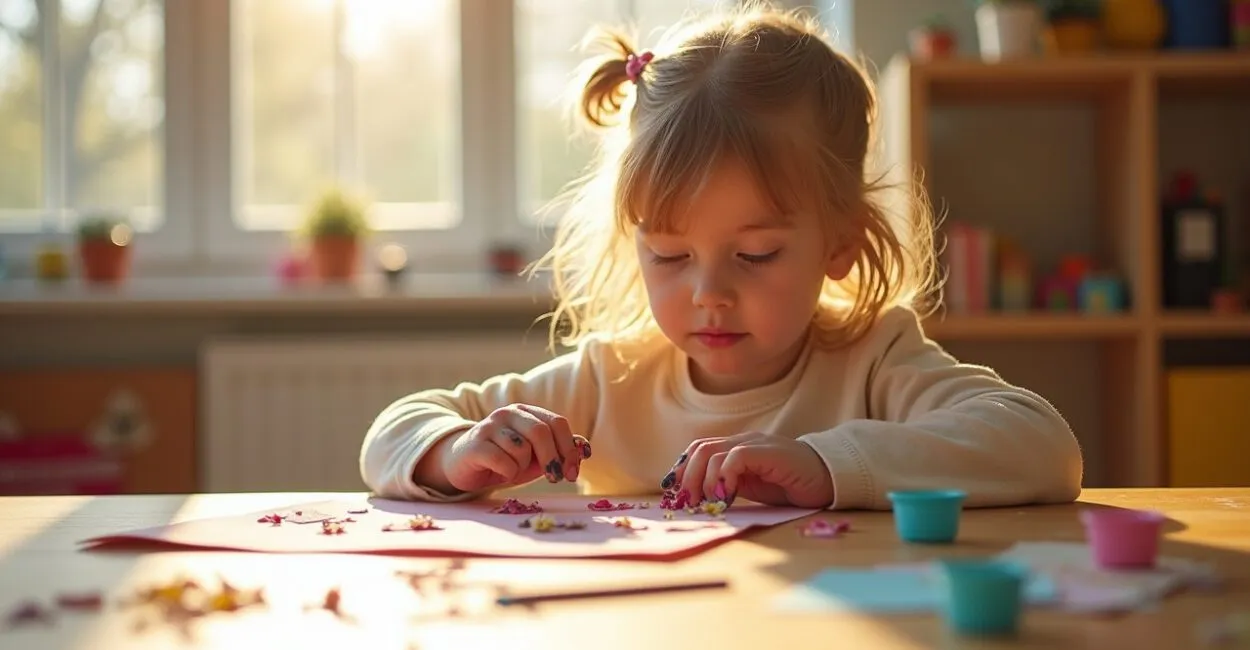
A 1-year-old can take part in a tribute without handling beads, scissors, or other small objects: an adult prepares the surface, and the child explores paint with their hands. To plan Mother’s Day activities for young children, choose short projects, age-appropriate materials, and someone special to receive the finished work. The occasion can inspire cards, drawings, collages, and group-made keepsakes. Most importantly, let each child participate in their own way, without pressure to make something perfect or any obligation to talk about their family.

At a glance
- For young children, 10- to 20-minute activities often make it easier to participate; the time may vary from group to group.
- Common school supplies, such as paper, crayons, and nontoxic glue, work for most activities.
- 1-year-olds need close supervision and large, washable materials without loose parts.
- Each creation can be dedicated to a mother or another important person chosen by the child.
How to plan Mother’s Day activities for young children
These activities are learning experiences focused on self-expression, interaction, and art, created to honor someone meaningful. To get started, choose an age group, set aside 10 to 30 minutes, put out just a few materials at a time, and offer ways to participate that don’t rely on skills the children are still developing. In the classroom routine, preparation matters as much as the activity itself. Have the paper ready before inviting the children over, use tables that are easy to clean, and explain the steps in short sentences. When working with paint, one small detail can save extra work: wet paper needs room to dry without being stacked.
| Age group | Suggested time | Helpful adaptation |
|---|---|---|
| 1 to 2 years | 5 to 10 minutes | One step at a time, with close adult supervision |
| 3 to 4 years | 10 to 20 minutes | Precut pieces and simple choices of color and shape |
| 5 years | 15 to 30 minutes | More independence to draw, tell stories, and combine materials |
These times are guidelines, not goals. Attention spans vary from child to child and even from one day to the next. If a child gets tired, it’s better to wrap up the activity calmly than insist they finish.
Cards, coloring pages, and handprints
A personalized card works well for children from preschool through pre-K and takes about 15 to 25 minutes. Set out folded paper, chunky crayons, and large stickers. For 1-year-olds, an adult should prepare the paper and offer only age-appropriate crayons, with constant supervision.
- Fold the paper and show the child where they can draw.
- Invite them to choose colors or add to a simple drawing, such as flowers, hearts, or a house.
- Write down the child’s words inside the card if they want to dictate a message.
A Mother’s Day coloring page can be a starting point, but leave room for free drawing. A printable activity should be simple, with broad outlines and few details. Printing a ready-made page doesn’t replace the child’s participation: they can choose colors, add details, or talk about what they drew. Another option is to make a handprint keepsake. An adult applies washable, nontoxic paint to the child’s hand, presses it onto the paper, and washes the child’s skin right away. For younger children, the handprint can become a flower or butterfly, with the teacher drawing in the details.
Safe collages and sensory gifts

Collage is an activity that builds fine motor skills and explores textures: children choose and attach materials to a surface. For children ages 3 to 5, set aside about 20 minutes and use paper, large fabric scraps, nontoxic glue, and shapes precut by an adult. Offer just a few options at a time. Children can make a flower, mosaic, or picture frame and tell you who they would like to give it to. For younger preschoolers, provide large pieces that have already been separated. 1-year-olds can touch large sheets of paper while an adult does the gluing.
Bracelets and necklaces require caution: beads, buttons, and small decorative pieces are choking hazards, especially for children who still put objects in their mouths. A safer alternative is a decorated paper band or a necklace made from wide strips of paper, with an adult responsible for cutting, fastening, and putting away the materials. The Brazilian Society of Pediatrics offers guidance on preventing childhood accidents on its official website. In the classroom, also follow school rules and the age guidance on materials. Nontoxic glue and paint still require supervision.
A class memory book and kindness coupons
A class book can bring together drawings, dictated sentences, and short stories about caring gestures. The activity takes 20 to 30 minutes per child, spread over more than one day: each child contributes a page, and the teacher binds the pages at the end.
To avoid comparisons, don’t ask every child to share the same kind of family experience. Instead, invite them to draw someone who takes care of them, a moment they enjoy, or an activity they’d like to share. They can also participate by drawing or choosing a picture, without speaking in front of the group.
Read also: Entrepreneurship for kids: activities for early childhood education
Kindness coupons turn the tribute into small acts, such as “a hug,” “a story to read together,” or “help putting away the toys.” Children ages 4 and 5 can illustrate the cards; for younger preschoolers, an adult can draw or write down the idea the child chooses.
A welcoming tribute lets each child choose whom they want to recognize and how they want to participate.
Read also: How to file an auto insurance claim after an accident
Brazil’s National Common Core Curriculum (Base Nacional Comum Curricular, or BNCC) identifies interactions and play as key elements of early childhood education. Consult the document on the BNCC portal, run by Brazil’s Ministry of Education, to connect the activity with the group’s learning experiences and goals.
Themed photo session and take-home display
A photo session can take 10 to 15 minutes per small group. Set up a simple backdrop, such as a piece of fabric or poster board, and provide large, safe props. Children can pose alone, with classmates, or with an object they choose. No one has to be in a photo to take part in the tribute.
Photos involve consent and privacy considerations. Before taking or sharing pictures, follow the institution’s rules and confirm that families have given permission. An alternative that doesn’t involve photos is to create a display of drawings and messages that each child can take home at the end.
Imagine a group where one child doesn’t want to pose and another would rather dedicate their work to their grandmother. The teacher can offer the display as an alternative to the photo and write down the dedication each child chooses, without asking personal questions. That way, both can participate at their own pace.
Surprise box and illustrated recipe
Children ages 3 to 5 can decorate a box in about 20 minutes. Use a clean container, large sheets of paper, and nontoxic glue. An adult should make any cuts and reinforce parts that might come loose. The class can put drawings, dictated messages, or cards made during other activities inside.
An illustrated cake or cookie recipe is a language and sequencing activity: children draw steps such as mixing, putting the batter in a pan, and waiting for it to bake. For younger preschoolers, the teacher can show pictures and ask the group to put them in order. Older children can dictate ingredients without handling food.
If the school decides to make an actual recipe, check with families about food allergies and restrictions, have everyone wash their hands, and make sure adults handle the oven, knives, and hot utensils. Anvisa, Brazil’s health regulatory agency, provides information about food safety. The precautions needed depend on the recipe, the school’s facilities, and local guidance.
Adaptations for younger preschoolers, 1-year-olds, and different families
For 1-year-olds, focus on brief, supervised sensory experiences: exploring large sheets of paper, looking at colors, or making a handprint with an adult’s help. Avoid small pieces, plastic bags, food used as a play material, and anything that could be put in a child’s mouth.
For younger preschoolers, keep the activity to a few steps and leave the outcome open-ended. A child can choose between two colors, point to a picture, or hand paper to an adult to glue. There’s no need for everyone to make the same drawing or stay at the table until the activity is over.
Some children may not live with their mother, may be grieving, in foster care, or dealing with difficult family circumstances. Present the tribute as something to make for someone important, without asking children to share their personal stories. If a child doesn’t want to choose someone, they can make the activity for themselves or the class, or simply take part in the art experience.
To reduce anxiety and frustration, show an example without asking children to copy it, value their choices, and avoid displaying the work as if there were one right way to do it. Fine motor skills and tolerance for certain textures vary. If paint or glue bothers a child, offer crayons, drawing, or observing as equally valid ways to participate.
Frequently asked questions
What’s the best age for these activities?
There are activities for children as young as 1 year old, as long as an adult adapts the materials and duration. Drawings with more steps and dictated messages often work better for older children, but every group has its own pace.
Do I need to buy expensive materials?
No. Paper, chunky crayons, fabric scraps, and clean containers work for many activities. Reuse materials only if they’re clean, intact, and free of small or sharp parts.
How can I use a printable activity without asking everyone to copy it?
Use the page as an invitation, not a required template. Children can color part of it, add their own drawing, or choose another way to make a tribute.
What if a child doesn’t want to participate?
Offer an alternative without insisting, such as watching, choosing materials, or trying the activity another time. A child’s refusal may be a sign of tiredness, discomfort with a texture, or a need for more time.
Choose an activity and adapt it to your group
Before planning the celebration, choose one main activity and a low-pressure alternative, such as free drawing or choosing pictures. Check the materials, permissions, and group needs. Then invite each child to decide who will receive their tribute and how they would like to participate.
%%AGPTRH4%%
Artigos Relacionados
 Exploring the World Through the Senses: 10 Creative, Safe Sensory Activities to Support Early Childhood Development
 A Guide to Early Childhood Education: Best Practices, Play-Based Activities, and Innovative Approaches to Whole-Child Development
 Fun Women’s Day Activities: 10 Playful Ways to Celebrate Women’s Strength in Early Childhood Education
 Women’s Day Cards for Early Childhood Education: Creative Ideas, Inspiring Messages, and Fun Activities to Celebrate Gender Equality
 Technology for Young Children: Finding the Right Balance
 Positive Discipline: The Key to Early Childhood Education
