
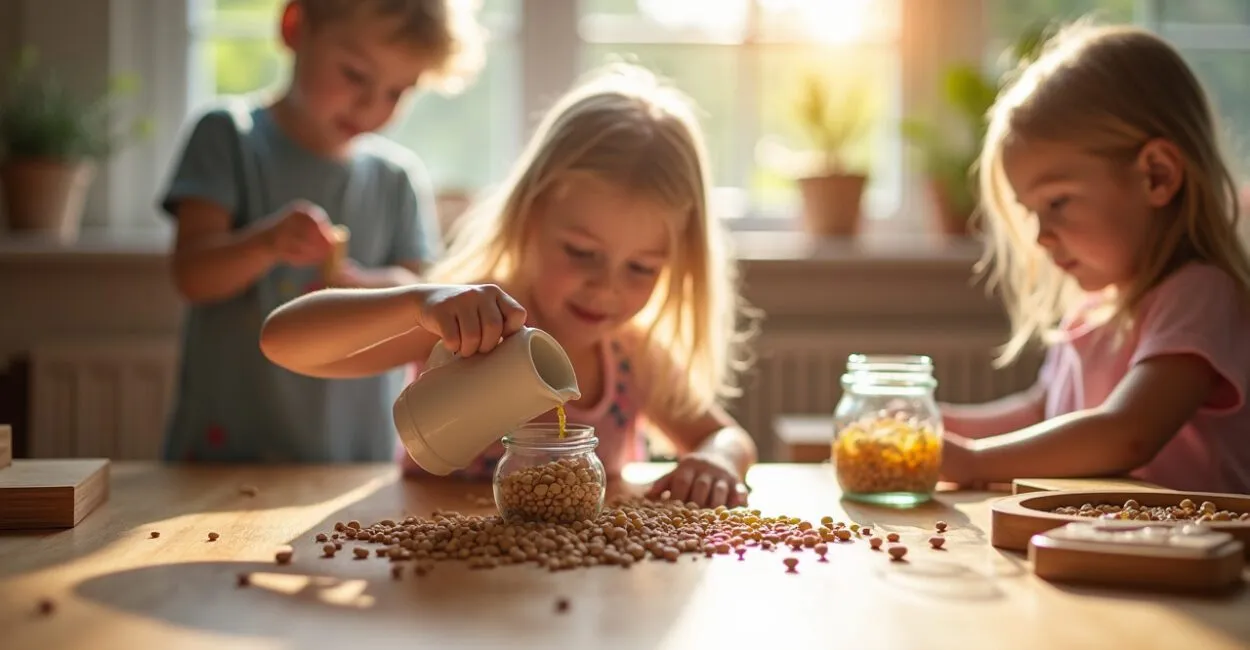
A thoughtfully designed sensory activity does more than “keep the group entertained”: it helps children focus, builds their vocabulary, and helps young children make sense of what they feel. With sensory activities in early childhood education, the goal is not mess for its own sake or stimulation for stimulation’s sake. It’s intentional exploration of textures, sounds, smells, colors, temperatures, and movement to support overall development.

In practice, that means offering simple, safe, age-appropriate experiences with a clear learning goal. Below, you’ll find a definition of the concept, its real benefits, essential safety guidelines, and 10 activities you can try with accessible materials—all while keeping hygiene, adult supervision, and purpose in mind.
The essentials
- Sensory exploration is the foundation for how children develop perception, language, coordination, and self-control.
- A good sensory activity has a goal, safe materials, adult guidance, and a duration that suits the age group.
- The same materials can be adapted for babies, 2-year-olds, or preschool groups by adjusting the complexity and risk.
- When teachers observe how children respond, an activity becomes a learning opportunity—not just play.
Sensory Activities In Early Childhood Education: What They Are And Why They Work
Sensory activities in early childhood education are learning experiences that invite children to explore their surroundings through their senses and bodies, with adult guidance and an educational purpose. They work because young children learn first through hands-on experiences: touching, listening, looking, smelling, moving, and comparing. In early childhood education, sensory learning isn’t an extra; it’s a pathway to learning.
This kind of activity aligns with the idea of sensory exploration in early childhood education, which is common in Montessori and Reggio Emilia practices, as well as contemporary approaches that value active observation of children. The basic idea is simple: the more varied, safe, and meaningful the experiences, the more connections children can make as they name, categorize, and relate what they encounter.
A clear, practical definition
A sensory activity is any planned experience in which children use one or more senses to investigate materials, phenomena, or actions. This could happen with a texture box, a light table, a water-play activity, a movement course, or an activity featuring natural scents. The goal isn’t to “flood children with stimulation,” but to offer enough information to spark perception, curiosity, and a physical response.
Why sensory experiences matter so much in early childhood
In early childhood, children are still developing vocabulary, sustained attention, fine motor skills, gross motor skills, and emotional regulation. That’s why hands-on experiences have a greater impact than abstract explanations. A handful of beans, for example, can inspire comparisons of weight, sound, flow, counting, spatial organization, and even oral storytelling—all in one activity.
What sets a quality sensory activity apart from ordinary play isn’t the material itself, but the intention behind how it’s introduced.
How Sensory Exploration Supports Cognitive, Motor, And Emotional Development
Sensory exploration in early childhood education supports cognitive development, motor skills, and social and emotional growth all at once. It’s one of the few types of learning experiences that can engage multiple areas of development without losing depth. When children handle, compare, and respond to different stimuli, they train their brains to notice patterns, adjust their movements, and adapt to change.
Cognition: comparing, sorting, and predicting
Textures, sizes, sounds, and temperatures create real opportunities for sorting and categorizing. Children learn to notice the differences between rough and smooth, light and heavy, full and empty, wet and dry. This strengthens attention, working memory, and descriptive language because they have to observe before they speak.
Motor skills: coordinating hands, eyes, and body
Handling modeling dough, transferring water with spoons, tongs, or funnels, fitting objects together, and walking across different surfaces all require physical adjustments. Fine motor skills come into play when children use their fingers to control pressure and direction. Gross motor skills are involved when the whole body adjusts to balance, force, and space.
Emotions: self-regulation and predictability
Sensory activities can also help children regulate excitement, anxiety, and impulsivity. Warm water, rice, sand, fabric, and modeling dough can provide predictable experiences, which may calm some children and help them focus. But there’s a limit: too much stimulation can be uncomfortable for more sensitive children, so adult observation matters.
Brazil’s Ministry of Education (MEC) highlights the central role of interactions and play in early childhood education, which aligns closely with well-planned sensory activities. UNICEF Brazil also emphasizes the importance of play for healthy, well-rounded development in early childhood.
When children explore with their bodies, they aren’t “wasting time.” They’re building the foundations for language, coordination, and independence.
Safety, Supervision, And Age Considerations Before Trying Any Sensory Activity

The main rule is simple: a sensory activity is only a good one if it’s safe, age-appropriate, and supervised. This applies to every group, but it matters even more with babies and young children, who put objects in their mouths, have little awareness of limits, and may not yet be able to clearly express discomfort. What seems simple to an adult can pose a real risk to a child.
What to check before getting started
- Material size: Avoid small pieces with children under 3 because of the choking risk.
- Where items come from: Choose clean, nontoxic materials without splinters, rough edges, or sharp points.
- Hygiene: Wash containers, change the water, discard moldy items, and sanitize surfaces.
- Supervision: Adults need to observe, step in, and adapt the activity—not just “let the kids play.”
- Group needs: Children with sensory sensitivities may need gentler versions of the activity.
For child safety guidelines, consult resources such as Brazil’s Ministry of Health website and guidance on preventing accidents at home and at school. In daycare groups especially, there’s little room for error: uncooked beans, loose lids, unsupervised water, and sharp objects don’t belong in open-ended activities.
An important caveat: children don’t all respond the same way
This type of activity works well for most groups, but it can fall short when adults assume every child tolerates the same level of stimulation. Some children find dough and sand calming; others get upset by sticky textures or repetitive sounds. In these situations, reducing the intensity usually works better than insisting.
A helpful approach is to notice whether a child seeks out, avoids, or has mixed reactions to a stimulus. This can offer useful teaching insights without turning the activity into a clinical assessment.
10 Sensory Activities For Early Childhood Education: Materials, Steps, And Goals
The activities below are organized to make them easy to plan for a classroom, playground, or learning center. Each sensory activity includes materials, a goal, and steps brief enough to fit into the school day.
1. Texture Box
Materials: fabric scraps, a sponge, cotton, fine-grit sandpaper, cotton balls, craft foam, Velcro, and felt.
How to do it: Put the materials in a box or tray and invite children to touch, compare, and describe how they feel. To extend the activity, ask them to sort items into “soft,” “rough,” “smooth,” and “bumpy” groups.
Goal: Build sensory vocabulary and tactile discrimination.
2. Light Table With Colorful Objects
Materials: a light table, translucent pieces, colored cups, acetate sheets, large letters, or transparent blocks.
How to do it: Arrange the objects on the illuminated surface and invite children to group them by color, size, or shape. The light table encourages observation, concentration, and visual perception.
Goal: Strengthen visual comparison and sustained attention.
3. Sensory Path
Materials: gym mats, sand, grass, bubble wrap, a rubber mat, fabric, dry leaves, and low-sided boxes.
How to do it: Set up a sequence on the floor for children to walk across barefoot or in nonslip socks, always under supervision. The path can include short challenges, such as stepping up, stepping down, and balancing.
Goal: Integrate touch, balance, and gross motor coordination.
4. Basins Of Water, Spoons, And Cups
Materials: basins, water, sturdy plastic cups, spoons, funnels, and strainers.
How to do it: Ask children to transfer water between containers, observe the volume, and compare which one fills faster. If you like, add a small amount of food coloring to make the activity more visually engaging.
Goal: Explore volume, motor control, and cause and effect.
5. Homemade Modeling Dough
Materials: flour, salt, water, oil, and food coloring.
How to do it: Mix the ingredients until a soft dough forms, then invite children to squeeze, roll, cut, and shape it. Homemade dough is one of the most versatile activities because you can adjust its texture and firmness.
Goal: Strengthen hands and wrists and encourage creativity.
6. Sensory Bottles
Materials: tightly sealed plastic bottles, water, glitter, large buttons, large beads, oil, and food coloring.
How to do it: Fill bottles with different materials and encourage children to shake them, observe, and compare how the contents move. Make sure the bottles are tightly sealed to prevent leaks and accidental ingestion.
Read also: Children’s Memory: Activities to Practice and Develop It
Goal: Encourage visual attention, movement, and scientific curiosity.
7. Sensory Bags
Materials: a thick, securely sealed plastic bag or laminated pouch, gel, colored shaving cream, large beads, or firm gelatin.
How to do it: Seal the bag securely and let children press it with their hands, watch the contents shift, and trace shapes with their fingers. This activity often works well with babies, as long as an adult prevents direct access to the contents.
Goal: Encourage safe tactile and visual exploration.
8. Sound Hunt
Materials: rattles, cans, bells, leaves, containers filled with rice, lids, and boxes.
How to do it: Hide sound-making objects around the room and ask children to find where each sound is coming from. With older groups, ask them to identify sounds as loud or soft, fast or slow.
Goal: Develop active listening and auditory discrimination.
9. Scent Jars
Materials: small jars with cotton balls, mild aromatic herbs, coffee, cinnamon, orange peel, or scented soap.
How to do it: Present the jars one at a time, without overwhelming children with too many scents, and observe their reactions. Use mild, natural scents when possible, and always take allergies and sensitivities into account.
Goal: Strengthen smell perception and associative memory.
10. Painting With Different Tools
Materials: tempera paint, sponges, thick paintbrushes, large cotton swabs, small rollers, and kraft paper.
How to do it: Invite children to paint with different tools and observe the marks each one makes. They can explore pressure, rhythm, line width, and color mixing without relying only on a traditional paintbrush.
Goal: Combine tactile exploration, fine motor coordination, and creative expression.
In a group of 4-year-olds I worked with on a sensory path, the most interesting response didn’t come from the child who ran through first, but from the one who took the longest to join in. They tested each surface with one foot, returned to the bubble-wrap section twice, and only then moved on. That day, it was clear that the pace of exploration is useful teaching information, too.
| Activity | Main senses involved | Suggested age |
|---|---|---|
| Texture box | Touch | Ages 2 and up |
| Light table | Sight | Ages 3 and up |
| Sensory path | Touch and proprioception | Ages 3 and up |
| Sensory bottles | Sight and hearing | Babies and young children, with secure seals |
How To Adapt Sensory Activities To Children’s Ages And Group Needs
The best adaptation isn’t to “make it more complicated.” It’s to reduce risk and adjust the language, timing, and amount of stimulation. In early childhood education, the difference between a great activity and a frustrating one often comes down to how much independence children are given and how clearly the adult explains what to do.
Birth to 18 months
For babies, use large, soft, washable materials that are simple to explore. Sensory bags, fabric, gentle sounds, and visual contrast work better than activities with loose pieces. At this stage, interaction with an adult matters as much as the object itself.
Ages 2 to 3
At this age, children want to repeat actions and test limits. Water play, modeling dough, boxes, and painting with chunky tools are good choices because they allow repeated handling without requiring very precise coordination. Keep the activity short, with simple instructions and a clear demonstration.
Ages 4 to 5
Children at this age can do more comparing, sorting, and simple hypothesizing. They can name sensations more precisely and take part in short challenges, such as identifying scents, discovering sounds, or putting together a sequence on a sensory path. This is also a good time to introduce oral storytelling, drawings of what they noticed, or simple combinations of materials.
The group’s needs matter
Not every group is comfortable in the same environment. High-energy groups benefit from activities with a clear beginning, middle, and end; more reserved groups often respond better when an adult models the activity first. If a child has tactile or auditory sensitivities, the ideal version is one that allows them to participate without forcing too much contact.
Institutional resources on health and prevention and references such as the UNESCO website support a view of well-rounded development that includes the body, emotions, and social relationships. This reinforces a practical point: adapting an activity is part of planning, not an afterthought.
Tips For Planning Purposeful Sensory Activities In Early Childhood Education
A well-planned sensory activity in early childhood education starts before you choose the materials and ends after the group discussion. The teacher decides what to observe, chooses the stimulus carefully, and plans how to document the experience. Without that, the activity is just a way to fill time.
Start with the goal, not the materials
If the goal is to build vocabulary, choose an experience that invites verbal comparisons. If the goal is fine motor development, choose something that requires pinching, twisting, or fitting pieces together. If the goal is self-regulation, prioritize predictable materials and a low level of stimulation.
Keep it brief and plan a clear wrap-up
A sensory activity doesn’t need to last long to be effective. For many groups, 10 to 20 minutes is more productive than a longer activity, because the quality of exploration drops when children lose interest or get overstimulated. Wrapping up with naming, drawing, a photo, or a chance to talk about what they noticed helps reinforce the experience.
Notice what children do with the materials
Focusing only on the final result means missing half the learning. What matters is whether a child avoids, repeats, compares, imitates, combines, or invents new ways to use the materials. This shows how they’re processing the stimulus and helps you adapt the next activity.
Good sensory planning isn’t about having the most materials. It’s about making meaningful observations with less risk and a clearer educational purpose.
Frequently Asked Questions About Sensory Activities In Early Childhood Education
What are sensory activities in early childhood education?
They are planned experiences that let children explore the world using their senses and bodies. They can involve touch, sight, hearing, smell, movement, and spatial awareness. What makes them different is their educational purpose: children aren’t just playing with materials; they’re learning from them.
What are the benefits of sensory activities for young children?
They strengthen attention, language, motor coordination, memory, curiosity, and emotional self-regulation. They also help children compare, sort, and anticipate what might happen. In many cases, they encourage participation because children’s bodies are part of the learning process.
What materials are safe for sensory activities in early childhood education?
Safe materials are generally large, washable, nontoxic, free of sharp edges, and appropriate for the child’s age. Fabric, homemade modeling dough, water, sturdy containers, cards, large blocks, and tightly sealed bottles are common examples. For children under 3, avoid small pieces and anything they could swallow.
Do sensory activities help develop speech and motor coordination?
Yes. They create situations where children need to notice, name, and act at the same time. Speech develops as children compare sensations and build vocabulary; motor coordination improves as they handle objects, adjust pressure, and organize their movements. The benefits are greater when an adult guides the activity with simple, open-ended questions.
How often can I offer this kind of activity?
There’s no set rule, but consistency matters more than quantity. Short, frequent activities often work better than long, occasional events. Ideally, alternate types of stimuli to prevent overstimulation.
Do I need expensive materials for sensory activities?
No. In general, the best results come from simple materials that are carefully chosen and used with purpose. Low-cost materials can still support high-quality learning when the teacher knows what to observe and what skills to develop.
Next Steps
The best way to use sensory activities isn’t to “do something different,” but to turn each activity into an opportunity for observation. When adults choose materials with purpose, adjust the level of challenge, and respect children’s ages, sensory experiences support real development—not just a way to fill time.
To put this into practice, choose one activity from the list, set a clear goal, review the safety guidelines, and observe how children respond as they take part. You’ll quickly see whether the activity is a good fit: greater focus, more language, more initiative, and less distraction are often signs that it’s working.
Artigos Relacionados
 A Guide to Early Childhood Education: Best Practices, Play-Based Activities, and Innovative Approaches to Whole-Child Development
 Women’s Day Cards for Early Childhood Education: Creative Ideas, Inspiring Messages, and Fun Activities to Celebrate Gender Equality
 Women’s Day Cards in Early Childhood Education: Celebrating Equality and Women’s Empowerment Through Art and Creativity
 Fun Women’s Day Activities: 10 Playful Ways to Celebrate Women’s Strength in Early Childhood Education
 Early Childhood Activities: A Daily Routine for Emotional Development
 Early Childhood Education: The Importance of Play in Child Development
