

When a letter stops being a “drawing” and becomes a sound, a child’s interest can change in an instant.
With letter activities in early childhood education, the secret isn’t to rush. It’s to help children notice, touch, hear, and repeat without feeling like they’re “doing homework.”

The key is a gradual progression. First comes visual recognition, then sound, then letter formation. If you skip steps, children may copy the letter without understanding it. That’s where many get stuck.
What Changes When a Letter Becomes More Than a Shape
In technical terms, letter activities in early childhood education develop graphemic awareness and phonological awareness: recognizing a letter, connecting it to its sound, and beginning to control the movements needed to form it. In other words, children aren’t just “learning the alphabet”—they’re connecting what they see, hear, and do.
In practice, that makes all the difference. A child might point to the letter A on a poster but still not know how to find it in their own name. They might repeat “B is for ball” and still not notice that the same sound starts the word “bike.” Letter activities in early childhood education work when children begin making these connections.
The goal isn’t to memorize the alphabet; it’s to build a genuine familiarity with letters. That familiarity comes from brief, varied, repeated exposure—not from a long worksheet that wears children out in five minutes.
Why Visual Recognition Should Come Before Letter Formation
Here’s a classic mistake: asking children to copy a letter before they can tell it apart from other letters. It’s like asking them to write a word they can’t yet picture in their mind.
With letter activities in early childhood education, the safest sequence is to identify, compare, name, and only then form the letter. This reduces frustration and makes it more likely that children will get it right because they understand, not by chance.
- Show two similar letters, such as p and b.
- Ask children to point to the one in their name.
- Use magnetic letters, cards, modeling dough, or bottle caps.
- Then move on to paper.
This before-and-after makes all the difference: at first, children only imitate; then they begin to recognize patterns. Once they see the pattern, forming the letter becomes less mechanical. That’s exactly what prepares them for the next step.
The 3 Layers That Make Letter Activities in Early Childhood Education Work

For a strong activity, think in terms of three layers: see, hear, and do. The letter should be presented in a concrete way through each one.
For the visual layer, show the letter on cards, posters, in books, and on objects. For the sound layer, work with initial sounds, rhymes, alliteration, and sound comparisons. For the motor layer, have children trace the letter with a finger, chalk, sand, paint, or a pencil.
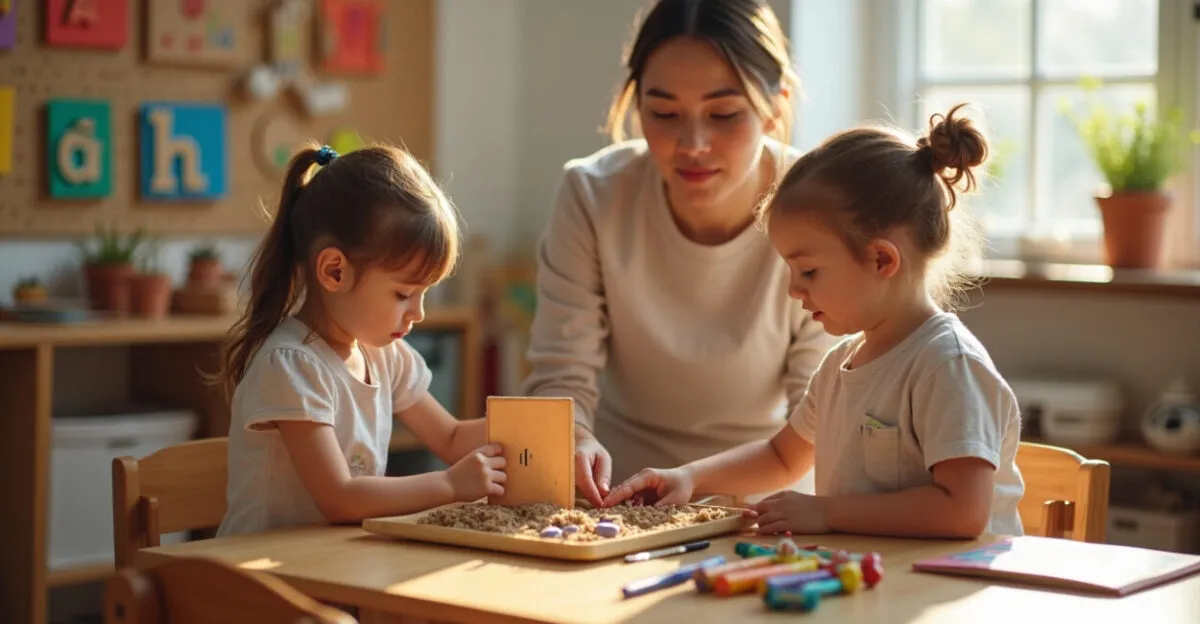
Anyone who works with young children knows they learn more when their bodies are involved. I’ve seen cases where a child couldn’t form a letter on paper, but understood it in seconds after tracing it with a finger in a tray of sand. The child’s hand “unlocked” once their body understood the path.
Paper alone puts children on the spot; play teaches.
Activities That Build Gradually and Hold Attention
The best letter activity in early childhood education looks like play on the outside but has a clear plan underneath. The key is to increase the challenge gradually without losing the fun.
Start with the child’s name. That creates an immediate connection. Then move on to letters from the children’s everyday world: a parent’s name, a classmate’s name, the classroom, snack time, or a favorite animal. Only then expand to the whole alphabet.
- Letter hunt: Hide letters around the classroom and ask children to find the first letter of their name.
- Sensory tracing: Make letters with string, sand, paint, or modeling dough.
- First-sound game: Sort pictures by the sound of their first letter.
- Living alphabet: Each child holds a letter and says a word that starts with it.
This progression seems simple, but it avoids the most common trap: trying to teach everything at once. When the experience changes each round, children stay interested. And along the way, you prepare them for the part that raises the most questions: forming letters correctly.
Common Mistakes That Leave Children Knowing and Not Knowing
The biggest problem with letter activities in early childhood education isn’t a lack of materials. It’s rushing. Children may follow along with an activity without retaining what they learn.
Here’s what often gets in the way:
- introducing too many letters in one day;
- mixing recognition, sounds, and writing without a clear sequence;
- using only worksheets;
- correcting letter formation too much and perception too little;
- ignoring the letters in a child’s name.
Here’s another useful comparison: memorizing letters is like recognizing faces in photos; truly learning letters means knowing what they’re called and telling similar ones apart. That takes varied repetition, not tiresome drills.
The problem is rarely the letter. It’s almost always how quickly it was introduced.
Correct Letter Formation Starts with the Body, Not the Notebook
This changes everything. Before children can hold a pencil steadily, they need to feel the path of the letter in space. That’s why letter activities in early childhood education are more effective when tracing starts with large, whole-body movements.
Have children trace with a finger in the air, on the floor, on a table, on sandpaper, in a tray of cornmeal, or in the sand. Only then move to smaller lines on paper. Children gain more control when they’ve already “walked” the letter’s path with their whole body.
This approach works very well in early childhood education, but it falls short when adults expect results too quickly. Children don’t all respond at the same pace; age, motor development, and spoken-language skills all matter. In the same classroom, two children may respond very differently to the same activity.
According to the Base Nacional Comum Curricular (Brazil’s National Common Curricular Base), early childhood education experiences should integrate language, movement, and interaction. That’s exactly what makes a good letter activity in early childhood education effective.
A Flexible Plan You Can Adapt to Your Class
When a letter activity in early childhood education has a beginning, a middle, and a next step, everything feels easier. You don’t need to turn every session into a formal lesson. You just need to provide direction.
Step
What the child does
Goal
1. Observe
Recognizes letters on posters, cards, and in names
Reinforce visual form
2. Listen
Connects letters and sounds in familiar words
Build phonological awareness
3. Touch
Makes the letter with modeling dough, a finger, or sand
Connect the symbol with the movement
4. Trace
Writes on paper with visual support
Develop directionality and motor coordination
In 2026, when everyone seems to be in such a hurry to see results, this plan may even seem old-fashioned. But it delivers what really matters: a child who understands what they’re doing. And when that happens, early literacy stops feeling like a mystery.
The Little Detail That Makes Children Want to Come Back Tomorrow
The deciding factor isn’t always educational; sometimes it’s emotional. Children come back because they felt capable. Letter activities in early childhood education need to give them small, visible wins.
Recognizing a letter in their name. Getting a sound right before their classmates do. Making a crooked letter—but making one. These small achievements are worth more than a completed worksheet.
When the activity offers just the right level of challenge, children want to repeat it without realizing they’re learning.
Data from IBGE (Brazil’s national statistics agency) are a reminder that family circumstances and access to learning materials vary widely among children. That’s why more concrete, accessible activities can help create a more even experience for the group. The same approach won’t apply to every child in exactly the same way, but gradual progression tends to work very well.
When a letter becomes a game, a sound, and a movement all at once, it stops being an abstract concept. That’s when learning happens in a way children remember the next day—and the day after that.
When Should I Start Letter Activities in Early Childhood Education?
You can start early, as long as the focus isn’t on demanding formal reading. The best approach is to explore letters, sounds, and motor coordination through play, at a pace that suits the class. Starting with the letters in a child’s name usually works best because it makes the activity immediately meaningful and sparks interest. The goal isn’t to rush children into formal reading instruction, but to build a foundation for it.
What’s the Best Letter to Start With?
The best choices are letters in a child’s name and letters that appear often in the class’s everyday life. Letters with a strong visual and sound connection can help children engage more quickly. Rather than starting with the whole alphabet, choose one or two letters at a time. This avoids confusion and gives children time to recognize, say, and trace each letter without rushing.
What Should I Do if a Child Confuses Similar Letters?
This is common and part of the learning process. Compare the letters visually, reinforce their initial sounds, and use hands-on materials such as magnetic letters, cards, and air tracing. Avoid overexplaining or relying on repetitive worksheets, which often tire children out without clearing up the confusion. Calmly comparing similar letters is more effective than unstructured repetition.
Do I Need to Use Worksheets in Every Lesson?
No. A worksheet is just one part of a letter activity in early childhood education, not the whole point. Young children learn better when they can handle materials, listen, and move their bodies. If the experience starts on paper, you miss some of the sensory understanding that helps children recognize letters. Ideally, vary the materials and formats to keep children engaged and strengthen learning.
How Can I Tell if the Activity Is Working?
Look for simple signs: the child recognizes letters in their name, identifies initial sounds, makes more intentional attempts at tracing, and takes part without giving up quickly. These signs matter more than a full notebook. Real progress shows when children start noticing patterns instead of just copying shapes. If they return to the activity with curiosity, you’re on the right track.
When a letter becomes a sound, a movement, and a discovery, children don’t “memorize” it—they start seeing the written world in a new way.
That’s the difference between a nice-looking activity and one that really teaches: children don’t just recognize letters; they begin to trust that they can read them.
Artigos Relacionados
 Activities for Early Childhood Education: Practical Ideas
 Mother’s Day in Early Childhood Education: 7 Memorable Activities
 Exploring the World Through the Senses: 10 Creative, Safe Sensory Activities to Support Early Childhood Development
 A Guide to Early Childhood Education: Best Practices, Play-Based Activities, and Innovative Approaches to Whole-Child Development
 Fun Women’s Day Activities: 10 Playful Ways to Celebrate Women’s Strength in Early Childhood Education
 Women’s Day Cards for Early Childhood Education: Creative Ideas, Inspiring Messages, and Fun Activities to Celebrate Gender Equality
