
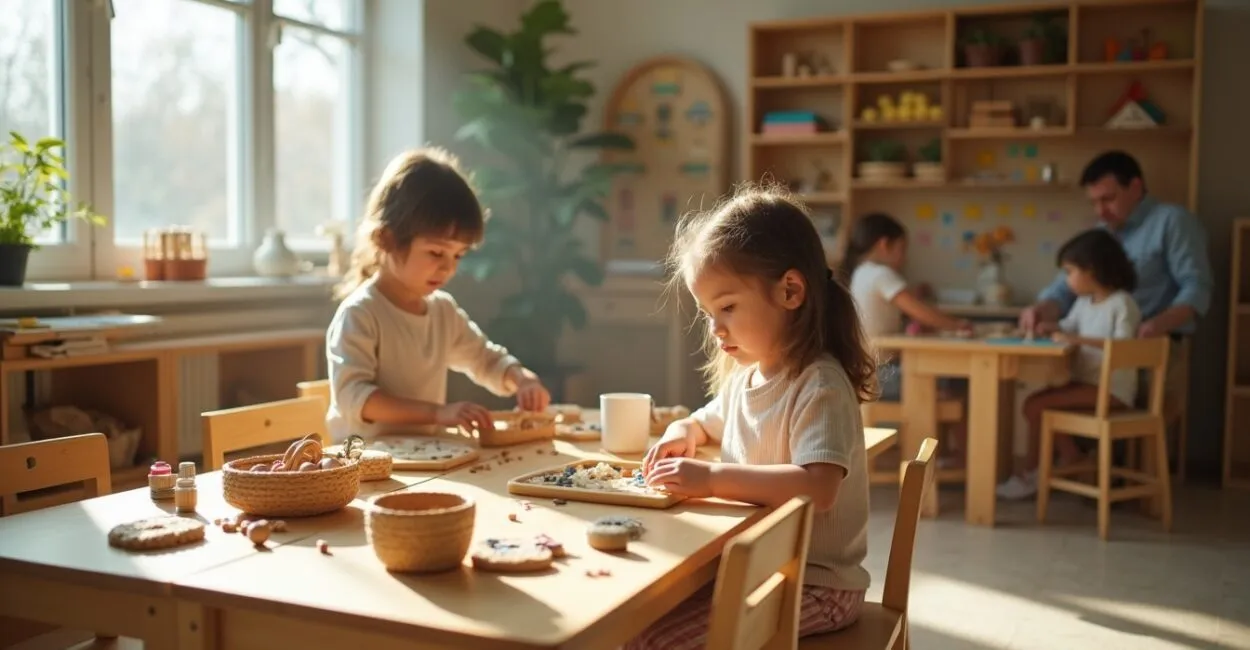
Have you ever felt that your classroom is full of good intentions, but the children seem disengaged and wait for instructions at every step—even when you try something new like Montessori?
I’ll share five Montessori techniques adapted for today’s schools: practical and easy to implement. You’ll find tips for fostering independence, using hands-on materials, and combining creative activities to boost engagement.

Rethinking Montessori for Today’s Schools
You want real independence, not just “independent activities” that turn chaotic, right? The secret is to prepare the environment with intention.
- Organize materials by purpose, not by subject.
- Create purposeful areas that are easy to access and have clear visual boundaries.
- Use visual routines that encourage choices rather than issue commands.
These simple steps create the conditions for children to make purposeful choices, and your role shifts from instructor to observer and facilitator. That’s where the Montessori magic happens in practice.
Prepared Environments That Invite Exploration
A prepared environment isn’t decoration—it’s an invitation. Here’s the secret: every object should say, “Use me,” without requiring your constant intervention.
- Furniture sized for children.
- Labels and pictures to guide use.
- Stations with just three to five options.
Limiting choices improves focus and reduces anxiety. When everything has a place, children learn responsibility by putting things away and taking care of materials, building genuine independence.
Hands-On, Sensory Materials That Build Understanding

Teaching fractions with paper alone isn’t enough—the brain needs hands-on experience. That’s why concrete materials are essential.
Leia também: The Reggio Emilia Approach: The Secret to Creative Classrooms
- Use blocks, string, and sensory panels.
- Turn abstract concepts into hands-on tasks.
- Combine art and science using reusable materials.
When students handle materials, they internalize what they learn. Sensory experiences speed up memorization and allow for natural assessment without the pressure of a test.
Creative Activities That Foster Independence
Creative activities aren’t extras; they’re tools that help children think for themselves. But that doesn’t mean making art without a purpose.
Leia também: Educational Toys: 9 Options That Inspire Creativity
- Projects with clear goals and flexible timelines.
- Connections between art, math, and language.
- Brief presentations that recognize the process.
Projects make room for decision-making, planning, and reflection—core Montessori skills that are essential in today’s schools.

How to Assess Without Undermining Independence
Assessment doesn’t have to diminish students’ curiosity. Consider thoughtful observation and ongoing portfolios instead.
| Approach | What It Measures | Frequency |
|---|---|---|
| Focused observation | Process and decision-making | Ongoing |
| Portfolio | Progress and reflection | Monthly |
| Self-assessment | Metacognitive awareness | After projects |
Pair these strategies with brief updates for families. Fewer grades, more storytelling. This supports independence and makes students’ growth clear.
Common Mistakes When Combining Montessori with Modern Practices
- Offering superficial choices with no real purpose.
- Adding more materials without teaching children how to use them.
- Measuring success only by completed tasks.
Avoiding these mistakes takes discipline: simplify, teach children how to use the materials, and assess the process and intent. This helps you stay true to Montessori while keeping things practical for today’s schools.
Resources and References for Further Reading
Want to learn more and ground your practice in reliable research and guides? These sources can help you explain changes to school leaders and families. Brazil’s federal government education portal and Harvard offer research on child development, and a helpful article from the BBC can inspire classroom strategies. Use these resources to make the case to stakeholders.
But don’t stop there. Turn theory into small classroom trials and make adjustments quickly—this is the surest path to lasting adoption.
Practical Implementation in 30 Days
Quick plan: reorganize the space in week one, introduce materials in week two, launch projects in week three, and assess and adjust in week four. Simple, iterative, and measurable.
- Week one: declutter and organize by function.
- Week two: teach small groups how to use the materials.
- Week three: launch one creative project per class.
In 30 days, you’ll have real data to discuss with your team, families, and school leaders. Start small, document your results, and scale up based on evidence. You already have practical tools to transform your classroom—not just ideas. Try one technique at a time and observe: independence grows alongside engagement.
Share your successes and challenges, and come back to make adjustments. Learning to apply Montessori is a collaborative process, and you don’t have to do it alone.
Question 1: What Does Applying Montessori in the School Day Actually Mean?
Applying Montessori in the school day means organizing time and space so children can choose purposeful activities and use hands-on materials to learn concepts. Adults become observers and facilitators, offering guidance without directing every step. This builds independence, responsibility, and deep learning, while also incorporating qualitative assessments and portfolios.
Question 2: Which Hands-On Materials Are Essential for Getting Started?
Start with simple sensory materials: blocks for logic and math, string and beads for coordination and sequencing, and natural objects for experiments. Materials should be durable, well organized, and limited in number at each station. Each item should have a clear educational purpose and allow for independent exploration.
Question 3: How Can You Align Montessori with Required Curriculum?
To align Montessori with required curriculum, map curriculum objectives and create stations that address them through interdisciplinary projects. Use portfolios to document evidence of learning and align goals with formative assessments. Small weekly adjustments can keep you on track without creating a rigid routine that limits independence.
Question 4: How Can You Involve Families Without Creating Resistance?
Involving families starts with transparency and invitations to participate in small ways, such as observing projects or reviewing visual progress reports. Share evidence of students’ growth and explain the benefits of independence. Short workshops and practical examples can reduce resistance by showing that Montessori builds life skills, rather than leaving out academic content.
Question 5: How Long Does It Take to See Improvements in Engagement?
Improvements in engagement may appear within weeks as behavior changes, while more complex skills can take months to develop. With prepared environments and materials used effectively, teachers often see greater focus and initiative within three to eight weeks, depending on consistency. Document progress and make adjustments to maximize the impact.
Artigos Relacionados
 Educational Projects That Transform Classrooms in 30 Days
 Educational Technology: Tools That Transform Classrooms
 Active Learning: Practical Classroom Techniques
 Writing That Captivates: What Techniques Make Writing More Engaging?
 Allowance: 7 Montessori Rules That Change Behavior
 Cultural Projects That Bring Communities Together in 4 Steps
