
A toy can entertain a child for 10 minutes or become a tool for development for months. The difference has less to do with the brand and more to do with the kind of challenge it offers. When we talk about educational toys, we mean objects and games designed to encourage active learning: building, comparing, testing, telling stories, making mistakes, and trying again. Here, the goal is practical: to highlight 9 options that truly foster creativity, reasoning, and independence, and explain how to choose without making an impulse purchase.
The Essentials
- A truly educational toy isn’t one that teaches letters all the time; it’s one that requires children to make decisions, try things, and reorganize their ideas.
- Open-ended materials, such as blocks, modeling clay, and building pieces, tend to inspire more creativity than toys with just one function.
- The best way to choose is to consider age, level of challenge, and freedom of use—not just the packaging’s visual appeal.
- When adults join in and ask the right questions, the same toy can encourage more language development, logical thinking, and persistence.
- There’s a difference between “playing with help” and “having an adult solve it”: in the second case, the educational benefit drops significantly.
Educational Toys and Creativity: What Really Makes a Difference
Technically speaking, educational toys are play-based resources that develop cognitive, motor, social, or emotional skills through purposeful interaction. In practice, that means children need to handle, compare, imagine, and make decisions. That’s where learning happens.

Anyone who works in child development knows that not every “colorful” toy teaches something. Some simply hold a child’s attention passively. Others create opportunities for spatial thinking, language, planning, and problem-solving. Creativity emerges when children can make something new with what they have—not when they just press a button.
What sets an educational toy apart from an ordinary toy isn’t its appearance; it’s the kind of mental effort it asks of a child.
For reliable guidance, it’s worth consulting the World Health Organization’s information on early childhood development and recommendations from the American Academy of Pediatrics, which emphasize active play, interaction with adults, and free exploration. In Brazil, the Ministry of Health, the country’s federal health agency, also highlights the importance of early childhood for developing cognitive and social-emotional skills.
9 Types Worth Considering
1. Building Blocks and Construction Sets
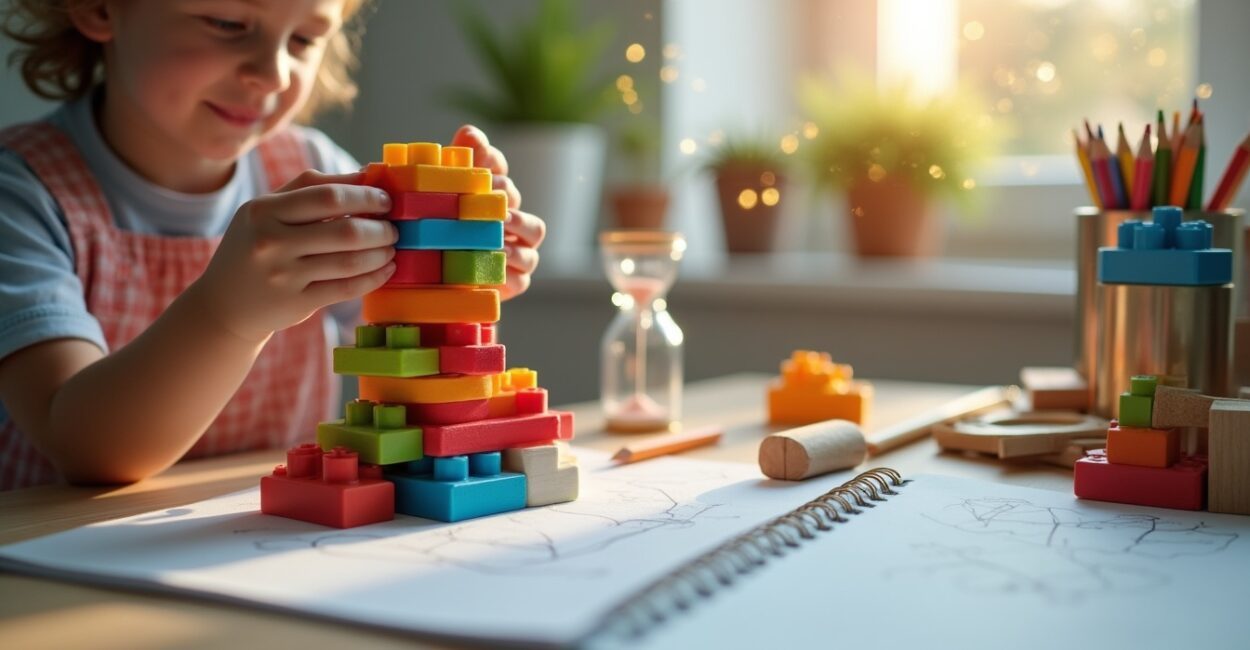
They’re one of the most reliable ways to spark creativity. LEGO, interlocking blocks, and modular sets develop fine motor skills, symmetry, balance, and project thinking. Their greatest strength is their open-ended nature: children decide what to make—a tower, a bridge, a city, or a robot. Each attempt shapes how they approach their next creation.
2. Magnetic Building Tiles
Magnetic tiles are great for learning about shapes, proportions, and stability. They provide immediate visual feedback, making cause and effect easier to understand. They work especially well for children ages 3 to 7, who can see the results without needing lengthy instructions. For younger children, adults can suggest simple challenges: “Can you make a cube?” or “Can the bridge hold two toy cars?”
3. Modeling Clay, Kinetic Sand, and Sensory Materials
These materials may seem simple, but they play an important role in creative development. They encourage children to explore texture, pressure, shaping, and imaginative play. A child doesn’t need to “make something beautiful” to learn with modeling clay. Rolling, squeezing, and mixing colors help build motor planning and self-expression. These materials can be calming while still keeping children engaged.
4. Science Kits and Experiments
Science kits introduce the experimental method in an accessible way: forming a hypothesis, testing it, observing, and drawing a conclusion. This is an important step because it moves learning beyond ready-made answers. One important caveat: these toys work best when adults don’t turn everything into a lesson. If children only follow mechanical instructions, their curiosity fades. The ideal approach is to ask questions before and after the experiment.
5. Traditional and 3D Puzzles
Puzzles develop visual perception, sustained attention, and spatial reasoning. 3D models add another layer of difficulty because they require mental rotation and an understanding of how pieces fit together.
For older children, these activities can help build frustration tolerance. Progress doesn’t come quickly, and that’s exactly what teaches persistence.
6. Matching, Memory, and Logic Games
Memory games, educational dominoes, category-sorting activities, and sequencing games develop executive functions. That’s the technical term for skills such as controlling impulses, remembering rules, and adjusting strategies.
They’re great for family play because they encourage friendly competition and conversation. Instead of focusing on winning or losing, children start noticing patterns and explaining their choices.
7. Art Kits and Open-Ended Materials
Paint, brushes, crayons, glue, child-safe scissors, clean recyclables, and different kinds of paper make up a far more powerful toolkit than it might seem. The value lies in open-ended use, not in a rigid activity.
I’ve seen children receive expensive art kits but use only the first page of the workbook. The results were limited. Give them loose materials and a simple prompt—“Create a setting for your character”—and their creativity can take off.
8. Puppets, Theater, and Storytelling
Puppets and theater kits develop language, storytelling skills, empathy, and physical expression. They’re especially useful for children who are still building their vocabulary or feel shy about expressing themselves.
This kind of toy can also help adults understand what children know about emotions, conflict, and social roles. An invented story often reveals more than a short answer.
Leia também: Maker Education: The Power of Making and Experimenting to Develop Critical Thinkers
9. Robotics and Beginner Coding
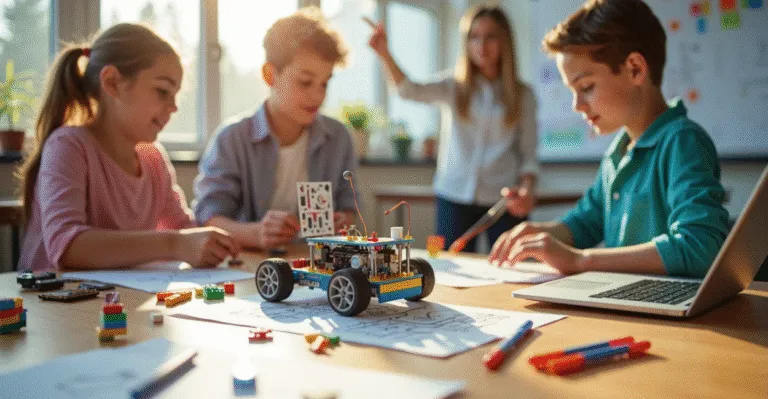
Educational robotics and visual coding kits, such as block-based programs, introduce computational logic, sequences of commands, and debugging. They’re among the best options for children ages 7 or 8 and up.
The best way to use them isn’t to teach “technology” in the abstract. Set a mission: make a toy car turn right, turn on a light, or avoid an obstacle. The task is what builds reasoning skills.
Leia também: Rural Technical Courses: A Reliable Path to a Successful Agribusiness Career
How to Choose Without Making a Bad Purchase

The most common mistake is choosing a toy for its marketing appeal rather than how it’s used. A box may promise reading skills, logic, and creativity all at once, but deliver only shallow stimulation. Use these three questions to guide your choice.
- Can the child use it in more than one way?
- Does the toy involve building, choosing, or adapting?
- Is the challenge just a little beyond what the child can already do independently?
If the answer to all three is “yes,” you’re much more likely to make a good choice. If not, the toy may lose its appeal quickly.
A Practical Guide by Age
For ages 2 to 4, prioritize large pieces, sensory exploration, and pretend play. From ages 5 to 7, blocks, puzzles, and simple logic games start to work well. At age 8 and up, robotics, science, and longer projects become good options.
This isn’t a rigid rule. Some children are especially advanced at building, while others prefer storytelling for longer. Finding the right fit depends on attention, interest, and frustration tolerance—not just age.
An educational toy falls short when an adult solves the task for the child; it works when the adult adjusts the difficulty and lets the child lead the play.
How to Turn the Same Toy into a Deeper Learning Experience
The same set of pieces can be just entertainment or a real thinking exercise. The key is asking questions. Instead of saying, “Make it look like the picture,” try “How could you make this stronger?”, “What would happen if you switched this piece?” or “How else could this story end?”
A simple technique is to alternate between three ways of playing:
- Explore: Play freely for a few minutes without instructions.
- Challenge: Set a clear goal, such as building a bridge or completing an obstacle course.
- Retell: Ask the child to explain what they did, why they did it, and what they would change.
This cycle works with blocks, science, art, and even puppets. It helps children retain what they learn because they have to organize their experience through words and actions.
For a deeper understanding of how play supports learning, check out UNICEF resources on child development and materials from the Center on the Developing Child at Harvard University. These sources reinforce a central point: interaction, repetition, and gradually increasing challenges matter more than excessive stimulation.
What to Buy First on a Tight Budget
If you want to start small, I’d prioritize building blocks or magnetic tiles. They last for years, work for different ages, and support many levels of complexity. Next, I’d choose open-ended art materials, which cost less and offer more possibilities than many boxed kits.
A good approach is to keep a small rotation at home: one box for building, one for sensory play, and one for creative activities. This prevents toys from piling up unused and reduces the feeling that there’s a lot to choose from but nothing holds a child’s interest.
If your family wants to invest in something with more structured content, consider science and robotics kits next. They require more adult support, but offer plenty in return once a child is interested in sequences, cause and effect, and problem-solving.
Mistakes That Reduce Educational Value
Two mistakes come up again and again: too much guidance and too many toys. When adults correct every step, children stop experimenting. When there are too many toys, children switch activities before getting deeply involved in any of them.
- Buying something that’s too advanced for the child’s actual age and abilities.
- Choosing toys with only one “right” answer.
- Not setting aside time for regular play.
- Keeping everything boxed up and never changing how it’s used.
Experts reasonably disagree about how structured a toy should be. My view is straightforward: the younger the child, the more important safety and a clear purpose are; the older the child, the more valuable open-ended play and the challenge of creating their own solutions become.
Next Steps
When you choose carefully, a toy stops being a quick purchase and becomes a tool for development. The best test is simple: see whether the child returns to it eager to try something different. If so, it has real value.
Before your next purchase, set a clear goal—coordination, language, logic, imagination, or independence—and compare the toy against that goal, not the packaging’s appeal. This helps you avoid mistakes and greatly improves your chances of choosing the right educational toys.
Frequently Asked Questions
How Can You Tell Whether a Toy Is Truly Educational?
It should require active engagement from the child: building, comparing, storytelling, solving problems, or testing ideas. If a child only presses a button and gets ready-made stimulation, the educational benefit is usually smaller. Ideally, the toy can be used in more than one way and supports different levels of challenge.
Can Educational Toys Replace School Activities?
No. They complement learning, especially in language, logic, coordination, and creativity. School and toys play different roles, though they can reinforce each other when used intentionally.
What’s the Best Type for Young Children?
For ages 2 to 4, the best options are usually sensory toys, large blocks, simple shape sorters, and pretend-play toys. At this stage, safety, repetition, and free exploration matter more than complex instructions.
Is It Better to Buy One Expensive Toy or Several Cheap Ones?
It depends on your goal. One versatile, well-chosen item will often get more use than several toys with only one function. In general, open-ended, durable toys offer better value for the money.
Is Robotics Right for Every Child?
No, and that’s okay. Robotics makes more sense when a child already shows interest in building, sequencing, and testing ideas. Introducing it too early or pushing it can lead to resistance.
How Often Should I Rotate Toys?
There’s no fixed rule. If a child is still creating variations, inventing stories, and returning to the same toy, it’s still useful. Rotate it when it no longer offers new challenges.
Artigos Relacionados
 Educational Technology: Tools That Transform Classrooms
 Educational Technology: Tools That Transform Teaching
 Phonics Teaching Methods That Build Fluent Decoding Skills
 Preschool Activities That Build Social Skills Every Day
 Transformative Education: Practices That Change Lives Today
 Creative Technology: Tools That Transform Teaching
