
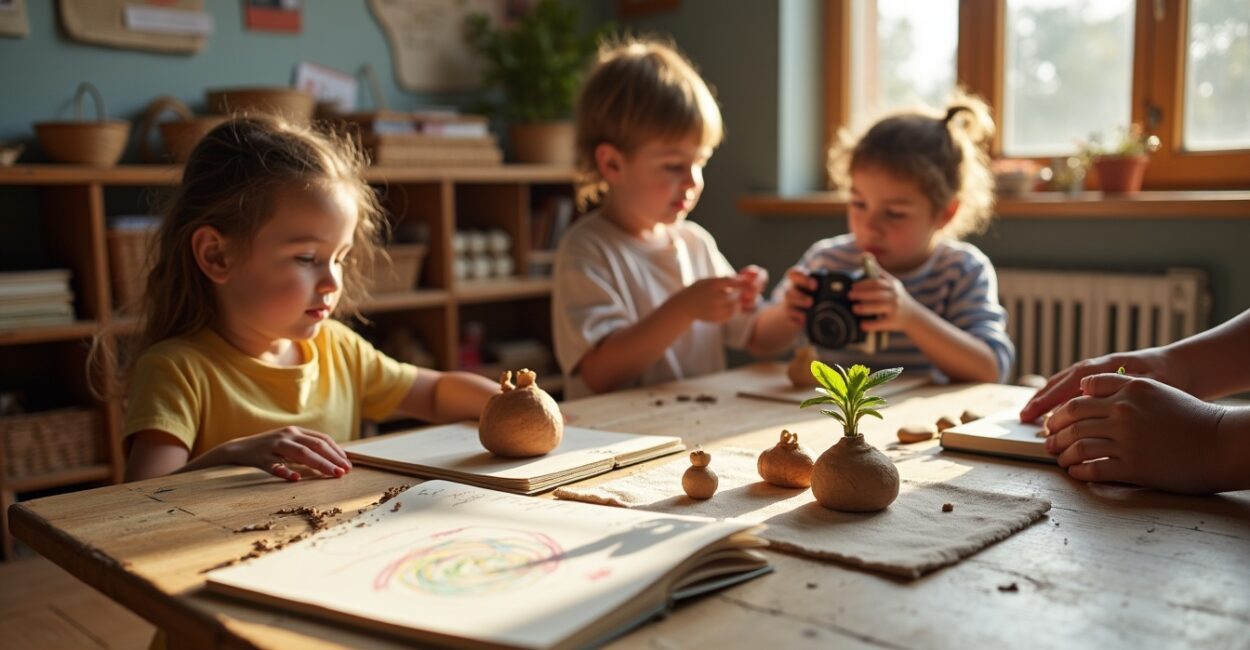
A classroom with few resources can still support rich inquiry when children have time to observe, test ideas, and talk about what they discover. The Reggio Emilia approach to early childhood education starts with children’s active participation and organizes learning around listening, projects, relationships, and the environment. Understanding its principles can help educators plan more open-ended experiences without turning the approach into themed decor or a rigid series of activities. The guidance below shows how to adapt practices to your daily routine and available resources.
At a glance
- Origin: Reggio Emilia, a city in northern Italy.
- Most closely associated with: young children.
- Core idea: Children actively participate in constructing knowledge.
- Recurring concepts: the hundred languages, listening, relationships, and pedagogical documentation.
- Application: Requires observation and planning, not a set of required materials.
What is the Reggio Emilia approach?
The Reggio Emilia approach is an educational approach developed from the experience of municipal schools in Reggio Emilia, Italy. It recognizes children as active participants in learning and organizes the curriculum around relationships, inquiry, and expression. At school, this means observing children’s genuine interests, creating opportunities to explore them, and revising the plan in response to what children reveal. The approach took shape amid Italy’s postwar social reconstruction, with the participation of families and educators. Today, the organization Reggio Children presents its principles as a cultural and educational experience rooted in the city, not as a universal package any school can reproduce by following a recipe.

This distinction matters. One classroom may have beautiful materials but offer little choice; another, with boxes, leaves, and simple tools, may support careful inquiry. The measure is what children can do, think about, and communicate in that environment.
Children’s agency, the hundred languages, and the educator’s role
In the Reggio Emilia approach, children are seen as capable of forming theories, making connections, and building knowledge with others. The phrase “the hundred languages” refers to the many ways they think and communicate: drawing, movement, speech, building, dramatic play, music, and many others. Educators don’t stand on the sidelines or hand out ready-made answers. They observe, listen, ask questions that extend the inquiry, and prepare materials or situations that help the group move forward. For example, if children discuss why a shadow changes size, the teacher might suggest observing it at different times of day and recording their hypotheses before explaining the phenomenon.
This perspective aligns with principles of Brazilian early childhood education, such as interaction and play in the National Curriculum Guidelines for Early Childhood Education. This connection does not mean the documents are identical: each approach has its own context and framework.
How to apply the Reggio Emilia approach at school

Start with a question children can investigate, not a ready-made list of activities. The team can observe a recurring play activity, identify what intrigues the group, and plan an experience that lets children explore it in greater depth.
- Observe: Note the words, gestures, choices, and questions that arise spontaneously.
- Choose a focus: Look for a curiosity that engages more than one child and allows for different kinds of exploration.
- Prepare the environment: Offer a few relevant, accessible, and safe materials instead of putting everything out at once.
- Follow and document: Gather evidence of the process and use it to decide on the next invitation to investigate.
- Replan: Continue the project when new questions arise; change course if interest fades.
In a public school, this sequence can begin with materials already on hand: clean containers, cardboard, fallen leaves, blocks, and pencils. Working as a team also helps prevent each educator from creating materials and documentation on their own.
Pedagogical documentation that informs planning
Pedagogical documentation is the selection and interpretation of evidence from the learning process to make children’s ideas visible and support educators’ decisions. It might bring together a child’s comment, a drawing, and a photograph of a construction, as long as the collection addresses a specific educational question. A common mistake is to photograph everything and then try to turn hundreds of images into reports. That creates work without improving understanding of the process. It’s more useful to choose a focus, such as “What explanations is the group developing about water?” and document only moments that help track that inquiry.
A brief display featuring transcribed comments and dated work can be reviewed by the team during planning. Documentation also lets children revisit earlier hypotheses, notice changes, and share their ideas with families. Before displaying identifiable images or comments, the school should follow its procedures for consent and privacy protection.
Read also: The Reggio Emilia Approach: The Secret to the Most Creative Classrooms
Reggio Children describes documentation as part of the approach’s culture of listening and reflection. Documentation is valuable when it changes an educational decision; without that purpose, it becomes an archive.
Projects in early childhood education: sustaining inquiry
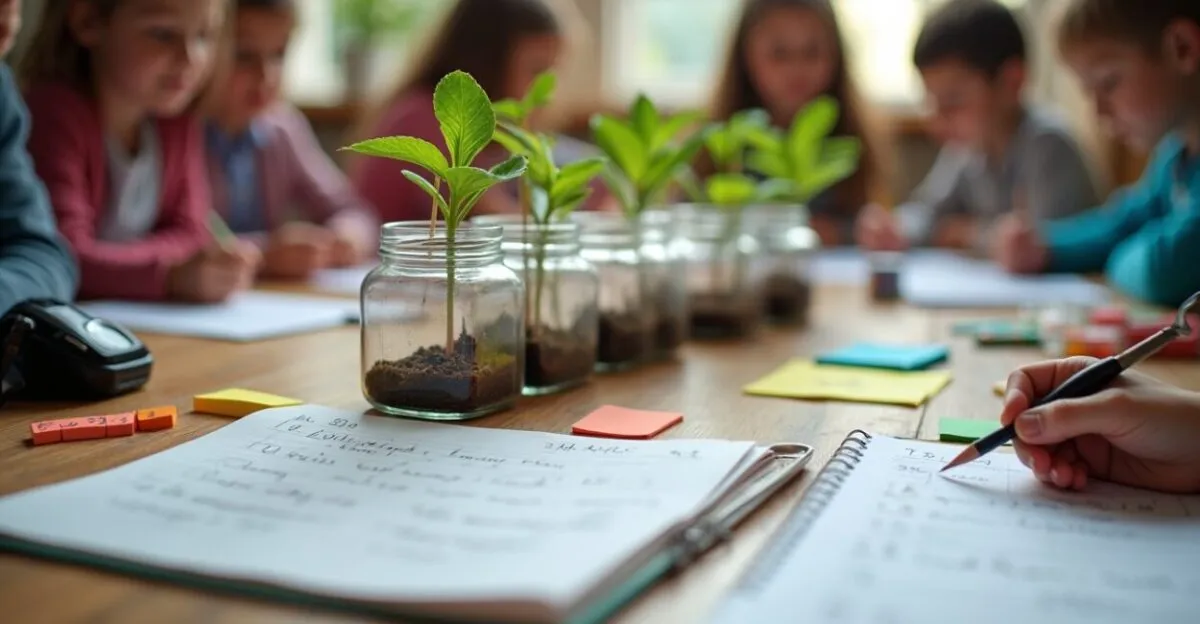
A project might begin with a question that keeps coming up during play, a discovery in the schoolyard, or an object that sparks curiosity. How long it lasts depends on what children are investigating: some questions can be answered in a few sessions; others lead to new hypotheses for weeks. To keep interest alive, offer variations that deepen the same line of inquiry. If the group is observing seeds, children might draw them, compare them, plant some, and track changes. A project loses its purpose when an adult keeps pushing it after children have lost interest, or when each activity shifts to an unrelated topic.
Leia também: The Importance of Design in Digital Communication: How Design Turns Messages Into Impact
Project time also needs to fit the daily routine, rest periods, and the needs of each age group. Listening does not require the team to follow every individual interest: teachers must consider safety, feasibility, curriculum goals, and opportunities for the group to participate.
Space, materials, and the Reggio Emilia approach: activity ideas
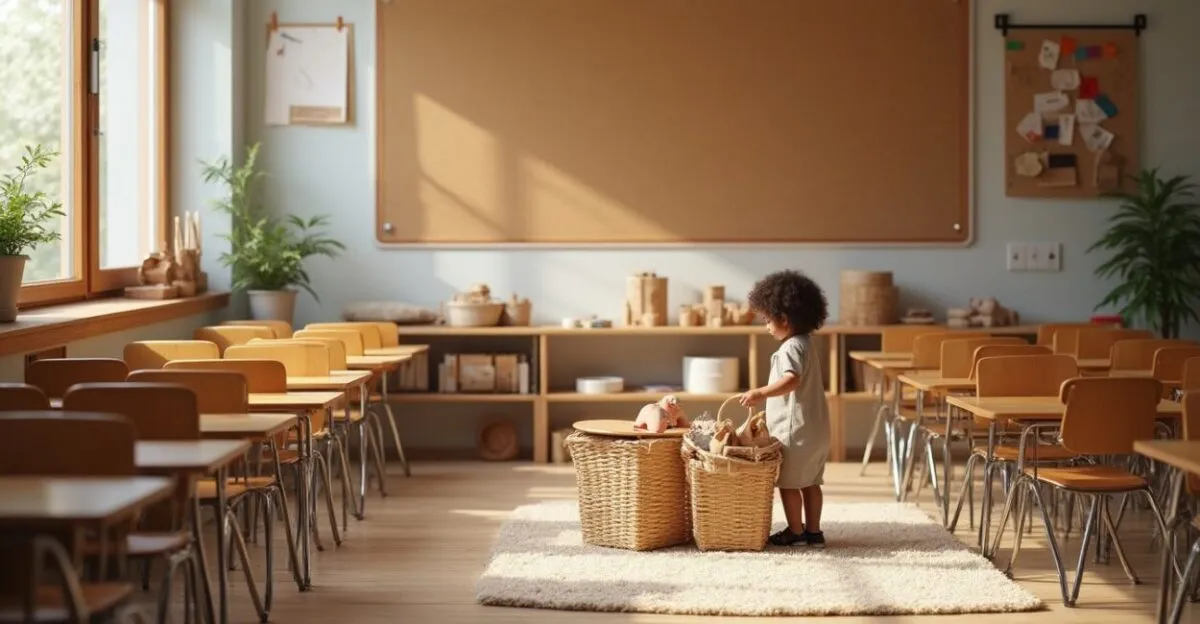
An early childhood classroom inspired by Reggio Emilia typically makes materials easy to access, allows for different ways of arranging work, and makes ongoing processes visible. There is no required furniture; the setup should suit the children, the available space, and the investigations underway.
Element Setup that limits inquiry Accessible alternative Exploration possibilities Tables and pathways Fixed desks in rows Movable tables and clear pathways Build with a partner or observe from different angles Materials Objects kept out of reach or single-use toys Labeled bins with cardboard, fabric, and safe containers Compare, combine, build, and invent new uses Documentation Only rules displayed on the wall Drawings, questions, and project stages within the group’s reach Revisit hypotheses and retell the process Sensory exploration A closed-ended activity with one result Leaves, large seeds, sand, and clear containers, with supervision Sort, observe textures, and compare shapes
A sensory station might include leaves and clear containers; an inquiry notebook might bring together a drawing and a word dictated by a child. To explore textures with light, a simple box and a safe LED light source can work, as long as an adult manages cords, heat, and access to the equipment. The activity becomes mere staging when the classroom’s appearance takes priority over how it is used. Small materials require a safety assessment based on the children’s ages, and natural items need to be clean and suitable for the group. The team should choose what supports inquiry, not what makes for a prettier photo.
Families, assessment, and the limits of adaptations
Families can participate without frequent meetings or homework: a question sent home in a school communication notebook, a brief note about a child’s discovery, or a voluntary contribution of materials already on hand are all possibilities. The school can plan for different ways to contribute, including options for families with limited time or access to digital channels; find more ideas about family engagement.
Learning is assessed through observations, children’s work, conversations, and planning reviews, rather than relying on formal tests for young children. That doesn’t mean assessment is unnecessary: the team needs to consider what each child can do, what support they need, and whether activities expand their participation. The NAEYC’s guidance on developmentally appropriate practice also emphasizes the importance of considering context, age, and individual development.
Lists such as “five teaching methods,” “four principles of education,” or “seven areas of development” are not official classifications established by the Reggio Emilia approach. Such numbers may appear in educational materials for their own purposes, but they should be attributed to the source that proposes them, not presented as a universal framework.
There are real limits to adaptation: large classes, little planning time, and space constraints affect what’s feasible. In that case, choose one small change the team can sustain, such as observing a play activity for a few days and reviewing the documentation together. A thoughtful adaptation preserves listening and reflection; copying the look of an Italian school alone does not reproduce its approach.
A next step could be to set aside time for observation this week and write down a question the children already seem eager to investigate. From there, the team can decide which safe materials are available and what evidence would help them choose the next invitation.
Frequently asked questions
Is there an officially recognized, free online course on the Reggio Emilia approach?
There is no single course that certifies a school’s application of the approach. Before enrolling, check who offers the training, what references it provides, and whether it distinguishes the principles of the Reggio Emilia experience from a commercial formula.
Does a school need an atelier to use this approach?
No. A dedicated space can support experiences in different languages of expression, but materials and investigations can also be organized in a regular classroom, the schoolyard, or other safe environments.
How can projects be adapted for children who don’t write yet?
Document children’s dictated words, gestures, drawings, constructions, and choices during an activity. Conventional writing isn’t required for children to form and communicate ideas.
What should you do when a child doesn’t want to join a group activity?
Notice whether the child would rather watch, explore the materials in another way, or join at a different time. Offer ways to participate without forcing the child to respond just like the rest of the group.
Does a school called Reggio Emilia necessarily follow this approach?
The school’s name alone doesn’t prove how its educational program works. To evaluate its approach, look for information about planning, children’s participation, documentation, and staff training.
How can you compare reviews of a Reggio Emilia school?
Separate opinions about customer service, communication, and facilities from information about teaching practices. Visiting the school and asking how educators plan projects and share documentation will give you more concrete information than a single rating.
Artigos Relacionados
 Supporting Emergent Literacy Through Playful Classroom Activities
 Boosting Reading Comprehension with Simple Classroom Tasks
 Educational Technology: Tools That Transform Classrooms
 Active Learning: Practical Classroom Techniques
 Creative Teaching Methods for Teachers
 Creative Curriculum: 7 Hands-On School Activities for 2025
