
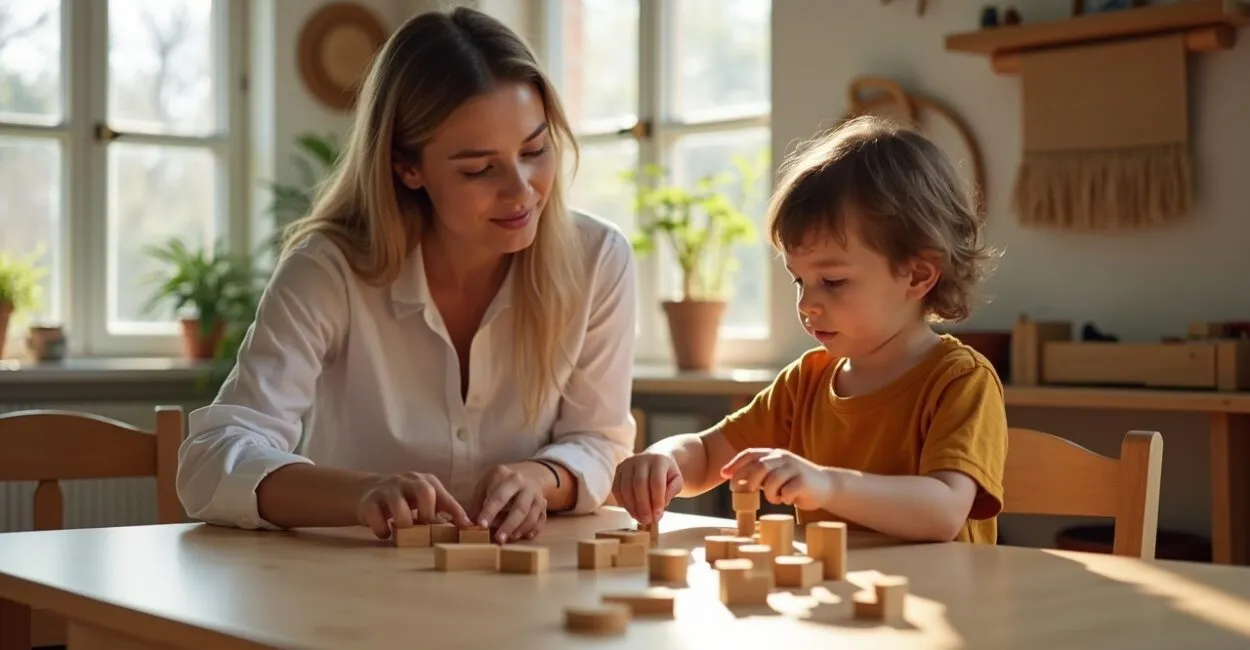
In some early childhood classrooms, children learn to care for shared spaces; in others, they spend long periods exploring a project chosen by the group. Early childhood education varies across cultures around the world, shaped by social values, family structures, language, history, and access to services. These differences influence what children learn, how adults participate, and what role play takes.

Comparing practices can help families and educators broaden their perspectives, as long as each approach is understood in context. Montessori, Waldorf, and Reggio Emilia are well-known points of reference, while Asian, Indigenous, African, and Latin American experiences show that there are many ways to educate young children—and no single model works for everyone.
What does early childhood education across cultures mean?
Early childhood education is the combination of intentional care, interaction, and learning processes that support a child’s development, both in institutions and in everyday life. Across cultures, these processes reflect different ideas about childhood, community, independence, and knowledge. As a result, routines, valued content, and the roles of family members and educators vary. In everyday terms, this means a child might learn to tell stories, contribute to shared tasks, explore materials, or follow a structured routine, depending on the environment in which they grow up. These practices are not unique to entire countries: within any society, they differ across regions, language groups, families, school systems, and economic circumstances.
One useful distinction is between educational principles and conditions for putting them into practice. For example, valuing independence also depends on safe spaces, available time, and adults prepared to support the child. Without these conditions, an approach can become just a list of activities or themed decorations.
An educational practice has meaning when it fits the life, language, and relationships of the community where a child lives.
How are Montessori, Waldorf, and Reggio Emilia different?
Montessori, Waldorf, and Reggio Emilia are educational approaches with their own histories and principles; none works as a universal formula. The right choice depends on the child’s needs, the staff’s training, available resources, and how well the school’s approach aligns with the family’s routine.
| Approach | Focus and the adult’s role | What to keep in mind |
|---|---|---|
| Montessori | A prepared environment, specific materials, and independence in activities children choose within set limits. | Requires an organized space and adults who observe without doing for children what they can already try themselves. |
| Waldorf | Rhythm, imaginative play, artistic activities, and experiences connected to everyday life. | Practices vary from school to school; it’s important to learn how they approach literacy, diversity, and technology. |
| Reggio Emilia | Project-based exploration, expression through different languages, and documentation of learning. | Depends on planning, dialogue with families, and time to follow the group’s interests. |
In the Montessori approach, materials have a specific purpose and often allow children to notice aspects of their own work. In schools inspired by Reggio Emilia, drawings, conversations, and constructions may be documented to guide future projects. Waldorf pedagogy, meanwhile, often emphasizes imitation, storytelling, and play with simple materials. In every case, quality depends less on the label than on what adults do day to day.
What changes in early childhood education in Japan, Korea, and China?

Japan, Korea, and China do not each have a single approach to early childhood education: every country has diverse policies, institutions, and family expectations. Still, some settings emphasize social interaction, group learning, and academic preparation, with important differences between public and private systems, urban and rural areas, and local communities.
In Japan, some preschool and childcare routines give children opportunities to help care for materials and learn to coordinate group activities. Independence can show up in small actions, such as putting away their belongings or helping organize a meal. This does not mean that all Japanese institutions follow the same routine or that cooperation replaces other educational goals.
In South Korea and China, demand for learning activities and school preparation can be strong in some settings, but the intensity varies by family, school, and education policy. Performance pressure deserves attention when it cuts into sleep, free play, or time spent together. Young children need age-appropriate experiences, not just an early start on formal academic content.
For a comparative reference, the OECD publishes analyses of education policies and early childhood education in different countries. Comparing systems requires looking at what the data measure and which groups are left out; a national indicator cannot describe every child’s experience.
What can Indigenous and African education teach us?
Indigenous education and African education encompass diverse experiences tied to specific peoples, languages, territories, and histories. In many communities, learning involves observing more experienced people, taking part in group activities, and passing on knowledge orally. However, the content and ways of participating belong to each people and should not be treated as a single model.
In Indigenous communities, relationships with the land may connect knowledge about plants, natural cycles, memory, and community responsibility. In schools, bringing this knowledge into conversation with the official curriculum depends on community participation and respect for local languages and teaching practices. For example, an activity about local plants needs to recognize who holds that knowledge and how it can be shared.
Educational practices in African countries also vary widely across regions, peoples, languages, and urban and rural settings. Oral traditions, music, storytelling, and collaboration feature in some experiences, but they do not define every childhood on the continent. Reducing dozens of societies to an “African pedagogy” erases their differences and turns living knowledge into a stereotype.
In Brazil, guidance from the Ministry of Education and regulations on Indigenous school education offer points of reference for considering intercultural education with the participation of the peoples involved. In an urban school, students can explore Indigenous languages, histories, and knowledge using sources created by those communities, while avoiding fantasies, out-of-context costumes, and activities that discuss peoples without including them.
Why is early childhood education in Latin America so diverse?
Early childhood education in Latin America varies because the region’s societies bring together Indigenous peoples, African heritage, migration, different languages, and widely varying material conditions. Local practices can strengthen community ties and cultural identities, while income inequality, the availability of school places, and access to qualified professionals limit what some families and schools can offer.
In rural areas and multilingual communities, education may need to incorporate the language spoken at home alongside the language used at school. In urban centers, classrooms with families from different backgrounds may need strategies to welcome diverse experiences without treating one culture as the norm. The right approach depends on the community: a useful practice in one place may need significant changes in another.
Brazil’s Common Core Curriculum (Base Nacional Comum Curricular), available on the Ministry of Education’s website, sets out learning rights and fields of experience for early childhood education in Brazil. The curriculum provides a helpful reference for planning, but it does not replace listening to children, families, and communities, nor does it solve differences in infrastructure on its own.
How can you compare goals, play, and assessment?
A fair comparison looks at what each approach considers learning, how adults support the group, and how play fits into the curriculum. Rather than asking which method wins, consider whether the routine is age-appropriate, provides secure relationships, and allows children to explore, express themselves, and participate.
- Goals: May prioritize independence, social interaction, exploration, artistic expression, or academic knowledge, in different combinations.
- The adult’s role: May include preparing the environment, offering experiences, observing, documenting, or guiding group activities.
- Play: May be free, imaginative, exploratory, or organized by the educator; its quality depends on having a clear purpose and real room for play.
- Assessment: In early childhood education, assessment usually supports monitoring development rather than turning young children into test scores or rankings.
A practical detail can reveal the quality of an approach: notice what happens when a child stops an activity, drops a material, or disagrees with a classmate. The adult’s response shows whether independence is respected, conflicts are mediated, and mistakes become opportunities for exploration or reasons for punishment. The name of the method alone cannot answer these questions.
In early childhood, the most useful assessment guides the educator’s next steps and protects time for play, exploration, and social interaction.
There are limits to comparisons: “independence,” “discipline,” and “play” can mean different things in different communities, and a single observation cannot represent an entire system. To evaluate a school, read its educational plan and talk with staff about routines, teacher training, inclusion, and relationships with families.
How can you bring ideas from other cultures into your home or school?
Ideas from other cultures can enrich early childhood education when they are adapted with context, respect, and input from the people they come from. Copying an activity without explaining its origin or purpose tends to produce a superficial version; learning about its history, perspectives, and limits helps you decide whether it makes sense for your group.
Families and educators can start with accessible activities: read books by authors from different backgrounds, listen to stories in more than one language, cook recipes connected to family history, and invite children to compare games without declaring one superior. If an activity involves Indigenous or African knowledge, seek materials created by the communities themselves, and don’t present sacred or restricted knowledge as freely available content.
Technology can support calls with relatives who live far away, access to stories, and documentation of projects. For young children, screens do not replace in-person interaction, movement, conversation, or play with objects. Their use should have a purpose, be age-appropriate in duration, and include adult supervision; privacy and unequal access also need to be considered.
When tests or early academic demands come up, talk with the school about what is being assessed and why. Observation notes can guide individual support without ranking children by speed. Performance pressure deserves a closer look when it takes time away from sleep, movement, play, and interaction—all of which also support learning.
Quick reference: Which principles should you consider?
| Question | Short answer |
|---|---|
| Is there one best method? | The best fit depends on the child, the staff, the family, and the actual conditions for putting it into practice. |
| What should you look for in educational approaches? | Goals, the adult’s role, room for play, assessment, and consistency in the daily routine. |
| How should Indigenous and African knowledge be addressed? | Use sources created by the communities and include their participation, without generalizing or turning their cultures into folklore. |
| How should academic pressure be handled? | Check the purpose of assessments and protect time for play, rest, and social interaction. |
| What role should screens play? | They should be supervised and purposeful, never a substitute for relationships and hands-on experiences. |
How can you choose a next step?
To choose an approach, first consider the child and the routine they will have, then look at how the school turns its principles into everyday practice. Ask for examples of how educators handle conflicts, document learning, and communicate with families. A consistent approach can explain what it does and why, without promising the same results for every child.
At home or at school, choose a practice from another culture, research its origins using reliable sources, and adapt it respectfully for your group. This process teaches about diversity without reducing cultures to curiosities, and lets you see through the children’s experience whether the idea really expands their opportunities to learn.
Frequently asked questions
How can you introduce other cultures without turning differences into stereotypes?
Use books, music, and accounts from people who belong to the cultures being explored, and show that there is diversity within every group. Avoid dressing children in generic costumes or assigning a single characteristic to an entire people.
Does a child need to learn another language in early childhood education?
Exposure to other languages can encourage listening and curiosity, but not every child needs formal lessons. The family’s language should be respected, and the approach should consider the child’s age, context, and educational goals.
How can you tell whether a school actually follows the approach it promotes?
Observe a routine, read the educational plan, and ask how the staff supports play, handles conflicts, and monitors learning. It’s also worth checking whether educator training and the way the space is organized match what the school says about itself.
%%AGPTRH5%%
Artigos Relacionados
 Biodiversity Project: Exploring Animals and Plants
 A School Garden in Early Childhood Education
 Environmental Activities for Early Childhood Education
 Letter Activities in Early Childhood Education
 Activities for Early Childhood Education: Practical Ideas
 Activities About Jobs in Early Childhood Education
