
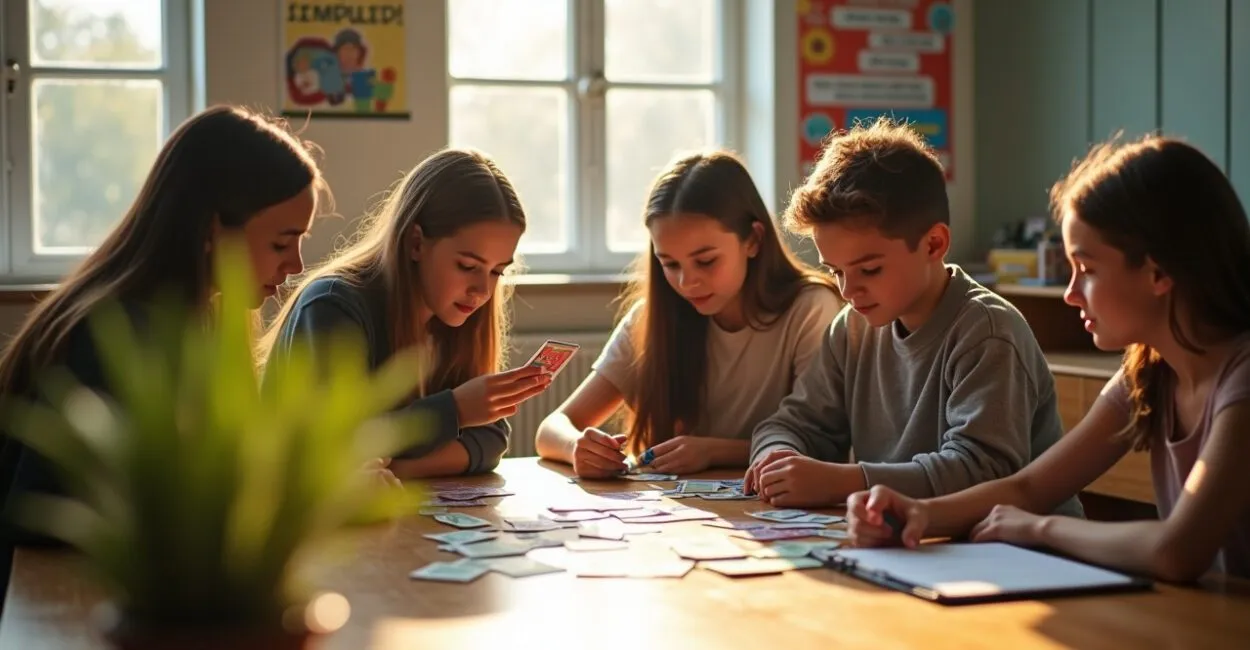
A class planning a school fair needs to decide how much to spend, how to divide tasks, and what to do with the money raised. Situations like these show why methods for teaching financial education in schools should start with choices that feel relevant to students’ lives and become more complex as they get older.

Financial education is the process of developing the knowledge and skills needed to make decisions about resources, spending, planning, and risk. In school, it can be taught through games, simulations, projects, and interdisciplinary activities, as long as each one has a clear objective and does not depend on families’ money.
Quick overview
- Search intent: informational, with a focus on practical application.
- Possible grade levels: Early Childhood Education, Elementary School, and High School, with activities suited to each age group.
- Resources: Paper, reused materials, and made-up data may be all you need to get started.
- Safety principle: Students do not need to use their own money to learn.
- Curriculum reference: Financial education can be integrated across different subjects in alignment with Brazil’s BNCC, the National Common Core Curriculum.
How to choose methods for teaching financial education in schools
The most suitable methods bring together the grade level, the learning objective, and the resources available. For younger children, choice-based games and everyday scenarios help them recognize needs and wants. For upper elementary students, budgeting and planning are appropriate; for high school students, lessons can cover credit, interest, and different scenarios.
Students should be able to explain their decisions.
Start with what the class needs to learn, not with the most appealing format. If the goal is to compare prices, researching store flyers may work better than using an app.
If the goal is to understand planning, a simulation using made-up amounts lets students test decisions without exposing anyone’s real financial circumstances.
| School level | Possible focus | Example approach |
|---|---|---|
| Early Childhood Education and early elementary grades | Choices, trading, and waiting | A decision-making game with play money |
| Upper elementary grades | Budgeting, spending, and planning | Allocating pretend resources for a class activity |
| High School | Interest, credit, risk, and goals | Comparing financial scenarios using data made up for the lesson |
Brazil’s Base Nacional Comum Curricular (BNCC), or National Common Core Curriculum, provides a framework for connecting competencies and subjects. Schools can relate this work to Brazil’s National Financial Education Strategy (ENEF) without treating a one-off activity as a substitute for ongoing instruction.
A strong financial education activity ends when students can justify their choice and explain what might change in a different scenario.
Gamification to explore choices, budgets, and planning
Financial education games work best when the rules teach more than how to earn points. A challenge might ask teams to plan a fictional party with limited resources, choose among options, and set some resources aside for unexpected expenses. Paper tokens, cards, and a chart on the board are all you need.
In the early elementary grades, use short scenarios with just a few options and symbolic amounts. For older students, introduce changes during the round, such as an increase in the cost of a material or an unexpected expense. After the game, make time to compare strategies: one team may have saved, while another prioritized a different item.
One practical detail is easy to overlook: if the game rewards only the team that finishes with the most tokens, students may conclude that spending less is always the best decision. Include criteria tied to the group’s goal and discuss the tradeoffs behind each choice. A classroom bank can also serve as a symbolic record of money coming in and going out, without handling real money.
Business simulations for making decisions with made-up data

A business simulation lets students practice budgeting, pricing, and scenario analysis without starting a company or involving personal funds. In elementary school, the class can plan to make an imaginary product; in high school, students can assess costs, projected revenue, and the effects of changing demand.
Read also: 5 Creative Teaching Methods That Work
Present a case with made-up numbers that are internally consistent. Teams decide what to offer, list costs, and explain their pricing. Then give them a change in the scenario, such as a shortage of a material or lower-than-expected sales, and have them record how they would adjust their plan.
The goal is to observe students’ reasoning, not reward the team that “made” the most money in the simulation. Without guidance, the activity may reinforce simplistic ideas about entrepreneurship, such as assuming every risk can be controlled or that profit depends only on effort. It is worth discussing uncertainty, responsibility, and the consequences for different people.
Read also: Project-Based Learning: How to Put It Into Practice Today
Hands-on projects with clear rules for managing resources
School fairs, services, and cooperatives bring concepts closer to real-world decisions. They can work for different age groups as long as students’ responsibilities match their maturity and the school sets clear rules in advance for permissions, supervision, how resources will be used, and financial reporting.
To keep costs down, the class can organize a noncommercial service, such as a book swap, or work with a fictional budget. If the project raises real money, designated adults at the school should manage it, keeping clear records and being transparent about how the funds are used. Taking part should not require families to contribute money.
Some students may prefer drawing, researching, or organizing data to speaking with the public. Offer different roles and an equivalent alternative, such as analyzing a simulated proposal. Participation does not have to mean being on display or selling something.
School projects teach financial responsibility when the class can understand where each resource came from, what it is for, and how it is tracked.
Mentors and digital platforms with teacher guidance
Guest speakers from financial institutions, credit unions, or small businesses can share their experiences and answer questions, but the school should set the purpose of the visit and avoid commercial pitches. For example, a brief talk about putting together a budget could be followed by questions prepared by students and a follow-up analysis activity.
Platforms and simulators can help make concepts visible, as long as they are accessible, age-appropriate, and used with guidance. Before assigning a tool, check its data collection practices, registration requirements, advertising, and accessibility. If internet access or devices are not available to everyone, adapt the exercise for paper and whole-class discussion.
The Banco Central do Brasil’s Financial Citizenship section offers resources to support conversations about financial decisions and services. Outside materials can enrich a lesson, but they do not replace the teacher’s critical judgment or give students a reason to accept a source’s recommendations without question.
Interdisciplinary financial education connected to everyday life
Interdisciplinary financial education is most meaningful when each subject brings its own way of exploring the topic. Math covers proportions and reading tables; English language arts addresses arguments and advertising analysis; social studies examines consumption and inequality; science explores resource use and environmental impacts.
For example, a project on food waste could include comparing quantities and estimated costs, writing informational texts, and discussing consumer habits. Data can be fictional or collected without identifying families. The key is not to publicly expose differences in income or judge household choices.
Interdisciplinary work requires shared planning. If each subject assigns an activity without common objectives, students may see the topic as a string of disconnected tasks. A shared question, such as “What decisions can reduce waste without limiting access?”, helps bring different contributions together.
Implementation and assessment without relying on expensive resources
To get started, choose an observable skill, set an age-appropriate activity, and decide how students will show what they have learned. Paper, a board, and fictional scenarios are enough for many activities. Costs may rise if the school chooses to use materials, events, or platforms, but none of these is required to teach the topic.
- Find out where students are starting: Ask them to explain how they would handle a simple situation without asking for information about their family’s income.
- Plan the activity: Set an objective, rules, resources, and adaptations for different ways of participating.
- Observe the process: Record students’ explanations, changes to their plans, and ability to compare alternatives.
- Revisit the learning: Present a new scenario to see whether students can apply their reasoning in a different situation.
Financial learning can be assessed through group work, oral explanations, decision records, and a brief individual task. The final answer alone does not show whether a student understood the consequences of a choice. Compare the student’s initial and later reasoning and look for specific signs, such as identifying an unexpected expense or explaining how setting money aside changes the plan.
Brazil’s Ministry of Finance provides official information about financial education that can support school planning and conversations with the community. When speaking with families and school leaders, show how the activities connect to curriculum objectives, explain that there will be no fees or disclosure of household circumstances, and propose a short pilot with learning evidence that can be used to review the initiative.
How well different approaches work depends on students’ ages, the class context, and the quality of teacher guidance. A simulation may produce little learning if students only fill in a spreadsheet; a simple game can spark a good discussion when the consequences of choices are clear. If students are reluctant to participate, offer different roles and equivalent alternatives rather than requiring everyone to take part in the same way.
Choose one skill to work on over the next few weeks, try a low-cost activity, and save examples of students’ reasoning. This first cycle can help you refine the approach before expanding the project to other classes or subjects.
Frequently asked questions
Which method works best for elementary school students?
No single approach works for every class. Games and everyday scenarios can help in the early grades; guided projects and budget simulations may work well in the upper grades, as long as the teacher adjusts the complexity and listens to students’ reasoning.
How much does it cost to implement financial education activities?
You can get started without buying anything, using paper, a board, and fictional amounts. Events, specialized materials, and platforms may involve costs depending on the school’s choices, but none should be treated as a requirement for learning.
How can you convince parents and school leaders that this topic matters?
Present curriculum objectives, examples of activities, and ways to assess what students have learned. Also explain the safeguards: no one needs to reveal their family’s financial situation or use their own money.
How can you tell whether learning has taken place?
See whether students can compare options, justify a decision, and revise a plan when circumstances change. A new problem presented after the activity can help show whether they can apply their reasoning in another context.
%%AGPTRH4%%
Artigos Relacionados
 Literacy in Elementary School: Methods That Work
 Environmental Education in Elementary School: Activities That Work
 Why Teens Need Financial Education
 The Montessori Method: How It Works in Europe
 Active Learning Methods: 7 Practices That Are Transforming Education
 Phonics Teaching Methods That Build Fluent Decoding Skills
