
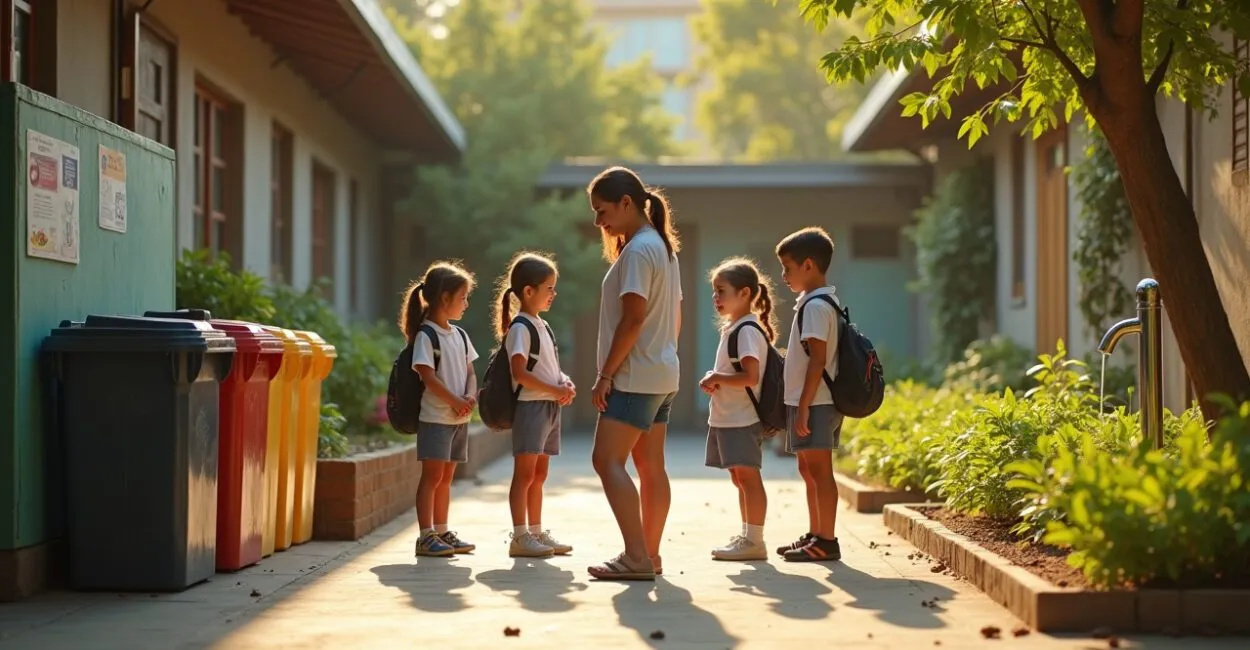
A dripping faucet during recess, unlabeled trash cans, and neglected garden beds give a class concrete questions to investigate. Environmental education in elementary school helps children and teens understand the connections between the environment, society, and everyday life—and turn that understanding into responsible choices and actions. At school, the topic becomes meaningful when it starts with situations students recognize: what happens to lunch waste, how water is used in the bathrooms, or where there’s shade in the schoolyard. Ongoing activities tied to the curriculum and the school’s daily operations teach more than a one-off event held just to mark a date.

What is environmental education in elementary school, and why does it matter?
Environmental education is a learning process that develops knowledge, values, skills, and participation so people can understand the relationship between society and nature and take action on environmental issues. In elementary school, that means investigating problems close to home, connecting observations to curriculum concepts, and deciding what the group can do collectively and responsibly. This work supports learning in science, geography, math, and English language arts. For example, by tracking water use, students can record data, compare time periods, discuss infrastructure, and present proposals. School also provides a place to talk about unequal access to green spaces, sanitation, and adequate housing, without blaming children for problems that depend on public policy or on each family’s circumstances.
Brazil’s National Environmental Education Policy, established by Law No. 9,795 of 1999, defines environmental education as an essential and ongoing part of the country’s education system. This guidance supports integrating the topic into the curriculum instead of limiting it to a lecture or annual campaign.
An environmental issue close to school can become an investigation, a curriculum-based learning opportunity, and a collective decision.
How can you integrate the topic into the curriculum and school routine?
Start with a recurring situation at school and turn it into a question students can investigate, tied to learning objectives. The topic can span different subjects without requiring every lesson to become an environmental activity. If water is being wasted, science can explore water use and availability; math can organize records; English language arts can produce a message based on the evidence; and geography can connect consumption, place, and access. Talking with staff responsible for cleaning or maintenance also helps students understand what can realistically change and what depends on repairs or administrative decisions.
The National Common Curricular Base document provides a framework for planning learning by subject area and grade level. The team can note the objective, activity, and expected outcome in its existing plans, avoiding a parallel project that disappears when the schedule changes.
Which hands-on activities work for waste, water, and consumption?

The most effective activities help students observe a real problem, gather evidence, and test a possible solution. They can use materials the school already has: scrap paper, notebooks, a whiteboard, reused containers, or the school building itself.
- Waste: For a few days, track what ends up in one classroom’s trash, sort it into categories, and discuss what could be avoided, reused, or sent for recycling. Before setting up color-coded bins, confirm that the school or local community has a compatible collection service.
- Water: Conduct a guided check of faucets and toilets, record any problems, and report them to the staff responsible. Students should not handle plumbing or take on repairs.
- Consumption: Look at lunch packaging or school supplies and discuss durability, disposal, and affordable alternatives. Don’t turn families’ choices into a reason for judgment.
- Green spaces: Observe shade, the species present, and signs of care in the schoolyard. A school garden may work if there is enough space, water, and someone responsible for maintaining it. Without those conditions, an inventory of plants or a study of the school’s trees can still support learning.
A common issue with school recycling is that sorting waste in the classroom doesn’t guarantee it will be recycled. If the materials are later mixed together or there’s no collection service, the activity teaches an incomplete process. Checking with school administrators about where the waste goes before launching a campaign helps avoid promising an outcome the school can’t control.
Read also: Environmental Education Projects: 7 Ideas for National Day
How can you adapt activities to students’ ages and school conditions?
Adapt activities based on students’ development, their interests, and what the school can sustain. A simple activity may work better than a large project with no follow-through.
| Approximate grade level | Possible approach |
|---|---|
| Lower elementary | Observe, draw, sort materials, and agree on concrete ways to care for the spaces students use. |
| Upper elementary | Compare records, research causes, consider different points of view, and develop well-supported proposals. |
These grade levels are guidelines, not strict rules. A lower elementary class can take on a longer investigation with support, while older students may prefer a hands-on activity to an extensive research project. To keep students engaged, invite them to choose among real school issues and offer different roles: observing, recording, interviewing, or presenting.
If the school has no budget, garden, or equipment, use what’s already available. A walk around the schoolyard, a conversation with the custodial staff, and a map drawn in a notebook may be enough to get started. Guidance from the Brazilian Ministry of the Environment and Climate Change can also help provide context for environmental topics; adapt any ideas to local conditions.
How can you involve families without overburdening them?
Families can contribute stories and perspectives, as long as participation is optional and simple and doesn’t replace the school’s responsibilities. For example, inviting families to observe how water is used in a shared space can spark a conversation without requiring them to buy materials or complete an extensive household assignment. Explain the purpose in plain language, say how much time the activity should take, and offer alternatives for anyone who can’t participate. Students can bring home a question to discuss or share a practice they know about at school, without asking families to send photos, fill out forms, or buy products.
Family involvement works best when it creates room for sharing without turning participation into an obligation or an expense.
How can you track results and student engagement?
Track the process with simple records: participation in activities, the quality of students’ observations, decisions made, and habits the class can practice at school. Comparing these records throughout the project helps you spot changes without relying on complex metrics.
A chart on the board can summarize the question being investigated, the evidence collected, the agreed-upon action, and what needs to be revisited. In a project about waste, for example, see whether students can identify materials correctly and whether sorted waste goes to an appropriate destination. Don’t hold students responsible for collection failures or inadequate infrastructure.
Results take different amounts of time and aren’t limited to changes in habits. Being able to explain why something shouldn’t be thrown away a certain way or suggest a realistic solution is also learning. If a student isn’t interested, offer another role or connect the investigation to something they already notice, without expecting everyone to show the same level of enthusiasm.
What should you do about common challenges, and how can you get started?
Lack of time, limited resources, and projects that lose momentum are common challenges. To address them, choose a small issue, agree from the start on who can make decisions, and plan to revisit the topic as part of regular lessons.
- Start by observing a space or routine at school.
- Choose a question with the class that can be investigated using available resources.
- Record what you observe and agree on an action that fits within the school’s responsibilities.
- Review the records after an appropriate period and decide whether to continue, change, or end the action.
It’s important to recognize the limits: no single activity can solve problems that depend on public waste collection, building maintenance, or funding. Acknowledging that boundary teaches civic responsibility and helps direct requests to the people with the authority to act.
Summary: Frequently asked questions about putting it into practice
| Question | Short answer |
|---|---|
| Where should we start? | With an environmental issue students can observe in their school routine. |
| Do we need funding? | Not necessarily; records, walks, and conversations can get the work started. |
| How can we include families? | With clear, optional invitations that don’t involve costs or excessive tasks. |
| How can we assess progress? | By observing participation, learning, and actions the school can sustain. |
Next step: choose an issue students can observe
A strong plan begins with a question students can investigate and ends with a decision the school can follow up on. Choose a space or habit, record the starting point, and test a small action before expanding it. This process lets you evaluate what worked for that particular class without promising the same results everywhere.
Do we need to create a separate subject for this work?
No. Brazilian law calls for environmental education to be integrated into educational processes, and lesson plans can connect it to different subject areas. How it’s organized depends on the school’s educational plan and available resources.
Is a school garden essential?
No. A garden is one option when there are conditions for ongoing care, but observing existing plants, studying shade in the schoolyard, or investigating where food comes from also provides ways to explore environmental issues.
What should we do if the school doesn’t have recycling collection?
Investigate where the waste goes with the class and raise the issue with school administrators or the responsible municipal service. Don’t encourage sorting as if it guarantees recycling when the system doesn’t follow through.
Can a campaign lasting just a few days be enough?
It can draw attention to a topic, but on its own, it leaves little room to investigate causes and track results. If you hold a campaign, connect it to a curriculum activity and revisit the topic afterward.
Artigos Relacionados
 Environmental Education in Elementary School: Hands-On Activities
 Literacy in Elementary School: Methods That Work
 Mother’s Day Activities for Elementary School
 Inclusive Education in Elementary School: Practices and Support
 Elementary School Activities: Creative, Practical Ideas
 Modern Elementary Education: Practices That Engage Students
