
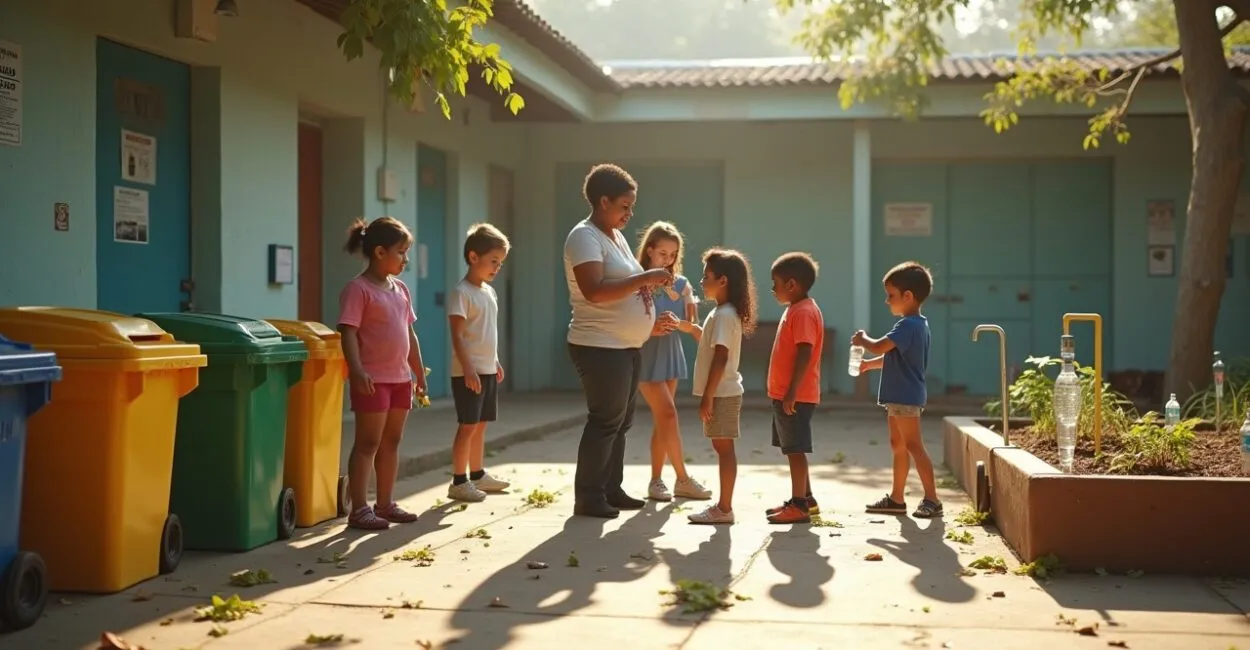
When a school turns trash into a resource, makes water a topic of discussion, and transforms the playground into a lab, learning takes on a new dimension. environmental education in elementary school isn’t an “extra” subject. It’s a way to teach science, citizenship, and responsibility through real-world problems children can observe, measure, and discuss.
In practice, what works best isn’t a great speech but a well-designed routine: sorting waste, reducing wastefulness, observing the surroundings, tracking water and energy use, caring for a garden, discussing transportation, and understanding the impact of personal choices. Educators who work in this area know that when an activity has a concrete purpose, students participate more and remember what they learned longer.

What You Need to Know
- Environmental education works best when it becomes a weekly practice, not a one-off event for a special occasion.
- Simple activities, such as waste audits and school gardens, lead to more learning than lecture-only lessons.
- The topic becomes more powerful when it connects science, geography, English language arts, and math.
- Sustainability projects only succeed when the whole school makes them part of the routine, from teachers to support staff.
- The biggest benefit isn’t “knowing the definition,” but building habits that are visible in a child’s everyday life.
Environmental Education in Elementary School: Hands-On Activities That Work in the Classroom
In technical terms, environmental education is an ongoing process of building values, knowledge, skills, and attitudes focused on conserving the environment and using natural resources responsibly. Put simply, it teaches children to recognize how their actions affect water, waste, energy, animals, and shared spaces.
In elementary school, this approach needs to be hands-on. Children learn best when they handle materials, observe, record, and compare. A lesson on recycling can become a classroom waste-sorting activity; a lesson about water can become an exercise in measuring water waste at the drinking fountain; a lesson about soil can lead to composting. This makes the material meaningful and helps students understand concepts such as mindful consumption, sustainability, and social and environmental responsibility.
What makes an environmental activity memorable rather than forgettable isn’t the topic—it’s the connection between a real problem, an observable action, and feedback for the class.
Starting in the Right Place
Before planning a project, take a look at the school’s context. Is there recycling pickup in the neighborhood? Does the school cafeteria generate a lot of food waste? Is the playground shady, or does it get very hot? The answers shape the strategy. Even a school with limited resources can accomplish a lot with a simple assessment and low-cost activities, as long as the work is consistent.
Organizations That Can Help Guide the Work
Useful resources include Brazil’s Ministry of Education, the Brazilian Institute of Geography and Statistics (IBGE) for local and sanitation data, and UNESCO for global guidelines on education for sustainable development. These sources help move beyond improvisation and provide a foundation for more effective projects.
How to Integrate the Topic Into Different Subjects Without Forcing It
The most common mistake is treating the subject as a standalone lecture. Environmental education works better when it’s woven into the curriculum. In science, students can study food chains, decomposition, and the water cycle. In geography, they can explore land use, climate, and urban development. In math, they can create consumption graphs, weigh recyclables, and build observation tables. In English language arts, students can write reflections, make posters, draft open letters, and create campaigns.
This integration doesn’t mean inventing an environmental theme for every lesson. Teachers may disagree about how much space the topic should take in the curriculum, and the honest answer is: it depends on the students’ age and the unit’s goals. With younger students, repeating habits matters more than teaching a long series of concepts; in the upper elementary grades, students can explore cause-and-effect relationships in more depth.
Where the Topic Fits Best
- Science: waste, energy, water, biodiversity, soil, and decomposition.
- Geography: landscapes, cities, rural areas, sanitation, and resource use.
- Math: counting, comparing, estimating, and interpreting data.
- English language arts: discussion, writing, persuasive arguments, and social communication.
What to Avoid
Not every environmental lesson needs to become a moral lecture. If an activity blames children for structural problems, it loses its impact. Schools should teach responsibility without placing the burden on students alone when these issues are also collective, public, and political. This distinction matters because sustainability isn’t just about individual behavior; it also involves infrastructure, public policy, and community organization.
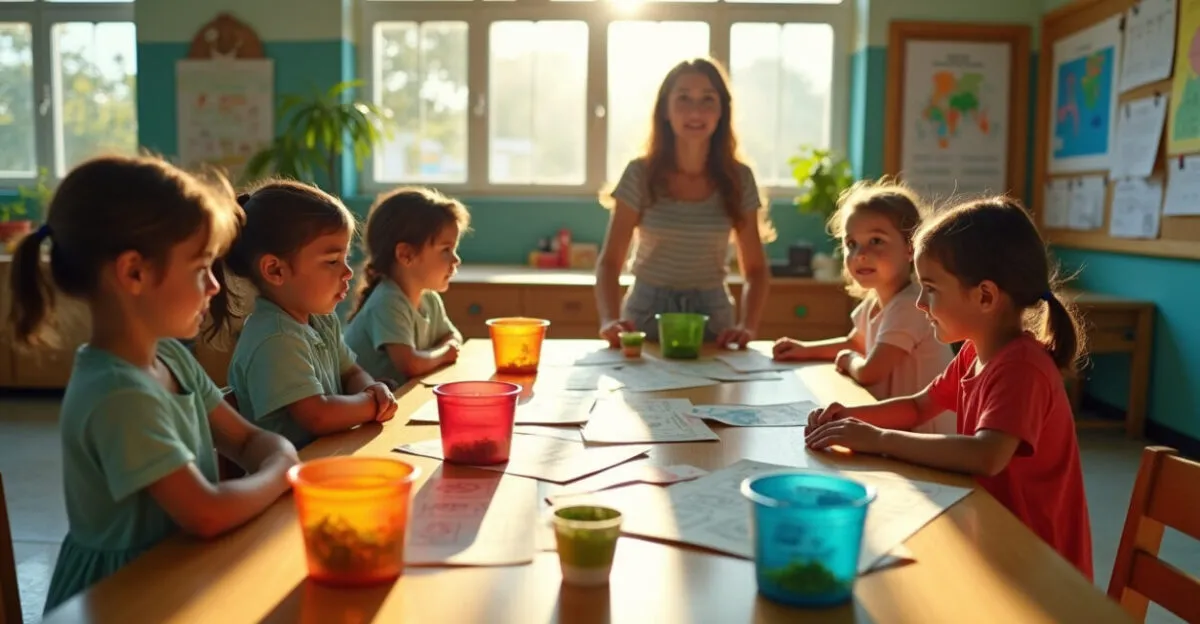
Hands-On Activities for Each Elementary School Grade

A good sequence starts with simple activities and builds as students mature. In the early grades, the focus should be on observation, care, and habits. In the upper grades, students can analyze data, compare solutions, and advocate for proposals. The key is to raise the level of challenge without losing the hands-on element.
Grades 1–3
- Sort waste using color-coded bins and labels in the classroom.
- Keep a calendar of “waste-free snack days.”
- Plant beans, sunflowers, or herbs in reused cups.
- Hold a group discussion about water, waste, and caring for plants and animals.
Grades 4–5
- Map the area around the school, noting litter, trees, shade, and drainage.
- Build a small compost bin for cafeteria food scraps.
- Survey families about their water- and energy-saving habits.
- Create a poster or campaign to reduce single-use items.
How to Turn an Activity Into Meaningful Learning
Doing the activity isn’t enough; students also need to document it. A display with photos, an observation chart, or a class journal helps children see their progress. Without documentation, the activity is just an enjoyable experience. With it, the activity becomes evidence of learning. In practice, this step is what separates a nice project from a meaningful educational one.
Read also: National Environmental Education Day: 5 Activities That Work at School
School environmental projects lead to lasting learning only when students see measurable results: less waste, more care for shared spaces, and visible changes in habits.
Simple, Low-Cost Projects With a Big Impact
Not every school has a lab, a large yard, or a dedicated budget. Even so, a lot can be done with reused materials and good planning. Low-cost projects often get more buy-in because they can continue throughout the year without relying on complex facilities. Consistency is what makes the difference.
Three Projects Worth the Effort
- School compost bin: uses cafeteria food scraps to make compost and teaches decomposition through hands-on experience.
- Garden in reused containers: demonstrates growing cycles, soil, water, and ongoing care.
- Waste audit: students weigh, sort, and analyze the waste produced over one week.
I’ve seen simple compost bins made from a bucket, sawdust, and fruit scraps spark more scientific discussion than several lectures. Students started asking why some materials rot, which smells signal a problem, and how compost can be used in the garden. Questions like these show learning in action.
Read also: Environmental Education Projects: 7 Ideas for National Day
When a Project Falls Short
A project falls short when it becomes window dressing. If no one measures or observes anything or shares the results with the class, interest fades quickly. Projects also struggle when they depend on just one person. School environmental projects need to be part of a shared routine so they don’t fall apart during breaks or when a teacher leaves.
The Role of the School, Families, and Community
Environmental education can’t be sustained in the classroom alone. For example, a child might learn to sort waste at school and return home to a neighborhood without recycling pickup. That contrast doesn’t invalidate the work; it shows why partnerships with families and the local community matter so much.
The best approach is to involve the community through small, visible activities: a campaign to reduce plastic, a neighborhood cleanup, a book and toy swap, or an invitation for families to share ways they save water. When a school listens to its neighborhood, the project feels less like something imposed from outside and more relevant to local needs.
How to Expand the Effort Without Making It Complicated
- Send home short notes with simple goals.
- Share results on a bulletin board, school radio, or at a parent meeting.
- Invite public health workers, recycling cooperatives, or local government representatives to speak with students.
This dialogue also helps build citizenship. Students learn that proper waste disposal, tree planting, and sanitation don’t depend on individual choices alone; they also require networks, public policy, and collective commitment. A school campaign becomes more effective when it connects with life beyond the school.
Assessment, Indicators, and Evidence of Learning
If a school wants to take this topic seriously, it needs to assess more than attractive posters. Assessment can include participation, argumentation, changes in habits, the ability to record data, and the quality of students’ proposals. In environmental education, the process matters, not just the final product.
Meaningful Indicators
Indicator
What to look for
Practical example
Participation
Engagement in discussions and tasks
A student takes responsibility for sorting classroom waste
Understanding
Ability to explain cause and effect
Connect accumulated trash to an increase in pests
Habits
Observable changes in daily routines
Fewer single-use items at snack time
Student work
Quality of notes and arguments
A report with data, graphs, or explanatory drawings
For legal and contextual guidance, consult Brazil’s National Environmental Education Policy and the BNCC, Brazil’s national curriculum guidelines, on the Ministry of Education website. These resources help align the work with legislation and the core competencies of basic education. That strengthens the project and keeps it from depending solely on individual goodwill.
Common Mistakes That Undermine the Topic
The first mistake is treating environmental education as a calendar event, as if discussing it in June were enough and the rest of the year didn’t matter. The second is treating students as individually responsible without discussing infrastructure, consumption, and management. The third is proposing activities that don’t fit the school’s actual circumstances.
There’s also a less obvious mistake: having the teacher do everything. If students don’t make decisions, document what they observe, compare findings, and make proposals, the activity loses its impact. Learning remains superficial, and environmental awareness becomes classroom decoration. That isn’t sustainable.
What to Do Instead
- Choose a real problem at the school and track it for several weeks.
- Focus on one indicator at a time, using age-appropriate language.
- End each activity by sharing concrete feedback with the class.
How to Get Started Next Week
The best place to start is small: assess the classroom, set a clear goal, and choose an action you can observe. Pick one focus—waste, water, gardening, energy, or consumption—and stick with it for at least one unit. This gives the work depth and keeps the project from feeling scattered.
If the school wants real results, the next step is to try an activity, measure student participation, and adjust what didn’t work. After that, consider expanding it to another grade or bringing in another subject. Environmental education in elementary school is most effective when it moves beyond talk and becomes a purposeful part of the routine.
Frequently Asked Questions
What Is the Goal of Environmental Education in Elementary School?
The goal is to help students recognize environmental problems, understand their causes, and make responsible choices in their daily lives. This includes scientific knowledge, care for the environment, and social participation. In elementary school, the focus isn’t just on teaching content but on building habits, knowledge, and a sense of belonging to shared spaces.
Which Activities Are Easiest to Do in the Classroom?
The easiest activities are those that require few materials and connect directly to students’ routines: sorting waste, monitoring water use, planting in reused containers, and running campaigns to reduce waste. These activities work because students see results quickly. Adding a record-keeping component and a follow-up discussion can greatly increase their educational impact.
How Can You Adapt the Topic for Young Children?
For younger children, it’s best to use observation, stories, pictures, group discussions, and short tasks. The language should be concrete and connected to everyday life at school and at home. Rather than spending a long time explaining abstract concepts, show, touch, compare, and repeat habits—this is how learning sticks at this age.
Can You Teach Environmental Education Without a School Garden?
Yes, and it’s important to remember that. A garden can help, but it isn’t required. Students can explore the topic through waste analysis, water conservation, research on the local area, composting, data interpretation, and writing. At schools without outdoor space, observation and documentation activities can be just as rich as a garden project.
How Can You Tell Whether a Project Is Working?
A project is working when there are observable changes: more participation, less waste, stronger arguments, and more mindful use of school resources. Success doesn’t depend on a polished final presentation. Ideally, track simple indicators over time, such as the amount of waste generated, participation rates, and the quality of students’ work.
Artigos Relacionados
 2025 Environmental Education Workshops: Hands-On Activities
 Mother’s Day Activities for Elementary School
 Inclusive Education in Elementary School: Practices and Support
 Creative Curriculum: 7 Hands-On School Activities for 2025
 Elementary School Activities: Creative, Practical Ideas
 Play-Based Activities for Elementary Education
