
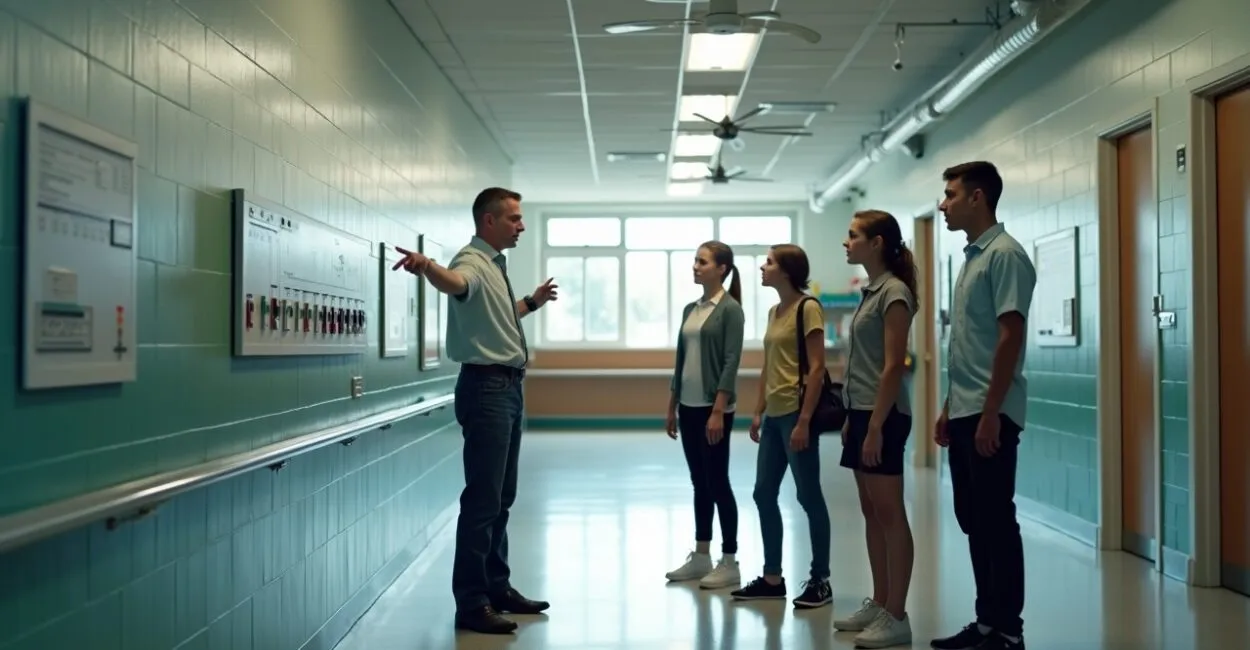
A school can lower its electric bill without sacrificing comfort, lighting, or learning. In practice, school energy savings depend less on major renovations and more on consistent decisions: better habits, preventive maintenance, lighting controls, smarter heating and cooling, and managing what gets left on unnecessarily.
The key idea is simple: wasted energy almost always stems from poorly designed routines. When school leaders, maintenance staff, teachers, and students follow clear guidelines, savings can show up quickly—and often without a major investment.

Here are 10 actions with a real impact, what works day to day, and the common mistakes that drive up operating costs.
The Essentials
- Schools often waste the most energy through lights left on in empty spaces, poorly regulated air conditioning, and equipment left in standby after hours.
- Low-cost measures like occupancy sensors, switching to LED lighting, and adjusting operating schedules often pay off sooner than major upgrades.
- Managing demand and performing preventive maintenance matter more than one-off campaigns because they address the causes of high energy use, not just behavior.
- Energy savings are more effective when they become part of standard operations, with designated owners, goals, and monthly bill reviews.
- Not every school can use the same solution: building size, local climate, and occupancy patterns all affect results.
School Energy Savings: Where Waste Begins
The technical concept behind energy savings is reducing consumption without compromising service performance. Put simply, it means spending less while keeping the school running well. This requires distinguishing necessary energy use from avoidable use, since much of the bill comes from misuse, miscalibrated equipment, and habits repeated out of inertia. Anyone who works in facilities management knows that waste rarely comes from just one source. It adds up across the building: lights on in empty classrooms, printers running all day, fans operating unnecessarily, water fountains in poorly chosen locations, and air conditioning running with the door open. In practice, schools pay for a combination of small oversights, not one single major culprit.
What Drives Up the Electric Bill
- Lighting: Classrooms, hallways, and gyms can use too much energy when the lighting design is poor.
- Heating and cooling: Improperly sized air-conditioning systems are among the biggest contributors to peak energy use.
- Equipment in standby mode: Computers, TVs, speakers, and routers continue to use energy even when not in active use.
- Demand charges: Simultaneous peaks in usage can raise costs at schools with higher electrical loads.
School energy savings don’t start with expensive technology; they start with managing usage. The cheapest waste to fix is the kind that hasn’t become a habit yet.
For technical information on energy use and efficiency in the sector, check the ANEEL website, which provides data and regulations for Brazil’s electric power sector, and materials from Inmetro, Brazil’s national standards and metrology institute, on equipment performance and labeling. These agencies can help you compare options without relying on vague promises of “guaranteed savings.”
LED Lighting, Sensors, and Making the Most of Natural Light
Replacing old bulbs with LEDs is often one of the quickest ways to see a return, but replacing bulbs alone won’t solve the problem. Real savings come when the lighting plan accounts for color temperature, light output, and how light is distributed throughout the space.
A poorly lit classroom lets the school “save” on paper while reducing visual comfort in practice.
Where LED Lighting Makes a Real Difference
Hallways, restrooms, common areas, and rooms used for long periods are obvious candidates for LED lighting. In labs and libraries, however, lighting quality matters just as much as energy use.
In many cases, removing excess fixtures is a better option than simply switching to a different type of bulb.
Occupancy Sensors and Dimming
Sensors work well in walkways and restrooms, but can fail when school routines are unpredictable or the detector is poorly positioned. Dimming, which reduces light intensity, is useful in spaces with plenty of natural light.
The most common mistake is installing equipment and never revisiting how it’s used.
For example, a public school in a rural area left its outdoor lights on all night for years because the timer was misconfigured. Adjusting it took just a few minutes. The savings showed up on the very next bill. Cases like this may seem minor, but they illustrate a broader pattern: one incorrect setting can cost more than lighting an entire classroom.
Efficient Heating and Cooling: Ventilation, Air Conditioning, and Thermal Comfort

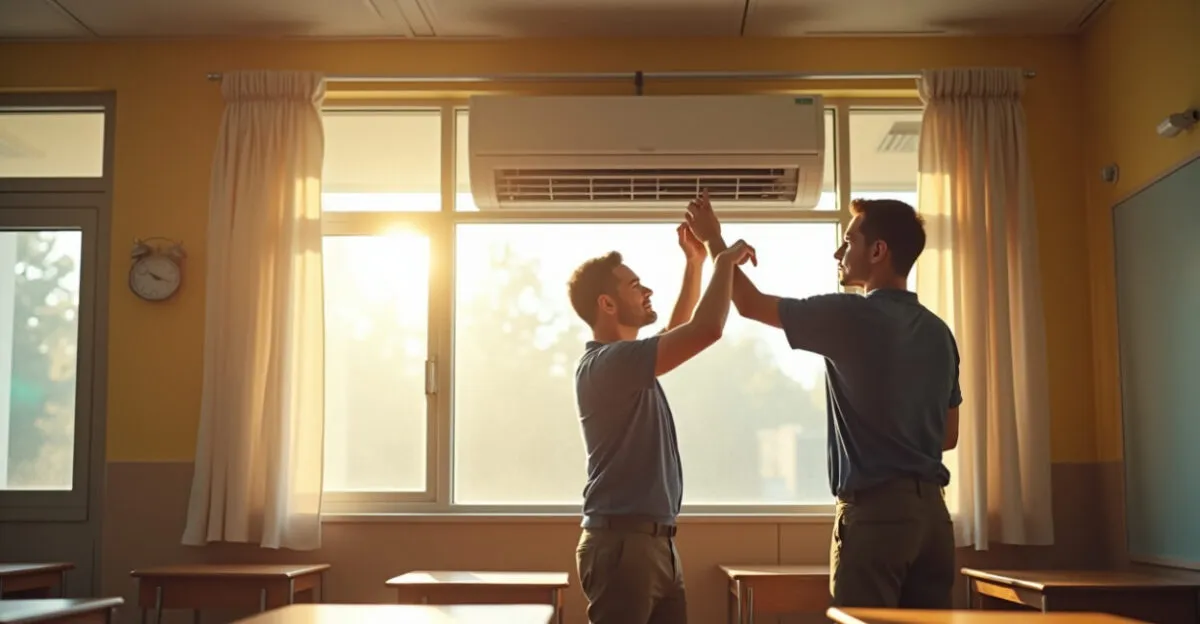
Thermal comfort is a condition for learning, not a luxury. The problem is that many schools try to solve the heat by simply increasing air-conditioning capacity, when the first step should be reducing the room’s heat load. If a room gets direct sunlight, has poor sealing, and uses an undersized unit, energy use goes up while performance remains poor.
An efficient air conditioner isn’t one that “gets colder”; it’s one that maintains a comfortable temperature with less run time and less compressor effort.
Ways to Reduce the Heat Load
- Seal gaps and improve weatherstripping around doors and windows.
- Use curtains, exterior shades, or window film on facades exposed to strong sunlight.
- Avoid opening doors while the system is running.
- Clean filters and inspect coils on a regular schedule.
When Fans Help—and When They Don’t
Fans are excellent for circulating air, especially in hot rooms with good cross-ventilation. But they can’t replace cooling when occupancy is high and outdoor temperatures are extreme. This approach works well in many parts of Brazil, but not in enclosed, humid, or poorly shaded spaces. Experts disagree on the ideal way to combine these systems because local climate has a major effect on results.
For more on energy efficiency in buildings, start with resources from Brazil’s Ministry of Mines and Energy on sector efficiency and the EPE, Brazil’s Energy Research Office, which publishes studies and assessments on energy use and planning.
Read also: School-Community Partnerships: Real-World Environmental Initiatives
Managing Schedules, Equipment, and Daily Operations
Managing operating hours is one of the most overlooked opportunities. A school with labs, a media room, an office, and a courtyard used at different times needs a clear usage schedule. Without one, everything stays on “just in case someone forgets,” and costs rise on autopilot.
Simple Rules to Prevent Hidden Energy Use
- Turn off computers, projectors, and TVs at the end of each shift.
- Use separate circuits for lighting in areas that are rarely used.
- Schedule water pumps and automatic gates to run only when needed.
- Check whether printers, routers, and uninterruptible power supplies are left on unnecessarily.
In practice, one of the most helpful steps is assigning someone to oversee each area. When nobody is responsible for energy use, the whole school becomes a system of small oversights. I’ve seen cases where simply creating a closing checklist reduced waste because the evening shift began routinely checking lights, outlets, and air conditioning.
Read also: Connecting Schools and the Environment: 2025
Preventive Maintenance and Fixing Problems Before They Raise Bills
Maintenance isn’t an expense that gets in the way of savings; it’s what prevents bigger costs. Equipment with dirty filters, loose connections, overheated wiring, or loads outside the recommended range uses more energy to deliver less. This applies to water fountains, cooling units, motors, pumps, and even electrical panels.
Periodic electrical inspections can identify abnormal heat, phase imbalances, and areas where energy is being lost. This makes a real difference to the monthly bill at larger schools. At smaller schools, preventive maintenance helps avoid replacing equipment too soon and reduces disruptions during class.
What to Check First
- Air-conditioning and ventilation filters.
- Outlets, cables, and makeshift extension cords.
- Timers, circuit breakers, and contactors.
- Pumps and motors that are noisy, vibrating, or overheating.
Preventive maintenance almost always costs less than the combined impact of ignoring small problems, because electrical waste can grow long before a visible defect appears.
Energy Planning, Tracking, and Monthly Goals
Without measurement, a school can only guess whether it has saved energy. Ideally, track kWh, contracted demand where applicable, bill history, and usage by area if the electrical system allows it. Tracking helps show whether a reduction came from behavior, milder weather, or a genuine structural change.
Metric
What it shows
How to use it at school
Monthly kWh
Total energy use
Compare similar months and identify unusual increases
Demand
Peak simultaneous usage
Avoid running many energy-intensive devices at once
Usage by shift
Where energy use is concentrated
Compare the morning, afternoon, and evening shifts
The best metric isn’t the most sophisticated one; it’s the one the team can track every month. A goal without a routine is just talk. With a simple spreadsheet and regular bill reviews, school leaders can quickly see whether a particular room, event, or change in weather affected energy use.
Behavior, School Culture, and Student Participation
Educational campaigns can work, but they lose momentum when they amount to nothing more than a poster on the wall. Real change happens when the school makes efficiency a shared rule: turn off lights when leaving, keep doors closed when the air conditioning is on, report equipment being used improperly, and assign people to oversee each area. This reduces energy use and teaches a practical form of energy citizenship.
The tricky part is that lecturing people doesn’t work. Showing the real impact of waste is more effective than simply asking for cooperation. When students see the difference between an orderly classroom and one with lights left on for no reason, the message is more likely to stick. School leaders need to be firm without being punitive.
How to Get Students Involved Without Losing Sight of Learning
- Display monthly energy use where everyone can see it.
- Create competitions between classes based on actual reductions.
- Connect energy use to the school budget and potential improvements.
- Use science projects to measure lighting, temperature, and energy use.
Schools looking to do more can explore public programs and energy education resources from utility companies and government agencies. ANEEL, Brazil’s electric power regulator, also runs energy efficiency initiatives that can help schools develop projects with more structure and less guesswork.
How to Prioritize Investments and Decide What to Do First
Not every low-cost solution is the most urgent, and not every expensive solution is the most effective. The right order is usually to fix obvious waste first, optimize operations next, and then consider larger investments. There’s rarely a need to replace everything at once.
If the budget is tight, start with projects that combine three things: high impact, low cost, and quick implementation. At many schools, that means reviewing lighting, sealing gaps, adjusting schedules, and performing maintenance. Next come sensors, automation, upgrades to heating and cooling, and, when technically and financially appropriate, distributed generation with solar photovoltaic power.
A Practical Priority Matrix
- Priority 1: Routine adjustments, turning equipment off, and simple maintenance.
- Priority 2: LED lighting, sensors, and lighting system updates.
- Priority 3: Heating and cooling upgrades and demand management.
- Priority 4: Major projects, such as solar photovoltaic systems and electrical upgrades.
This approach avoids a common mistake: investing in technology before addressing the basics. A photovoltaic system, for example, can help a lot, but it won’t make up for air leaks, poorly regulated equipment, and the habit of leaving everything on. The most effective solution is the one that reduces energy use at the source.
Next Steps
The best way to reduce energy costs isn’t to copy a ready-made model, but to start by assessing your own building. If the school tracks its energy use, identifies critical hours, and fixes obvious problems, savings can follow without waiting for a major renovation. After that, investments are easier to justify and involve less risk.
A practical next step is to create a 30-day plan with three areas of focus: review lighting, inspect heating and cooling, and establish end-of-day shutdown procedures. To make steady progress, compare the last 12 months of bills, list the equipment that uses the most energy, and set goals for each area. School energy savings work when they become part of daily operations, not a one-time campaign.
Frequently Asked Questions
What’s the First Step to Cut Energy Costs at a School?
The most effective first step is usually to identify and eliminate obvious waste: lights on in empty rooms, equipment left on after hours, and air conditioning running with doors open. These issues are generally inexpensive to fix and can quickly affect the bill. In many cases, the biggest savings come before any purchases are made, simply by adjusting routines and checking rooms every day.
Is It Really Worth Switching Everything to LED?
It can be, but not automatically. LEDs reduce energy use and maintenance, but the actual savings depend on the lighting plan: the number of fixtures, the required light levels, and how much natural light is available. If a school replaces bulbs without reviewing how light is distributed, it may spend more than necessary or even create visual discomfort. It’s best to assess each room before buying in bulk.
Is Air Conditioning Always the Main Energy Drain?
No. The problem isn’t the equipment itself, but improper use, poor maintenance, and a space that isn’t suited to air conditioning. A properly sized unit with a clean filter and a closed door can operate reasonably efficiently. But a poorly regulated system in a hot room with air leaks drives up costs without providing adequate comfort for students and teachers.
How Can You Tell Whether a School Is Really Saving Energy?
The most reliable approach is to compare kWh, bills, and, where applicable, contracted demand across comparable months. It’s also helpful to separate usage by shift and note any changes in weather or the number of full-day classes. If usage drops consistently after an improvement, that’s strong evidence of real savings. Without measurements, any sense of savings is unreliable and prone to error.
Can Solar Energy Projects Solve the Problem on Their Own?
No. Solar photovoltaic power can significantly lower the bill, but it doesn’t replace energy efficiency. If the school continues to waste energy on lighting, heating and cooling, and equipment, the solar system will only offset some of that excess. The best approach combines on-site generation with reduced energy use, which makes the investment go further and the payback more predictable.
Artigos Relacionados
 Energy Savings at School: Cut Costs and Reduce Impact
 Common Low-Cost Solar Panel Mistakes: Nine Failures That Cut Your Savings and How to Avoid Them Now
 Low-Cost Solar Panels: Lower Your Energy Bill and Pay Back Your Investment Faster
 How to Improve Reading Skills in Elementary School: Practical, Proven Ways to Build Fluency and Comprehension in the Classroom
 Collaborative Group Activities: 5 Creative Ways to Build Teamwork and Communication Among Middle School Students
 Collective Buying on the Rise: How Parent Groups Cut Costs and Streamline Purchases for Municipal Schools
