
Impulse-buying a solar system often leads to expensive regret: common mistakes with low-cost solar panels reduce efficiency and extend the payback period—sometimes by years. If you’re looking to save money quickly, read this now: in the paragraphs below, I’ll cover nine common pitfalls when choosing inexpensive panels and practical steps to restore efficiency and save more.
1. Incorrect System Sizing: Less Power Than You Think
One of the most easily overlooked common mistakes with low-cost solar panels is improper system sizing. Technically, this means selecting a system with a rated capacity (kWp) that doesn’t match your consumption profile or account for inverter losses and shading.

Here’s what that looks like in practice: you buy a system rated at “x kW” and find that, in the summer, its output is 20–40% lower than expected. The result: less savings and more frustration.
- What to avoid: choosing based solely on price per watt.
- What to do: request an hour-by-hour production estimate and account for losses (temperature, wiring, and inverter).
I’ve seen cases where a customer’s system was undersized by 30% because the company didn’t ask about peak usage times—and the customer kept paying high utility bills for months.
2. Confusing Panel Warranties: Low Price, High Risk
One of the common mistakes with low-cost solar panels is being misled by a long warranty. Technically, there are two types: a product warranty (for defects) and a performance warranty (for the annual degradation rate). Many inexpensive panels advertise “25 years” without specifying the degradation rate. That means you may be covered on paper, but in practice, output could drop significantly sooner.
- Check the “annual degradation” rate and guaranteed output in year 25 (for example, ≥80% at the end).
- Compare manufacturers A and B—a lower price may come with insufficient quality testing.
3. Incompatible Inverters: When Savings Become a Bottleneck

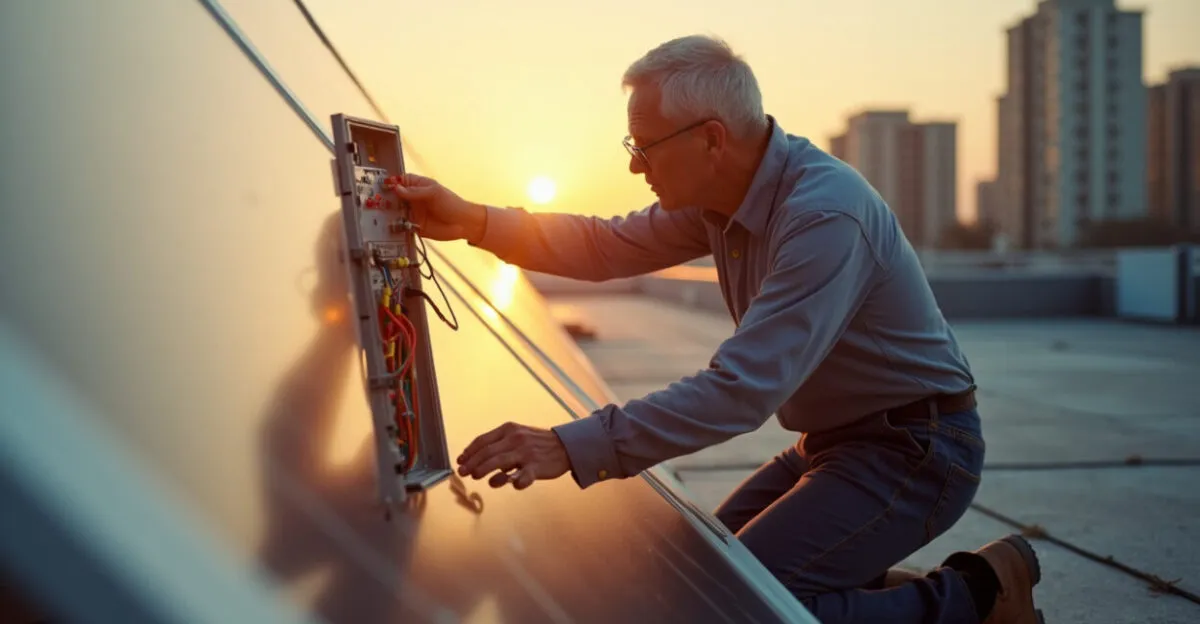
A recurring technical issue among the common mistakes with low-cost solar panels is pairing inexpensive panels with cheap or mismatched inverters. The inverter converts DC to AC and manages MPPT (Maximum Power Point Tracking). If it’s improperly sized, it won’t extract the maximum power from the modules—or it may limit strings for safety. The consequence: real production losses, even with “okay” panels.
- What to avoid: an undersized inverter or one without enough MPPT inputs for the strings.
- What to do: calculate string current and voltage and check inverter efficiency at different temperatures.
4. Poor Electrical and Structural Installation: Risks Beyond Your Bill
Many common mistakes with low-cost solar panels happen during installation. Poorly made connections, missing surge protection, loose mounting rails, and inadequate wiring reduce output and increase fire risk. This isn’t theoretical—it’s a real danger in your home.
Read also: Residential Solar Panel Maintenance: Costs and Care
- Warning signs: exposed wires, an unsealed junction box, loose screws.
- Quick fix: have a certified professional inspect the system, tighten connections, reorganize strings, and install residual-current and surge protection devices.
5. Shading and Poor Orientation: The Invisible Enemy
An inexpensive panel may look like a great deal until it’s partially shaded by an antenna, chimney, or tree. One of the most common mistakes with low-cost solar panels is overlooking the impact of shading: output losses are nonlinear, and a single affected cell can reduce the output of an entire string. Orientation and tilt matter too—small deviations can significantly reduce annual production.
- A surprising comparison: a panel that costs 10% more but uses string-level optimization (microinverters/optimizers) often produces 20–30% more on shaded roofs.
- Avoid: installing panels where they’ll be periodically shaded without using optimization.
6. Neglected Maintenance: The Hidden Cost of Cheap Panels
Buying cheap and forgetting about maintenance is a common pattern among the common mistakes with low-cost solar panels. Dust, leaves, bird droppings, and minor damage reduce efficiency. Simple maintenance, such as periodic cleaning, connection inspections, and checking output by string, can restore production. Without it, your initial savings disappear as production drops.
- Quick checklist: clean annually (or quarterly in dusty areas), check output by string, and use thermal imaging every 2–3 years.
- Myth vs. reality: “rain cleans solar panels”—myth; rain prevents heavy buildup but doesn’t remove oily residue.
7. Missing Certifications and Documentation: Buying Blind
One of the common mistakes with low-cost solar panels is buying equipment without IEC/INMETRO certification or technical documentation. These certifications verify safety, performance, and traceability. Without documentation, you may lose access to incentives, financing, and effective warranty coverage. Buying without checking certifications is like signing a blank check for future problems.
- What to request: IEC/CE/INMETRO certifications where applicable, a technical manual, and a commissioning thermogram.
- Practical consequences: difficulty obtaining insurance, financing, or proving performance to the utility company.
A short story (3 lines): A condo association saved money upfront and bought very cheap panels without checking the inverter. After a year, production was 35% below expectations; fixing the problem cost more than the initial price difference. It was an expensive lesson: not every discount is a smart investment.
Sources and further reading: technical data and guidance from the Agência Nacional de Energia Elétrica (ANEEL), Brazil’s national electricity regulator, ANEEL, and certification and performance documents from the Instituto Nacional de Metrologia, Qualidade e Tecnologia (INMETRO), Brazil’s national metrology and standards institute, INMETRO. For research on degradation and efficiency, consult scientific papers and reports from reputable manufacturers. Not every recommendation here applies to every situation: this approach works well for typical residential roofs but may not work for large off-grid projects or regions with extreme microclimates. Experts disagree about ideal degradation parameters and optimization techniques, so check the technical documentation.
You can fix most of these problems without replacing the entire system: adjusting the inverter, reorganizing strings, adding optimizers, and addressing shading often bring your bill down. One final thought: paying less today can cost much more when the real problem is the bargain you bought—not your electricity bill.
Frequently Asked Questions
How Long Does It Take a Cheap System to Pay for Itself When These Mistakes Occur?
Payback time varies widely, but when several common mistakes with low-cost solar panels are present—such as undersizing and poor installation—the expected payback period can stretch from 4–6 years to 8–12 years or more. Systems with accelerated degradation or an inefficient inverter produce less electricity each year, extending the time it takes to break even. Repair costs (replacing the inverter, repositioning panels, and maintenance) also factor into the calculation and delay the return even further.
Can I Fix Problems Without Replacing the Cheap Panels?
In many cases, yes. Among the common mistakes with low-cost solar panels, issues such as loose connections, the need for optimizers or microinverters, shading, and faulty wiring can often be addressed to restore much of the system’s efficiency. Replacing the inverter with a more suitable model often offers the best value. However, if the panels have severe degradation or manufacturing defects, replacement may be unavoidable—in that case, check the warranty and documentation.
How Can I Tell Whether an Advertised Warranty Is Reliable?
Check the type of warranty: product or performance. Look for clear degradation rates and details about the manufacturer’s geographic coverage. One of the common mistakes with low-cost solar panels is trusting vague terms like “extended warranty” without a defined scope. Review technical catalogs, serial numbers, and test records (IEC/INMETRO certifications). Also research the manufacturer’s reputation and the availability of local support—a warranty on paper without practical support has little value.
What Quick Steps Can Reduce Shading-Related Losses?
Immediate steps include repositioning panels to minimize shade during peak production hours, installing power optimizers on each panel or switching to microinverters, and clearing obstructions such as branches and antennas. Among the common mistakes with low-cost solar panels, overlooking optimization solutions is common; these can turn an underperforming system into a much more efficient one, especially on partially shaded roofs. A site assessment and hour-by-hour simulation can help you choose the best approach.
What Technical Documents Should I Request Before Choosing a Low-Cost Supplier?
Request a certificate of conformity (IEC/INMETRO), module datasheets (showing efficiency and degradation), inverter specifications (MPPT efficiency and performance curve), a detailed invoice, and warranty terms with time frames and conditions. One of the common mistakes with low-cost solar panels is signing a contract without these documents. Also request a commissioning report after installation, including string readings and photos or a thermogram confirming electrical integrity.
Artigos Relacionados
 Multiple-Choice Exams: Common Mistakes That Cost You Points
 7 Common Startup Mistakes That Can Shut You Down
 Bedroom Decorating Mistakes: How to Avoid Them Today
 Low-Cost Solar Panels: Lower Your Energy Bill and Pay Back Your Investment Faster
 Entrepreneur Biographies: Real-World Lessons to Avoid Common Mistakes and Grow Your Business Faster
 Energy Savings at School: Cut Costs and Reduce Impact
