
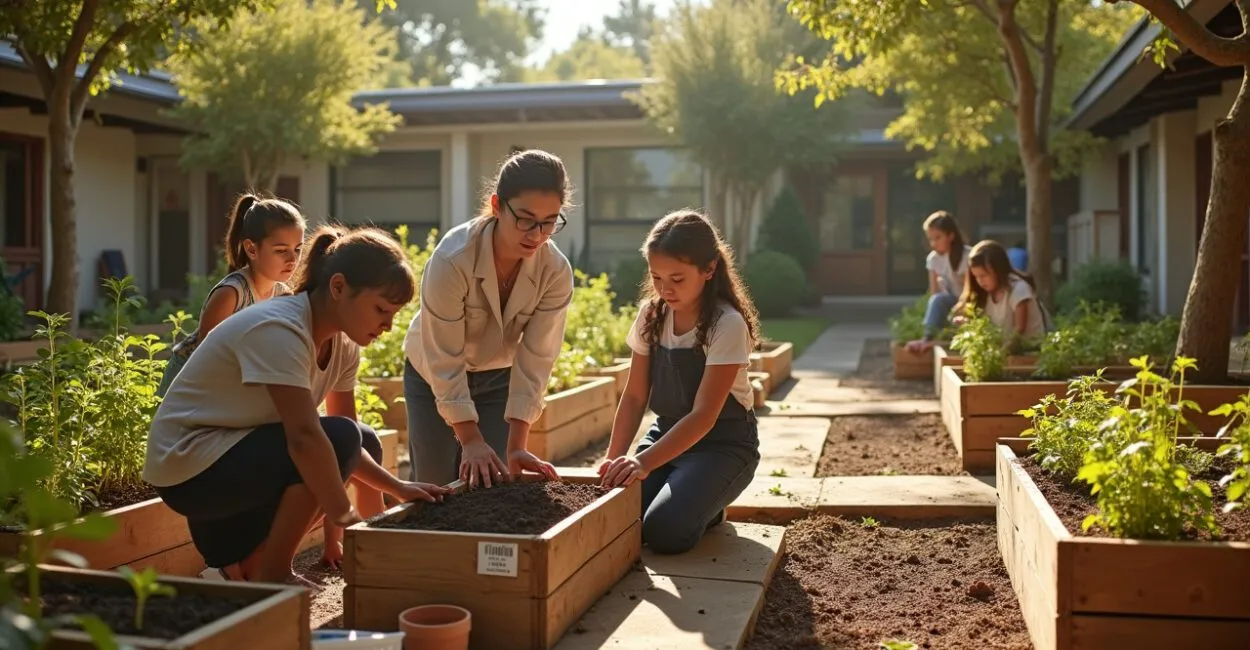
A well-designed school garden is more than decoration: it becomes a living laboratory, a source of food, and a tool for bringing people together. A sustainable school garden combines growing vegetables, reusing resources, school composting, and student participation to keep the project running year-round, even on a tight budget.

What makes this kind of garden work isn’t having a lot of space—it’s planning. When a school chooses a location, plans water use and planting schedules, and assigns responsibilities, the garden no longer depends on occasional goodwill. Instead, it becomes a practical part of environmental education, healthy eating, and the curriculum.
The Essentials
- A sustainable school garden is a growing system designed to teach, produce food, and recycle resources at the same time.
- The best results come when students, teachers, cafeteria staff, and maintenance teams share real responsibilities, not just symbolic ones.
- Composting, water reuse, and heirloom seeds reduce costs and give the school more independence.
- The project works best with quick-growing crops such as lettuce, green onions, arugula, cilantro, and radishes.
- Without a regular care routine, the garden becomes a start-of-year activity and dies off before the end of the first quarter.
Sustainable School Gardens: What Good Planning Changes
A sustainable school garden is a learning, environmental, and food-growing system designed to operate with minimal waste, responsible water use, and ongoing maintenance. In practice, that means the garden can’t rely on enthusiasm alone: it needs healthy soil, a regular care routine, student participation, and a connection to the curriculum.
The difference between an ordinary garden and a sustainable school garden comes down to how the project is designed. The first may produce food for a few weeks; the second plans from the outset for who will water, fertilize, harvest, take notes, and reuse organic waste.
That kind of thinking turns a school garden into a real learning tool.
What sets a decorative garden apart from a sustainable school garden isn’t the size of the bed—it’s consistent care.
This kind of initiative aligns with the FAO, the United Nations agency that connects food production with food education, as well as with the environmental education guidelines used in Brazilian schools. When gardening is an ongoing practice rather than a one-time event, it supports urban agriculture, healthy eating, and sustainability at school.
Educational, Environmental, and Food Benefits You’ll See Every Day
The educational benefits are stronger than they might look on paper. A school garden creates hands-on opportunities to teach science, math, language arts, citizenship, and shared responsibility.
A student who measures a garden bed, tracks germination, and compares plant growth learns through observation, not abstraction.
Learning
In the classroom, the garden can introduce topics such as plant life cycles, photosynthesis, decomposition, weather, mindful consumption, and where food comes from. It also works well for garden-based activities such as field journals, germination experiments, and identifying pollinators.
The school environment
From an environmental perspective, the biggest advantage is closing the loop. Fruit and vegetable scraps from the cafeteria can become compost; water used to wash vegetables, if handled properly and without detergent, can be reused for watering in appropriate situations; and seeds can be saved from one growing season to the next. This makes sustainability visible.
Food
When a school grows some of its own vegetables, the connection to healthy eating becomes tangible. Children begin to recognize smells, textures, and seasonal availability, changing how they relate to school meals and food at home. It’s not a miracle cure, but it can go a long way toward helping kids accept vegetables and herbs.
Public information and guidance on school meals are available from the National School Feeding Program (PNAE), administered by FNDE, Brazil’s National Fund for Education Development, which highlights the school’s role in food and nutrition education.
When the garden becomes part of the curriculum, it’s no longer an “extra activity”—it supports lessons, habits, and everyday decisions at school.
How to Plan the Space, Soil, and Water on a Budget

Start by choosing a location that gets at least four to six hours of direct sunlight a day, is easy for different classes to access, and has some protection from foot traffic. If the space gets too much shade, leafy vegetables may still grow, but growth is likely to be slow and uneven.
Choosing a location
Balconies, garden beds along the edges of a yard, courtyards, and even large pots can work. At schools with limited outdoor space, raised beds and vertical gardens can help, as long as they drain well and are easy to maintain.
Soil and setup
The soil should be loose, fertile, and well-drained. Mixing topsoil with organic compost helps, but the key is to avoid compacted soil. If the area already has garden beds, loosen the soil, amend it with organic matter, and add a layer of mulch to reduce evaporation.
Water and reuse
Water reuse can make a difference for schools on tight budgets. A good starting point is hand-watering with watering cans or perforated bottles, along with simple rainwater collection containers if the infrastructure and permissions are in place. Use caution: not all reused water is suitable for every purpose, so check local technical guidance before improvising.
For guidance on gardening and urban agriculture, see Embrapa Hortaliças, the vegetable research division of Brazil’s agricultural research agency, which offers practical resources on growing, soil, and adapted crops. For schools in very dry or hot areas, these resources can help prevent mistakes that kill a garden in its first month.
Step-by-Step: Starting a Sustainable School Garden From Scratch
To start a sustainable school garden from scratch, begin small, choose easy-to-grow crops, assign responsibilities, and test the system for one short growing cycle before expanding. This reduces problems and waste and makes it more likely that the project will thrive throughout the school year.
- Assess the space. Check sunlight, ventilation, water access, student traffic, and the risk of vandalism or foot traffic.
- Set clear goals. Will the garden support classes, school meals, composting, research, or all of the above?
- Choose the first crops. Pick vegetables that are easy to grow and quick to harvest.
- Prepare the beds or containers. Make sure they drain well, use fertile growing medium, and clearly mark each area.
- Set up a school composting system. Collect clean organic scraps and manage them carefully.
- Create a care routine. Watering, weeding, checking for pests, and tracking growth all need assigned days and people.
- Start harvesting and using the garden for learning. The sooner students harvest, the more meaningful the garden becomes.
Plants that tend to work best
- Lettuce
- Arugula
- Green onions
- Cilantro
- Chicory
- Radishes
- Parsley
I’ve seen schools try to start with more demanding crops, such as tomatoes and strawberries, only to get discouraged quickly. For a first project, the smarter approach is to focus on quick-growing crops with predictable harvests. Once students learn the basics, they can try more delicate varieties.
How to Keep the Garden Going All Year
Maintenance is where almost every school garden runs into trouble. The reason is rarely a lack of enthusiasm; it’s usually a lack of routine. If no one knows who will water during breaks, check for pests during exam week, or replace seedlings, the garden will lose its vitality within a few months.
Sharing responsibilities
A rotating schedule by class or group works best. A visible task chart can help assign watering, removing dry leaves, observing insects, recording growth, and collecting scraps for composting. Teachers and staff need to be part of the plan, too, because students alone can’t keep the garden going.
Read also: Educational School Gardens: How to Get Students Involved
A simple calendar
Create a calendar with three levels: weekly, monthly, and seasonal. The weekly schedule covers watering and observation; the monthly one covers fertilizing and replanting; the seasonal one guides crop changes based on heat and rainfall. This helps avoid the mistake of planting everything at once and harvesting everything at once.
Pests and losses
Not every problem calls for chemicals. Chewed leaves, fungi, and aphids show up in all kinds of gardens; what matters is how you respond. Hand removal, good airflow, mulch, and a variety of plants can solve many problems. Experts disagree on the limits of biological pest control in school settings, so it’s best to prioritize simple, safe methods.
Read also: Plants for a Vertical Garden: 9 Options for Apartments
A school garden doesn’t fail because it lacks plants; it fails when no one makes regular care part of the educational project.
How to Integrate the Garden Into the Curriculum
A garden can be part of almost any subject, as long as the teacher plans the activity with a clear goal. It’s not just for science. It can support math, language arts, geography, art, and environmental education.
Examples by subject
- Science: germination, photosynthesis, decomposition, and food chains.
- Math: measuring garden beds, graphing plant growth, and estimating harvests.
- Language arts: reports, field journals, interviews, and labels for garden signs.
- Geography: climate, soil, local food production, and urban agriculture.
- Art: garden signs, botanical drawing, and label design.
A project with a beginning, middle, and end
The best plan builds on a sequence. First, students observe and prepare; then they plant, track, and compare; finally, they harvest, cook, or share what they’ve grown. This gives the educational project purpose and keeps it from becoming a photo-op volunteer day.
If the school wants to broaden the project, it can also connect the garden to urban agriculture, food security, and waste disposal, using data and resources from public agencies and universities. A good place to start is the environmental education page of the Ministry of the Environment and Climate Change, Brazil’s federal environmental agency.
Sustainable Practices That Make a Real Difference
The most useful sustainable practices are the ones that reduce reliance on outside resources and increase self-sufficiency. At a school, that means reusing what would otherwise be thrown away, saving seeds, and simplifying processes without losing oversight.
School composting
School composting turns plant scraps into fertilizer for the garden. The material should be clean, free of grease and meat, and not too wet. If the compost smells bad, the problem is usually too much wet material and not enough dry material, such as dried leaves or appropriate sawdust.
Saving seeds
Saving seeds from some crops helps cut costs and teaches students about the growing cycle. Cilantro, lettuce, and arugula can be part of this process, as long as the school selects healthy plants and records the source and date. Don’t reuse seeds indiscriminately: germination rates may drop, and students may lose confidence in the results.
Reusing water safely
Reusing rainwater or water from suitable processes is a good strategy, but it requires attention to sanitation and guidance from school administrators. Reused water isn’t necessarily risk-free. When the school treats this topic seriously, it strengthens sustainability education; when it improvises, it creates problems.
These practices form the backbone of sustainability at school because they reduce purchases, waste, and reliance on outside help. That’s when the garden stops being a “green activity” and starts working as a system.
How Much Does a Sustainable School Garden Cost, and How Can You Save?
The cost can be low, moderate, or close to zero, depending on what the school already has. In many cases, the biggest expense isn’t the plants but the setup: containers, soil, tools, and protection for the space. A simple starter garden can cost anywhere from very little to a moderate amount, depending on its size and the materials available for reuse.
| Item | Budget option | Practical note |
|---|---|---|
| Containers | Crates, tires, buckets, plastic bottles | Must be properly cleaned and have drainage |
| Growing medium | Local soil + organic compost | Compacted soil needs to be amended |
| Seedlings and seeds | Donations, swaps, or growing your own | Start with easy-to-grow varieties |
| Tools | Shared basic kit | Small hoe, shovel, watering can, and gloves |
| Fertilizer | School composting | Reduces the need for regular supply purchases |
The best way to save is to reuse materials and invest in organization. A school that can compost, save seeds, and use suitable containers can cut a large part of its budget. The project also tends to become more educational because students learn where each resource comes from.
Frequently Asked Questions About Sustainable School Gardens
How do you start a sustainable school garden from scratch?
Assess the space, choose a sunny and accessible location, prepare the soil with organic matter, and assign people to watering and maintenance. Then plant quick-growing crops and start composting to complete the waste cycle.
Which plants are easiest to grow in a school garden?
Lettuce, arugula, green onions, cilantro, parsley, and radishes tend to work best for beginner projects. They grow quickly, are easy to care for, and show results in a short time, which helps keep students engaged.
How much does it cost to start a sustainable school garden?
The cost depends on the size of the space and how much the school can reuse. In general, costs drop considerably when the school uses recycled containers, donated seedlings, composting, and shared tools.
How do you keep a garden going during the school year?
The key is a regular routine, rotating responsibilities, and a replanting calendar. Without these, the garden depends on occasional efforts and loses momentum during the busiest weeks of the semester.
How can a school garden be used in class?
It can support activities in science, math, language arts, geography, and art. The best approach connects observation, recordkeeping, and hands-on work instead of treating the garden as an occasional field trip.
Is school composting required for a garden to succeed?
No, but it makes the project much more self-sufficient. When the school produces its own fertilizer, it cuts costs, teaches students about the organic matter cycle, and helps them feel invested in caring for the garden.
%%AGPTRH7%%
What to Do Next
If the school is ready to move from planning to action, the next step is simple: choose a small space, pick three easy crops, and set up an eight-week care schedule. Starting small increases the chance that the garden will survive the school calendar and become an ongoing project.
After that, document everything: what was planted, when it was watered, what worked, and where losses occurred. These records turn experience into repeatable knowledge and help the school improve the project in the next growing cycle.
Artigos Relacionados
 Start an Apartment Garden From Scratch: A 1-Hour Method That Works
 A Practical Guide to School Sustainability Projects
 Sustainable School Supplies Are on the Rise: Why Public Schools Are Adopting Eco-Friendly Items—and What It Means for Families
 Sustainable Workshops: Low-Cost Activities for Schools
 Early Learning: Strategies to Foster Development from the Start
 School Gardens as Learning Labs: Inspiring Projects for 2025
