
A class can discover how much water the school wastes by timing a leaky faucet; that observation makes for a more concrete investigation than a lecture. Environmental education projects for elementary school work best when students observe a nearby problem, try an action, and track what changes.

Environmental education is an ongoing process of building knowledge, values, and skills to understand the relationships between society and nature and take action on environmental problems. At school, this can take the form of a garden, composting, a waste audit, an investigation into water use, or observations of nearby biodiversity.
The ideas below use accessible materials and can be adapted to students’ ages and the resources available.
Before you begin: decisions that prevent rework
- Choose a problem that’s visible at school, such as leftover cafeteria food or dripping faucets.
- Set a question students can investigate and a period for tracking progress, such as four weeks.
- Decide who will handle each task and on which days, including days when school is not in session.
- Check safety rules, water availability, and permission to use shared spaces.
How to choose environmental education projects for your class
Good options for elementary school include a school garden, composting, a waste audit before starting recycling, a water audit, and observations of local biodiversity. Start with a question students can investigate, choose an action that fits the school’s resources, and record a measurement before and after. This sequence makes learning measurable and helps the class understand both limitations and results. In the early grades, short activities involving sorting, observational drawing, and plant care help build vocabulary and routines. In the upper grades, students can create spreadsheets, compare data, interview staff, and discuss why a solution works in one place but not another. Age matters, but so do the time available and the ability to keep the activity going.
A good guiding question is specific: “Which snack items could we avoid or sort properly?” That gives the investigation direction.
“How can we save the planet?” is too broad to lead to an action the class can evaluate.
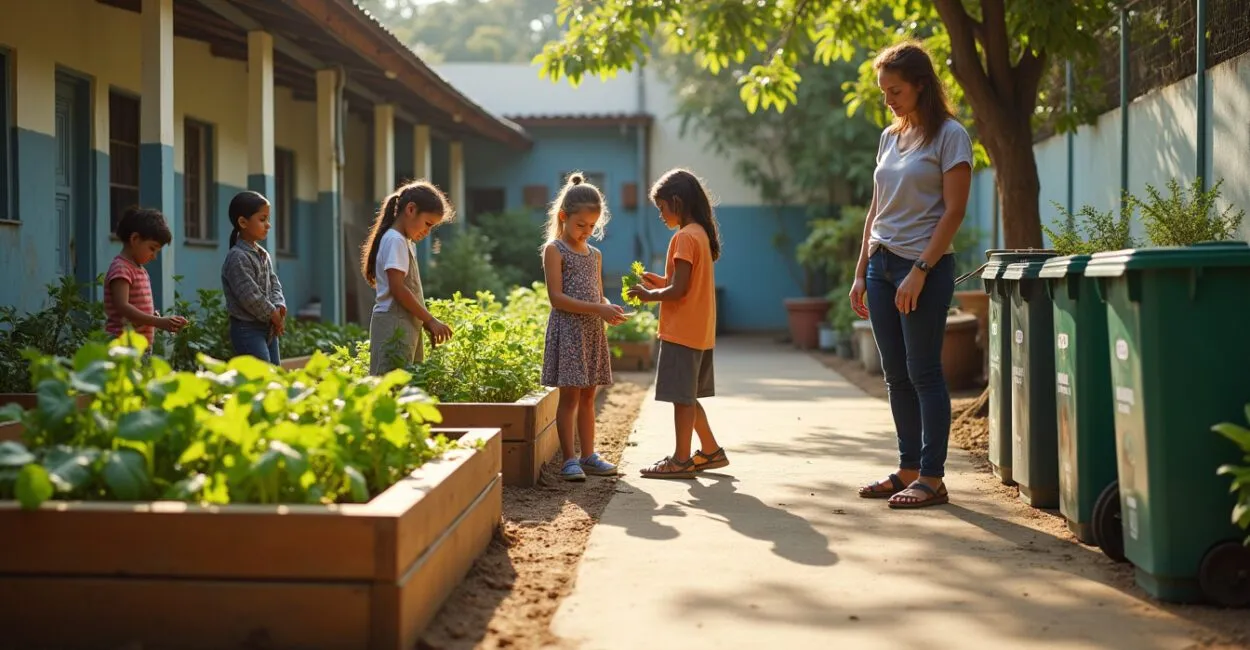
School garden: plant, care for, and track growth
Goal: Connect germination, soil, water, food, and life cycles. Suitable for different ages, with tasks adapted to the class’s development.
Materials: Seeds suited to the region, reused containers with drainage or a small garden bed, soil, finished compost, and labels. Before planting, check how much sun the space gets and whether water is available; a beautiful garden bed that no one can water is likely to fail.
- Choose plants suited to the season and space, such as herbs or quick-growing vegetables.
- Plant a few seeds under similar conditions and label each container with the plant type and date.
- Set up a watering and observation schedule. Each week, record height, number of leaves, and visible changes.
- At the end, compare the records and discuss differences between plants without attributing every variation to a single cause.
In the early grades, students can draw the plant each week. In the upper grades, they can test one variable, such as sun exposure, while keeping other conditions similar.
A common mistake is planting too many varieties without planning for school breaks, holidays, and maintenance responsibilities.
School composting: turn waste into fertilizer

Goal: Track the decomposition of organic waste and understand how matter returns to the soil. This activity works for both early and upper grades, as long as an adult supervises the process.
Materials: A commercial compost bin or a ventilated, covered container, dry leaves, small amounts of raw vegetable scraps, and a tool for mixing. Avoid meat, dairy, and cooked food in simple school compost bins, as they can attract animals and cause odors.
Read also: Environmental Education Impact Assessment: Indicators That Matter
First, weigh or count the organic waste generated over a sample of days. Then build alternating layers of moist material, such as fruit and vegetable peels, and dry material, such as leaves. Label the compost bin and check its moisture, smell, and appearance each week; the contents should be damp but not soggy.
Once the compost is dark and soil-like, the class can discuss using it in pots or garden beds. Maturation time varies depending on the materials, climate, and management, so it’s best not to promise a specific date. The Brazilian Ministry of the Environment and Climate Change website offers background for discussing waste and environmental responsibility.
Read also: Environmental Education at School: Mistakes That Weaken the Message
School recycling: assess waste before sorting
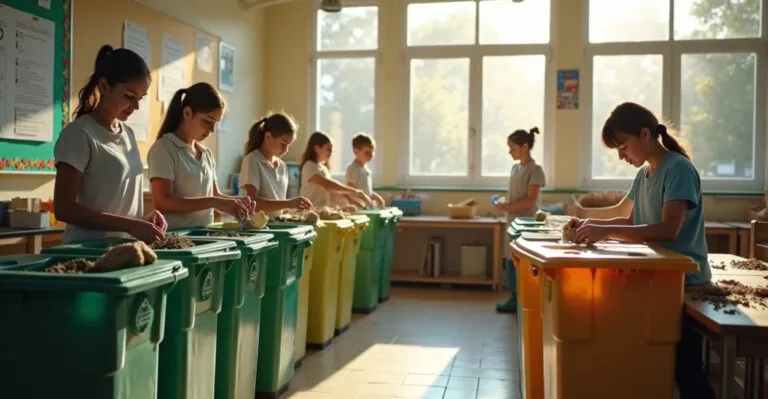
Goal: Identify what the school throws away and check whether sorting matches the available collection options. Materials include appropriate gloves, a scale or containers for counting, labels, and a recording sheet. Students should not handle sharp, contaminated, or unknown waste; responsible adults must handle that step.
For a few days, record the types of waste in a safe area without opening any bags that may pose a risk. The class can sort clean packaging, paper, organic waste, and trash, noting the quantity or weight in each category. Then check with school administrators and custodial staff to find out which materials are actually picked up through the local recycling program.
The assessment may reveal that even though there are color-coded bins, the waste gets mixed together later. In that case, the solution needs to address the collection process inside the school and involve the people who handle pickup—not just add new signs. The Brazilian Ministry of the Environment’s solid waste section provides context on waste management and Brazil’s National Solid Waste Policy.
Using water wisely: investigate usage and suggest solutions
Goal: Find waste and assess changes in water use. In the early grades, the investigation can start with observations and counting faucets; in the upper grades, students can compare water meter readings with help from school staff.
Walk around the school to look for dripping faucets, malfunctioning toilets, and habits that leave water running unnecessarily. Record what you find and report it to the maintenance team. If you have authorized access to water bills or the meter, compare equivalent periods and note factors that affect usage, such as the number of school days or activities outside the usual routine.
A single reading doesn’t prove that a campaign caused a decrease: weather changes, repaired leaks, and fluctuations in attendance also affect the numbers. The class can evaluate a more focused action, such as checking faucets at the end of recess for a few weeks. The National Water and Basic Sanitation Agency (ANA), Brazil’s federal water agency, provides information on water resources that can support the research.
Biodiversity nearby: observe species and create a green space
Goal: Recognize living things in the schoolyard and understand their relationships with shelter, food, and environmental conditions. With paper, pencils, and a safe area, the class can make observations without capturing animals or removing plants.
Mark off part of the schoolyard and observe it at set times. Record plants, insects, and birds with drawings or photos, without claiming an identification when you’re unsure. A table with the date, location, and weather conditions can help students see that species presence varies.
Then choose an improvement that suits the school: grow native plants in pots, protect an existing vegetated area, or set out water containers only if there’s a plan to clean them frequently. Creating a green space depends on sunlight, maintenance, and safety; suitable plants vary by region. Track results by repeating observations in the same place under similar conditions.
How to evaluate results and keep the project going
Evaluation should combine evidence of learning with observable changes. Before starting, record a baseline: the amount of waste in each category, the number of leaks, the number of plants, or the ideas students can explain. Repeat the same observation after the activity and save worksheets, dated photos, or charts made by the class.
A project can teach a lot even if the environmental indicator doesn’t improve during the study period. For example, composting may have moisture problems before it works well; identifying the cause and adjusting the process is also evidence of learning. To keep the effort going, share responsibilities among classes, staff, and families, with small tasks and a visible schedule. Families can take part by sending clean, dry leaves or sharing how they sort waste at home, without being asked to buy anything.
If the activity loses momentum, scale it back: a smaller garden bed, a one-week assessment, or monitoring a single faucet is usually more sustainable than a large project with no one responsible. Choose a question for the next staff meeting, define an indicator, and start a short trial. This first cycle gives the school its own data to decide what to expand, adapt, or end.
Artigos Relacionados
 National Environmental Education Day: 5 School Actions That Work
 Water and Energy Conservation: Hands-On Projects for Kids
 Environmental Education in Elementary School: Activities That Work
 School Recycling Projects: 7 Ideas to Get Students Involved
 Environmental Education in Elementary School: Hands-On Activities
 Environmental Storytelling: 7 Ideas for Young Children
