
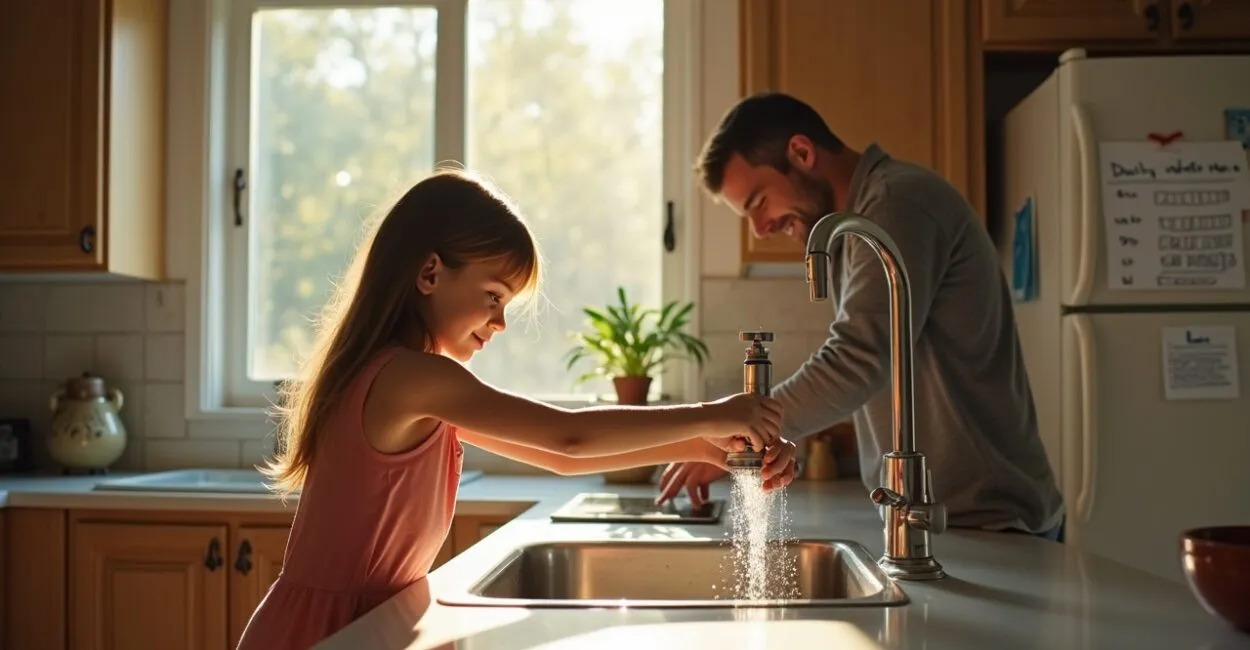
A running faucet while someone brushes their teeth and an empty room with the lights on are everyday situations kids can observe and investigate. Environmental education projects for kids about water and energy turn these habits into learning activities: students record what happens, test safe solutions, and discuss the results without claiming savings before measuring them.

The goal here is informational: to offer ideas for home or school, with age-appropriate adaptations, accessible materials, and ways to track changes. A small start can go a long way: a week of observation often reveals where action makes sense and which questions kids want to answer.
Water and Energy Projects for Kids: How to Get Started
Environmental education projects for kids are planned sequences of investigation and action that help children understand the connections between human activities and the environment. To explore water and energy, choose an observable problem, pose a question, record the starting conditions, test a change, and compare what happened.
Young children can take part through observation and discussion; older kids can also measure, calculate, and present results.
A project can last from one class period to several weeks. The timeline depends on the question: timing how long a faucet runs takes just a few minutes, while comparing a class’s habits requires records from different days.
Start with a familiar situation, such as dripping faucets, lights left on unnecessarily, or devices running during recess.
For each activity, set an approximate age range, an objective, and an adult responsible for safety. In preschool, use pictures, counting, and drawings. In the early grades, add simple tables, estimates, and explanations of cause and effect. Age alone does not determine participation: motor skills, independence, and the needs of the group matter, too.
How to Investigate Water Use with Kids
Measure Before Suggesting a Change
A water-focused environmental education activity for kids starts with an observable question: how many seconds does the faucet run while someone washes their hands? With adult supervision, kids can time the routine without changing hygiene practices.
Record the time at different points and discuss whether any habits could change, such as turning off the faucet while lathering their hands.
If a water meter is accessible and the school or family has given permission, an adult can record the reading at the beginning and end of a set period. A water bill can help put usage in context, but it cannot, by itself, prove that an activity caused a change: the number of people, cleaning, weather, and other uses affect the readings.
For a fairer comparison, use similar time periods and record anything that may have affected the results.
Use a Demonstration Filter Without Risk of Drinking the Water
To demonstrate how particles are trapped, have an adult cut a bottle and add layers of cotton, clean sand, and small stones. Pour in muddy water and observe what gets trapped and what passes through. The activity teaches physical filtration, but the resulting water is not safe to drink: it may contain microorganisms and invisible substances. Label the container “experiment water” and dispose of the contents without letting anyone drink them.
A safe reuse option is to collect clean water that would otherwise go down the drain while rinsing fruit and use it to water ornamental plants, as long as it contains no soap, cleaning products, or contaminants. Do not reuse water from an unknown source or experiment water.
Local health rules and the intended use determine what is appropriate.
Turn Showering into an Observation Challenge
For kids who can shower independently, an adult can use a short song or timer as a guide without rushing them through hygiene routines. Track the time for a few days and discuss what changed. Shower length alone does not show how much water was used: shower flow rate and how the water is used also matter.
At home, younger kids can take part by drawing an action to save water, such as telling an adult when they notice a dripping faucet. Plumbing repairs should be handled by an adult or professional.
Solar Energy and Motion Experiments

Energy activities for kids work best when they show a transformation the group can observe. In a solar oven, for example, the sun’s rays heat the inside of an insulated box. Results vary with sunlight intensity, reflective material, how well the box is sealed, and exposure time; treat each test as an investigation, not a promise that food will cook.
Demonstration Solar Oven
An adult can prepare a cardboard box with an opening covered in clear plastic and a flap lined with aluminum foil. Line the inside with dark paper and place a thermometer inside, if available. Kids can observe the temperature before and after placing the box in the sun, without touching hot surfaces.
Read also: Project-Based Learning: How to Put It into Practice Today
Do not use the oven to prepare food or claim that food cooked in it is safe to eat. The temperature may not be high enough to cook food evenly. Place the box on a stable surface, protect eyes from glare, and keep the activity under adult supervision.
Solar-Powered Car and Motion-Based Electricity Generation
An educational car with a photovoltaic cell lets kids see how light can be converted into electrical energy to power a motor. If the school does not have one, compare how a toy moves in bright and shaded areas without taking it apart. A hand-crank dynamo demonstration can also light a small bulb; an adult operates the equipment while kids observe the connection between motion and electricity generation.
When choosing kits, check the manufacturer’s instructions, small parts, and age suitability. Kids should not take batteries apart, connect wires to household electrical outlets, or handle damaged components. Brazil’s National Electric Energy Agency (ANEEL) provides official information about the electricity sector; for this activity, keep the focus on concepts and safe observation.
Energy Audit at Home and at School
A school energy audit for kids is an organized observation of habits and equipment to identify opportunities for responsible energy use. It does not replace a technical inspection of the electrical system or the work of professionals. With a checklist and adult guidance, kids can record whether lights are on in empty rooms, projectors are still running after class, or doors are left open in air-conditioned spaces.
The record should include the location, time, situation observed, and possible action. Kids can suggest putting reminders near light switches or agree that an adult will check equipment at the end of the day. They should not open electrical panels, touch outlets, unplug unfamiliar devices, or change equipment settings.
A common observation in projects like these is that a group spots lights left on but forgets to return to the same place to check whether the habit changed. Assigning someone to check and keeping the record visible helps complete the loop. An electricity bill can add context to the discussion, but changes in weather, schedules, and occupancy make it difficult to attribute any change to a single action.
To broaden the discussion, consult reference materials from Brazil’s Ministry of the Environment and Climate Change website and adapt the topics to local conditions. Projects about solar energy, renewable sources, and conscious consumption are more meaningful when they address observable questions rather than relying on posters with generic recommendations.
How to Integrate the Activities into the Curriculum
Water and energy topics can connect different subject areas without separating investigation from everyday life. In science, students observe materials, cycles, and transformations; in math, they measure time, organize records, and compare results; in language arts, they write questions and present conclusions. Drawings, school maps, and oral reports are also valid ways to communicate what they observed.
One possible sequence is to choose a problem with the kids, record the starting conditions, plan a safe intervention, and then observe again. The final discussion should cover what worked, what remains uncertain, and which factors may have influenced the results. This approach to investigation aligns with environmental education under Brazilian law, which establishes the subject as part of education through Law No. 9,795/1999.
The project can also build collaboration: different groups observe different areas, compare records, and work out a shared proposal. For younger kids, records can be a series of drawings; older students can use a table with the date, location, and observation.
Materials, Assessment, and Common Challenges
Almost all these activities can get started with paper, pencils, reused containers, a phone timer operated by an adult, and materials the school already has. A household thermometer can help measure temperature, but it is not necessary to discuss solar heating. If photovoltaic kits are not available, focus on observing light and shade or on a demonstration led by an adult.
Choose simple indicators that match the objective. If the group wants to reduce the number of lights left on in empty rooms, count the occurrences at comparable times. If they are investigating how long a faucet runs, record the duration at a sample of different times. If they are tracking the monthly bill, treat it as contextual data, not as standalone proof of an effect.
If interest fades, give kids a real choice among questions that are safe to investigate. If the results do not change, first check whether records were made in the same places and at the same times and whether the agreed-upon action was actually taken. An inconclusive result can also be a learning opportunity: it may show that the chosen measure did not capture the problem or that other factors had a greater effect.
How to Involve Families and Keep the Project Going
Families can take part through a brief observation at home without turning the activity into a source of pressure. The group can send home a weekly question, such as “When do we use water unnecessarily?” and invite each child to bring back a drawing or account. Avoid requiring families to share household bills: not everyone has access to the document or wants to share utility usage information.
A bulletin board displaying the question, records, and next step keeps the project visible to people who did not attend the lessons. At the end, kids can present a specific recommendation to the school community, such as checking the routine for turning off lights in unoccupied areas. The real impact depends on participation, infrastructure, and follow-through; only a comparison of data under similar conditions can show whether usage changed.
Frequently Asked Questions About Water and Energy Projects
At what age can kids participate?
Young children can already observe, sort pictures, draw, and follow agreements with an adult. Measurements, numerical records, and greater independence are usually appropriate depending on the group’s abilities, with supervision and individual adaptations.
How long does it take to carry out a project?
A demonstration can fit into one class period. To assess habits, set aside days or weeks to record the starting conditions, test an action, and observe again; the timeline depends on the routine and the indicator chosen.
Can we do the activities without buying materials?
Yes. Scrap paper, clean packaging, and observations of school spaces can support investigative projects. Do not improvise with electricity or heat: if safe equipment is unavailable, choose another activity.
How can we tell whether the project reduced the school’s energy use?
Decide in advance what to measure and compare similar periods, recording changes in occupancy, weather, and routines. A single monthly bill cannot show that a change was caused by the project.
Can we drink water that has passed through a homemade filter?
No. A demonstration filter traps some visible particles, but it does not guarantee the removal of microorganisms or dissolved contaminants. Label the water as unsafe to drink and dispose of it safely.
Choose a question the kids can observe this week, record the starting conditions, and agree on a safe action. Then check the same indicator again to see what changed and what still needs investigating.
%%AGPTRH0%%
Artigos Relacionados
 LEGO Education: 7 Hands-On Projects for Today’s Class
 2025 Environmental Education Workshops: Hands-On Activities
 Environmental Education in Elementary School: Hands-On Activities
 Environmental Activities for Early Childhood Education
 How to Teach Elementary School Kids About Money
 What Age Should Kids Start School in Europe? A Guide
