
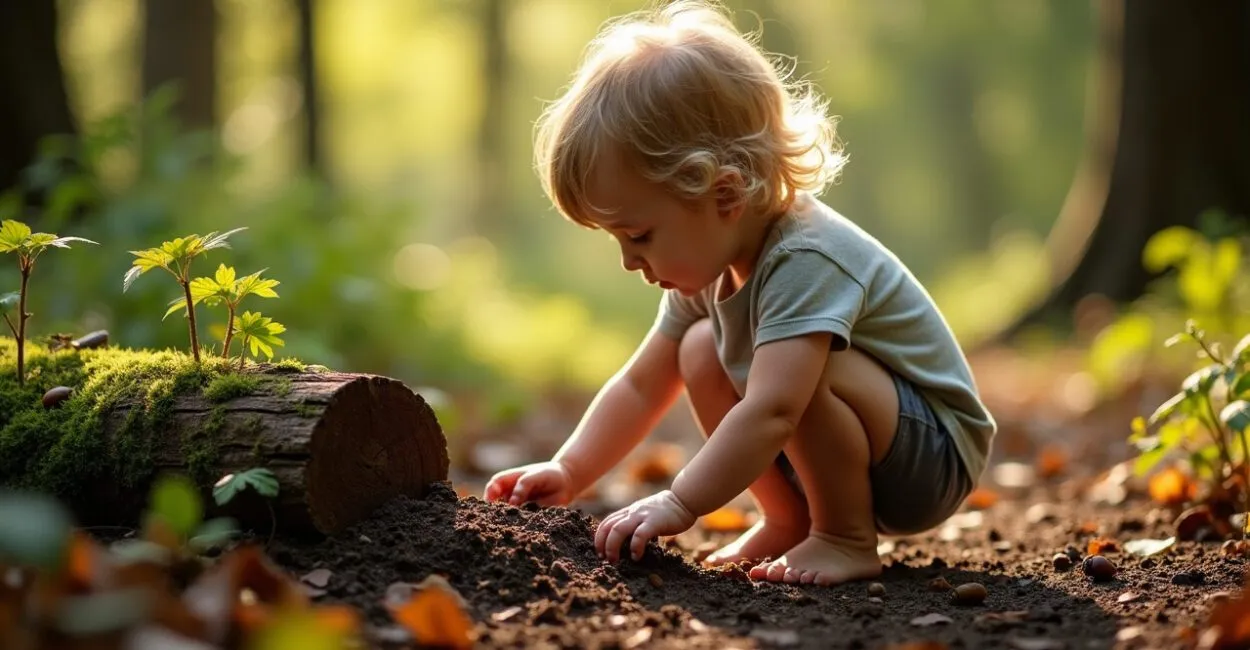
A fallen leaf on the way to the grocery store can turn into a five-minute observation activity. Educational games about nature for young children can use simple materials and work just as well in a backyard as by a window. To get started, choose a short activity, let your child explore at their own pace, and keep plants and animals safe.

These activities encourage curiosity and language development: children compare textures, notice changes, and learn to describe what they see. The results depend on age, interest, and environment; there is no one duration or frequency that works for every child.
What makes nature games suitable for young children
A nature activity for early childhood education is a hands-on exploration that helps children observe natural phenomena, living things, or materials, with age-appropriate guidance from an adult. Put simply, the child does, notices, and talks instead of just listening to an explanation.
A good game has an easy-to-understand task, safe materials, and room for choices. “Find something round” usually works better than a long list of things to locate. Here’s an easy-to-miss detail: young children may be more interested in repeating the same action, such as pouring water or lining up leaves, than in completing the goal an adult had in mind. Repeating an action is exploration, too.
The idea is connected to inquiry-based learning and environmental education. Brazil’s Base Nacional Comum Curricular (National Common Core Curriculum), established by the Ministry of Education, guides experiences involving exploration, observation, and children’s participation in early childhood education.
Ten activities with plants, animals, and natural patterns
The activities below use household items or things children can observe without removing them from their environment. An adult should stay with children during outdoor activities and prepare the materials beforehand.
- Texture box. Place fabrics, a large pine cone, a smooth stone, and fallen leaves with no sharp edges or small parts on a tray. Invite your child to describe how each item feels or point instead of touching. For ages 2–3, offer two items at a time; for ages 4–5, ask them to group items by texture. Avoid anything they might put in their mouth.
- From seed to plant. Plant a fast-growing seed, such as a bean, in damp cotton inside a clear container. Your child can watch it change and draw what they see; later, transplant it with supervision. For younger children, an adult can plant the seed while the child waters it with a small amount of water. Keep small seeds out of reach of children who still put things in their mouths.
- Observation scavenger hunt. At home, in a park, or in the yard, look for something green, a shadow, a large leaf, or a bird sound. For ages 2–3, choose just two things to find; for ages 4–5, add clues such as “something that moves in the wind.” Observe without picking plants or collecting animals.
- Act out metamorphosis. Tell the story of a butterfly’s life cycle and invite your child to use movements to represent an egg, caterpillar, chrysalis, and butterfly. Younger children can imitate two movements; older children can put illustrated cards in order. Explain that the activity is a representation and that life cycles vary among species.
- Birdwatching spot. From a window or a bench, count the birds you see for a short time and compare their colors or sizes. With young children, the adult can point and name what they see; ages 4–5 can make marks on a sheet of paper to keep count. Binoculars are optional; stay away from nests and don’t feed birds unless local guidance recommends it.
- Habitat on a tray. Use blue paper to represent water and brown paper for land. With drawings or large toys, have your child place each animal where they think it lives. Talk about needs such as water, shelter, and food. For ages 4–5, ask them to explain their choices; don’t use live animals or small pieces with children who might swallow them.
- Track investigation. Make marks in damp sand with animal toys or look at tracks already printed in a book. Compare sizes and shapes without claiming that a real track belongs to a particular species unless you’re sure. For younger children, simply match a track to a toy; older children can make a sequence.
- Food chain with pictures. Draw a sun, plant, herbivore, and predator on large cards and arrange them with your child. Use the sequence to talk about relationships between living things, without presenting every food chain as a simple line: ecosystems have more varied relationships. For ages 2–3, name two cards; for ages 4–5, explore what each living thing needs to survive.
- Patterns in nature. Look at stripes, spots, leaf veins, or the repeated arrangement of petals in pictures and on intact plants. Your child can continue a sequence with blocks or drawings. Younger children can copy a two-part pattern; older children can create their own. Don’t offer unfamiliar flowers or leaves to smell or taste.
- Shadows and light. In a safe place, compare an object’s shadow at two different times or make hand shadows near a wall. Ask what changed without expecting a ready-made scientific explanation. Younger children can follow the movement; older children can draw where the shadow falls. Never look directly at the Sun.
How to adapt activities for ages 2–3 and 4–5

For ages 2–3, focus on hands-on actions and short instructions: touching with supervision, pointing, imitating, and choosing between two options. The adult sets up the space and guides the conversation with simple words such as “rough,” “damp,” or “flies.”
Many children ages 4–5 can compare things, anticipate what might happen, and explain their choices. Give them more independence without turning the activity into a test: asking “What do you notice?” often gets you further than correcting every answer. Age ranges are a guide, not a rule; language, coordination, experience, and interest vary widely.
| Age range | Helpful adaptation | Example |
|---|---|---|
| 2–3 years | One action at a time, a few options, and close supervision | Choose between two fallen leaves to compare |
| 4–5 years | More choices, comparisons, and recording observations with drawings or marks | Sort observations by color and explain the criteria |
Read also: Educational Games: 5 Apps to Inspire Creativity in Kids
How to organize activities at home or outdoors
You don’t need a backyard. A window, a screened-in porch, a park, or a tray on the table is enough to observe light, weather, leaves, and birds. For indoor activities, define the area with a towel and use small amounts of water or soil, if appropriate.
There is no proven weekly quota that guarantees a particular result. Start with one or two short sessions, perhaps ten minutes each, and adjust based on your child’s interest. If they leave the activity to watch an ant from a distance or follow a cloud, follow their curiosity without forcing the plan.
Read also: The Family’s Role in Children’s Literacy
Photos, drawings, and marks on a calendar can help you notice changes, such as a plant growing. IBAMA, Brazil’s environmental protection agency, provides information about conservation and respect for wildlife; use it as a reference to reinforce that observing animals doesn’t mean capturing them or disturbing their homes.
Safety, allergies, and sensitivities during exploration
Closely supervise activities involving water, soil, seeds, and small objects. Wash hands afterward, don’t let children taste plants or found materials, and discard anything moldy, thorny, contaminated with feces, or from an unknown source. Outdoors, check the area and avoid touching animals, nests, mushrooms, and unfamiliar plants.
If your child has a known allergy, follow guidance from their healthcare provider and avoid the known allergen. If they’re sensitive to certain textures or afraid of insects, offer alternatives: look through a window, use pictures, move safe objects with large tongs, or choose familiar, dry materials. Children don’t have to touch anything to take part.
Contact with nature is not a substitute for medical evaluation and doesn’t guarantee that a sensitivity will go away. If exposure causes symptoms, stop the activity and follow your child’s health plan; seek emergency care for severe symptoms. Recommendations also depend on the local environment, the species present, and individual needs.
What children learn and when to change the activity
When children compare a dry leaf with a green one, they practice attention, vocabulary, and classification. When they watch a seed sprout, they follow a change over time. These experiences can support learning, but pace and interest vary; a single activity can’t measure a child’s development on its own.
If your child rejects a texture or gets scared by an insect, take a step back and offer another way to observe. If an activity causes frustration, simplify it or stop: pushing on can make exploration feel like an obligation. For guidance on environmental health and age-appropriate care, also consult the World Health Organization and the professionals who work with your child.
Getting started this week
Choose one activity, set out only what you need, and establish a clear safety boundary. A good first try is to observe a plant through a window and draw it today and again a few days later. If your child prefers to talk, point, or simply look, that counts as participation, too.
Try the activity when you’re not in a hurry, and adjust its duration, materials, and distance based on your child’s response. The goal is to create opportunities to pay attention to the environment, even if they last only a few minutes.
Frequently asked questions
At what age can I start?
You can start around age 2 with brief observations, large objects, and close supervision. The activity should match your child’s abilities and interests, without requiring them to touch the materials.
Do I need a group to do these activities?
No. Many activities work with one child and one adult, and some can be done independently when a child is old enough and mature enough. Supervision is still necessary around risky materials and environments.
What should I do if my child is afraid of insects?
Don’t force them to get closer. Observe from a distance, through a window, or with pictures, and let your child decide whether to continue.
How can I keep the activity from feeling like a chore?
Offer a short activity and allow your child’s interests to change. If they want to repeat a step or stop, respect that signal and try again another time.
{
“@context”: “https://schema.org”,
“@type”: “FAQPage”,
“mainEntity”: [
{
“@type”: “Question”,
“name”: “At what age can I start?”,
“acceptedAnswer”: {
“@type”: “Answer”,
“text”: “You can start around age 2 with brief observations, large objects, and close supervision. The activity should match your child’s abilities and interests, without requiring them to touch the materials.”
}
},
{
“@type”: “Question”,
“name”: “Do I need a group to do these activities?”,
“acceptedAnswer”: {
“@type”: “Answer”,
“text”: “No. Many activities work with one child and one adult, and some can be done independently when a child is old enough and mature enough. Supervision is still necessary around risky materials and environments.”
}
},
{
“@type”: “Question”,
“name”: “What should I do if my child is afraid of insects?”,
“acceptedAnswer”: {
“@type”: “Answer”,
“text”: “Don’t force them to get closer. Observe from a distance, through a window, or with pictures, and let your child decide whether to continue.”
}
},
{
“@type”: “Question”,
“name”: “How can I keep the activity from feeling like a chore?”,
“acceptedAnswer”: {
“@type”: “Answer”,
“text”: “Offer a short activity and allow your child’s interests to change. If they want to repeat a step or stop, respect that signal and try again another time.”
}
}
]
}
Artigos Relacionados
 How to Teach Elementary School Kids About Money
 Water Activities: Teach Sustainability Through Play
 A School Garden in Early Childhood Education
 Technology for Young Children: Finding the Right Balance
 Neuroscience in Early Childhood Education: How Children’s Brains Learn and How to Apply This Knowledge to Maximize Learning
 Christmas Gifts for Preschoolers: 25 Ideas
