
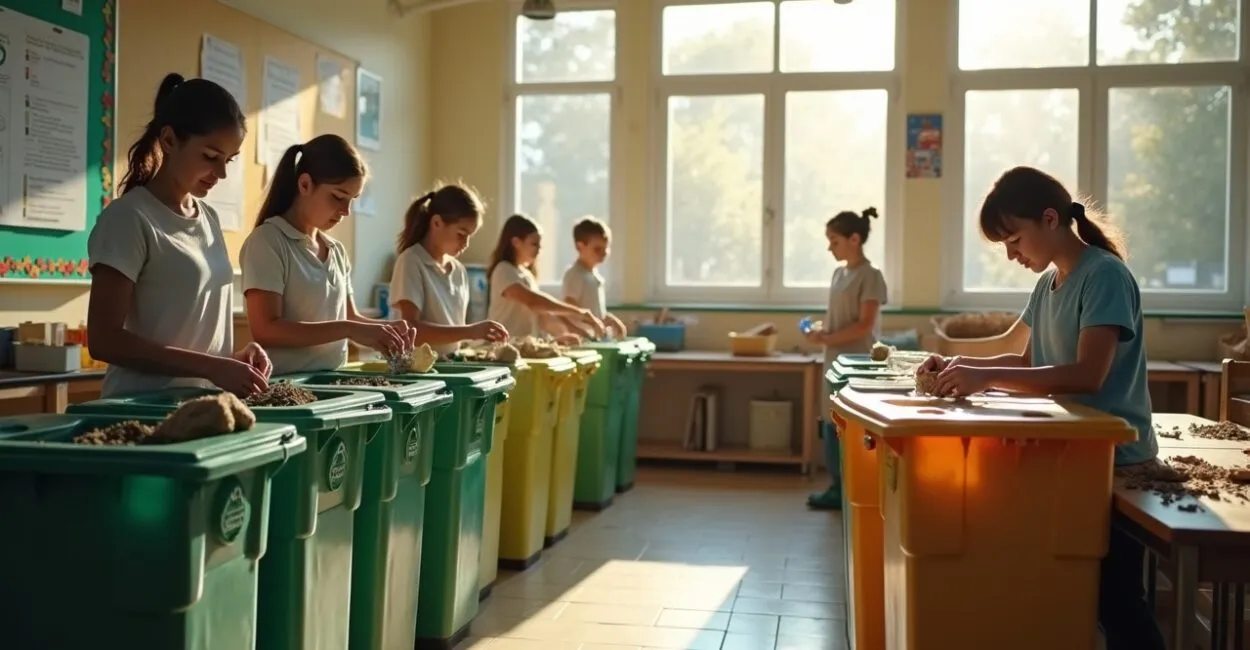
The waste a school produces every day reveals more than just carelessness: it shows whether environmental education has become part of everyday practice or remained a poster on the wall. In school recycling projects, the main goal isn’t simply to “collect materials.” It’s to build routines, foster responsibility, and encourage critical thinking about consumption, waste sorting, and the proper disposal of discarded items.
In practice, the best approach is to start small and set clear rules. When a school tries to tackle paper, plastic, metal, glass, and organic waste all at once, confusion becomes more likely. When it starts with a simple process, measures results, and gives students meaningful roles, the project is more likely to take hold.

Below, you’ll find practical ideas, tips to avoid rework, and ways to make recycling a visible part of learning.
What You Need to Know
- A good school recycling project doesn’t depend on complexity. It depends on proper sorting, consistency, and participation from students, staff, and families.
- The best results come when a school selects a priority material, assigns someone to each step, and uses a simple way to track volume or frequency.
- School recycling works best as part of regular instruction, not as a one-week campaign.
- Creative reuse projects can be helpful, but they only have real value when reuse isn’t confused with industrial recycling.
- Without a partnership with a cooperative, waste picker, or municipal collection service, some of the effort may result in waste piling up with nowhere appropriate to go.
School Recycling Projects: How to Turn Waste into Learning
To be precise, a school recycling project is an organized educational initiative to reduce, sort, collect, transport, or reuse waste at school for environmental and educational purposes. Put simply, it makes waste visible and turns it into a way to teach about consumption, logistics, civic responsibility, and caring for the community.
This kind of project is most effective when it reflects the school’s reality. There’s little point in proposing sophisticated sorting if the cafeteria puts everything in the same bag or students don’t know the difference between recyclable waste and trash. According to the Brazilian Ministry of the Environment and Climate Change website, environmental education should be continuous and integrated into daily life. That matters because habits form through repetition, not one-off events.
What to Include in the Project—and What to Leave Out
Not every “clean” material is recyclable in every situation. Greasy paper, for example, is usually rejected by conventional recycling programs; packaging with food residue can also complicate sorting. Printer paper, PET bottles, cans, and aseptic cartons may be accepted, as long as the school provides clear guidance on cleaning, storage, and where the materials will go.
Why Clear Definitions Matter
Anyone who works on these projects knows that half the problems come from ambiguity. If a class understands “recycling” to mean any kind of arts-and-crafts reuse, the project loses focus. That’s why it helps to distinguish among three ideas: reducing consumption, reusing, and recycling. They’re different things, and a project is stronger when it doesn’t lump them all together.
What sets an attractive school project apart from a truly effective one isn’t the creativity of the activity—it’s a clear process from collection and sorting to final destination.
Idea 1: Clearly Marked Recycling Drop-Off Points
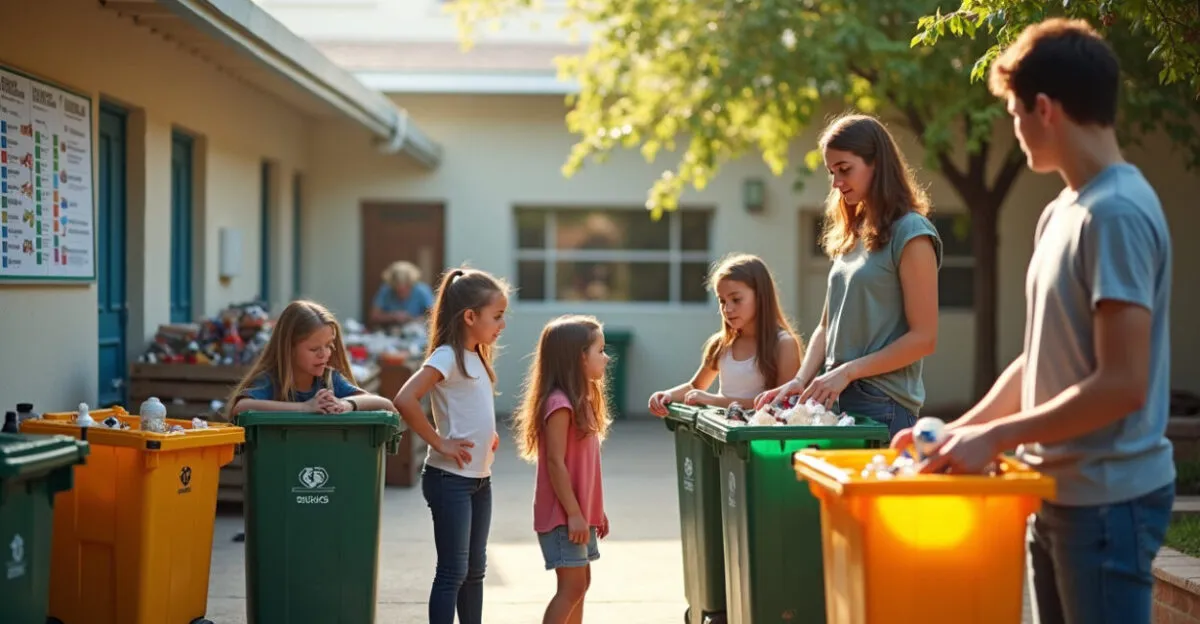
This is the most straightforward initiative, and for that reason, it often fails when there’s no plan. Setting up recycling drop-off points means more than putting out color-coded bins. It means deciding what each bin accepts, where it goes, who maintains it, and where the materials are taken at the end of the week.
In a school setting, the location of recycling bins makes all the difference. If the recycling bin is far from the cafeteria, no one will use it. If it’s nearby but has no clear label, people will sort items incorrectly. Ideally, use simple visual signs, consistent colors, and examples of what can and can’t go in each bin.
How to Set It Up Without Overcomplicating Things
- Choose one initial focus: paper, plastic, or both—but not everything at once.
- Train student monitors to guide sorting during the first few days.
- Post signs with pictures of items commonly found at school.
- Arrange weekly pickups with a recycling cooperative, a partner waste picker, or the municipal service.
One practical detail matters: a simple, well-maintained recycling program is better than an attractive setup no one follows. Field experience shows this time and again. At many schools, the project only takes off after the team reduces the number of options and clears up obvious questions.
Idea 2: A Waste-Sorting Challenge with Goals for Each Class

If the school wants to build engagement without getting stuck in a rut, a waste-sorting challenge can work really well. Each class competes to sort waste brought from home, the cafeteria, or their classroom, with points awarded for accuracy, cleanliness, and the amount properly sent for recycling.
This format works because it makes the topic tangible. Kids and teens quickly understand a concrete goal, a scoreboard, and feedback. Just don’t turn it into a race to collect the most, since that can encourage students to bring in dirty or irrelevant items. Sorting quality should be the main criterion.
Rules to Keep Things Organized
- Award more points for correct sorting than for the volume collected.
- Deduct points for items contaminated with food or liquids.
- Track results weekly, not just at the end.
- Give brief feedback to explain common mistakes.
There’s an important caveat: this approach works well in schools with organized classes and teacher support, but it loses momentum without adult supervision. Without at least some oversight, the competition can become pointless. Assigning someone to each step helps prevent that.
Idea 3: Creative Reuse Workshops with an Educational Purpose
Creative reuse workshops, also known as school upcycling, are a great way to give materials like cardboard boxes, paper tubes, bottle caps, containers, and fabric scraps a second life. But the goal shouldn’t be just to “make pretty crafts.” The activity needs to explain the difference between reuse and recycling.
In practice, a successful workshop connects materials to their uses and invites reflection. A box can become a book organizer, a supply holder, or a science model. Teachers can use the activity to discuss product life cycles, consumption, and disposal. For more technical information on recycling and waste management, consult the institutional resources of Ibama, Brazil’s environmental agency.
Ideas That Work Well
- Pencil holders made from cardboard tubes and magazine paper.
- Vertical garden made with PET bottles.
- Library organizers made from reinforced cardboard boxes.
- Educational games made with bottle caps and clean packaging.
A quick story: At a public elementary school, a fifth-grade class started by making storage boxes for the classroom. The students thought it would be just a hands-on activity. Two weeks later, they were sorting paper and plastic on their own during recess because they understood what it was for. The change came less from the workshop itself and more from the meaning it gave to the action.
Idea 4: Composting Food Waste from the Cafeteria
If the school wants a more lasting environmental impact, composting is worth considering. Organic waste from fruits, vegetables, and plant-based leftovers can become fertilizer, reducing the amount of trash sent to landfills. This is organic material being recycled through controlled decomposition—not “trash that disappears.”
This project requires care. Not all organic waste is suitable for every composting system. Meat, dairy, and excess grease can attract odors and pests, while peels, coffee grounds, and plant-based scraps usually work better. Schools looking to get started safely can find useful technical resources on composting and organic waste management from Embrapa, Brazil’s agricultural research corporation.
Read also: Energy Savings at School: 10 Ways to Cut Costs
When It Makes Sense to Start
Composting makes the most sense when the school has a cafeteria, garden, or yard with soil that can receive the finished compost. In very small spaces, a poorly maintained composter can become a sanitation problem. In that case, it’s better to start with a small volume and a responsible team before scaling up.
The Most Common Mistake
The most common mistake is treating the composter as a standalone attraction. Without tracking what goes in, monitoring moisture, and allowing enough time for the compost to mature, the system stops working as intended. The project needs a routine, not just good intentions.
School composting works only when the school treats organic waste as a resource, not a decorative experiment.
Idea 5: A Campaign to Reduce Single-Use Items in the Cafeteria
Before recycling, it’s worth reducing waste. That changes everything. A campaign to cut single-use items in the cafeteria—plastic cups, disposable cutlery, and excessive packaging—often delivers results faster than projects focused only on collection.
The logic is simple: waste that’s never generated doesn’t need to be sorted, transported, or processed. At school, this could mean encouraging students to use reusable water bottles and mugs, using cloth napkins for certain activities, and reviewing the items sold in the cafeteria.
How to Measure the Impact
Metric
Before
After
Disposable cups per week
Initial estimate
Percentage reduction
Trash bags generated
Historical baseline
Monthly comparison
Class participation
Low or inconsistent
Students engaged per class
This kind of effort can win over school leaders and coordinators when the numbers show progress. It’s also important to be realistic: not every school can eliminate single-use items right away because of budget, hygiene, and logistical constraints. The best approach is to reduce them gradually, with a realistic goal.
Idea 6: Partner with a Recycling Cooperative or Local Waste Pickers
Without a proper destination, school recycling becomes little more than symbolic stockpiling. A partnership with a recycling cooperative, local association, or municipal recycling program closes the loop. That connection gives the project environmental credibility.
Beyond arranging for materials to be picked up, the partnership makes the issue more human. Students learn that work, income, and a supply chain are behind the materials they sort. This takes recycling out of the abstract. Public information and guidance on education and waste management are available through resources on Brazilian federal waste management legislation, especially when the school needs to align its project with the city’s collection policy.
What to Ask Before Setting Up a Partnership
- Which materials does the partner actually accept?
- How often do pickups take place?
- How should the materials be cleaned and sorted before pickup?
- Is there a minimum volume required for pickup?
This is where many schools run into trouble: they collect a good amount of material, then discover too late that the partner doesn’t accept glass, foam, or contaminated packaging. Clarifying these rules in advance prevents frustration and protects the project’s credibility with students.
Idea 7: An Environmental Fair Showcasing Real Results
Once the school starts sorting, reusing, and reducing waste, it makes sense to show what has changed. An environmental fair featuring posters, simple charts, objects made in workshops, and student stories can help make the project part of the school’s culture.
The biggest benefit of this step is educational: students see the impact, not just the activities. Showing how many pounds of paper were collected, how many workshops took place, and how many drop-off points were used makes the process tangible. Without this public wrap-up, the project may be forgotten by the end of the semester.
What to Showcase
- Before-and-after photos of recycling drop-off points.
- Items made through creative reuse.
- Simple waste volume metrics.
- Brief quotes from students and staff.
A successful fair doesn’t need a big budget. It needs a story, data, and participation. When the community understands what has changed, the project stops being just a “school activity” and becomes a shared practice.
How to Get Started Without Disrupting the Whole School
The biggest mistake in school recycling projects is trying to design the perfect solution before testing a first version. The safest approach is to pilot, adjust, and expand. Choose one class, one material, and one simple goal. Track progress for four weeks, then scale up.
This pace reduces strain on the team and avoids overloading people who already have full schedules. It works better because it reflects how the school actually operates. A small school, a school with a full-day program, and a district with a contracted cafeteria all have different needs. The project should fit the existing setup, not fight against it.
A Practical Plan for the First 30 Days
- Choose one priority waste material.
- Create a clear, visible sorting rule.
- Assign people to each class or department.
- Arrange collection or a final destination.
- Track results every week.
If the school does this well, recycling stops being a standalone activity and becomes part of learning, community life, and responsibility. The smartest next step is to test a small pilot, document what went wrong, and only then expand to other areas.
Frequently Asked Questions
What’s the Best Recycling Project for a School to Start With?
The best project to start with is a recycling program focused on one material, such as paper or plastic, because it requires little infrastructure and teaches proper sorting from the beginning. When a school tries to launch several initiatives at once, mistakes and disorganization become more likely. The best approach is to start with a simple pilot, track it for a few weeks, and only then expand to other waste streams and educational activities.
Are School Recycling and Creative Reuse the Same Thing?
No. Recycling means sending waste back into a production cycle, while creative reuse means finding a new use for an item without processing it industrially. Schools can do both, but they shouldn’t be confused. This distinction helps students understand the life cycle of materials and avoids labeling every hands-on activity as recycling.
How Can You Engage Students Who Aren’t Interested in Environmental Education?
Engagement increases when the project moves beyond talk and gives students a concrete task with visible results. Friendly class competitions, short-term goals, and clearly defined roles work better than long lectures. It also helps to connect the topic to everyday life: cafeteria waste, disposable items, and the waste generated in the classroom. When students see an immediate impact, they’re more likely to get involved.
Does It Take a Lot of Money to Start a School Recycling Project?
Not necessarily. Many projects start with posters, collection boxes, an organized process, and a partnership with a cooperative or municipal recycling program. Expansion, storage facilities, or a larger composting system are more likely to require additional investment. In many cases, the main resources aren’t financial—they’re organization, consistency, and support from school leadership to keep the process running.
What Can Derail a Project Even When the School Is Committed?
The main obstacles are lack of follow-through, bins without clear signs, no partner to pick up the waste, and confusion between recyclable materials and trash. Another common problem is an overloaded team, which makes the project depend on one person. When that happens, the initiative quickly loses momentum. To avoid this, the school needs to establish routines, assign responsibilities, and decide where the materials will go from the start.
Artigos Relacionados
 A Practical Guide to School Sustainability Projects
 Mother’s Day Bulletin Board Sayings: 25 Ideas for Schools
 Mother’s Day Cards in Elementary School: Practical Ideas
 Individualized Planning for Students With ADHD: How to Create Goals, Accommodations, and Differentiated Assessments for Elementary School
 Inclusive Strategies for Students with ADHD: Practical Accommodations and Academic Outcomes for Elementary School Teachers
 Creative Icebreakers: 7 Innovative Activities to Help Middle School Students Connect
