
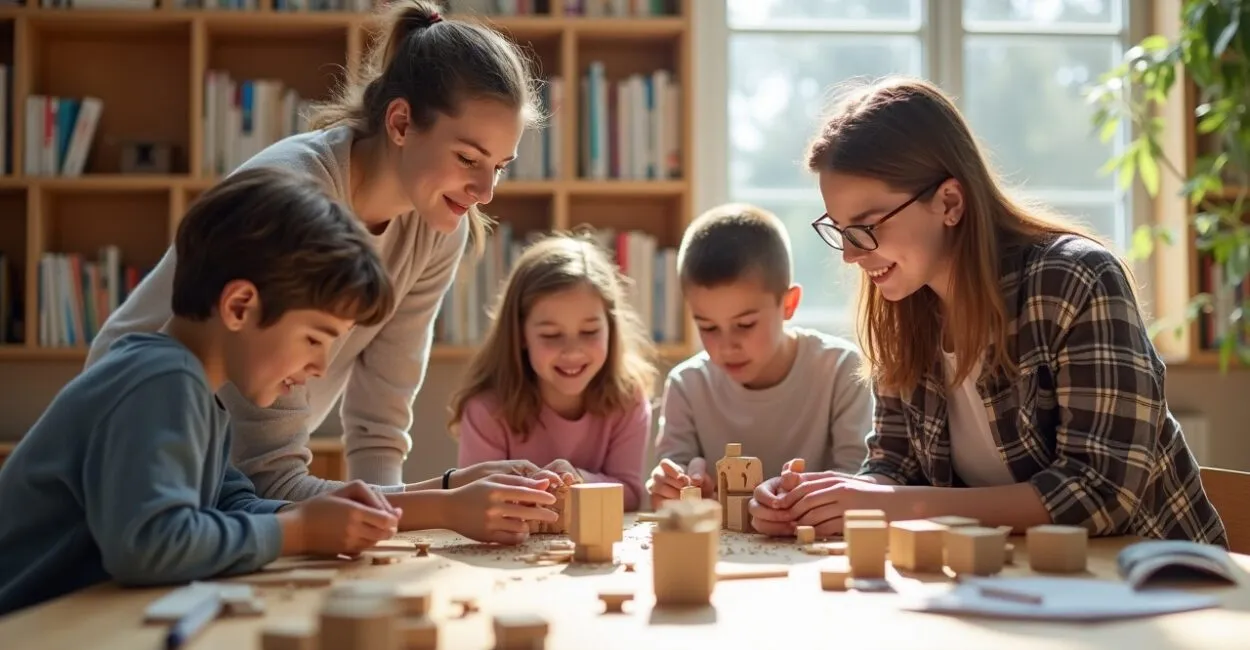
A class can build a cardboard prototype, investigate the school’s water use, or redesign a shared space without turning the activity into just a nice-looking project to display. Creative education methods in the classroom help teachers plan this kind of learning: they connect problems, inquiry, creation, and reflection, with choices suited to the subject, students’ ages, and available resources.

Design Thinking, project-based learning, STEAM, Maker practices, learning circles, and gamification each have distinct purposes and formats. The right choice depends on what students need to learn and how the teacher will guide the process.
No approach, on its own, guarantees creativity or participation from everyone.
Quick overview
- Search intent: Informational, with a practical and comparative focus.
- Common goal: Develop knowledge and skills through inquiry, creation, and reflection.
- Approaches covered: Design Thinking, projects, STEAM, Maker, learning circles, and gamification.
- Resources: Range from everyday materials and a whiteboard to digital tools or a fabrication space.
- Assessment: Should consider both the learning process and the outcome, using clear criteria.
What creative education methods in the classroom are
Creative education methods in the classroom are teaching approaches that organize learning around inquiry, idea generation, creation, and the revision of solutions, while connecting these processes to defined curriculum goals. For teachers, this means planning challenges that ask students to draw on their knowledge, make decisions, and explain what they have learned.
“Creative” doesn’t mean unstructured. A challenge needs a purpose, clear boundaries, and time to test ideas. Without these conditions, some students may take on all the work while others aren’t sure how to contribute. When choosing an approach, start with the content and the class: What do students already know? What barriers might they face? What resources are available? A project may be better suited to investigating a problem over several weeks; a Design Thinking session might work for exploring solutions in less time.
Design Thinking to investigate problems and test solutions
Design Thinking in education is a problem-solving approach centered on the needs of the people affected by a challenge. In the classroom, it often involves understanding the context, defining the problem, generating ideas, building prototypes, and testing them.
The stages can be revisited: for example, testing may reveal that the original question needs to be reframed.
It works best when students are given a problem that feels relevant to them but is open-ended enough to allow different answers. A class might investigate why it’s difficult to find books in the library, talk with library users, propose changes to the signs, and try out a temporary version. The teacher needs to guide the inquiry and help students distinguish opinions from relevant observations. The approach falls short when the activity focuses on designing attractive solutions without research or testing. It’s also important to make sure listening doesn’t become a token exercise: if students interview their classmates, they should show how the responses influenced their decisions. The approach doesn’t replace teaching the knowledge students need to assess whether a proposal is feasible.
Project-based learning with a clear curriculum purpose

In project-based learning, students investigate a question or problem over a defined period and create something that demonstrates what they have learned. A well-designed project starts with curriculum goals, requires research and student decision-making, includes feedback along the way, and ends with a presentation or product for a clearly identified audience.
Authenticity comes from connecting the task to a context students can understand, not from pretending to be adults in a particular profession. A project about water quality can bring together data literacy, science, and communication; a school campaign has educational value only if students also learn to support their recommendations with evidence and recognize the limits of the information available.
Planning requires careful attention to scope. Projects that are too broad take up too much time and make it harder to track individual learning.
Breaking the work into smaller deliverables, such as a research question, a draft, and a revised version, helps uncover questions before the final presentation.
STEAM and Maker: Connecting subjects through hands-on learning
STEAM brings science, technology, engineering, the arts, and mathematics together to explore problems or create something. Each subject needs to play a meaningful role: adding an artistic decoration to a science activity, for example, isn’t enough to make it interdisciplinary. STEAM differs from a general project in its explicit goal of connecting ways of thinking and knowledge from different fields.
Read also: Creative Education: 7 Practical Strategies to Try Today
Maker learning emphasizes hands-on work, experimentation, and revising objects or solutions. 3D printers and robotics kits can be part of a Maker space, but they aren’t required. Paper, clean packaging, string, and reusable materials can be used to explore structure, measurement, force, and design, as long as the teacher sets a learning goal and establishes safety guidelines.
One area that often needs attention is how much time students spend building: groups may spend the entire class decorating a prototype and almost no time explaining why it works. Setting aside time to record attempts, compare versions, and justify choices turns the creation process into evidence of thinking. Access to specialized equipment expands the possibilities, but also brings costs, maintenance, and training needs.
Learning circles and gamification to encourage participation
Learning circles organize knowledge-sharing among participants around a shared question, text, investigation, or practice. The teacher can pose a question, assign discussion roles, and ask each group to record ideas, questions, and connections. This format encourages listening and collaboration, but it needs participation guidelines so it doesn’t favor students who find it easier to speak up.
Gamification is the intentional use of game elements, such as missions, levels, feedback, and choices, in an activity that isn’t a game. A mission might guide students through revising a piece of writing in stages, with progress criteria tied to the quality of the argument. Points and rankings, when used carelessly, can shift the focus from learning to competition or single out students who need more time.
These strategies can support other methods. A learning circle can help a team compare experiment results during a project; a gamified sequence can break research into stages. In both cases, the game mechanics should support the intellectual work, not serve as a reward disconnected from the content.
How to choose and combine approaches
You don’t have to choose just one method for the school year. Approaches can complement each other, as long as each has a clear purpose and the combination doesn’t overload the activity with too many stages, tools, and rules.
| Approach | A good choice when… | Key considerations |
|---|---|---|
| Design Thinking | There’s a human-centered or everyday problem to investigate and test. | Avoid solutions without research or validation. |
| Project-based learning | The goal requires investigation and creation over time. | Set a manageable scope and track each student’s work. |
| STEAM | The content benefits from connections across subject areas. | Make sure each area meaningfully contributes to learning. |
| Maker | Building, testing, or modifying something helps students understand the content. | Plan for documentation, safety, and access to materials. |
| Learning circles | Exchanging perspectives is an important part of the goal. | Share participation opportunities and structure the discussion. |
| Gamification | Stages, feedback, and choices can guide practice. | Avoid competition that distracts from the content. |
There’s no one-size-fits-all best method for students who have difficulty paying attention. Breaking tasks into visible stages, giving short instructions, offering participation options, and scheduling breaks can help students stay engaged; what works depends on each student’s needs and the supports already in place at school. Coordinate these steps with the school’s instructional team and make relevant accessibility accommodations.
Implementation and assessment without relying on technology
Start with a short sequence tied to a curriculum goal. Decide what each student should know or be able to do, choose an approach that helps them demonstrate it, and prepare criteria before getting started. Simple materials are enough when the activity involves observation, building, or communication; digital tools make sense only if they add something to the work.
Assessing creativity means looking at observable evidence, such as the range of ideas considered, the reasons behind students’ choices, their use of subject knowledge, and their ability to revise a proposal after receiving feedback. Explain these criteria to students. Tests can check specific knowledge, but on their own they don’t show how a student conducted research, collaborated, or improved a solution.
Here’s one possible scenario: the class studies water waste at school. Students observe where water is used and organize their notes in a table; in groups, they propose a low-cost intervention and build a prototype sign or device. A rubric might assess the quality of the data, the connection between evidence and proposal, and the revisions made after classmates’ feedback.
CAST presents Universal Design for Learning as a framework for planning different ways to access, participate in, and express learning. This perspective helps teachers anticipate barriers, for example, by offering alternatives to a presentation that relies entirely on speaking. Schools should adapt activities to their students’ context without assuming that one accommodation works for everyone.
For resources on education and interdisciplinary learning, also consult the OECD’s education resources and the National Academies of Sciences, Engineering, and Medicine. These organizations publish materials on learning and educational practices; consulting a source doesn’t remove the need to assess whether an approach fits the curriculum and local conditions.
Results don’t appear on a fixed timeline. The time required depends on the length of the learning sequence, students’ prior knowledge, the quality of feedback, and opportunities to revise. Process notes, successive versions of student work, and conversations with students can reveal changes that a final grade might miss.
Next steps for making creativity part of the routine
Choose something your class needs to learn and turn it into a question students can investigate. Plan a short first activity, decide how you’ll observe learning, and, at the end, ask students to explain which decisions changed along the way. This reflection gives teachers a basis for adjusting the next sequence based on what happened, not on promises about a method.
Can these methods be used in any subject?
Yes, as long as the approach supports the subject’s goals. Creativity can be part of interpreting historical sources, writing stories, conducting scientific investigations, or solving math problems, with criteria suited to each subject.
How can you track each student’s contribution to a group project?
Combine observations of the work with individual records, such as learning logs, oral explanations, or written justifications. This way, assessment considers the group’s product without assuming that everyone learned or contributed in the same way.
How long does it take to see results?
There’s no timeline that works for every class. Some evidence, such as participation at different stages or the quality of revisions, may emerge during a learning sequence; broader changes require monitoring across different activities.
Does a creative activity need to end with a physical product?
No. An argument, an interpretation, a presentation, or a mathematical solution can also demonstrate creativity and learning. The format should follow from the goal, not from an expectation that students produce something to display.
Artigos Relacionados
 5 Teaching Methods That Work for Financial Education
 The Montessori Method: How It Works in Europe
 Active Learning Methods: 7 Practices That Are Transforming Education
 Literacy in Elementary School: Methods That Work
 Environmental Education in Elementary School: Activities That Work
 Creative Portfolio for Clients: The Mistake That Costs You Work
