
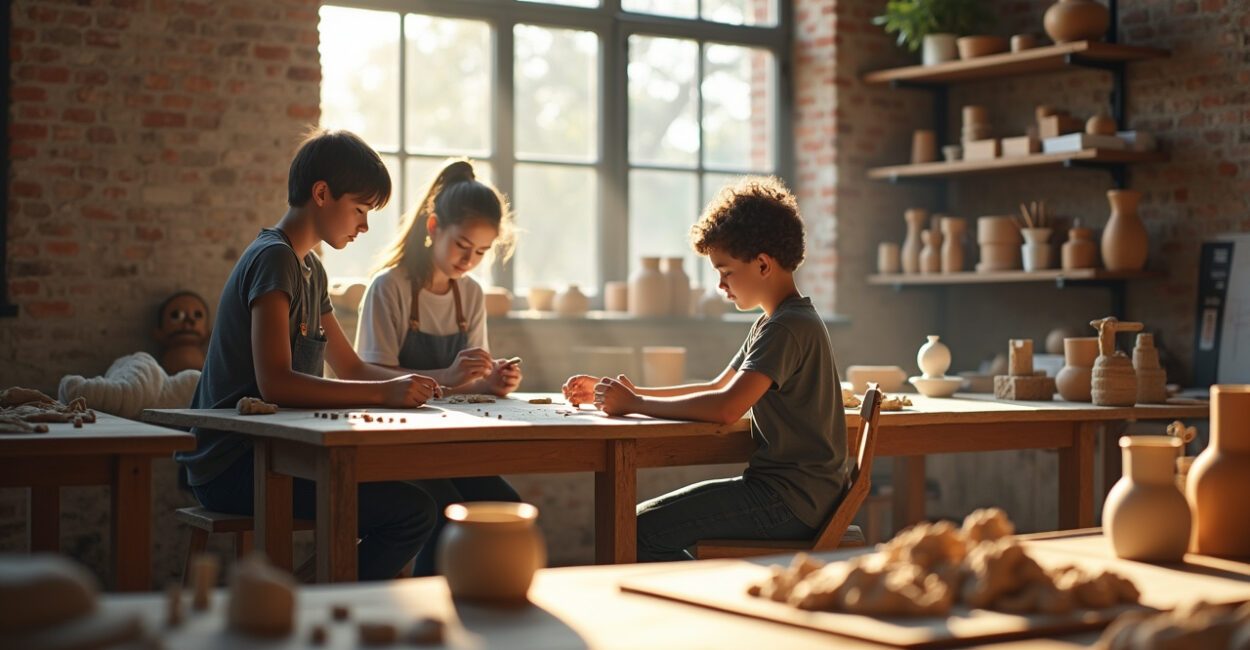
A class can spend an entire lesson building a paper bridge and still learn very little if no one has to test the structure, explain their choices, or revise the design. Creative education builds skills by combining experimentation with clear goals, feedback, and reflection. This turns creativity from a rare talent into a capacity anyone can practice.
To understand how creative education helps build skills, think of activities that ask learners to create a solution, put it to the test, and improve it. This process can happen at school, at home, or at work, using simple materials or digital tools.

What matters is connecting each challenge to the intended learning outcome.
Quick Facts
- Definition: A learning approach that uses creation and inquiry to develop knowledge and skills.
- Skills developed: Problem-solving, communication, collaboration, and critical thinking.
- Contexts: Early childhood education, K–12, adult learning, and workplace settings.
- Strategies: Projects, prototypes, challenges, games, and feedback cycles.
- Assessment: Evidence of both process and outcome, using criteria participants know in advance.
Creative Education: How to Build Skills
Creative education is an intentional teaching approach that organizes learning experiences around inquiry, creation, and the revision of ideas. It builds skills when learners apply their knowledge to solve a problem, explain their decisions, receive feedback, and improve something they have made. In everyday terms, it means learning by creating, with purpose and reflection. In this context, creativity is not limited to the arts, nor does it depend on being born with a special gift. It involves coming up with ideas or solutions that fit a situation, and it can be practiced across different subjects. For example, a science activity can foster creativity when students suggest ways to reduce water waste and test which one best meets defined criteria.
Observable skills include asking questions, comparing options, handling failed attempts, dividing up tasks, and communicating results. The mix varies depending on age, subject matter, and available support.
Making a poster, by itself, does not necessarily demonstrate these skills; it is important to observe the decisions and reasoning behind it.
Principles That Give Creative Learning Purpose
Effective learning starts with a clear question or need but leaves room for different approaches. The challenge should be open-ended enough to allow choices, yet defined enough for participants to understand what they are trying to learn. Without this balance, the activity can become confusing or mechanical. Feedback matters, too. Specific comments, such as “The base sagged when you added weight. What change could make it sturdier?” help guide the next attempt. Vague praise gives learners less information to decide what to do next.
A creative experience builds skills when each attempt offers a useful clue for the next decision.
Another principle is connecting the work to knowledge. Building an object can involve math, language, science, and planning, but these connections need to be taught, not assumed.
The OECD recognizes creativity and critical thinking as important dimensions of learning. In the classroom, that means giving students opportunities to think and do, not just memorize content.
Methods for Turning Ideas Into Skills

Creative methods share cycles of exploration, creation, and revision, though each structures the process differently. The right choice depends on the goal, time, and resources. Using a familiar method does not guarantee learning: educators need to identify the skill in focus and plan how it will show up during the activity.
Project-Based Learning
In a project, participants investigate a question over several stages and present something they have made or a proposal. A class might explore how to make the schoolyard more accessible, identify obstacles, consult users, design changes, and make a case for a solution. Along the way, students use research, negotiation, and communication skills, as well as knowledge related to the topic.
Read also: Creative Education: Why Schools Are Changing
Design Thinking in Education
Design thinking organizes problem-solving around people’s needs. One possible cycle includes understanding the context, defining the problem, generating ideas, building a prototype, and testing it. The process can be adapted: young children, for example, can talk with classmates and try paper models without having to learn design jargon.
Gamification and Collaboration
Gamification means using game elements, such as missions, rules, and feedback, in activities that are not full-fledged games. It can help sustain engagement, as long as points do not become the main goal. Collaboration works best when individuals are accountable: each participant needs to contribute, and the group needs to make decisions together.
At Stanford University’s d.school, human-centered design is presented as a practice of exploration and experimentation. In any setting, simple prototypes and quick tests help surface assumptions before investing more time in a solution.
How to Practice at Home, School, and Work
Everyday activities at home offer concrete challenges: planning a meal with the ingredients on hand, reorganizing a room, or coming up with a way to store toys. Adults can ask children what they tried, what worked, and what they would change. Giving them all the answers right away limits opportunities to make decisions; leaving them without support can also lead to frustration.
At school, a project can start with a curriculum question and end with a presentation, model, or proposal. One useful practical observation: when groups start building before agreeing on criteria, they often spend time discussing finishing touches without knowing whether the solution addresses the problem. Setting criteria before building a prototype prevents this detour and makes revision more productive.
At work, teams can test a new workflow on a small scale before changing an entire process. Record the hypothesis, what you will observe, and who will decide on next steps. This precaution helps distinguish an appealing idea from a change that actually improves the work.
Where to Apply These Skills and How to Recognize Their Impact
Skills developed through creative experiences can be applied in situations that call for adaptability, such as solving problems, explaining proposals, working with others, and learning new tools. They do not all emerge at once, nor do they automatically transfer from one activity to every other situation. A child who collaborates well in a game may need support negotiating in a group project with different rules.
To recognize progress, look for concrete behaviors: the learner asks more precise questions, considers alternatives before choosing, uses feedback to revise their work, or explains why they changed strategies. Brief records of different versions, teacher observations, and self-assessments can track these changes more consistently than a general impression.
UNESCO views education as part of developing the capacity for participation and lifelong learning. This reinforces an important idea: a skill’s value also depends on opportunities to use it and the context in which a person learns.
Assessing Creativity Without Reducing the Process to a Grade
Creativity assessment can combine criteria for both process and outcome without trying to measure a personal trait as if it were fixed. Explain what you will observe before the activity begins. A rubric might consider the range of ideas, how well the solution addresses the problem, the use of feedback, and the clarity of the presentation.
For a class building a bridge, for example, criteria might include stability, the reasoning behind design choices, and revisions made after testing. The final result matters, but it does not tell the whole story: a failed solution may reflect careful investigation, while a model that works by chance may reveal little about the group’s reasoning.
Combine different kinds of evidence, such as drafts, observations, oral explanations, and self-assessments. Avoid scoring “originality” without defining what it means for that challenge: doing so may favor those who already know the references valued by the evaluator. Assessment is fairer when criteria describe observable actions and everyone knows how to use them.
How to Get Started, Recognize Limitations, and Calculate ROI
To get started, choose one specific skill and a small challenge. Define the expected outcome, set aside time for at least one revision, and decide what evidence will show what participants learned. Your first activity does not need expensive technology; paper, reused objects, and a well-framed question may be enough.
Creative education works at every age, but not with the same level of autonomy or complexity. Young children need concrete instructions and close support; teens and adults can take on more decisions, but they still need guidance. Real limitations include limited time, large classes, inadequate accessibility, and a lack of connection to the curriculum, all of which can reduce the quality of the experience.
In business, the ROI of a creative initiative should be calculated based on the problem it is intended to solve. Record a baseline, define relevant indicators—such as rework, completion time, adoption of a process, or perceived quality—and compare results after implementation. Include the costs of facilitation, materials, and work hours; do not attribute every change to the program if other factors played a role.
The first step is to test a short activity with a clear goal and explicit criteria. Then record what participants did, what they were able to explain, and what they would change on the next attempt. This cycle provides a more reliable basis for deciding whether to expand the practice.
Does Creative Education Work for All Ages?
Yes, as long as the challenge, support, and level of autonomy are appropriate for each stage of development. Young children can explore materials and make simple choices; adults can work on more ambiguous problems and longer projects.
Can You Develop Creativity Without Being Born With It?
Yes. Creativity can be practiced through idea generation, testing, feedback, and revision. The pace of development varies, and the environment influences opportunities to experiment and learn.
How Can I Tell if My Child Is Getting a Truly Creative Education?
Notice whether your child can make choices, explain decisions, test ideas, and revise what they have made. One hands-on activity is not enough to conclude that creative learning is taking place; also look for a learning goal and discussion about the process.
How Can Creative Skills Be Assessed in Practice?
Before the activity, define observable behaviors, such as suggesting alternatives or using feedback to revise a solution. Gather more than one piece of evidence—for example, versions of the work, explanations, and observations—instead of relying only on the final product.
How Do You Calculate the ROI of a Creative Initiative at a Company?
Compare costs and outcomes tied to the stated goal, using a baseline and indicators suited to the process. The calculation is more credible when it accounts for external factors that may also have influenced the results.
Artigos Relacionados
 A Complete Guide to Entrepreneurial Education: Build Leadership Skills, Create an Effective Business Plan, and Start a Successful Career
 Digital Education: Skills for the Future, Starting Now
 The Importance of Certificates in Your Career: Prove Your Skills, Build Credibility, and Find Better Opportunities
 Exploring the World Through the Senses: 10 Creative, Safe Sensory Activities to Support Early Childhood Development
 Women’s Day Cards for Early Childhood Education: Creative Ideas, Inspiring Messages, and Fun Activities to Celebrate Gender Equality
 Collaborative Group Activities: 5 Creative Ways to Build Teamwork and Communication Among Middle School Students
