
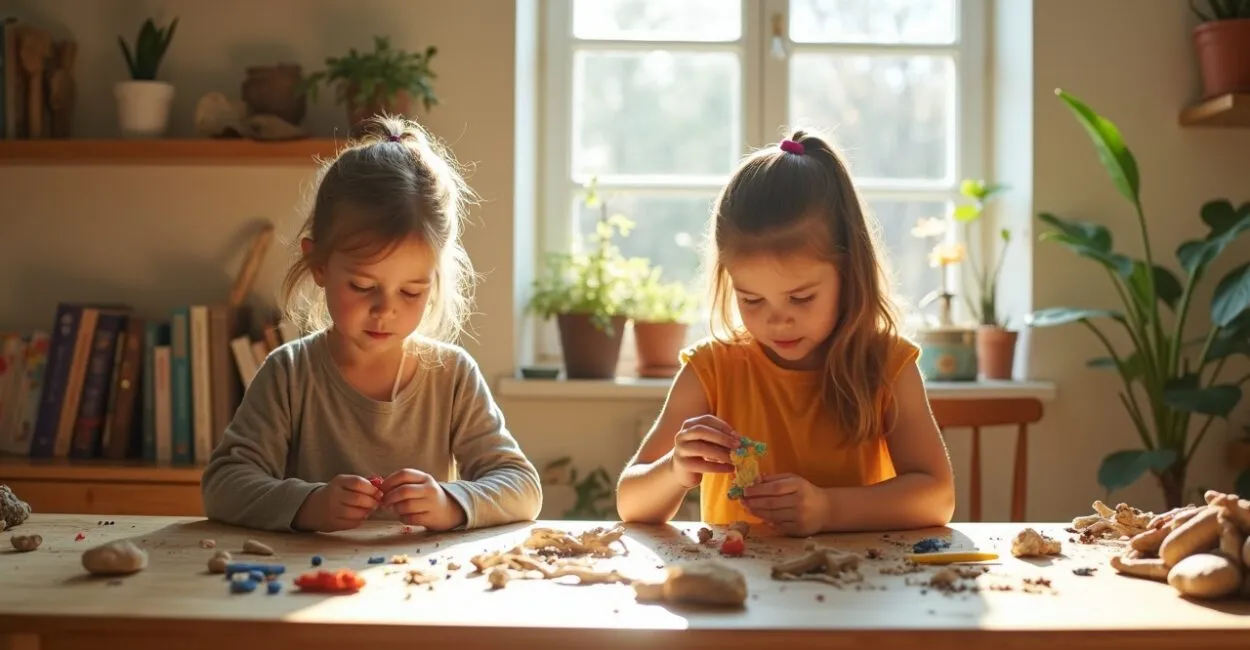
One child turns a cardboard box into a spaceship, a house, and a hideout; another watches the game before joining in. Both may be using their imaginations at their own pace.

To understand how to encourage creativity in children through education, families and educators can combine exploration, meaningful choices, and challenges with more than one possible answer.
Creativity is the ability to come up with ideas or solutions that are original and appropriate to a situation. In childhood, it can show up in a drawing, a theory about plants, a block construction, or a new rule for a game.
Creative education doesn’t depend on expensive materials. Much of it comes down to how adults set up the environment and respond to a child’s ideas.
How to encourage creativity in children through education
To foster children’s creativity, give them time to explore, a variety of materials, and open-ended problems with more than one possible solution. Ask questions that help children think, allow age-appropriate choices, and welcome attempts that don’t work the first time.
At home and at school, adults provide guidance and ensure safety without doing every step for the child.
This approach combines autonomy with purposeful teaching. The goal might be to learn about shapes, tell a story, or observe changes in nature; children take part in shaping the process.
The National Common Curricular Base (BNCC), Brazil’s Ministry of Education curriculum framework includes exploration, expression, and participation among the key experiences in early childhood education.
What tends to stifle imagination
When every activity has a single model to copy, children learn that success means reproducing the example. This can limit opportunities to make decisions, experiment, and explain their own ideas.
Detailed instructions have their place, especially in safety-related tasks or learning that requires precision, but they don’t need to dictate every outcome.
Other obstacles include rushing to finish, correcting children before they’ve completed their train of thought, and filling the schedule without leaving room for choice. An unexpected drawing, for example, may express an intention the adult hasn’t yet understood. Instead of correcting it, try asking, “Tell me what’s happening here.”
It’s also important to pay attention to the context. Noise, fatigue, difficulty with communication, or fear of making a mistake may lead a child to turn down an activity. Not taking part in one particular activity, by itself, doesn’t mean a child isn’t creative.
Activities for different stages

Age can help you choose materials and the type of support to offer, but it doesn’t dictate a rigid sequence. Children in the same age group may have different interests, motor skills, and ways of communicating. Offer safe options and adjust the challenge based on each child’s response.
| Approximate stage | Activity | Goal and adult’s role |
|---|---|---|
| Before learning to read and write | Explore boxes, fabric, large containers, and sounds in the environment | Investigate properties and invent new uses; name what the child notices and supervise small objects. |
| Early childhood education | Create characters with modeling clay or tell a story using pictures | Develop expression and storytelling; ask open-ended questions without imposing a “right” plot. |
| Elementary school | Build a paper bridge or suggest solutions to a classroom problem | Plan, test, and revise; help document attempts and compare results. |
In early childhood, sensory exploration can spark creativity: touching, stacking, combining, and observing cause and effect are meaningful experiences even before children learn to read and write. Use age-appropriate materials and supervise any pieces that could pose a choking hazard. One simple activity is to offer large containers and fabric so children can create a scene, without first demonstrating what they “should” do.
For more ideas about play and development, UNICEF Brazil offers resources on childhood and caregiving. Adapt the suggestions to each family’s circumstances and follow safety guidance for the materials you use.
How educators can support children without taking over
Adults prepare the space, set boundaries, and observe. When a child reaches an impasse, an adult can respond with a question: “What have you tried so far?” or “What material might help?” This kind of support preserves the child’s initiative and offers clues without giving away the whole solution.
One practical detail can make a difference: children may need a quiet moment before answering. Repeating the question, offering too many choices, or finishing the task for them often cuts that thinking time short. If an activity doesn’t spark interest, allow a break or invite the child to watch before joining in.
An open-ended question gives children room to find their own paths; a ready-made answer ends the exploration.
Clear boundaries also support cooperation: agreeing on how to use materials, taking care of the space, and waiting your turn are all compatible with creativity. Rules help structure the experience; they don’t need to require everyone to produce the same result or participate in the same way.
Interdisciplinary projects that invite investigation and creativity
Projects inspired by design thinking can organize an investigation into steps: identify a need, imagine alternatives, build an initial version, test it, and revise it. With children, the process should be brief and hands-on. They can make a prototype with paper, blocks, or reusable materials, without needing to create a polished finish.
In the classroom, students might explore how to create a shady spot for a plant. The project brings together science, as they observe light and growth; math, as they compare measurements; language arts, as they record their theories; and art, as they sketch designs. The teacher guides the investigation and helps the class revisit ideas as they make observations.
Here’s an everyday example: while listening to a story, children notice that a character can’t cross a river.
In small groups, they draw ways to help the character and choose available materials to build a bridge.
When they test the structure, some pieces give way; the class discusses why and revises the design.
The adult records the children’s ideas and asks what each group would do in another attempt.
Collaboration, inclusion, and the right to observe
Working in groups exposes children to different ideas and creates opportunities to negotiate decisions. To keep collaboration from turning into a struggle over materials or control of the task, agree on flexible roles: one child draws, another tests, and another describes the process. Children can switch roles during the project.
Include different ways to participate. A child might contribute by speaking, pointing, building, drawing, or observing until they feel ready. Consider communication and accessibility accommodations; when needed, talk with the school team and the professionals who work with the child. Creativity doesn’t require everyone to express ideas in the same way.
How to track progress and maintain balance
Pay attention to the process, not just the finished product. A portfolio of drawings, photos of constructions, and children’s descriptions can help you notice changes in their strategies, questions, and willingness to revise an idea. Brief notes can also help teachers plan future activities without turning every game into a test.
Creativity and academic learning can go hand in hand when an activity has a clear goal. An investigation might involve reading, counting, and observing; it still needs to leave time for exploration. If the routine demands immediate results all the time, children will have fewer opportunities to come up with and test their own solutions.
There’s no one activity that works for every child, and no fixed timeline for seeing results. Interests, development, environment, and individual needs all affect participation. If a child continues to refuse activities in different settings and appears distressed or has trouble with their daily routine, talk with the school and, when appropriate, a professional who knows the child. One isolated activity isn’t enough to assess development.
At home, try setting aside a short time for unstructured play and offering a few safe materials. At school, choose a question children can investigate and let them suggest ways to explore it. Then observe what they tried and use those clues to shape the next activity.
Frequently asked questions
What’s the best age to start encouraging creativity?
Start in the early years with interaction, sensory exploration, and age-appropriate play. There’s no need to wait until a child learns to read and write or to follow a formal program with every young child.
What should I do if a child doesn’t want to participate?
Don’t turn the invitation into an obligation. Let the child observe, offer another way to contribute, and revisit the activity later. It’s also worth checking for fatigue, discomfort with the materials, or fear of making a mistake.
How can I encourage creativity at home without buying materials?
Use safe household items, such as large boxes, fabric, and paper for drawing. Invite the child to invent new uses or stories and let them choose how to get started, with appropriate supervision.
Does free play get in the way of discipline?
Not on its own. Agreements about safety, caring for materials, and getting along set limits without requiring a single outcome. A routine can alternate between exploratory play and structured activities.
How can I tell if an activity is helping?
Notice whether the child tries different strategies, asks questions, changes their mind, or finds their own way to participate. Interest may show up in the process, even if the child doesn’t finish the expected product.
%%AGPTRH2%%
Artigos Relacionados
 Women’s Day Cards in Early Childhood Education: Celebrating Equality and Women’s Empowerment Through Art and Creativity
 Parents and Speech: Practical Strategies to Encourage Conversation
 Improving Basic Education: Practical, Measurable Strategies
 Water Activities: Teach Sustainability Through Play
 A School Garden in Early Childhood Education
 Neuroscience and Child Learning: 7 Practical Strategies
