
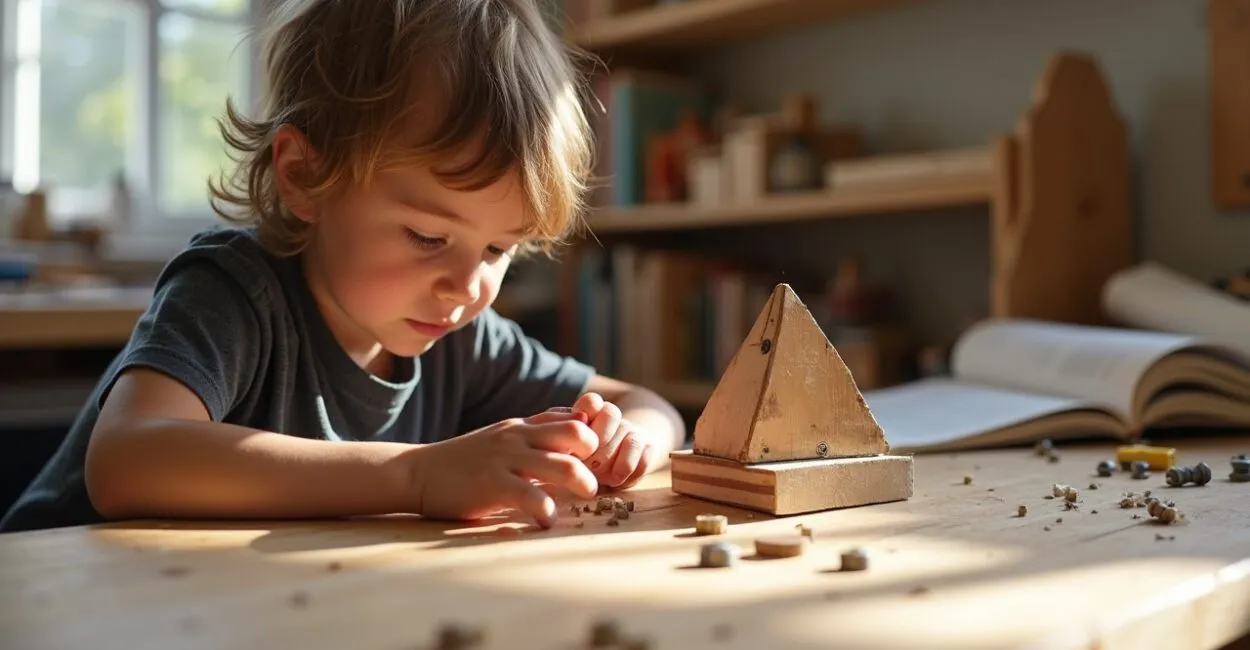
When a child asks why a paper bridge collapses, they’re already facing a problem that can lead to hypotheses, tests, and new conclusions. Creative education can support the development of children’s critical thinking by giving them room to investigate, compare ideas, and explain their choices, with guidance suited to their age.

This approach works at home and at school, including in traditional classrooms with limited materials. The results depend on the quality of the questions, the teaching of subject matter, and opportunities to reconsider one’s own reasoning; a “fun” activity by itself does not guarantee learning.
Creative Education and the Development of Children’s Critical Thinking
Creative education encourages critical thinking in children by presenting open-ended situations in which they need to ask questions, consider information, test possibilities, and justify a conclusion. Creativity means producing original ideas or solutions that suit a particular context; critical thinking means evaluating reasons and evidence before accepting an explanation or choosing a course of action.
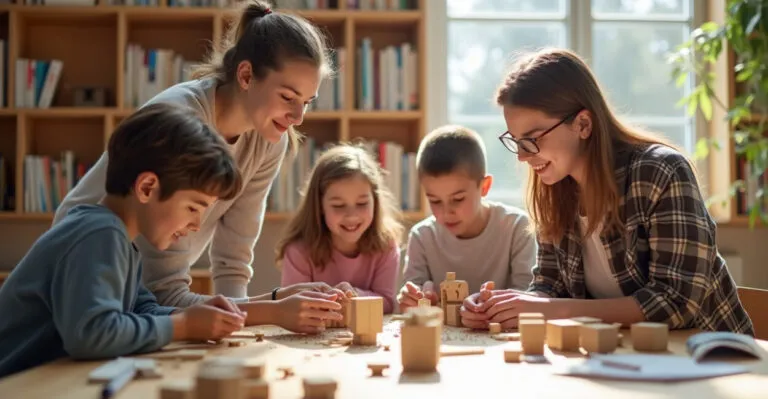
These skills come together when an idea moves beyond imagination and is examined. For example, when designing a shelter for a toy, a child invents different shapes, compares how stable each one is, and explains why they chose a particular material.
A teacher or family member can extend the child’s reasoning by asking what they would change if the shelter needed to withstand water.
Development begins early, in ways that are appropriate for each stage. Young children can notice differences, predict what will happen, and recognize simple cause-and-effect relationships. As they grow and gain experience, they tend to make more detailed arguments, recognize conflicting information, and reconsider their opinions in light of new evidence. There is no single age when critical thinking “begins.”
Why Open-Ended Activities Encourage Reasoning
A task with only one correct answer tends to show whether a child has memorized a procedure. An open-ended challenge, on the other hand, lets you see how they arrive at an answer: what clues they consider, how they handle obstacles, and whether they can explain a decision.
This difference helps explain why creativity in education can make a child’s reasoning visible, not just the final result.
Errors can also provide useful information. If a tower falls, a child can compare its base, height, and the way the blocks are arranged instead of simply being told they “did it wrong.” One detail that often goes unnoticed is that adults who step in too soon end up choosing the approach for the child. A pause and a question about what they noticed can lead to more learning than a ready-made solution.
Critical thinking is evident when a child can explain what they observed, why they chose an idea, and what might make them change it.
Open-ended questions work best when they have a purpose and are appropriate for a child’s abilities. “Which of these two packages would better protect the toy if it fell?” defines a problem and invites the child to compare evidence.
“What do you think about all of this?” may be too broad for a child who still needs help organizing an answer.
Methods for Turning Curiosity Into Investigation

Project-based learning, STEAM, and design thinking in education are ways to structure challenges, not one-size-fits-all recipes. Each approach can connect classroom content to decisions children need to make and justify.
Read also: Creative Teaching Methods: 5 Tested Models to Transform Lessons
- Project-based learning: Students investigate a question over time and present a product or explanation. A project on water waste might start with observations at school, move on to analyzing possible causes, and end with proposals discussed with the community.
- STEAM: Integrates science, technology, engineering, the arts, and math through interdisciplinary activities. Building a bridge with paper and tape can involve predicting, measuring, drawing, and comparing structures, while concepts from each subject are taught explicitly.
- Design thinking: Organizes work around understanding needs, generating ideas, prototyping, and revising. In an elementary classroom, children might create a book stand that is easy for their classmates to use, test different models, and adjust them after getting feedback.
The National Association for the Education of Young Children (NAEYC) provides resources on child development and developmentally appropriate practices in early childhood education. Any method needs to be adapted to the children’s ages, curriculum goals, and participation needs.
How to Support Curiosity at Home and at School
Everyday situations at home already offer opportunities to investigate. While making a recipe, a child can predict what will happen if an ingredient amount changes; when planning a trip, they can compare routes and explain which seems more convenient. Adults can help by asking for reasons and inviting children to check their predictions, without turning every conversation into an oral quiz.
Read also: Systems Analysis and Development Remains One of the Most Employable Fields
At school, accessible materials such as scrap paper, boxes, string, and blocks can be used to build prototypes. A challenge to build packaging that protects an object might include an initial drawing, a drop test, and a redesign. The subject matter can be part of the task: measurement, material properties, and recording observations need not be separate from the creative work.
To make room for exploration without losing focus, set a guiding question, a clear boundary, and time to test ideas. “How can you carry three books without using a bag?” defines a problem; the constraint encourages alternatives, while testing lets students compare whether each idea works. The learning objective should guide the activity, even when the final product is unexpected.
Signs of Progress and What the Evidence Can Tell Us
Progress shows up in observable behaviors, not just creative objects or quick answers. A child starts asking more specific questions, comparing solutions, citing clues that support a choice, and agreeing to revise a hypothesis after a test. These signs may appear inconsistently and vary depending on the subject, the child’s confidence, and their prior experience.
One useful way to track the process is to save drawings, project versions, and brief notes about what the child explained. Compare their reasoning over time: Have they started identifying why an attempt failed? Can they distinguish an observation from a guess? Assessment is more informative when it considers these steps as well as the finished product.
The OECD Education publications directory offers resources for understanding skills, learning, and educational challenges. Research on teaching practices does not justify promising that a creative activity by itself will improve grades or develop critical thinking in every child. Results depend on consistency, guidance, prior knowledge, and teaching conditions.
Challenges, Academic Performance, and the Limits of This Approach
Projects can complement instruction in reading, writing, math, and science when subject matter is taught and revisited intentionally. For example, an investigation of shadows might require students to read instructions, record measurements, and compare data. If an activity takes up time without teaching or reinforcing concepts, creativity can become little more than classroom decoration.
There are also practical constraints: large classes, limited planning time, unequal access to materials, and difficulty assessing individual contributions. Some children need more structured instructions before tackling an open-ended task; others may participate more effectively by drawing or handling objects than by speaking in front of the group. Adapting support is part of the work and does not diminish the value of the investigation.
If a child consistently struggles to keep up with school activities, communicate ideas, or participate, a creative activity is no substitute for assessing their learning needs. Talk with the school team and, when appropriate, consult qualified professionals. An activity can support development, but it cannot diagnose or resolve specific difficulties on its own.
How to Get Started in a Traditional Classroom
You don’t need to overhaul the curriculum to get started. Choose a topic already on the syllabus and add a short investigation: before explaining a concept, ask students to make predictions; then offer a simple test and set aside time to compare the results with their hypotheses. A clearly defined problem keeps the activity manageable while giving students room to take initiative.
- Identify the curriculum concept students need to learn and frame an investigable question.
- Gather available materials and set time or safety limits.
- Ask students to record a prediction before testing, either in a drawing or in writing.
- Pay attention to their reasoning and wrap up with a review: What did the data confirm or change?
To assess learning, use clear criteria: Did the child offer a hypothesis, draw on observations, explain a choice, or revise an idea? A short rubric or teacher notes can help track reasoning without requiring everyone to come up with the same solution. The official website of Brazil’s Ministry of Education provides information on Brazilian education policies and resources that can help guide curriculum planning.
Frequently Asked Questions
Does creative education hurt traditional academic performance?
There is no reason to assume it does, as long as activities teach and reinforce curriculum content. Projects without clear objectives, however, can take up time without consolidating knowledge; it’s worth tracking both students’ reasoning and their understanding of concepts.
How can I tell if my child is developing critical thinking?
Notice whether they start explaining why they chose a solution, comparing possibilities, or changing their minds in response to evidence. Progress may show up in one situation but not another, so it’s best to look for patterns over time.
Do I need to buy materials for creative activities?
No. Paper, clean packaging, and everyday objects are enough for many challenges; what you choose depends on the goal and safety considerations. Expensive materials don’t guarantee deeper investigation.
How can I engage a child who prefers ready-made answers?
Start with limited choices and a concrete question, such as comparing two ways to solve the same problem. Make the task more open-ended as the child gains confidence, and offer hints without doing the work for them.
%%AGPTRH3%%
Artigos Relacionados
 Exploring the World Through the Senses: 10 Creative, Safe Sensory Activities to Support Early Childhood Development
 Maker Education: The Power of Making and Experimenting to Develop Critical Thinkers
 Design Thinking for Creative Businesses: Apply Innovative Methods to Solve Problems, Develop Unique Products, and Win Loyal Customers
 How to Encourage Creativity in Children: 7 Practical Strategies
 5 Creative Education Methods That Work
 Creative Education: Building Skills
