
Some children suddenly take off when their environment changes; others seem to get stuck despite trying hard. The difference is rarely a matter of “talent” or “not paying attention.” More often, it has to do with how a child’s brain consolidates memories, regulates emotions, sustains focus, and repeats meaningful experiences.

Neuroscience and child learning can help explain this process without resorting to miracle solutions.
The key takeaway is practical: children learn best when they have strong connections, predictable routines, rich language, enough sleep, spaced repetition, and challenges suited to their level. Here, you’ll learn how this works in the brain and, most importantly, how to turn science into everyday decisions at home, at school, and during tutoring.
The Essentials
- Children’s learning depends on more than “stimulation”; it also requires sustained attention, emotional security, spaced repetition, and memory retrieval.
- Children’s brains learn through neural plasticity: connections grow stronger when experiences are meaningful, repeated, and tied to context.
- Sleep, emotional connection, and predictable routines are not just organizational details; they directly affect memory consolidation and self-regulation.
- In practice, effective teaching for children combines language, play, course correction, and time to mature—not an overload of activities.
- Not every learning difficulty is neurological; sometimes the issue is the environment, fatigue, anxiety, earlier learning gaps, or an unsuitable teaching method.
What Is Neuroscience and Child Learning?
The neuroscience of learning studies how the nervous system perceives, processes, stores, and retrieves information. When applied to childhood, it examines how brain development in children supports skills such as speech, reading, working memory, inhibitory control, coordination, and symbolic thinking.
In plain language, this means looking at what actually helps a child learn and what only creates the appearance of learning. Not every “stimulating” activity leads to lasting learning; the brain needs meaningful experiences, repetition, and rest to consolidate connections.
The Technical Concept, Without the Hype
Learning means changing neural circuits through experience. Technically, this relies on synaptic plasticity—the ability of synapses to grow stronger or weaker depending on how they are used.
In childhood, this plasticity is high, but it is neither unlimited nor automatic.
What helps the brain learn is not the quantity of stimulation, but the combination of relevance, repetition, regulated emotions, and time to consolidate memories.
That’s why a serious conversation about neuroscience-based education doesn’t start with apps, expensive toys, or brain-training exercises. It starts with sleep, language, connection, and the quality of everyday experiences.
How Children’s Brains Really Learn
Children learn when they receive information, select what matters, connect it to what they already know, and revisit it in different contexts. This process involves attention, working memory, the hippocampus, the prefrontal cortex, and sensory networks.
Without enough attention, information doesn’t get properly processed; without repetition, it doesn’t stick; without regulated emotions, learning gets disrupted.
Attention Opens the Door
Attention and learning go hand in hand because attention determines what gets processed first. Young children have less steady attention than adults, and that’s normal.
The classroom, the home environment, and even the time of day can help or hinder a child’s ability to focus.
Memory Consolidates What We Experience
Children’s memory doesn’t work like a continuous recording. It requires encoding, practice, and retrieval.
In other words, children learn better when they review material, use it in different situations, and try to recall it without constantly looking at the answer.
Spaced repetition is one of the most underrated tools. Reviewing today, again tomorrow, and then a few days later leads to better retention than studying for a long time in a single session.
This applies to vocabulary, letters, numbers, concepts, and instructions.
Language Organizes Thought
Language isn’t just a school subject; it’s a cognitive tool. Children who hear more words, explanations, open-ended questions, and stories have more opportunities to organize their thoughts, expand their vocabulary, and strengthen comprehension.
Neuroscience in early childhood education shows that talking with children is a powerful way to teach.
For a trusted source on child development and health, the CDC provides clear, useful information on child development milestones for families and educators. The NICHD, part of the NIH, publishes resources on development, language, sleep, and learning.
The Factors That Most Influence Learning

In practice, four factors show up again and again when children are learning well: attention, emotions, sleep, and connection. They don’t operate in isolation. A day of anxiety can undermine focus; a week of too little sleep can look like “inattention”; and an insecure relationship can limit exploration and curiosity.
Emotions Regulate Access to Learning
Emotions and learning are connected because the brain prioritizes what seems relevant, safe, or threatening. A child who is feeling intense fear, shame, or frustration will have a harder time learning in that moment. That doesn’t mean avoiding challenges; it means offering challenges with enough emotional support.
I’ve seen cases where a child “couldn’t learn math,” but the real problem was fear of getting the answer wrong. When the intervention eased the pressure, introduced gradual practice, and made corrections less punitive, performance improved. The material wasn’t the main obstacle; the child’s emotional state was.
Sleep Organizes Memory
Sleep and children’s learning are directly connected to memory consolidation and self-regulation. Too little sleep affects attention, processing speed, and impulse control. In children, this often shows up as irritability, forgetfulness, distractibility, and inconsistent performance.
If a family wants to support learning, it’s worth looking at the bedtime routine before buying more educational materials. A consistent sleep schedule often does more good than any nighttime “brain boost.” For a broader perspective on health and sleep, the American Academy of Pediatrics provides recommendations and important guidance for different age groups.
Connection Reduces Threat and Encourages Exploration
Emotional connection and learning go together because children learn more when they feel safe enough to try, make mistakes, and try again. This applies to their relationships with parents and teachers. Security isn’t coddling; it’s a condition for cognitive exploration.
Read also: Brain Plasticity in Learning: How to Accelerate It
In practice, a strong connection doesn’t replace teaching, but it reduces enough emotional noise for children to use their attention and memory more effectively.
How to Apply Neuroscience to Early Childhood Education
The most useful application of neuroscience and child learning isn’t “brain activities”; it’s how you structure everyday life: how you introduce a task, how long it lasts, how you offer feedback, when you review material, and what kind of environment the child experiences.
Read also: Neuroscience Applied to Learning
Choose Quality Over Quantity
Fewer activities, more intention. A short, well-chosen task repeated with some variation often teaches more than a stack of worksheets completed on autopilot. The brain learns through patterns, not information overload.
- Give short, specific instructions.
- Break tasks into small steps.
- Revisit the same concept on different days.
- Ask the child to explain it in their own words.
- Give feedback on the process, not just the result.
Play With a Purpose
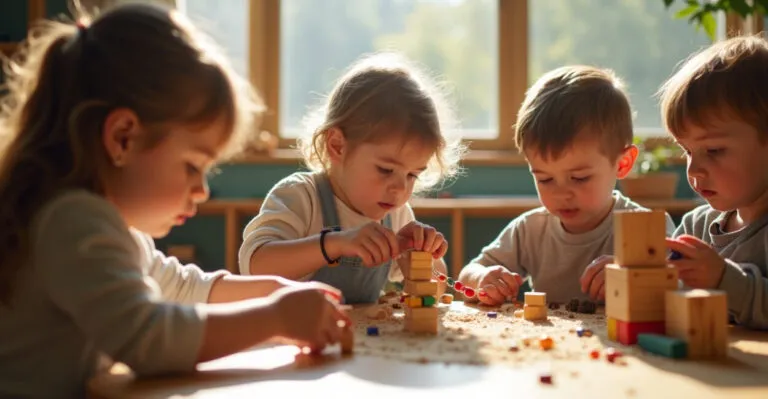
Play isn’t a break from learning; at many ages, it is the way learning happens. Puzzles, pretend play, building blocks, songs, shared reading, and sequencing challenges engage language, working memory, impulse control, and imagination.
The key is not to turn play into a test. When adults take too much control, children lose cognitive independence. When adults disappear completely, the experience can be less enriching. The balance is to guide without taking over.
A Classroom Story
A preschool teacher noticed that her entire class was forgetting letters they had just learned. Instead of handing out more worksheets, she changed the routine: she reviewed two letters a day, combined movement with sounds, did a quick review at the start of class, and asked the children to find each letter in familiar words. Within a few weeks, retention improved without “more content.”
This kind of adjustment highlights a key point about children’s learning: sometimes the problem isn’t ability, but the teaching strategy.
Strategies for Different Ages and Settings: Home, School, and Tutoring
What works depends on a child’s age and circumstances. The same strategy can help a 4-year-old a lot and do little for a 9-year-old. Home and school also play different roles: home provides regulation and structure, while school teaches with specific educational goals.
| Setting | Most Useful Strategy | Why It Works |
|---|---|---|
| Home | Predictable routines, daily reading, conversation during activities | Reduces emotional strain and builds language skills |
| School | Spaced repetition, short instructions, immediate feedback | Improves retention and attention |
| Tutoring | Identify learning gaps and provide guided practice | Avoids reviewing material without a clear goal |
Ages 0 to 6
At this stage, language, routine, affection, and sensory exploration matter most. Songs, stories, pretend play, and conversation are far more helpful than long, repetitive activities. The goal isn’t to rush children into reading at any cost, but to build a strong foundation.
Ages 7 to 10
Children can now focus for longer, but still need outside support to organize their tasks. Try visual checklists, short breaks, content review, and questions that require an explanation. At this age, cognitive stimulation for children works best when it’s tied to concrete goals.
Targeted Tutoring
Good tutoring doesn’t mechanically repeat what happens at school. It identifies the learning gap, addresses the foundation, and provides enough practice to build retention. For example, if a child struggles with reading, the issue may be phonological awareness, not simply a “lack of practice.”
Common Myths About “Stimulating the Brain”
One of the biggest risks with this topic is confusing science with marketing. Many products and claims promise to “supercharge the brain,” when what really supports learning is a well-structured routine, consistent teaching, and secure relationships. The neuroscience of learning does not support miracle shortcuts.
“The More Stimulation, the Better”
That’s false. Too much stimulation can lead to fatigue, distractibility, and irritability. Young children need breaks, predictability, and time to process what they experience.
“Educational Games Solve Everything”
They don’t. Games can help when they have a clear purpose and are used thoughtfully, but they can’t replace language, sleep, connection, and practice. Without these elements, the benefits are usually superficial.
“Learning Earlier Is Always Better”
Not always. Some developmental milestones require time to mature. Pushing children before they’re ready can lead to shallow memorization, anxiety, and aversion to the task. Experts disagree on the ideal intensity of certain forms of stimulation because it depends on the child’s age, circumstances, and individual profile.
The difference between helpful stimulation and overload becomes clear when an activity stops expanding a child’s skills and starts taking away attention, sleep, and curiosity.
Signs a Child Is Learning Well or May Need Support
Good learning isn’t reflected only in high grades. It also shows up in a child’s ability to remember, apply what they’ve learned in a new situation, keep trying, and recover from mistakes. The need for support often becomes apparent before performance drops sharply.
Positive Signs
- Remembers material after a few days, not just in the moment.
- Can explain it in their own words.
- Makes new connections between related topics.
- Can handle small frustrations without giving up right away.
Warning Signs
- Forgets what was taught very quickly.
- Frequently avoids tasks that require focus.
- Shows persistent irritability, fatigue, or sleepiness.
- Has trouble following simple instructions in different settings.
These signs don’t establish a diagnosis. They indicate that something deserves a closer look: sleep, vision, hearing, anxiety, teaching methods, accumulated learning gaps, or, in some cases, a neurodevelopmental condition. The best approach is to look for patterns, not judge by a single day.
Next Steps: Apply Science Without Chasing Fads
If you want to use sound science, start with the changes that can make the biggest difference with the least disruption: a consistent sleep routine, daily conversation, spaced repetition, and short, purposeful tasks. Then adjust the environment, the time spent focusing, and the kind of feedback you give. That matters more than any promise to “stimulate the brain” as much as possible.
The simplest way to assess whether it’s working is to observe the child for two weeks: Do they remember more, complain less, participate more, and learn more from their mistakes? If things don’t improve, change the strategy before increasing the pressure. Quality early childhood education doesn’t force the brain to speed up; it creates the conditions for children to learn at the right pace.
Frequently Asked Questions About Neuroscience and Child Learning
Does neuroscience in early childhood education really work?
It works when it moves from theory to practice: routines, spaced repetition, connection, language, and attention management. It doesn’t work as a promise of quick results or as a list of “premium” activities. Its value lies in guiding educational choices that better align with brain development.
How can a child’s brain learn more effectively?
It learns best when information is meaningful, repeated at intervals, and paired with regulated emotions. Children also need enough sleep to consolidate memories. Without it, a child may be able to repeat something in the moment but is more likely to forget it quickly.
What helps a child’s brain learn the most?
Connection, predictability, rich language, clear feedback, and tasks suited to the child’s developmental level. For many children, better sleep and less overload make a bigger difference than adding more exercises. The fundamentals matter more than the extras.
Do sleep, emotions, and routines really affect learning?
Yes, directly. Poor sleep undermines attention and memory; unregulated emotions use up cognitive resources; predictable routines reduce anxiety and help children get organized. These three factors affect learning even before schoolwork comes into play.
Does spaced repetition work for young children?
Yes, as long as reviews are short and playful. Children don’t need long sessions to consolidate learning; they need frequent reviews, varied contexts, and simple language. It’s a subtle but powerful strategy.
When should I seek professional support?
When signs persist in more than one setting, such as home and school, and don’t improve after adjusting routines and teaching methods. Significant difficulties with attention, language, memory, or reading warrant a professional evaluation. The sooner the problem is properly understood, the more targeted the support is likely to be.
%%AGPTRH8%%
Artigos Relacionados
 Play-Based Learning: Practical Strategies for Teachers
 Neuroscience-Based Study Strategies for Better Focus
 Inclusive Environments and Sensory Supports for ADHD: Practical Strategies for Organizing Spaces and Materials to Reduce Distractions
 Inclusive Strategies for Students with ADHD: Practical Accommodations and Academic Outcomes for Elementary School Teachers
 Neuroscience in Early Childhood Education: How Children’s Brains Learn and How to Apply This Knowledge to Maximize Learning
 First-Grade Curriculum: Essential Subjects, Skills, and Tips for Supporting Your Child’s Learning
