
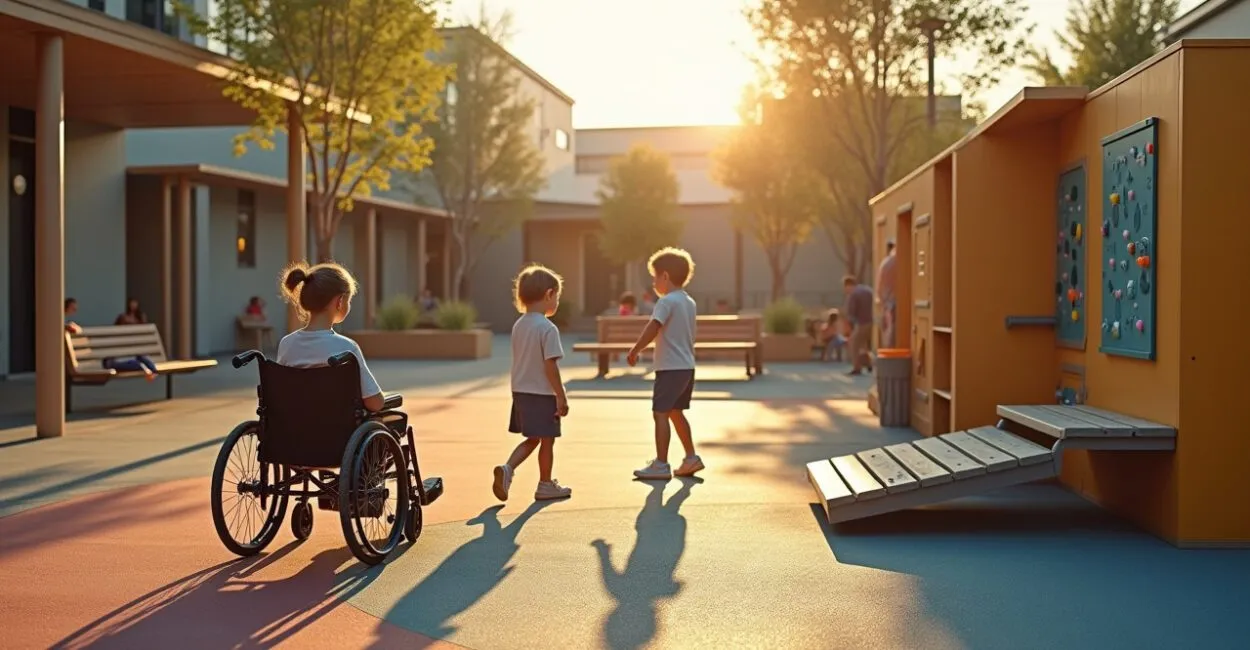
A poorly designed school playground quietly leaves some children out: they may be at recess, but they aren’t really taking part. When we talk about inclusive school playground equipment, we mean equipment and structures designed so students with a range of physical, sensory, cognitive, and social abilities can play, interact, and move around safely.
This changes the feel of a school. A well-chosen set of inclusive play equipment reduces barriers, creates more ways to participate, and keeps recess from becoming a space dominated by only certain groups of students. The right choice isn’t just about “being accessible”; it depends on balancing accessibility, age range, supervision, maintenance, and site design. This article explains how to make a thoughtful choice without falling for attractive solutions that don’t work in everyday use.

What You Need to Know
- Inclusion on the playground isn’t just about ramps: equipment should support independent use, interaction with peers, and safe movement around it.
- The best equipment offers multiple ways to play, rather than serving just one isolated motor function.
- Surfacing, maintenance, and spacing between pieces of equipment matter just as much as the equipment itself to the user experience.
- Age range and reach height matter: “inclusive” equipment may be unsuitable if it requires more strength, coordination, or speed than expected.
- Good choices for schools can withstand heavy use and the elements, and have replaceable parts that are easy to inspect.
Inclusive School Playground Equipment: What Really Makes Equipment Accessible
In practice, accessibility in school playground equipment means a child can enter, use, stay in, and leave an activity with as few barriers as possible. Technically, this involves reach, transfers, stability, an accessible route, visual contrast, and usability for people with different functional needs.
Put simply, it’s no use having “beautiful” equipment if a child can’t get to it or understand how to take part.
The concept goes beyond architectural accessibility. A swing with a backrest, for example, can be a big help for a child with limited trunk control. But it still falls short if the ground around it is slippery or there isn’t enough room for a wheelchair to approach.
The same goes for sensory panels: they’re great for tactile and cognitive exploration, but only if they’re installed at an appropriate height.
Inclusive playground equipment isn’t equipment that works for “everyone” all at once. It’s equipment that removes enough barriers for more children to play independently, safely, and with genuine interaction.
A useful resource for thinking about this topic is the U.S. Access Board, which compiles accessibility guidelines for public spaces. In Brazil, it’s worth considering the public policy for people with disabilities (Brazil’s government policy on disability) alongside accessibility standards, because schools can’t treat recreation areas as spaces “free” from rules.
Four Criteria That Prevent the Most Problems
- Independent use: A child can start playing without needing constant help.
- Shared use: The equipment supports parallel or cooperative play, not just isolated individual use.
- Physical access: There’s enough room for an accessible route, adequate width, and approach space.
- Ease of understanding: The equipment makes it clear how it works through its shape, color, texture, or simple signage.
Types of Playground Equipment That Work Best at School
Not all “inclusive” equipment delivers the same results. At school, the most useful equipment tends to combine movement, interaction, and low risk.
The most common mistake is buying something designed for one specific skill, then discovering that half the class ignores it because it doesn’t fit the pace of recess.
Equipment That Tends to Work Best
- Interactive and sensory panels: Great for tactile, visual, and cognitive stimulation, especially in waiting or transition areas.
- Adaptive swings: Useful for students who need extra trunk support and lateral stability.
- Controlled-spinning equipment: A good choice when the design limits speed and provides a secure grip.
- Accessible tables and ground-level games: Encourage participation by children with limited mobility and support group play.
- Low modular structures: Allow children to climb, explore, and interact without requiring much strength or height.
I’ve seen schools invest heavily in one large, tall, complex centerpiece, only for recess to remain chaotic. The reason was simple: the equipment required students to wait in line, use a lot of strength, and have constant supervision. A smaller set of well-spaced pieces worked better because it reduced competition and created more places to gather. This is common on playgrounds with large groups: fewer “main attractions” and more accessible options tend to lead to greater inclusion in practice.
Age Range, Development, and Shared Use on the Same Playground

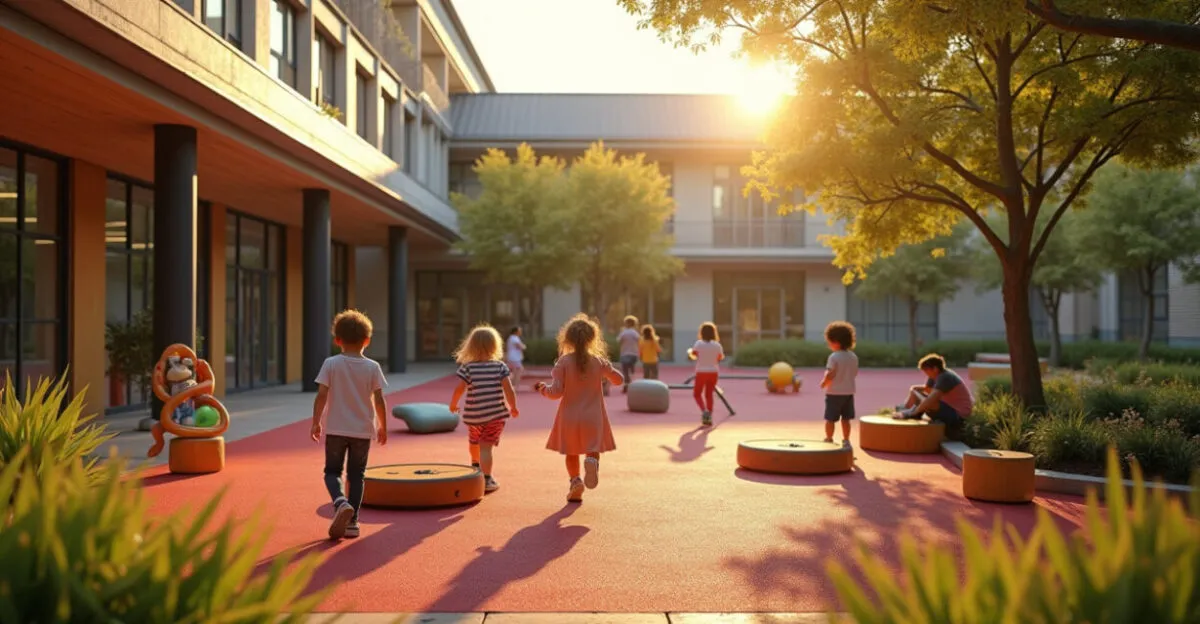
Schools need to consider chronological age as well as motor and social maturity. Equipment suited to preschoolers may feel too babyish for elementary school students, while more challenging equipment may work well for older children but create barriers for younger ones. The goal isn’t to make everything the same; it’s to offer a range of challenge levels.
Read also: Rubber Playground Surfacing at School: Is It Worth the Investment?
How to Balance Different Needs
- Separate by activity level: Create areas for high-energy play and areas for quieter exploration.
- Prevent one child from monopolizing equipment: Equipment designed for one user at a time needs quick turn-taking or it can lead to social exclusion.
- Plan for facilitation: Some games work better with short, visual instructions.
A school doesn’t need a “neutral” playground; it needs a playground with different zones. Children who like to run, children who prefer to watch before joining in, and students who need more support should all find something useful in the same space. When the playground offers only speed and action, those who can’t keep up are left out. When it offers variety, participation grows without forcing anyone to adapt.
Safety, Materials, and Maintenance to Prevent Problems After Purchase
Safety on a school playground isn’t just about avoiding sharp corners. It also involves materials, wear and tear, inspections, and how the equipment holds up over time. A piece of equipment may be safe in its first month but become dangerous after a semester if bolts loosen, moving parts come loose, or the surfacing loses its cushioning.
Read also: School Health and Physical Activity: Policies and Initiatives
To make more informed choices, it’s worth consulting product and public-space safety resources, such as guidance from the Consumer Product Safety Commission. In Brazil, the same principles apply to accessibility standards and risk management in school settings. Here’s what many people overlook: even the best design on paper will fail if maintenance is improvised.
Inclusive equipment without regular inspections can quickly become a hazard: accessibility and safety must go hand in hand, because children use the very parts that are most prone to wear.
What to Check Before You Buy
- Surfaces without burrs, exposed sharp edges, or vulnerable fasteners.
- Materials that can withstand sun, rain, and frequent cleaning.
- Replaceable parts that don’t require complex disassembly.
- A load capacity suitable for group use.
- Surfacing around the equipment that can cushion falls and support assisted movement.
How to Read Standards and Specifications Without Falling for Catalog Hype
A good specification isn’t the one with the most adjectives; it’s the one that answers practical questions. When evaluating school purchases, I always look at three things first: who the equipment is for, how it will be maintained, and what happens when it breaks. If the spec sheet doesn’t answer those questions, it’s not enough to support a sound decision.
It’s also worth comparing catalog claims with official guidelines and real-world experience. The ABNT (Brazil’s national standards organization) is an important source for technical standards in Brazil, and consulting it can help schools avoid impulse purchases. Not every situation is the same—a covered playground, an open space, and a school with many students who have specific needs all present different differences.
Criterion
Best practice
Warning sign
Reach height
Accessible to children of different heights
Requires reaching up high or jumping
Interaction
Allows children to play together
Designed for isolated, individual use
Maintenance
Easy to inspect, with replaceable parts
Repairs are costly and time-consuming
Safety around the equipment
Suitable surfacing and clear pathways
Cramped, slippery area
Playground Planning: The Right Equipment Also Needs the Right Space
Even excellent equipment can fail if it’s installed in the wrong place. Student traffic, sun exposure, proximity to walls, shade, and staff visibility all affect how the equipment is used. On a school playground, inclusion depends on the overall design, not just an individual purchase.
Three Layout Decisions That Make a Difference
- Cluster equipment in separate zones: Prevents crowding in one spot.
- Provide continuous paths: Makes it easier to enter and exit without pushing and shoving.
- Maintain clear sightlines: Supports supervision and reduces conflict.
Here’s a real example: a school installed a sensory panel near the lunch line. The equipment was good, but students ignored it. When the panel was moved to a quieter walkway, it became a place where students who hadn’t spoken before could interact. The equipment didn’t change; the setting did. That’s why space planning matters just as much as product selection.
Final Selection Criteria: What to Buy First and What to Save for Later
If the budget is limited, the priority shouldn’t be the most eye-catching item, but the one that increases participation for the most students. The most sensible order is usually: access and surfacing first, then shared-use equipment, then sensory modules, and finally more specialized pieces. This helps avoid buying an attractive solution before addressing the basics.
For schools just getting started, the most effective approach is to put together a small but well-planned mix: one active play area, one sensory exploration area, and one social gathering area. This combination tends to work better than putting everything into a single structure. The key isn’t having a lot of equipment; it’s offering enough variety so recess doesn’t exclude children who learn, move, or interact differently.
The best purchase isn’t the one that sounds the most “inclusive”; it’s the one that increases real participation, reduces conflict, and stays safe after months of heavy use.
What to Do Next
Before making a purchase, inspect the playground and ask three practical questions: Who can use this equipment independently? Who needs support? Where could it fail? Compare at least two vendors using the same technical criteria, require maintenance specifications, and confirm that installation accounts for traffic flow, surfacing, and age range. If you choose based on appearance alone, the playground will look new for only a short time. If you choose based on clear criteria, it will work during real recess.
Frequently Asked Questions About Inclusive School Playground Equipment
What Makes Playground Equipment Truly Inclusive at School?
Playground equipment is truly inclusive when children with different needs can access it, use it, and participate without relying on constant, improvised accommodations. That includes mobility, understanding the activity, safety in the surrounding area, and opportunities to play alongside classmates. If only a small group can use it comfortably, the equipment may look accessible, but it isn’t fulfilling its role in inclusive school recess.
Are Accessible and Inclusive Playground Equipment the Same Thing?
Not exactly. Accessible equipment removes physical and usability barriers; inclusive equipment goes further by considering social participation, interaction, independence, and the ability to stay engaged in the activity. A panel installed at the right height may be accessible, but it’s only inclusive if it fits the playground’s layout and invites other children to join in. At school, the two ideas need to go hand in hand.
What Is the Most Common Mistake When Buying School Playground Equipment?
The most common mistake is choosing equipment that looks appealing in a catalog but isn’t useful in the reality of everyday recess. This happens when the decision ignores age range, maintenance, student traffic, and supervision. The result is often underused equipment—or worse, a safety hazard. The right question isn’t “What looks modern?” but “What works every day for more students?”
Do I Need Special Surfacing for Inclusive Playground Equipment?
In most cases, yes, because surfacing directly affects safety and independence. Cushioned, even, stable surfaces help protect children from falls and support movement and access for children with limited mobility. The best type depends on the equipment, its height, and how heavily the area is used. Without suitable surfacing, even good equipment loses some of its value and increases the risk of accidents.
How Should I Prioritize Purchases When the Budget Is Tight?
Start by prioritizing what benefits the most children at once: pathways, safety around the equipment, and shared-use equipment. Then consider adding sensory modules and more specialized play equipment. This approach usually supports greater inclusion than spending everything on one flashy centerpiece. When the budget is tight, a connected system works better than a single-item approach.
Artigos Relacionados
 Inclusive Strategies for Students with ADHD: Practical Accommodations and Academic Outcomes for Elementary School Teachers
 Inclusive Education in Elementary School: Practices and Support
 Inclusive Education in Schools: Transformative Paths for Every Student
 Reading at Home and Family Engagement: Build Routines, Choose Books, and Motivate Kids to Improve Reading Habits and School Performance
 Agricultural Machinery: How to Choose and Finance Equipment
 Safety in School Play Areas: 7 Key Points
