
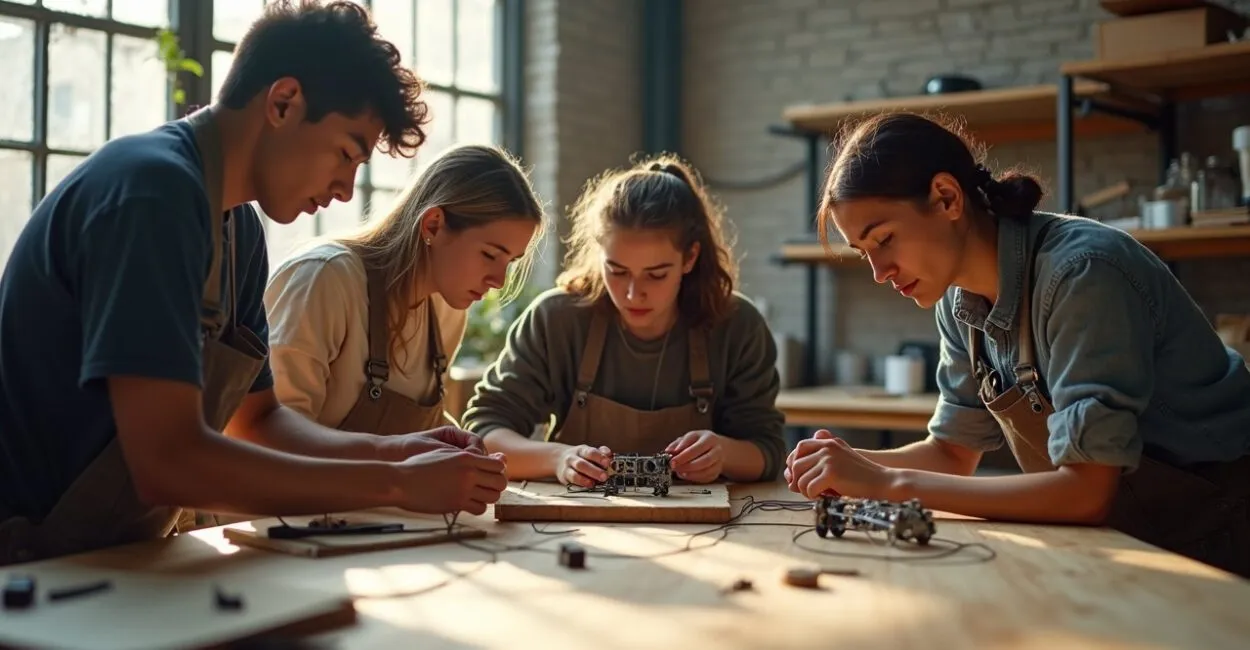
A class measures the water temperature at school, investigates why some faucets are left running, and proposes a campaign to reduce waste. This kind of work shows how active learning and project-based learning can connect the curriculum to real-world issues.

Project-based learning, also known as Project-Based Learning (PBL), organizes instruction around an extended investigation that leads to a product or public presentation. Students make decisions and build knowledge throughout the process; the teacher plans, guides, and checks what each student is learning.
For a project to work, it needs to connect to curriculum goals and include investigation, revision, and assessment of the process. A group assignment that ends with a poster does not become PBL just because it has a final product: the learning process is what gives the project meaning.
Before you begin
- Choose the curriculum goals students should meet.
- Check how much time is available and what resources the class can access.
- Decide how you will track individual learning during collaborative work.
- Plan a product or presentation that makes sense for the class’s audience.
1. How active learning connects to project-based learning
Project-based learning is an instructional approach in which students investigate a relevant question over time and apply curriculum knowledge to create a product, solution, or presentation. In active learning, students take part in decision-making and intellectual work; the teacher structures the process, provides resources, and monitors learning.
A project starts with clear goals and a guiding question that cannot be answered with a quick search. The investigation may involve reading, data collection, discussion, and revising ideas. The final product gives the work a purpose, but it should show what students learned, not just what they managed to put together.
The teacher does not disappear when the class becomes more independent. The teacher selects content, anticipates challenges, teaches concepts when they are needed, and steps in when the investigation loses direction. One useful observation: groups often divide up tasks too early. If each student researches one part without discussing how the pieces connect, the project may end up as a patchwork of information, without shared understanding.
2. Distinguish between project-based and problem-based learning
Project-Based Learning and Problem-Based Learning are related approaches, but they are not identical. In project-based learning, the investigation usually culminates in a product or presentation; in problem-based learning, the problem serves as a starting point for identifying what needs to be learned and proposing a response. How PBL is used varies across institutions, so it is worth clarifying which approach you are taking.
| Aspect | Project-based learning | Problem-based learning |
|---|---|---|
| Starting point | A curriculum-related question or challenge | An open-ended problem that calls for investigation |
| Focus | Building knowledge throughout a project | Learning used to understand and respond to the problem |
| Typical outcome | A product, presentation, or proposal for an audience | A well-supported explanation, hypothesis, or solution |
| Possible uses | Interdisciplinary units and public-facing work | Case discussions and complex situations |
In practice, the approaches can overlap: a project may begin with a problem, and a case investigation may lead to a presentation. The distinction helps teachers plan. If the goal is to deepen understanding of content through a product created over several stages, a project format is usually a good fit. If the priority is to analyze a case and learn from the gaps it reveals, a problem-based approach may work better.
3. Align the project with the curriculum before choosing the product

Start with learning goals, not with the idea of putting on a fair, making a video, or building a model. Identify the concepts, skills, and evidence students need to demonstrate. Then write a guiding question that invites investigation and allows for different approaches, without losing sight of the curriculum content.
The Base Nacional Comum Curricular (BNCC), Brazil’s national curriculum framework, can help guide this selection by outlining expected learning at each grade level. It does not require instruction to be project-based; the teaching team decides whether this approach fits the goals and the class context.
Read also: Active Learning in Lesson Planning: Practices and Examples
For example, a class might investigate how to make the school courtyard more comfortable on hot days. Students observe shaded areas, record sunlight exposure, and draw on science and math concepts. Then they present a proposal to the school community, supported by data and reasoning. The product makes sense because it depends on the knowledge students have worked with, not because it looks appealing.
4. Plan the stages, timeline, resources, and autonomy
A well-defined project progresses through clear stages. Its duration depends on the scope, schedule, and class’s level of independence; there is no single timeline that works for every school. To start, choose a question that fits the calendar and available resources.
- Introduce the challenge: Share the guiding question, audience, and quality criteria.
- Find out what the class knows: Record hypotheses and questions to identify prior knowledge.
- Teach and investigate: Alternate lessons, reading, research, and field activities as needed to meet the goals.
- Create and revise: Produce a first draft, get feedback, and make changes based on the criteria.
- Present and reflect: Share the results and discuss what each student learned and what they would do differently.
Autonomy grows with structure. Short checkpoints, learning logs, and conversations with each group help catch delays before the deadline. Collaborative digital tools can track drafts and sources, but they should support a clearly defined task. A shared spreadsheet, for example, can bring together collected data; opening several platforms without a good reason only distracts students.
The Buck Institute for Education, through PBLWorks, describes elements of high-quality projects, such as a challenging question, sustained inquiry, critique, and revision. These elements are useful planning references, not a rigid formula for every class.
5. Assess content, process, and individual contributions
Assessment in PBL can maintain academic rigor when teachers define from the start what evidence will demonstrate learning. Assess students’ command of the content, the quality of the investigation process, and the final product, without letting visual polish stand in for conceptual understanding.
A rubric makes the criteria clear. For example, it can distinguish between accurate use of concepts, quality of evidence, revision based on feedback, and clear communication. Combine formative assessment throughout the project with a final review. Self-assessment and peer assessment help students reflect on the process, but they do not replace teacher monitoring.
To identify individual learning within the group, use brief check-ins: an oral explanation, a reflection note, or a written question about a project decision. If the class submits a strong product but a student cannot explain the data used, the group result alone is not enough evidence of what that student learned.
6. Adjust the project when challenges arise
Disengagement may mean the question feels irrelevant, the tasks are unclear, or some students do not have room to contribute. Talk with the class, revisit the purpose, and offer a limited set of choices, such as selecting from different audiences or presentation formats. If needed, narrow the scope without abandoning the curriculum goals.
Different learning paces call for checkpoints and varied support. Planning templates, selected sources, and interim tasks help students who need more guidance; additional challenges can keep students who are moving ahead engaged. Roles should also be revisited: fixed assignments can leave one student always drawing or typing, keeping them away from the core content.
Teacher workload is a real constraint. Broad projects require planning, monitoring, and coordination across subjects; starting with a smaller unit makes it possible to test feedback and assessment routines. An entire school does not change overnight: implementation time depends on the schedule, training, leadership, and resources. A team can start with pilot projects, evaluate what worked, and expand the practice in stages, without imposing a universal deadline.
7. Choose examples that fit the grade level and context
This format can work across subjects, as long as the question and tasks match the content and students’ age. In science, a class might investigate water quality at different locations around the school and explain the limits of its observations. In English language arts, students might create a reading guide for another class, supporting their recommendations with textual analysis.
In the early grades, short projects involving observation, drawing, and reporting can develop vocabulary and measurement concepts. In high school, a proposal about transportation in the surrounding neighborhood can draw on map reading, data analysis, and argumentation. Gamification can also support the process, for example, through progress milestones or challenges tied to concepts. Points and rewards alone do not replace investigation or evidence of learning.
Before getting started, check whether the product requires the knowledge you intend to teach, whether resources are accessible, and whether everyone will have a way to participate. A project can be adapted or dropped if these conditions are not met. That decision is part of responsible implementation, as are consulting curriculum references and planning assessment criteria before introducing the challenge.
Frequently asked questions about school projects
Can this approach be used in math or other specific subjects?
Yes. Math, science, history, languages, and other subjects can all include projects when there are clear curriculum goals and appropriate evidence of learning. The project needs to create real opportunities to learn the content, not just use the subject as thematic window dressing.
What should you do when a group cannot reach an agreement?
Ask students to present evidence and criteria for comparing the options, rather than deciding based on preference alone. If the disagreement continues, the teacher can narrow the choices or suggest a provisional decision to revisit after a trial.
How can you keep one student from doing most of the work?
Set interim deliverables with clearly identifiable responsibilities, and check in with each group member throughout the process. Individual records, oral explanations, and self-assessment can help identify imbalances before the final presentation.
Does the class need to use digital technology?
No. Technology can make research, record-keeping, or collaboration easier, but paper, books, observing the environment, and talking with the community can also support the goals. Choose resources based on what they help students learn and create, not because they are new.
The first project does not need to be big to be meaningful. Choose a curriculum goal, write an investigable question, and decide how each student will demonstrate what they learned. At the end, use evidence from the class to refine the next project.
Artigos Relacionados
 Project-Based Learning: How to Get Started Today
 Play-Based Learning in Elementary School: Learning Through Play
 Active Learning Methods: 7 Practices That Are Transforming Education
 Play-Based Learning: The Secret to Engaging Students Today
 Play-Based Learning: Practical Strategies for Teachers
 Active Learning: Practical Classroom Techniques
