
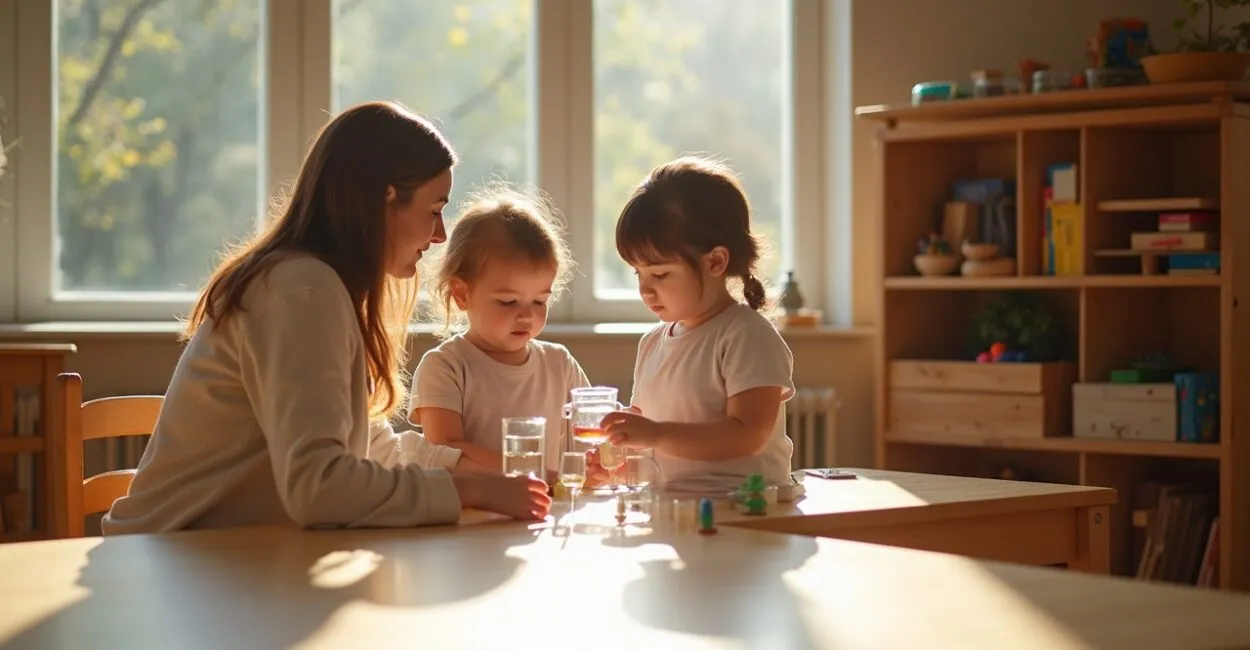
A child may look for a toy hidden under a blanket and, a few years later, explain why the same amount of water looks different in glasses with different shapes. These changes help us understand child cognitive development through Piaget’s stages: four periods that describe ways of thinking and learning, with approximate ages rather than a rigid timetable. The model covers the sensorimotor stage in the first years of life, followed by the preoperational and concrete operational stages, and then the formal operational stage around adolescence. Parents and educators can use it to choose activities and tailor explanations to a child without turning individual differences into a diagnosis.

Before using the model
- Think of the ages as approximate guidelines.
- Observe what the child does in different situations, not just in one task.
- Consider language, learning opportunities, cultural context, and support needs.
- Talk with a healthcare professional if you have ongoing concerns about development.
Child cognitive development: Piaget’s stages at a glance
Piaget described four stages of cognitive development: sensorimotor (birth to about age 2), preoperational (about ages 2 to 7), concrete operational (generally ages 7 to 11 or 12), and formal operational (starting around age 12). Each period represents typical changes in the way children think, but ages vary and are not, by themselves, a way to assess a child.
| Stage | Approximate age | Key characteristic |
|---|---|---|
| Sensorimotor | Birth to age 2 | Knowledge built through the senses and actions |
| Preoperational | Ages 2 to 7 | Growing use of language and symbolic representation |
| Concrete operational | Ages 7 to 11 or 12 | Logical reasoning applied to concrete situations |
| Formal operational | Starting around age 12 | Growing ability to think about hypotheses and abstractions |
Who was Piaget, and what does his theory explain?
Jean Piaget was a Swiss psychologist and epistemologist who studied how knowledge develops. In his theory, cognitive development involves changes in how thinking is organized: children interpret experiences through schemas, mental structures that can adjust when something new does not fit what they already know. This adjustment happens through processes such as assimilation, when an experience is understood using an existing schema, and accommodation, when the schema changes. In everyday terms, children learn both by recognizing something familiar and by revising an idea that no longer explains what is happening.
Piaget’s work influenced developmental psychology and education, but later research challenged the rigidity of the stages and showed that performance also depends on the task, experience, and context. The Encyclopaedia Britannica outlines Piaget’s life and ideas; his theory is an important historical reference, not a complete picture of every child.
Sensorimotor stage: Learning through the body and senses

From birth to about age 2, children learn about their surroundings through actions such as looking, touching, mouthing objects, shaking them, and moving around. Gradually, they begin to coordinate these actions and anticipate some outcomes. Object permanence—the understanding that something continues to exist even when it is out of sight—develops during this period.
Partially hiding a toy may prompt a baby to look for it; repeating the game lets you observe the child’s response without requiring a verbal answer. Conversations, gestures, safe exploration of objects, and peekaboo games provide opportunities for interaction suited to this stage. One detail that often confuses adults: a child may look for a toy when it is covered with a cloth, but not when its hiding place changes. On its own, this does not prove that the child “doesn’t understand” object permanence; the task involves several demands, such as tracking movement and remembering where to look.
Preoperational stage: Language, symbols, and perspective
From around ages 2 to 7, language and symbolic thought become more prominent. Children use words, drawings, or pretend play to represent things that are not present. They may still have difficulty coordinating different aspects of a situation or imagining another person’s point of view.
Piaget called this difficulty in considering perspectives other than one’s own egocentrism; the term describes a feature of reasoning, not selfishness. Animism, in turn, is the tendency to attribute life or intention to objects, such as saying that the moon is following the car. In play, a block might become a phone, food, or a steering wheel. Following the child’s lead, asking open-ended questions, and offering materials for drawing or pretend play can expand vocabulary and symbolic representation without expecting abstract explanations before the child is ready.
Concrete operational stage: Logic tied to what can be observed
Between about ages 7 and 11 or 12, many children begin to use more stable mental operations in concrete situations. They may understand conservation—the idea that an amount stays the same even when its shape changes—as well as classify objects, put things in order, and mentally reverse some actions. If the same water is poured from a short, wide glass into a tall, narrow one, a child who understands conservation may recognize that the amount has not changed. Hands-on materials, problems involving real objects, and step-by-step explanations support reasoning at this stage.
Logical reasoning may still break down when a situation is highly abstract, unfamiliar, or described in complex language. So getting one question wrong is not enough to conclude that a child has not developed a particular ability.
Formal operational stage: Hypotheses and abstract thinking
Starting around age 12, Piaget described the development of formal operational thought: a growing ability to reason about hypotheses, possibilities, and abstract concepts. Adolescents may compare explanations for a phenomenon or plan how to test an idea rather than relying only on objects in front of them. This kind of thinking does not come as easily in every subject. Previous experience, knowledge of the topic, and familiarity with the task all affect performance. An adolescent may discuss abstract ideas with ease and still need help organizing an unfamiliar problem.
Piaget also described forms of adolescent egocentrism related to concern with one’s own perspective and how others perceive them. This should not be confused with a lack of empathy or treated as a universal feature of all adolescents.
How to use the stages without turning differences into a diagnosis
Use the stages as a general framework for thinking about learning opportunities, not as a test a child has to pass. An activity may be accessible in one context and difficult in another, and language, attention, movement, and reasoning do not always develop at the same pace. For babies, offer safe exploration and responsive interaction. In early childhood, use stories, pretend play, and objects that can be compared; for school-age children, suggest hands-on activities and problems connected to everyday life. With adolescents, invite them to form hypotheses and explain their conclusions, while leaving room for examples and support when needed.
The World Health Organization provides information about development in childhood and adolescence on its child health page. For guidance tailored to life in Brazil, the Ministry of Health (Brazil’s federal health department) also offers information on health and care. These resources help put the topic in context; assessments of individual children should be conducted by qualified professionals.
Common questions about observing development
Do all children go through the stages at the same age? No. The ages are approximate, and skills may emerge at different times depending on the child, the experience, and the task.
What if my child seems behind the stages? A difference observed in one activity is not enough to conclude that a child is delayed. If the concern persists or affects communication, learning, or everyday participation, talk with your child’s pediatrician or another healthcare professional, who can consider the child’s development as a whole.
Is Piaget outdated? Should I consider other theories? The theory remains useful for understanding broad changes in thinking, but later research has expanded and revised his ideas. Perspectives such as Lev Vygotsky’s sociocultural theory, for example, emphasize the role of social interaction, language, and support from others.
Can I speed my child through the stages? There is no reliable way to speed up the transition between stages. Appropriate experiences, conversation, and achievable challenges can support learning without pressuring a child to demonstrate skills they still need help with.
How should I account for children with disabilities or specific needs? Piaget’s ages and descriptions may not reflect every developmental path. Consider how the child communicates and participates, their accessibility needs, and their skills in different contexts; an individualized assessment can help guide accommodations.
Piaget’s stages help us ask useful questions about learning, but observing a child requires considering their history, context, and the demands of each task.
When planning an activity, notice what the child can already do independently and what kind of support helps them make progress. Record examples from different situations and, if a concern persists, share your observations with a professional for an assessment that takes the child’s context into account.
Artigos Relacionados
 Child Language Development From Birth to Age 6: Stages and How to Encourage Speech
 Child Development Stages: A Guide to Ages 0–5
 A Guide to Early Childhood Education: Best Practices, Play-Based Activities, and Innovative Approaches to Whole-Child Development
 Free Play: How It Strengthens Cognitive Development
 Social-Emotional Learning in Schools: Transforming Learning and Whole-Child Development
