
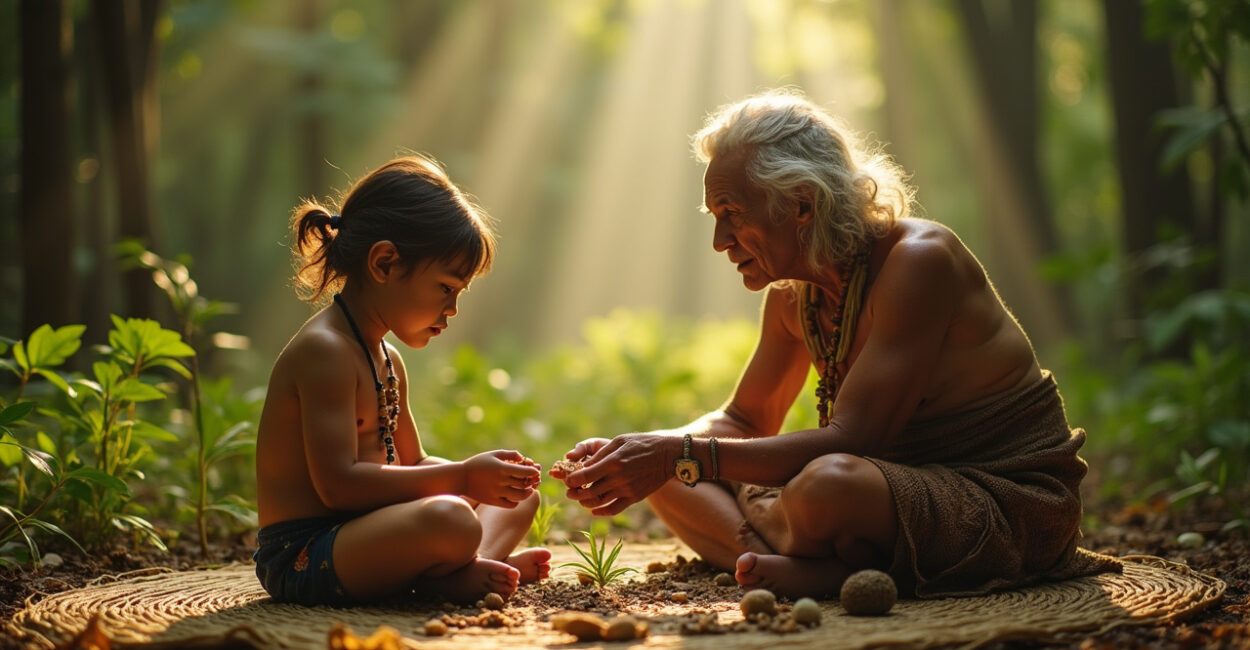
A child can learn to identify plants, follow a story, and take part in family tasks long before entering a classroom. Indigenous early childhood education in Brazil, grounded in traditional learning, takes place through diverse practices shaped by each people and community. In many contexts, this learning exists alongside Indigenous schooling. Understanding how the two dimensions relate helps dispel a misconception: that there is one way Indigenous people educate children, or that attending school automatically erases community knowledge.
Quick Facts
- Indigenous education: Learning and development that take place in the community, shaped by its knowledge and ways of life.
- Indigenous schooling: Formal education for Indigenous peoples, with specific rights and guidelines.
- Everyday learning: May involve oral communication, play, observation, and participation, with practices varying from one community to another.
- Language: Many communities maintain or strengthen their Indigenous languages; others experience language loss or revitalization.
- Legal reference: Brazil’s 1988 Federal Constitution recognizes the cultural and linguistic rights of Indigenous peoples.
Indigenous Early Childhood Education in Brazil and Traditional Learning
Indigenous education encompasses the processes through which each people nurtures children and passes on knowledge, values, languages, and ways of relating to the community and the land. Learning may take place at home, during play, in group activities, and through observing more experienced people; its content and forms vary among peoples and families. “Traditional” does not mean unchanging or the same in every village. Knowledge is maintained, adapted, and renewed in specific historical contexts, including displacement, contact with non-Indigenous society, and cultural revitalization efforts. It is therefore more accurate to discuss the practices of specific peoples than to attribute a single pedagogy to hundreds of communities.

Play, Observation, and Participation in Everyday Life
Play can also be a way to explore relationships, materials, and skills valued in the community. Games, imitation, and activities invented by children may involve cooperation, attention to the environment, and experimentation, but their meaning depends on context: play does not serve the same purpose everywhere.
Observing adults and other children lets kids learn gestures and sequences without turning every activity into a formal lesson. During a group task, for example, a child might start by watching, then help with a simple part, and eventually take on more complex steps. The pace often depends on age, interest, family relationships, and local norms.
A small detail from everyday life helps illustrate this process: following an activity may mean learning when to wait, how to ask to join in, and which materials can be used. Copying a gesture without understanding these relationships gives only a partial picture of learning.
Stories, Languages, and Knowledge Passed Between Generations

Oral storytelling can pass on memories, knowledge about places, and guidance on how to live together. The way a story is told, the occasion, and who has the authority to tell it all matter. Not every story is meant for every audience or moment, and that choice should be respected.
An Indigenous language is more than a tool for naming objects: it shapes ways of expressing ideas and can carry distinctions that matter to collective life. In multilingual communities, children may move between an Indigenous language and Portuguese, while others take part in language revitalization efforts. There is no single language experience.
Read also: Why Play Matters in Childhood for Holistic Development
The website of the Fundação Nacional dos Povos Indígenas (Funai), Brazil’s National Foundation for Indigenous Peoples provides institutional information about Indigenous peoples and their rights. When discussing a community’s stories or words, identify their source and avoid treating them as a generic collection of “Indigenous legends.”
Land and Nature as Places of Learning
The land is part of education because it sustains relationships, practices, and points of reference specific to each people. In some contexts, a walk may involve learning to recognize signs in the environment or locate resources; elsewhere, knowledge is passed on through different activities and settings. We should not assume that all children learn in the same way or have free access to every area.
Read also: AI in Early Childhood Education: Transforming How Children Learn
Indigenous ecological knowledge may include observations accumulated over time about species, cycles, and environmental changes. It is valid as a system of knowledge, built through its own experiences and standards. When a question calls for scientific evaluation, such as testing a hypothesis about a particular species, dialogue with academic methods can be useful; that does not justify reducing Indigenous knowledge to a simple confirmation of Western science.
The relationship between land and education also depends on real-world conditions. Restrictions on movement, environmental degradation, and territorial disputes can limit practices that were once part of everyday life. Each community’s context needs to be considered.
Autonomy and Community Participation in Childhood
In many communities, children have opportunities to observe activities and take initiative, but autonomy does not mean a lack of care or boundaries. Responsibilities vary according to age, family relationships, collective needs, and local customs. Treating particular tasks as universal erases these differences.
Children learn through real relationships: with people, language, land, and practices that matter to their community.
Taking part can also teach children to notice when an activity calls for help, when they should observe, and how to contribute without interrupting the group’s work. These cues are not always given as explicit instructions; they may be learned through everyday life together.
Indigenous Schooling: Rights and Connections to Community Knowledge
Indigenous education refers to community-based learning and development; Indigenous schooling refers to formal education organized to serve Indigenous peoples while respecting their cultural and linguistic rights. The two can coexist, although how they are connected depends on the community, education policies, and the school’s actual circumstances.
Brazil’s 1988 Federal Constitution recognizes Indigenous peoples’ social organization, customs, languages, beliefs, and traditions. The constitutional text also establishes a basis for recognizing their own learning processes. To understand how these principles relate to basic education, consult the Ministry of Education’s information on education policies.
Children who attend formal schools do not automatically lose traditional knowledge. Continuity depends, among other things, on community participation, the place given to Indigenous languages, and how the curriculum is developed. A school disconnected from local realities can create tensions; an intercultural approach that involves the community can make room for different kinds of knowledge.
What Other Educational Practices Can Learn—Without Copying
Non-Indigenous families can value principles such as listening, age-appropriate participation in tasks, and attentive engagement with the environment. That does not mean reproducing ceremonies, stories, or practices from specific peoples. Respecting where knowledge comes from is part of learning.
- Invite the child to observe an activity before joining in, without expecting them to learn at the same pace as someone else.
- Share stories from your family and community, noting who passed them on and what may or may not be shared.
- Explore the nearby environment carefully, distinguishing observation, hypothesis, and confirmed information.
There are limits to comparison: educational practices arise from histories, languages, and community relationships that cannot be transferred as ready-made techniques. The most respectful step is to learn from sources created by Indigenous peoples and recognize their authority to speak about their own experiences.
Do Indigenous Children Stop Learning from Their Community When They Attend Formal School?
Not necessarily. Schooling can coexist with learning at home and in the community, but continuity depends on the context, the language used at school, and the community’s involvement in the educational program.
Is All Knowledge About Plants Passed Down by a Community a Scientific Conclusion?
Indigenous ecological knowledge is a legitimate system of knowledge, with its own ways of observing and passing on information. A specific claim can also be investigated using scientific methods, without erasing its origins or cultural value.
How Can You Discuss an Indigenous Story with Non-Indigenous Children?
Look for materials created by Indigenous authors or sources that identify the community of origin. Avoid presenting a story as if it represented all peoples or as if it had no cultural context.
Does an Intercultural School Use Only an Indigenous Language?
There is no single answer. Language choices depend on the community, the status of local languages, and the educational program; in some contexts, instruction includes both an Indigenous language and Portuguese.
To learn more about this topic, consider where the materials you use come from and who created them. At home or at school, start with one concrete step: choose an identified Indigenous source and talk about its context, language, and community.
Artigos Relacionados
 Neuroscience in Early Childhood Education: How Children’s Brains Learn and How to Apply This Knowledge to Maximize Learning
 Early Childhood Education in Japan: The Yōchien Method Explained
 The Montessori Method: What Does It Look Like in Practice?
 Early Childhood Education Across Cultures
 Biodiversity Project: Exploring Animals and Plants
 A School Garden in Early Childhood Education
