
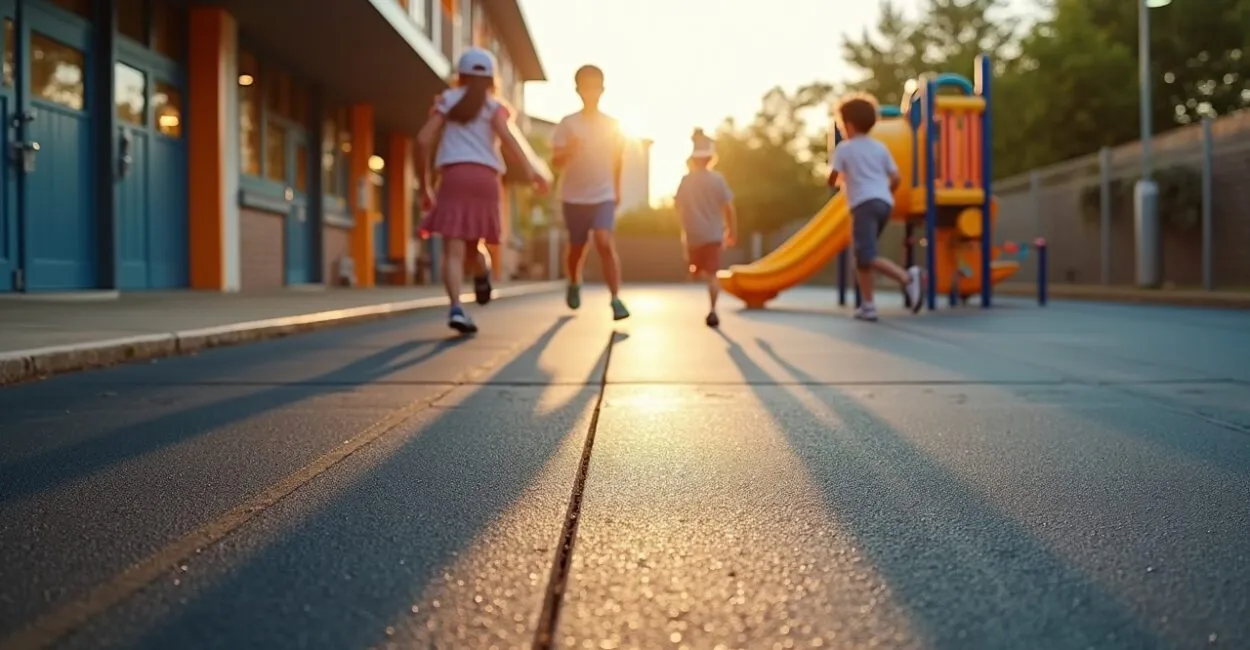
When schools face two challenges at once—safety and maintenance—the budget is usually the first to feel the strain. Choosing rubber flooring for school play areas is about more than just looks. It also involves impact absorption, durability under heavy use, and easy day-to-day cleaning.
In practice, this type of flooring makes a difference in recess areas, running zones, walkways, and around fixed playground equipment. It reduces the severity of falls, makes walking more comfortable, and tends to hold up better to a school’s demanding daily routine than makeshift solutions.

The key is choosing the right material and installation method, because not all rubber flooring delivers the same results.
The Essentials
- The best flooring for school play areas balances cushioning, drainage, durability, and ease of cleaning—not just softness to the touch.
- In high-impact areas, seamless rubber flooring usually performs better than loose tiles because it has fewer joints and potential failure points.
- The true cost-benefit becomes clear when the material withstands heavy traffic without coming loose, crumbling, or staining easily.
- The investment makes the most sense in schools with heavy daily use, playground equipment, younger children, and greater safety requirements.
- If the base is poorly prepared, no flooring can “save” the project; the subbase is part of the finished result.
Rubber Flooring for School Play Areas: When Does It Really Make a Difference?
The technical concept is simple: it’s a resilient surface designed to reduce the impact of falls and improve safety in areas used by young children. In everyday terms, it’s a floor that “gives a little” to protect better than ceramic tile, concrete, or even some types of thin rubber.
It makes the most sense where play areas see a lot of running, sudden changes in direction, and contact with fixed playground equipment. The difference quickly becomes clear in covered courtyards, playgrounds, outdoor play areas, and preschool programs.
In less-used spaces with little foot traffic and a low risk of falls, less expensive options may be sufficient.
The best flooring isn’t the softest to the touch; it’s the one that maintains its cushioning, stability, and cleanability after months of real-world use.
Where It Offers the Most Value
In practice, the benefits are most noticeable in schools with younger students, where falls are frequent and children fall from lower heights—but may fall several times a day. It also makes a big difference in spaces with fixed playground equipment, slides, and swings, where safety needs to be considered by age group, not just appearance.
The Most Common Buyer Mistake
A common mistake is looking only at thickness while ignoring the base, fastening system, and intended use. I’ve seen cases where the material looked good on paper, but poor installation led to buckling, water seeping in at the edges, and premature wear.
That drives up replacement costs and undermines confidence in the project.
Cushioning, Traction, and Falls: What Really Protects Children
In a school setting, the most important factor isn’t “comfort”—it’s impact absorption. The better the flooring distributes the force of a fall, the less severe the impact on the body tends to be. That’s why reputable manufacturers talk about safety performance, not just texture.
Three factors matter greatly for play areas: thickness, density, and elasticity. Rubber that’s too soft may seem safe, but it gives too much and can make running less stable. A surface that’s too rigid offers little protection. The right balance depends on the height of the equipment and the age of the children using it.
For playground projects, standards such as those published by ABNT (Brazil’s national standards organization) and impact-performance testing help make it easier to compare materials objectively. It’s also worth consulting the Consumer Product Safety Commission‘s technical guidance on playground surfaces, which emphasizes surfacing and cushioning around fall zones.
What to Look for in Performance
- Critical fall height: indicates the height from which the surface helps protect against falls.
- Coefficient of friction: affects traction and helps prevent slips.
- Consistency: prevents harder or softer spots within the same area.
- Joints and seams: fewer separation points mean less risk of failure.
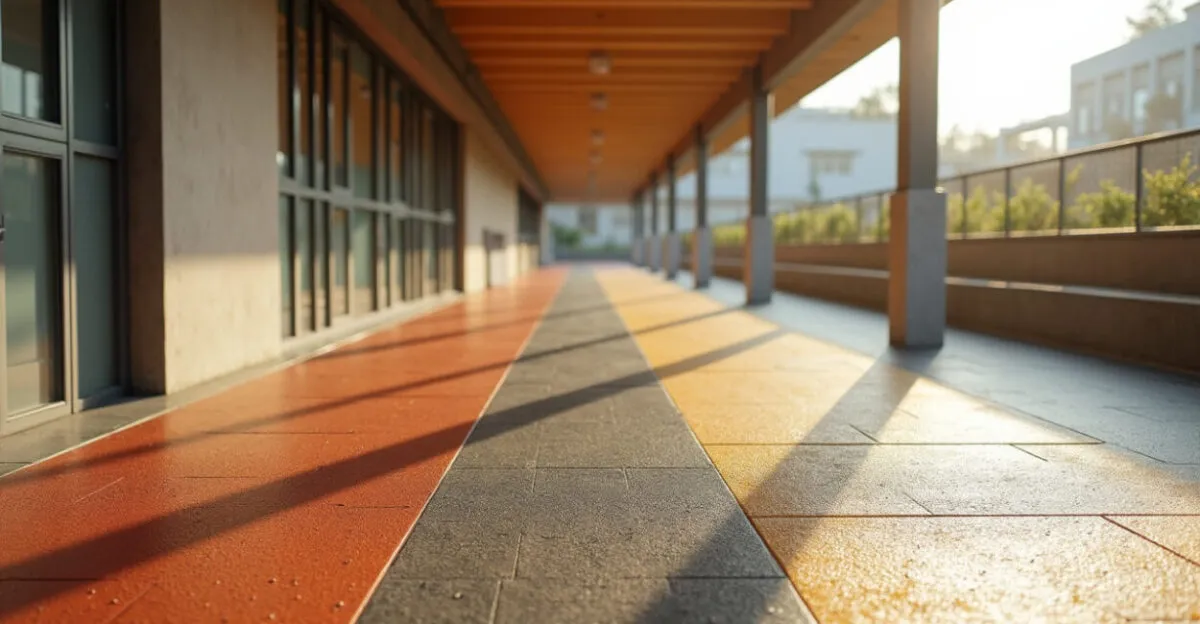
Comparing Rubber Tiles, Rolls, and Seamless Flooring

Not every rubber flooring option is suited to the same type of play area. Schools typically choose among modular tiles, glued rubber rolls, and poured-in-place seamless flooring. Each solves one problem and creates another.
Option
Cushioning
Durability
Cleaning
Best suited for
Modular tiles
Medium
Medium
Good
Smaller areas and spaces that may need quick replacement
Rubber rolls
Medium to high
Good
Good
Covered courtyards and walkways
Seamless flooring
High
High
Excellent
Playgrounds, high-activity play areas, and projects with stringent safety requirements
Seamless flooring usually comes out ahead when a school wants fewer seams, less dirt buildup, and a better finish. Tiles, on the other hand, can be useful in smaller areas or when maintenance needs to be done in stages. Rubber rolls fall somewhere in between: they offer a good solution, but depend heavily on the quality of the adhesive and the base.
The biggest difference between tiles, rolls, and seamless flooring isn’t in the product catalog—it’s how the material holds up after months of rain, cleaning, and daily traffic.
When Tiles Make Sense
Modular tiles are useful for quick upgrades, spot replacements, and spaces where the school can’t shut down. The downside is that in high-traffic areas, they can shift, develop gaps, and trap moisture along the edges. That’s not necessarily a flaw in the material itself; it’s a limitation of where it can be used.
Cost-Benefit: Where the Investment Pays Off—and Where It Doesn’t
The real cost-benefit of rubber flooring in a school depends on the full life cycle: purchase, installation, cleaning, maintenance, and service life. It’s common to compare only the upfront cost per square foot, but that can be misleading. More expensive flooring may cost less over five years if it needs fewer repairs and partial replacements.
In busy schools, the benefits include fewer accidents, less visible wear, and easier cleaning. In spaces used only occasionally, the return is lower. In those cases, a mid-range option may be enough, as long as it meets safety requirements.
According to public budget and project-execution data published on official portals, school construction projects often require costly rework when specifications are weak or vague. For transparency and planning resources, it’s worth following the FNDE (Brazil’s National Fund for Education Development) and education infrastructure documents from the MEC (Brazil’s Ministry of Education), which can help explain how material choices affect public facilities.
When It Pays to Invest More
- When young children use the area and falls are a constant risk.
- When the space sees heavy daily use and frequent cleaning.
- When the goal is to reduce corrective maintenance over the years.
- When the school wants to standardize safety and appearance in a high-priority area.
When It May Not Be Worth It
If the space is small, seldom used, and has no impact-related playground equipment, the financial return will likely take longer. There are also cases where the budget is so limited that it’s better to prioritize higher-risk areas before resurfacing everything. It depends on student traffic, the local climate, and the type of play.
Durability, Base, and Installation: The Three Factors That Determine the Outcome
Anyone who works on school construction projects knows that installation can matter as much as the product itself. Even well-chosen rubber flooring can fail early if the base isn’t level, is damp, or hasn’t been properly prepared. This happens more often than you might think.
Durability depends on three decisions. First, preparing the subfloor. Next, ensuring compatibility between the adhesive, rubber, and thermal expansion. Finally, the space’s day-to-day use: dragging furniture, cleaning with harsh products, and sun exposure can all speed up wear.
Technical Checklist Before You Buy
- Make sure the base is level and dry.
- Choose the thickness based on the area’s fall height.
- Confirm that the material can withstand heavy traffic.
- Check whether cleaning requires neutral or specialized products.
- Get the warranty and maintenance instructions in writing.
One detail many people overlook: shaded and sun-exposed areas age differently. In courtyards with strong sun exposure, specifications should account for thermal stability and resistance to degradation. Without that, the surface may lose its appearance before it loses its function—and that can already make the space less appealing.
Easy Cleaning and School Maintenance
In a school, good flooring is easy to clean. There’s little benefit in protecting children if the surface easily collects dust, stains, and odors. A practical maintenance routine should fit the cleaning staff’s schedule without requiring lengthy steps or expensive products.
Seamless flooring usually has the advantage because it has fewer joints and gaps. That means less dirt buildup and easier disinfection in shared spaces. Tiles with seams or loose pieces may require more attention along the edges, where water and dust can get in easily.
The practical takeaway is this: in schools with daily cleaning and heavy foot traffic, operational simplicity matters as much as safety. This factor rarely appears in advertising, but it determines the total cost over the year.
A Routine That Works Best
- Sweep or vacuum to remove sand and debris.
- Damp-mop with a neutral cleaner.
- Inspect edges, joints, and loose spots weekly.
- Fix small issues right away to prevent bigger repairs.
In school play areas, the ideal flooring reduces accidents without becoming a headache for the maintenance staff.
How to Choose the Right Flooring Without Falling for a Sales Pitch
The safest decision starts with how the space will actually be used, not with the finish shown in a catalog. Before buying, answer four questions: How many children will use the area? What age group are they? What kind of playground equipment will be there? How much exposure will it get to rain and sun? Those answers make it easier to write a realistic specification.
Then compare three things: proven cushioning, traffic resistance, and ease of cleaning. If the supplier doesn’t provide technical data, ask for a performance sheet, installation guidelines, and warranty terms. That helps you distinguish a solid product from a generic solution.
Criteria I Would Consider Nonnegotiable
- Safety performance suited to the area.
- A properly prepared base before installation.
- A material the school can maintain.
- A supplier with clear technical documentation.
If the school wants a lasting result, investing in rubber flooring for school play areas only makes sense as part of a broader safety and operations plan. In this case, buying wisely means defining how the space will be used, requiring clear specifications, and rejecting “almost good enough” solutions.
Next Steps to Make the Right Decision
The best approach is to weigh three factors: safety, operations, and budget. If the area has a high risk of falls, focus on cushioning and installation. If it sees heavy daily use, prioritize cleaning and durability. If the budget is tight, compare the total cost over three to five years, not just the upfront price.
Before signing a contract, request at least one site visit, the material’s technical sheet, and a maintenance plan. This simple check can prevent surprises after installation and help you compare bids fairly. In school construction, vague specifications can make the cheapest option more expensive in the long run.
Frequently Asked Questions
Is Rubber Flooring Better Than Concrete for School Play Areas?
Yes, when the priority is reducing the impact of falls and improving children’s safety. Concrete is durable, but offers far less protection in play areas. Rubber flooring makes more sense in spaces with playground equipment, running, and heavy traffic. However, it needs a suitable base and proper installation to deliver the expected performance.
Which Type of Rubber Flooring Lasts Longest in Schools?
In general, seamless flooring tends to last longer because it has fewer seams, fewer potential failure points, and performs better in high-traffic areas. That doesn’t mean tiles or rolls are poor options; they may simply be better suited to other settings. Actual durability depends on material quality, the base, and maintenance. If any of those three factors are lacking, even the best product can wear out quickly.
Does This Type of Flooring Get Very Hot in the Sun?
It can, especially outdoors with strong sun exposure. Surface temperature varies depending on the color, composition, and local climate. In areas with a lot of sun, consider shade, ventilation, and materials with better thermal stability. Overlooking this can lead to discomfort and faster visible wear.
How Can I Tell Whether the Flooring Is Thick Enough?
Thickness should be based on the fall height and the type of playground equipment or activity in the area. There’s no one-size-fits-all number. For playgrounds, the technical specifications should account for impact safety and the manufacturer’s guidance. If the area has elevated equipment, insufficient thickness can undermine the flooring’s primary purpose.
Does Rubber Flooring Require a Lot of Maintenance?
No, as long as the material is good quality and cleaning follows a simple, regular routine. Maintenance is usually minimal: removing debris, washing with a neutral cleaner, and checking edges or joints. Problems arise when the flooring is poorly installed or chosen for the wrong use. In those cases, issues appear early and require frequent repairs.
Artigos Relacionados
 Safety in School Play Areas: 7 Key Points
 School Recess Areas: A Planning Guide
 Play-Based Learning in Elementary School: Learning Through Play
 Entrepreneurship Degree: Is It Worth the Investment?
 Play at School: Bringing Free Play Into the Early Childhood Curriculum
 Assessing School Interdisciplinary Projects: Criteria
